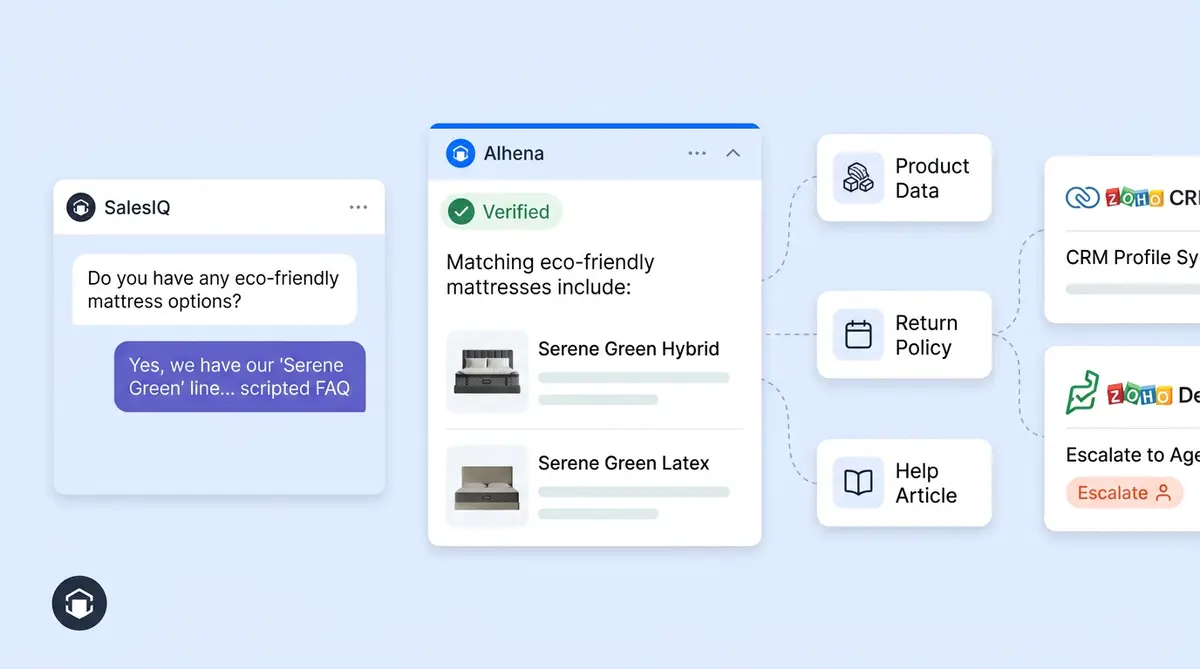
Zoho SalesIQ gives e-commerce businesses of all sizes solid live chat features and solutions for visitor engagement: visitor tracking, lead scoring, and codeless bot flows through Zobot. But when a shopper asks, "Will this moisturizer work under my SPF?" or "Can I return a sale item after 14 days?", scripted bots hit a wall. The customer engagement challenges are real: they weren't built for open-ended product and policy questions.
A generative AI chatbot closes that gap, but only when it stays grounded in your actual catalog and policy data. This post covers strategic approaches for going beyond scripted bots. Alhena AI upgrades your existing SalesIQ chat surface into a shopping assistant that answers accurately, escalates cleanly, and feeds richer data into CRM, helping you scale customer interactions.
Where SalesIQ's Native Bots Hit Their Ceiling
Zobot handles deterministic tasks well: routing chats by department, capturing and qualifying leads through forms, and surfacing knowledge-base articles through Answer Bot. But Answer Bot only matches pre-written KB entries. These scripted flows work for high-volume FAQs like "What are your shipping rates?" or "Where's my order?"
The challenges appear with questions that need reasoning across multiple data sources. For example, a shopper asking, "Which of your serums targets redness and works with retinol?" needs the bot to cross-reference ingredients, product compatibility, usage guidelines, and personalization recommendations. Scripted intents can't synthesize that answer.
Generative AI adds intelligent, conversational language understanding, multi-turn conversational memory and can provide personalization recommendations, and the ability to pull answers from your product catalog, policy documents, and knowledge base simultaneously. The key difference: it generates paragraph-level responses grounded in your data rather than selecting from pre-written scripts.
How Alhena Keeps Answers Grounded Inside SalesIQ Chats
The biggest risk with generative AI on a live chat surface is hallucination. An AI that confidently states incorrect product specs or invents a return policy destroys trust faster than a slow human reply.
Alhena's architecture solves this through retrieval-grounded generation. Every conversational response pulls from your verified knowledge base, product catalog, and policy documents before generating an answer. If the information doesn't exist in your data, Alhena's Shopping Assistant won't fabricate it.
Inside SalesIQ, this works by reading the visitor's profile and chat history from Zoho's data layer, then writing the generative reply back into the SalesIQ live chat widget. This integration approach ensures your shoppers see fast, accurate answers without leaving the conversation. For a deeper look at how this architecture learns and improves over time, see our breakdown of Alhena's continuous learning system.
What you need to provide: a clean knowledge base, structured product data (descriptions, specs, ingredients, compatibility notes), and up-to-date policy pages. Without these source documents, no architecture can guarantee accuracy. Data privacy remains protected because Alhena only reads what you authorize.
Connecting Commerce Data Through Zoho's Ecosystem
Alhena's Zoho SalesIQ integration doesn't operate in isolation. It connects to your broader integration stack:
- Product catalog and order data from your commerce platform (Shopify is the most common source) feeds real-time inventory and order status into chat responses
- Zoho CRM receives enriched leads and contact records with full chat context, intent labels, and product interests captured during customer engagement interactions
- Zoho Desk gets pre-qualified tickets with chat history when escalation is needed
This means a shopper who asks about a product at 9 PM gets an AI-generated answer grounded in your catalog, and then returns the next day already having their context preserved in the CRM. Your sales team sees exactly which leads browsed what and discussed.
Smart Escalation to Zoho Desk
Not every interaction should stay with AI. Complex complaints, VIP customers, and edge-case policy questions need human agents. The difference is how the handoff happens.
Alhena automatically writes structured tickets into Desk with the full chat transcript, an intelligent intent label (like return-request, sizing-help, or complaint-escalation), and the customer's CRM context. Your human support agents don't ask "How can I help you?" because they already know.
This mirrors the approach we cover in how AI creates better support tickets than agents do. The result: faster customer service resolution, higher CSAT, improved customer experiences, and agents who spend time on complex tasks, solving problems instead of gathering context. Instead of gathering context. Teams already using Zoho Desk for support workflows can also explore 7 ways to automate Zoho Desk workflows with agentic AI.
What to Measure After Launch
Alhena surfaces real-time dashboards and automation insights alongside SalesIQ's native analytics. The metrics that matter:
- Deflection rate (conversations resolved without a human). Alhena reports 70%+ deflection as a published benchmark.
- First response time. Generative replies fire in under 5 seconds, compared to average live chat wait times of 1-3 minutes.
- Escalation rate and post-escalation CSAT to confirm handoff quality stays high.
- KB article gaps flagged when the AI can't find a grounded answer, pointing you to content you need to create.
For teams evaluating whether AI chat drives actual revenue (not just ticket deflection), our omnichannel customer experience guide covers attribution models that connect chat conversations to purchases.
A Two-Week Rollout Pattern
Week 1: Connect SalesIQ, Desk, and CRM. Ingest your knowledge base and product data. Run Alhena in shadow mode (AI generates responses, but a human reviews before sending).
Week 2: Enable AI responses on one department or route. Monitor escalation patterns, tune intent labels, and review flagged conversations through Alhena's quality control system, then expand to additional routes.
Alhena deploys within days, not months. No dev resources required. For a detailed framework on running your first AI pilot without risk, see our guide on how to run a low-risk AI pilot.
The Bottom Line
Generative AI doesn't replace Zoho SalesIQ. It upgrades the chat surface your team already pays for. The win is better customer experiences at scale: grounded answers that convert browsers into buyers, cleaner Zoho Desk tickets that save agent time, and richer Zoho CRM lead context that helps your sales team close and grow revenue.
Ready to see how generative AI works inside your stack? Book a demo with Alhena AI or start free with 25 conversations.
Frequently Asked Questions
Does Alhena AI replace Zoho SalesIQ or Zobot?
No. Alhena augments your existing SalesIQ setup. Zobot continues handling routing, lead forms, and scripted flows. Alhena adds generative AI responses for open-ended questions that scripted bots cannot answer accurately.
How does Alhena prevent hallucinations in Zoho SalesIQ chats?
Alhena uses retrieval-grounded generation. Every response pulls from your verified product catalog, knowledge base, and policy documents. If the answer does not exist in your data, Alhena will not fabricate one.
What data flows between SalesIQ and Alhena AI?
Alhena reads visitor profiles and chat history from SalesIQ. It writes AI-generated responses back into the chat widget. Escalated chats create structured tickets in Zoho Desk, and enriched lead data syncs to Zoho CRM.
How long does it take to deploy Alhena AI with Zoho SalesIQ?
Most businesses get started and go live within two weeks. Week one covers data ingestion and shadow mode testing. Week two enables live AI responses on select routes before expanding.
What ecommerce platforms work with Alhena and Zoho SalesIQ?
Shopify is the most common commerce source. Alhena also integrates with Salesforce Commerce Cloud and WooCommerce. Check the integrations page for your specific platform.
What metrics should I track after enabling generative AI on SalesIQ?
Focus on deflection rate (target 70%+), first response time (under 5 seconds with AI), escalation rate, post-escalation CSAT, and KB gaps flagged by the AI when it cannot find grounded answers.