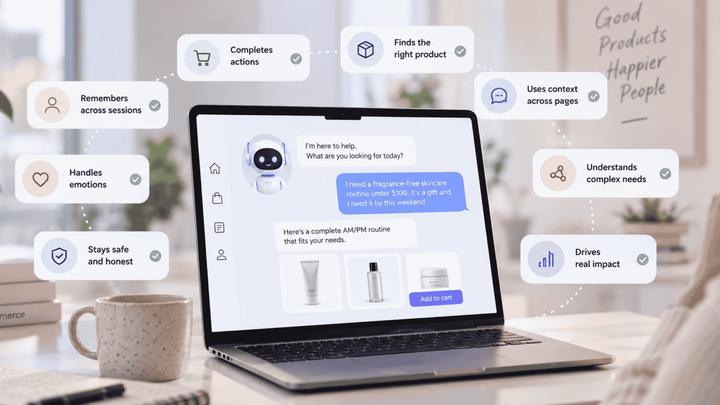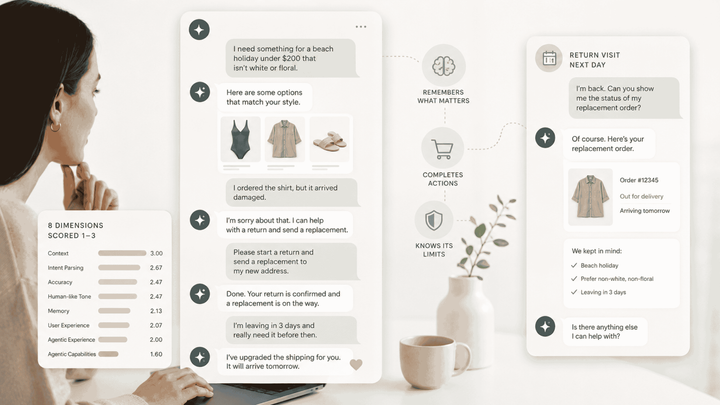
The disadvantages of chatbots are real. Customers get trapped in loops, simple questions go unanswered, and the whole experience feels robotic. But not every chatbot shares these flaws. Below, we break down the 7 biggest disadvantages of chatbots in customer service, explain why each one happens, and show you how to fix it.
Advantages of Chatbots: What They Get Right
Before we get into what's broken, it's worth noting what chatbots do well. Millions of businesses run them for good reason.
Always On, Always Available
Chatbots don't take lunch breaks or call in sick. They answer questions at 2 AM on a Sunday, which matters when 82% of customers expect an immediate response to their inquiry. For global brands selling across time zones, round-the-clock coverage without staffing costs is a genuine advantage.
They Scale Without Hiring
During a product launch or holiday rush, a chatbot handles 500 conversations as easily as 5. You don't need to hire seasonal agents or worry about hold times spiking. According to Gartner, 65% of CRM leaders say AI is more effective for scaling service than adding headcount.
Faster First Response
Nobody likes waiting. Chatbots reply in seconds, not minutes. For straightforward questions like "Where's my order?" or "What's your return policy?", speed alone improves satisfaction scores.
Lower Cost Per Interaction
Handling a support ticket through a human agent costs $5 to $12 on average. A chatbot handles the same query for pennies. When 40% to 60% of incoming tickets are repetitive, the savings add up fast.
Those are real benefits. But they only hold up if the chatbot actually works well. Here are the 7 disadvantages that can undermine everything above.
Limitations in Understanding Complex Input
Why This Happens
One of the most significant disadvantages of many chatbots is their limited natural language processing ability.
Here are some scenarios that might trip up even advanced chatbot AI:
- Subtle humor or sarcasm that humans would notice
- Complex questions with multiple intents
- Exceptions or edge cases not covered in training data
- Misspellings, poor grammar, homonyms, and idioms
- Customers can pose the same question in many different ways
Chatbots not being able to answer customer questions can decrease customer satisfaction and reduce the overall customer experience.
How to Fix It
Thankfully, the most recent generation of chatbots use generative AI, which uses Large Language Models (LLMs). LLMs are massive artificial intelligence models that are excellent at understanding complex input and creating relevant and accurate responses.
The Lack of a Human Touch
Why This Happens
Despite rapid technological advances, many chatbots still lack critical human qualities like empathy, emotional intelligence, and the ability to make personal connections.
Human touch and empathy are still necessary in many scenarios, like
- Grieving customers dealing with loss or tragedy
- When angry customers need to vent
- Customers with disabilities or special needs
It's always necessary to keep a human in the loop.
How to Fix It
Studies have found that generative AI chatbots can be even more empathetic than humans. Researchers at UC San Diego compared generative AI chatbot responses and actual physician responses to medical questions on Reddit. The generative AI chatbot responses were 9.8 times more empathetic than human responses. The best approach is pairing AI with a smooth handoff to human agents for sensitive cases. Tools like Alhena Agent Assist let AI handle the routine while flagging emotional conversations for your team.
Set-Up Time and Effort
Why This Happens
The time and energy required to set up a chatbot can be overwhelming, including:
- Creating complex rules and decision trees for the end user to navigate through
- Writing extensive FAQs
- Writing different ways to phrase the same question
- Carving up existing documentation into smaller "snippets"
- Editing existing knowledge from disparate sources in the organization
How to Fix It
Much of this set-up time and effort goes away when you use a generative AI chatbot. These tools crawl your existing help docs, product pages, and knowledge base automatically. No decision trees, no manual FAQ writing. Alhena AI deploys in under 48 hours with zero dev resources needed.
Ongoing Maintenance
Why This Happens
The same chatbots that require significant time and energy to set up often require significant ongoing maintenance. Specifically:
- Complex rules and decision trees often need updating.
- Extensive FAQs need updating, especially as products and services change over time.
- You'll always be finding different ways for customers to ask the same question.
- Your organization will always be creating new knowledge and documentation.
How to Fix It
Generative AI chatbots not only reduce set-up time, they also reduce ongoing maintenance and improve customer service efficiency. Generative AI chatbots require just 2 forms of ongoing maintenance:
- Periodic re-crawling of the knowledge base, which can happen automatically
- Manual supervision of feedback. To improve its answers over time, a good generative AI chatbot will collect feedback on its responses. You review responses with negative feedback occasionally and update outdated knowledge.
Data Security Concerns
Why This Happens
Chatbots handling sensitive customer data can potentially expose businesses to security risks if not properly safeguarded.
Sophisticated hackers can find ways to exploit weaknesses in chatbot platforms, using them as entry points into backend systems.
How to Fix It
Look for chatbot vendors who hold SOC 2 Type 2 certification. With this certification, you can be confident your chatbot vendor's data security practices meet SaaS industry standards. Also ask about data encryption at rest and in transit, and whether the vendor stores or trains on your customer conversations. AI safety should be a non-negotiable in your vendor evaluation.
Bias
Why This Happens
LLMs rely on training data from the entire internet. Because the internet can often be a biased place, generative AI chatbots that use LLMs can potentially create biased responses.
How to Fix It
Best-of-breed generative AI chatbots constrain responses to your provided documentation. If there is no bias in the provided documentation, there should be no bias in the answers.
One example is Alhena AI. Alhena AI provides answers based solely on your proprietary knowledge base, not the open internet. That grounding makes biased responses nearly impossible.
Hallucination
Why This Happens
Hallucination is when a chatbot or LLM creates a response that contains a factually incorrect statement.
Hallucination occurs because LLMs only predict the next most probable word in a conversation. LLMs do not determine whether the sentence or paragraph they produce is actually accurate.
Because of this, many people are afraid to put generative AI chatbots in front of their paying customers.
How to Fix It
Leading generative AI chatbots minimize or eliminate hallucination. For example, Alhena has focused on building a generative AI chatbot that doesn't hallucinate. 80% of Alhena's tech stack proactively focuses on preventing hallucination through retrieval-augmented generation and multi-layer fact checking.
While chatbots and generative AI assistants offer cost savings and 24/7 support, businesses still face challenges in trust, accuracy, and ethical AI governance. Ensuring data privacy and minimizing bias in AI responses are essential for maintaining customer trust and preventing possible legal liabilities.
Conclusion: Choose Wisely
Chatbots offer tremendous benefits, but they also have real disadvantages. These include:
- A limited ability to understand complex input
- A lack of empathy
- Set-up effort
- Ongoing maintenance effort
- Data security concerns
- Bias
- Hallucination
Choosing your chatbot vendor wisely can address every one of these disadvantages. Specifically:
- Generative AI chatbots dramatically improve chatbot ability to understand complex input and their empathy. They also dramatically reduce set-up and maintenance effort.
- SOC 2 Type 2 certification can mitigate data security concerns with chatbots.
- Among generative AI chatbots, bias and hallucination can be concerns. But best-of-breed generative AI chatbots like Alhena AI have removed bias and hallucination.
Ready to see the difference a purpose-built AI chatbot makes? Book a demo with Alhena AI or start for free with 25 conversations.
Frequently Asked Questions
What are the biggest disadvantages of chatbots for customer service?
The biggest disadvantages are poor understanding of complex questions, lack of empathy in sensitive situations, hallucinating wrong answers, and high setup and maintenance costs for rule-based systems. Generative AI chatbots fix most of these issues by using large language models that understand context, tone, and intent far better than traditional bots.
Are chatbots actually worth it or do the downsides outweigh the benefits?
For most businesses, chatbots are worth it when chosen correctly. The key is picking a generative AI chatbot over a rule-based one. Rule-based bots create more frustration than they solve. Generative AI chatbots handle 60% to 80% of inquiries accurately, cut response times to under a minute, and cost a fraction of human agent handling. The ROI is positive for most ecommerce and SaaS companies within the first quarter.
Why do chatbots give wrong answers and how do I stop it?
Chatbots hallucinate because large language models predict the next word in a sequence without checking if the full response is factually correct. You stop it by choosing a chatbot that grounds every answer in your verified knowledge base, not the open internet. Alhena AI, for example, dedicates 80% of its tech stack to hallucination prevention through retrieval-augmented generation and multi-layer fact checking.
Can a chatbot handle an angry customer or does it make things worse?
Traditional chatbots often make things worse by giving canned responses to frustrated customers. Generative AI chatbots are different. A UC San Diego study found AI responses were 9.8 times more empathetic than human responses in medical contexts. The best setup pairs AI for routine queries with automatic escalation to a human agent when the conversation turns emotional or complex.
How long does it take to set up a chatbot and keep it running?
Rule-based chatbots can take weeks or months to set up because you need to write every FAQ, build decision trees, and map out conversation flows manually. Generative AI chatbots skip all of that. They crawl your existing help docs and product pages automatically. Alhena AI deploys in under 48 hours with no developer resources needed. Ongoing maintenance is minimal, mostly reviewing flagged responses and updating your knowledge base when products change.
What is the difference between a rule-based chatbot and a generative AI chatbot?
A rule-based chatbot follows pre-written scripts and decision trees. If a customer asks something outside those scripts, it fails. A generative AI chatbot uses large language models to understand natural language, handle complex phrasing, and generate original responses grounded in your documentation. Generative AI chatbots are better at understanding sarcasm, multi-part questions, and misspellings. They also require far less setup and maintenance.
Do chatbot disadvantages go away if I use an AI-powered chatbot instead?
Most of them, yes. Generative AI eliminates the biggest chatbot disadvantages: poor language understanding, rigid scripts, and high maintenance. Hallucination and bias still require attention, but best-in-class platforms like Alhena AI solve these by grounding responses in your proprietary knowledge base only. Data security depends on your vendor's certifications, so look for SOC 2 Type 2 compliance regardless of which chatbot type you choose.
Advantages vs. Disadvantages: The Other Side
Chatbots have real disadvantages, but the honest picture is a trade-off. Used well, they also deliver clear advantages, from instant 24/7 responses to lower support costs and higher conversion. For the full pros-and-cons view, see our guide to the benefits of AI chatbots.