Why Most Businesses Get AI Chatbots Wrong
Sixty-seven percent of businesses that deployed chatbots reported the technology "did not meet expectations," according to Gartner's customer service report. Two out of three. That's a staggering failure rate for a technology that, when done right, delivers 15 to 35 percent conversion rate improvements and cuts support costs by a third.
The problem isn't the technology. It's how businesses choose and deploy it. Most companies treat an AI chatbot for business as a glorified FAQ page, something that deflects tickets and saves a few hours of agent time. They miss the bigger opportunity entirely: an AI chatbot that actually sells, recovers abandoned carts, and turns every customer conversation into revenue.
This 2026 guide breaks down how AI chatbots really work, what separates the ones that pay for themselves from the ones that get switched off after 90 days, and how to pick the right one for your business.
How an AI Chatbot for Business Actually Works
Forget the old chatbots that matched keywords to canned responses. If a customer typed "return," they got a copy-pasted returns policy. If they phrased the question differently, the bot got confused.
Modern artificial intelligence chatbots are built on large language models (LLMs) that understand language the way people do. They grasp meaning, context, and intent. When a customer types "I got the wrong size and my wedding is Saturday," a well-built AI chatbot understands the urgency, identifies the problem as a size exchange, and can start an expedited replacement without you lifting a finger. It doesn't just link to a returns page.
The Role of Knowledge Grounding
An LLM on its own is like a smart new hire who has never seen your product catalog, pricing, or policies. It can hold a conversation, but it will make things up when it doesn't know the answer. In AI terms, that's called hallucination, and it's the fastest way to destroy customer trust.
The fix is a technique called Retrieval-Augmented Generation (RAG). Before the chatbot answers any question, it first looks up the relevant facts from your actual business data: product feeds, inventory levels, order management systems, CRM records, return policies, help center articles. The AI then builds its response around verified information instead of guessing.
This is what separates an AI chatbot that helps from one that confidently gives wrong answers. Alhena AI's Shopping Assistant, for example, grounds every response in your live product catalog and order data, keeping hallucination rates near zero.
Five Ways an AI Chatbot Drives Revenue (Not Just Deflects Tickets)
Most businesses evaluate chatbots on one metric: how many support tickets did it handle? That's like judging a sales associate only by how many times they pointed someone to the bathroom. The real value is in what an AI chatbot for business can do beyond support.
1. Product Discovery and Guided Selling
A customer browsing 500 products is overwhelmed. An AI chatbot that asks "What's the occasion?" or "What's your budget?" and then narrows the catalog to three or four perfect matches acts as a virtual shopping consultant. According to DemandSage's 2026 chatbot research, 31 percent of ecommerce shoppers add products after chatbot recommendations.
Tatcha, the luxury skincare brand, saw a 3x increase in conversion rate and a 38 percent lift in average order value after deploying Alhena AI's product recommendation engine. The AI understood ingredient preferences, skin types, and gifting contexts in ways a static product filter never could.
2. Cart Abandonment Recovery
The average online shopping cart abandonment rate sits at 70.19 percent, and on mobile it's 80.2 percent, according to Envive.ai's 2025 analysis. That's billions left on the table. AI chatbots can detect exit intent in real time, address specific objections (shipping costs, size uncertainty, comparison shopping), and offer targeted incentives. AI-powered recovery reaches up to 35 percent of abandoned carts, compared to 5 to 8 percent for email follow-ups alone.
3. Order Tracking That Prevents Tickets
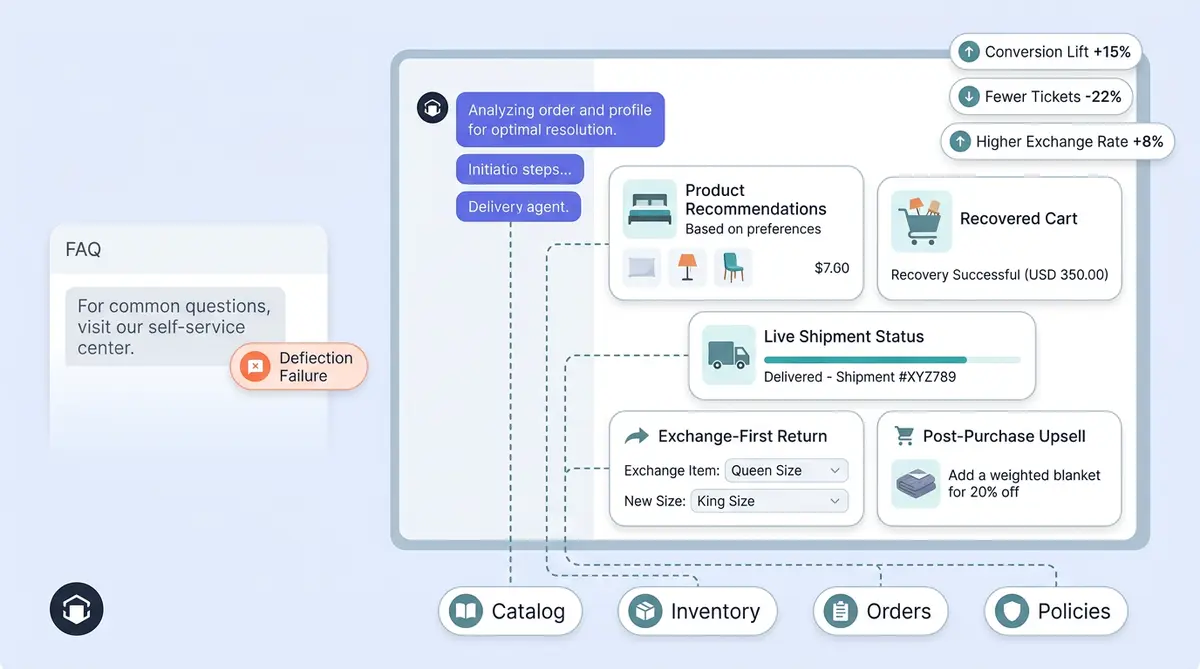
Instead of "here's your tracking link," an AI chatbot connected to your order management system tells customers exactly where their package is, proactively flags delays, and can initiate solutions like expedited shipping or partial refunds. Alhena's Support Concierge handles this end to end, pulling live data from Shopify, WooCommerce, or Salesforce Commerce Cloud orders. McKinsey found that AI-enabled self-service reduces incident volume by 40 to 50 percent, and this type of proactive order communication is a big reason why.
4. Returns That Protect Revenue
A smart virtual AI chatbot handles the full returns workflow: verifies eligibility against your policy, generates return labels, and (here's the key) suggests exchanges instead of refunds. Every return turned into an exchange is revenue protected. Every exchange turned into an upsell is revenue gained. Puffy, the mattress brand, achieved 63 percent automated inquiry resolution and 90 percent customer satisfaction by letting Alhena AI handle post-purchase conversations including returns, exchanges, and warranty claims.
5. Post-Purchase Engagement That Builds Lifetime Value
The Salesforce State of Service report projects a 15 percent upsell revenue boost from agentic AI. After a purchase, AI chatbots can recommend complementary products, check in on satisfaction, prompt reviews, and re-engage customers at the right time for a repeat purchase. Victoria Beckham saw a 20 percent average order value increase driven by AI-powered product recommendations during and after purchase.
What Separates a Good AI Chatbot from a Bad One
The 67 percent failure rate Gartner reported isn't random. The same patterns show up again and again. Here's what to look for when evaluating an AI chatbot for your business.
Knowledge Base Depth
Businesses with 50 or more documents in their chatbot's knowledge base achieve 18 percentage points higher resolution rates than those with fewer than 10, according to analysis by LoopReply. A thin knowledge base means vague answers, more escalations, and frustrated customers. Your AI chatbot needs access to your full product catalog, CRM data, detailed policies, shipping information, and historical support data.
Integration Depth, Not Just a Chat Widget
There's a massive gap between a chatbot that chats and a chatbot that acts. Can it look up an order status in your OMS? Can it process a return? Can it check real-time inventory before recommending a product? Can it populate a cart? Alhena AI connects directly to platforms like Shopify, WooCommerce, and Salesforce Commerce Cloud, so it can take real actions, not just talk about them.
Sales Capability, Not Just Support
This is the single biggest differentiator most businesses overlook. A support-only chatbot deflects tickets. A sales-capable chatbot guides product discovery, handles objections, recovers carts, and drives conversion. If your chatbot vendor can't show you revenue attribution data, you're buying a cost center, not a growth tool.
Omnichannel Presence
Your customers don't all live on your website. 91 percent of conversational AI interactions in 2025 took place on WhatsApp, per Trengo's WhatsApp statistics. An AI chatbot that only works on your website misses most of the conversation. Look for tools that cover web chat, email, Instagram, WhatsApp, and voice AI from a single platform with shared customer context. Alhena's Social Commerce agent handles all of these channels while maintaining the same conversation thread.
Human Handoff Design
Even the best AI needs to escalate sometimes. Research shows conversations escalated at the 3 to 4 message mark score 4.3 out of 5 in customer satisfaction. Escalations at 7 or more messages? Just 3.1 out of 5. The chatbot's handoff strategy matters as much as its AI quality. Look for smooth escalation that passes full context to the human agent. Alhena's Agent Assist gives human agents the full conversation history plus AI-suggested responses, so the customer never has to repeat themselves.
How Alhena AI Works as a Business Chatbot
Most AI chatbots were built for support and had sales bolted on as an afterthought. Alhena AI was built from the ground up for ecommerce, which means it treats every conversation as both a support interaction and a sales opportunity.
Two specialized agents handle the work. The Product Expert Agent manages product discovery, recommendations, comparisons, and pre-purchase questions, all grounded in your live catalog data. The Order Management Agent handles everything post-purchase: order tracking, returns, exchanges, and warranty claims, pulling data directly from your ecommerce platform.
The results show up in case studies across verticals. Tatcha saw 11.4 percent of total site revenue attributed directly to AI conversations. Crocus, the gardening retailer, hit an 86 percent deflection rate with 84 percent customer satisfaction. Manawa, the travel experience platform, cut their response time from 40 minutes to under 1 minute while automating 80 percent of inquiries.
Setup takes less than 48 hours with no developer resources needed. Alhena pulls your product catalog, policies, and knowledge base automatically through its platform integrations. You can connect it to your existing help desk (Zendesk, Freshdesk, Gorgias, Intercom) so AI and human teams work from the same queue.
How to Measure AI Chatbot ROI (The Right Way)
"Conversations handled" is a vanity metric. It tells you the chatbot is busy, not that it's valuable. Here are the numbers and tools that actually matter.
Revenue Metrics
- AI-attributed revenue: How much revenue came from conversations where the AI influenced the purchase? Tatcha tracks this at 11.4 percent of total site revenue.
- Conversion rate lift: Compare conversion rates for visitors who engaged with the chatbot versus those who didn't. McKinsey data suggests 15 to 35 percent improvements are achievable.
- Average order value change: AI-assisted shoppers spend approximately 25 percent more per transaction.
- Cart recovery rate: What percentage of abandoned carts does the AI recover?
Efficiency Metrics
- Cost per resolution: AI interactions cost $0.50 to $0.70 compared to $6 to $25 for human agents. Calculate your savings based on deflection volume.
- Deflection rate: What percentage of inquiries does the AI resolve without human involvement? Crocus achieves 86 percent.
- Response time: Manawa went from 40 minutes to under 1 minute. What's your before and after?
Quality Metrics
- Customer satisfaction (CSAT): Puffy maintains 90 percent. Organizations with smooth escalation paths see 92 percent satisfaction.
- Resolution rate: Aim for 55 to 65 percent in month one, improving to 75 to 85 percent by month four.
Alhena's built-in ROI calculator and revenue attribution dashboard track all of these automatically, so you're never guessing whether the chatbot is paying for itself. For a deeper walkthrough, see our 2026 Ecommerce AI ROI Playbook.
Six Mistakes That Kill AI Chatbot Projects
Before you pick a vendor, know the traps. These are the reasons behind that 67 percent failure rate.
- Buying a support tool when you need a sales engine. Most ecommerce chatbot value comes from revenue, not ticket deflection. If the vendor only talks about cost savings, they're solving the smaller problem.
- Launching with a thin knowledge base. The 18 percentage point gap in resolution rates between robust and thin knowledge bases is real. Feed the AI your full catalog, detailed policies, and historical support data before going live.
- Set-and-forget deployment. This is the third most common reason for chatbot failure. Follow best practices: plan for weekly reviews of failed conversations and monthly knowledge base updates. Resolution rates should climb steadily from month one through month four.
- Ignoring mobile and social channels. With 80.2 percent mobile cart abandonment and 91 percent of conversational AI happening on WhatsApp, a website-only chatbot misses most of your audience.
- Measuring the wrong things. Track revenue influenced, not just conversations handled. Generic chatbot greetings convert at 6.1 percent, while contextual messages hit 12.4 percent. You only improve what you measure.
- Skipping the human handoff plan. The difference between escalating at 3 messages versus 7 messages is 1.2 points of CSAT. Design the escalation path before you launch.
Getting Started: From Zero to Live in 48 Hours
If you're evaluating an AI chatbot for your business and want to get started quickly, here's a practical checklist.
- Audit your current support data. What are your top 20 most common questions? What percentage could an AI handle? Most ecommerce businesses find 60 to 80 percent of their volume is repetitive.
- Calculate your cost baseline. Multiply your monthly ticket volume by your average cost per ticket. That's the floor for what AI should save you, and revenue gains sit on top of that.
- Evaluate vendors on sales capability, not just support. Ask to see revenue attribution data, cart recovery features, and product recommendation demos. If they can't show you these, keep looking.
- Start with your highest-volume channels. Website chat, email, and voice typically handle the most volume. Add social channels (Instagram, WhatsApp) as a fast follow.
- Set a 90-day benchmark. Expect 55 to 65 percent resolution in month one, climbing to 75 percent or higher by month three. If you're not seeing improvement, the knowledge base or the vendor needs attention.
Alhena AI deploys in under 48 hours with no developer resources. You can start with 25 free conversations to test it against your actual customer questions, or book a demo to see how it works with your specific product catalog and tech stack.
For more on choosing the right chatbot for ecommerce specifically, our ecommerce chatbot buyer's guide covers the evaluation process in detail. And if you're curious how chatbot accuracy claims stack up under scrutiny, that's worth a read before signing any contract.
Frequently Asked Questions
What is an AI chatbot for business?
An AI chatbot for business is software that uses large language models and your company's data to have natural conversations with customers. Unlike old rule-based bots, modern AI chatbots understand context and intent, handle product questions, process orders, and recover abandoned carts. They work across web chat, email, WhatsApp, and Instagram.
How much does an AI chatbot for business cost?
Pricing varies widely. Entry-level tools start around $50 per month for small businesses. Enterprise solutions with full ecommerce integrations, revenue attribution, and omnichannel support typically run $500 to $2,000 per month depending on conversation volume. Alhena AI offers 25 free conversations to start, with plans scaling from there. Check the pricing page at alhena.ai/pricing for current rates.
How long does it take to set up an AI chatbot?
Legacy chatbots required months of manual training and developer resources. Modern platforms like Alhena AI deploy in under 48 hours by automatically importing your product catalog, policies, and knowledge base through direct integrations with Shopify, WooCommerce, and other platforms. No coding is required, and you can get started without any developer resources.
Can an AI chatbot actually increase sales, not just handle support?
Yes, and the data backs it up. McKinsey reports 15 to 35 percent conversion rate improvements from AI-assisted shopping. Tatcha saw 3x conversion and 11.4 percent of total site revenue from AI conversations. The key is choosing a chatbot built for sales (product discovery, cart recovery, recommendations), not just ticket deflection.
What's the ROI of an AI chatbot for ecommerce?
Juniper Research reports an average 340 percent first-year ROI for AI chatbot implementations, with payback periods of 3 to 6 months. ROI comes from two sources: cost savings (AI costs $0.50 to $0.70 per interaction vs $6 to $25 for human agents) and revenue gains (higher conversion rates, increased AOV, and cart recovery). Use Alhena's ROI calculator at alhena.ai/roi-calculator to estimate your specific numbers.
How do I prevent my AI chatbot from giving wrong answers?
The solution is knowledge grounding through RAG (Retrieval-Augmented Generation). Instead of generating answers from its training data, the AI first retrieves facts from your actual product catalog, policies, and order systems, then builds responses around verified information. Businesses with 50 or more documents in their knowledge base see 18 percentage points higher resolution rates.
Should I use an AI chatbot or hire more support agents?
It's not either-or. AI handles the 60 to 80 percent of questions that are repetitive (order status, return policies, product specs), freeing your support teams for complex issues that need empathy and judgment. McKinsey found this approach cuts cost-per-call by 50 percent while actually improving customer satisfaction. Your agents handle fewer but higher-value conversations.
What channels should my AI chatbot cover?
Start with web chat and email since they typically handle the most volume. Then add WhatsApp and Instagram as fast follows. In 2025, 91 percent of conversational AI interactions happened on WhatsApp globally, and mobile cart abandonment runs at 80.2 percent. A website-only chatbot misses most of where your customers actually are.