The short version
- Onboarding is open to every current Alhena customer, and each store is scoped and validated before anything goes live.
- UCP is the open standard Google and Shopify announced in January 2026. ACP, from OpenAI and Stripe, is separate, and support for one does not imply the other.
- A store on any platform can be made ready for AI shopping surfaces. The first milestone is usually product lookup and a cart, not a native buying flow.
- Ratings alone rarely answer a shopper's real question, so we are proposing approved review and knowledge interfaces alongside the product data.
- Being technically ready and being approved on a channel are two different things.
Starting today, we are opening UCP onboarding to all current Alhena customers. Our goal is to help each customer make their store usable by AI shopping agents, with an implementation path that fits their commerce platform and the product knowledge they already have.
Being agent-ready is becoming an important part of running an ecommerce business. An agent needs a reliable way to identify the right product and help a shopper buy it. The shopper also needs answers about whether that product will work for them. Those answers often live across reviews, buying guides and a support team's knowledge base.
We are starting with the Universal Commerce Protocol, or UCP, the open standard co-developed by Google and Shopify and announced in January 2026, with Etsy, Wayfair, Target and Walmart named as co-developers. The Agentic Commerce Protocol, or ACP, was co-developed by OpenAI and Stripe. Each has its own integration requirements. Our onboarding starts with the Google and Shopify standard; it does not imply ACP support is already implemented.
What we're opening today
Every current customer can start an onboarding assessment with Alhena. We will review the store's existing capabilities and agree on the first useful implementation, including scope, timing, and commercial terms. Brands exploring Alhena can request an assessment too.
The work will vary by store. For some, it will mean connecting a catalog and creating a cart that a shopper can complete on the merchant's website. For others, it will mean building on native platform support and making additional approved product knowledge available to compatible agents.
Opening onboarding is the start of that work. Each store will have its own validated capabilities and activation milestones.
Where an AI agent meets your buyer
Agentic commerce is not a single destination, and no standard can unify how every surface behaves. Shopify has described UCP powering merchant selling through Google AI Mode and Gemini checkouts as part of Agentic Storefronts, and it has paired its Microsoft Copilot integration with a Shopify checkout an agent can embed. ChatGPT runs its own agentic buying journey on ACP with OpenAI and Stripe. The Shop app sits alongside all of this as Shopify's own consumer surface.
For a brand, that means the same product page can be read by several agents that each follow different rules. An AI agent in the Gemini app may be able to finish a purchase without the buyer leaving the conversation. An assistant in another product may only be able to pass the buyer to your site. Copilot may sit somewhere between the two, depending on how the store is set up.
Agent brand visibility, meaning how often an AI agent names your brand and links a product the buyer can actually buy, is becoming something to measure rather than a side effect of search rankings. An agent brand mention is worth very little if the product identifier behind it resolves to the wrong variant.
We work through three questions with every customer:
- Can an agent find the right product? This is product discovery, catalog accuracy, and identifier hygiene.
- Can it answer the buyer's real question? This is reviews, buying guides, and connected support knowledge.
- Can it complete the purchase or hand it off cleanly? This is cart, checkout, and handoff behavior.
Most stores are further along on the first question than on the third.
How the standard works under the hood
UCP is a capability model rather than one fixed endpoint, which is why two stores can both be compliant and still support very different journeys.
A store publishes a discovery profile at /.well-known/ucp that declares the version it speaks and the capabilities it supports. An agent presents its own profile, and the two sides negotiate the intersection: what the platform declares it can handle is matched against what the store supports, and the session settles on one negotiated set. Capabilities carry reverse-domain names, and extensions for fulfillment, discounts, and buyer consent build on top of them, each with a published JSON schema.
Calls can travel over a REST API or over MCP, where shopping operations are exposed as callable tools and requests are carried as JSON-RPC messages. Versions are date-based, so both sides negotiate an agreed version instead of assuming one. Shopify documents cart and checkout tools in this shape, including a cart to checkout conversion and a referral back to the storefront.
Inside a session, line item pricing, taxes, fulfillment options, and promotion codes are resolved by the commerce system, not by the shopping assistant. Payment handlers are declared by the merchant, and the business stays the merchant of record. When an agent cannot finish a purchase through the API, the spec allows an escalation: a URL handoff paired with a buying step the surface can embed, so the buyer completes the order in a trusted interface. That handoff is a supported outcome, not a failure, and for many stores it is the sensible first milestone.
The point worth repeating is that a protocol can unify the interface without touching the business logic. Price, inventory, tax, discount eligibility, loyalty rules, recurring plan terms, pre-order availability, and final sale policy stay where they already live.
How this works outside Shopify
For a store running on another platform, we plan to implement UCP interfaces through Alhena that connect to the merchant's existing systems. The starting scope is capability negotiation and product lookup, followed by cart creation where the platform supports it. Native checkout and order updates come after the underlying transaction flow has been tested.
In practice that adapter has three unglamorous jobs. It has to keep a catalog in sync through the merchant's own API, so an agent reads current availability and price. It has to expose a cart that maps cleanly to the merchant's own cart, including how a promotion is applied. And it has to report back, through webhooks or scheduled jobs, when an order changes state, so a delivery question can be answered later.
There are existing alternatives. Shopify's Agentic plan lets non-Shopify merchants use its infrastructure while keeping their current storefront, which effectively lets a brand transact on Shopify rails without replatforming. It still requires setup and ongoing synchronization. Our assessment will weigh the merchant's existing systems against the work each path requires, including who owns the payment relationship and which payment processor stays in place.
Google now documents separate validation paths for cart transfer and native checkout. That gives us a practical way to start with a supported shopping journey and expand the implementation as the merchant is ready.
The commerce system remains responsible for the transaction. A review summary should never determine inventory, and a stored product description should never override the price calculated at checkout.
What Shopify customers can build on
Shopify already provides substantial agentic commerce infrastructure. Its tools for AI surfaces cover product search, carts, checkout, and order tracking. Eligible stores receive native support through Agentic Storefronts, with availability depending on the channel and store configuration, and much of it is managed from the Shopify admin rather than through custom code.
Shopify also exposes aggregate ratings in its catalog interfaces and offers policy and FAQ search. Shop Pay and Shopify Payments remain available as payment handlers where a store already uses them, and existing checkout UI extensions continue to govern what a buyer sees when an order is completed on the storefront. A Shopify merchant may already have much of the foundation they need.
For these customers, we plan to build on Shopify's native interfaces rather than duplicate them. The assessment will identify where Alhena can add useful knowledge from connected sources and where the existing setup already answers the shopper's question. Where a store has custom logic in a checkout UI extension, we will confirm how it behaves when an agent is driving the flow rather than a person, and we will use the Shopify CLI and the test profiles published on shopify.dev to check it in a development store before anything is switched on.
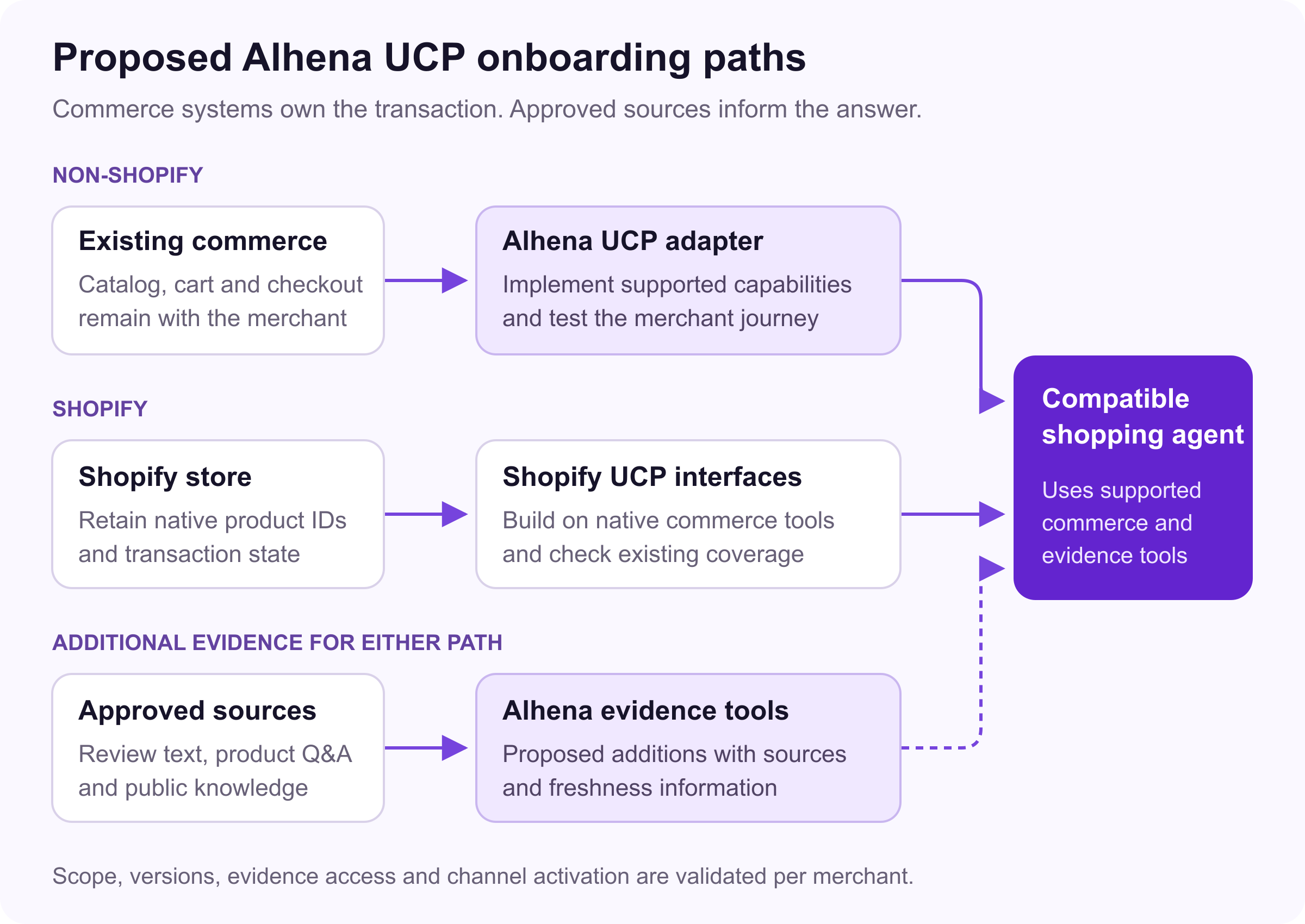
Proposed implementation paths. Additional Alhena evidence requires a supporting agent; channel activation is validated separately.
Give agents the evidence behind the product
Consider a shopper asking whether a shoe is comfortable for someone with wide feet. A rating tells an agent how customers scored the shoe overall. Relevant review text and the brand's fit guide can help it answer the actual question.
Alhena already documents Product Review Search, which searches stored product reviews during a conversation. The published implementation uses Yotpo data and reflects the last product crawl, rather than making a live provider request for every question. Alhena's built-in agents also retrieve information from the knowledge sources a merchant has connected.
We are proposing additional interfaces for approved review evidence and product knowledge, with sources and freshness information. That could help a supporting agent find specific feedback or retrieve a relevant passage from a care guide. We would embed source and last-updated metadata in every response, so the assistant reading it can judge how much weight to give it. These are Alhena additions, not mandatory endpoints in the standard, and an external system has to support them before it can use them.
A useful agent needs access to the evidence behind a product recommendation.
From this article
Only content approved for this purpose belongs in that interface. Connecting a knowledge source to Alhena should not automatically make private support material available to outside agents.
UCP and ACP are not interchangeable
Both aim at the same outcome, and a large brand may end up supporting both. They are built differently.
| Universal Commerce Protocol | Agentic Commerce Protocol | |
|---|---|---|
| Co-developed by | Google and Shopify, with retail co-developers | OpenAI and Stripe |
| Scope | Capability discovery, negotiation, purchase, post-purchase | Centered on the buying step |
| Model | Declared capabilities plus versioned extensions | A defined set of endpoints |
| Transport | REST, with MCP as an option | REST |
| Surfaces referenced publicly | Google AI Mode, the Gemini app, Microsoft Copilot | ChatGPT |
Supporting one does not give you the other. Our onboarding assessment covers UCP first, and we will document what an ACP path would require for customers who ask.
Keep readiness useful as protocols change
Our aim is to make ongoing readiness part of the customer relationship. We plan to track supported versions, check whether product identifiers still resolve correctly, and run a test transaction through the journey a shopper would actually take. An endpoint that responds successfully is only one part of a working experience.
That is a workflow rather than a launch. A date-based version moves. A catalog feed changes shape. A CLI check that passed last quarter can fail after a theme update, and a webhook that stopped firing is invisible until a buyer asks where their order is. We would rather find those in a scheduled CLI run than in a support ticket.
Google's integration requirements also separate technical implementation from approval to go live on its AI surfaces. We will keep those milestones clear for each customer, because being ready and being approved on a channel are two different things.
If you are a current customer, reach out to your Alhena team to start UCP onboarding. If you are exploring Alhena, we can assess your store too.
Frequently Asked Questions
What is the Universal Commerce Protocol?
UCP is an open standard co-developed by Google and Shopify that lets an AI agent discover a merchant's capabilities, negotiate what both sides support, and move through a purchase. It was announced in January 2026 with Etsy, Wayfair, Target, and Walmart among the co-developers, and it covers the whole journey rather than only the payment step. One shared vocabulary replaces a bespoke integration per platform.
Is onboarding included in my current plan?
Your Alhena team will confirm scope, timing and commercial terms after reviewing your store.
What does agent readiness mean for brand visibility?
An AI agent can only recommend what it can identify and verify. Clean catalog data, retrievable review evidence, and a purchase path that can be completed are what turn a mention into an order.
Will Google automatically use Alhena's review and knowledge interfaces?
No. Those proposed interfaces require a supporting agent integration. Google channel eligibility and approval are separate.
Is UCP the same as the Agentic Commerce Protocol?
No. They are different standards with their own integration requirements. UCP is associated with Google AI Mode and the Gemini app, while ACP is associated with ChatGPT. A brand can support both, but the work does not carry over.
What can an AI shopping agent do with UCP?
Depending on the supported implementation, an agent can help with product search, catalog lookup, and cart creation, with checkout capabilities validated separately. Some journeys finish inside the conversation, and others end with a handoff to your own site.
Do I need to move my store to Shopify?
No. The initiative includes an assessment of UCP integration with your existing platform. The implementation depends on the commerce capabilities your store exposes.