Seventy per cent of e-commerce marketers say AI search optimization will reshape their strategy, according to Aspiration Marketing. Only 20% have started doing anything about it. The gap between "we should" and "we are" comes down to one question nobody in the AI Visibility cluster has answered yet: Who actually does the work? With AI-driven product discovery and ai search reshaping how online shoppers find, evaluate, and buy, the staffing question is urgent for every e-commerce brand investing in e-commerce AI.
Your existing 25 AEO, GEO, and SEO playbooks cover what to optimize, what to measure, and what tools to use. This post covers who runs it, how to staff an AI visibility team for e-commerce, and when to bring in (or fire) an agency.
Why AEO and GEO Need Different Skills Than SEO
Traditional SEO teams think in keywords, backlinks, and ranking positions. AEO and GEO teams think in prompts, generative AI model outputs, citations, and rendering quality. The skill overlap is real (about 60% of tactics carry over), but the 40% that's new is genuinely different work.
An SEO specialist researches "best running shoes" and builds a page to rank for it. An AEO specialist tests how ChatGPT, Perplexity, and Google AI Overviews (the leading AI engines) answer that same query in an increasingly agentic ai interface and search environment, then restructures content so the brand gets cited as a source in AI answer results. As consumers trust AI-generated (or ai generated) answers and recommendations more than traditional search results, the metric shifts from "Position 1" to "cited in 3 of 5 AI platforms." And AI Share of Voice replaces traditional share of voice as the KPI that matters.
Prompt testing replaces keyword research. Citation building replaces link building. Content freshness becomes urgent: pages updated within 60 days earn 28% more AI citations than older content. And 80% of URLs cited in AI Overviews don't even rank in Google's top 100 for the same query. Traditional seo tools like Semrush and Ahrefs alone can't handle generative ai optimization. They can't cover AEO and GEO. Your SEO team isn't wrong for the job. They're incomplete.
Three Team Models for Your AI Visibility Team
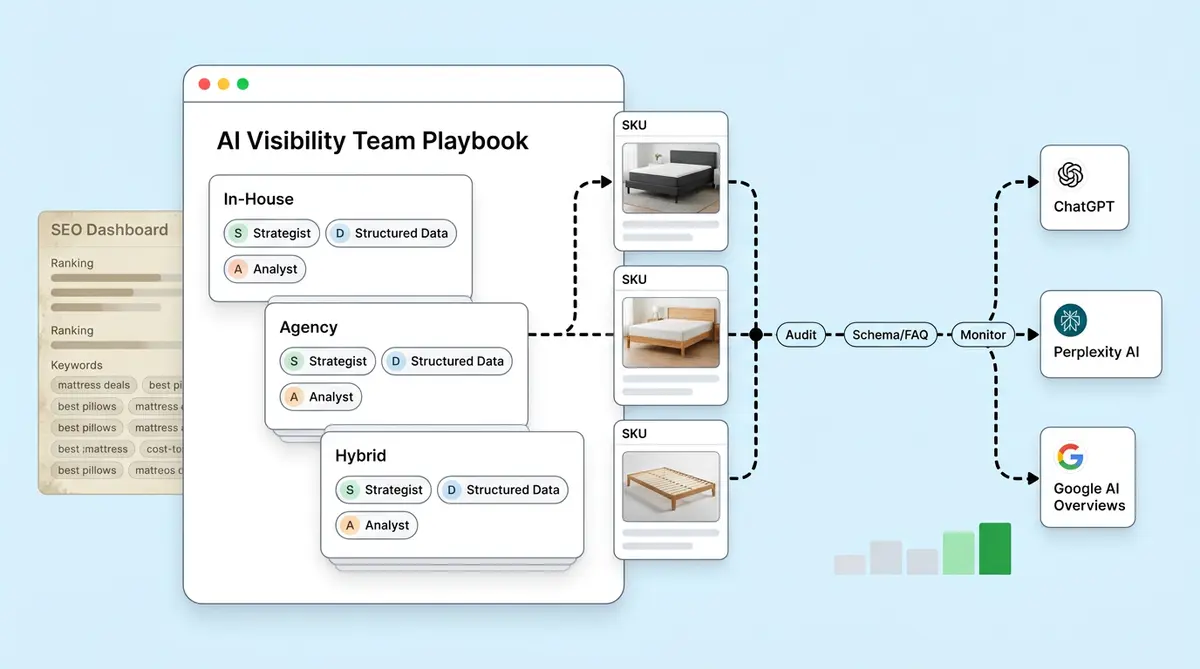
Model 1: Fully In-House
Build a three-person core: a content strategist who understands answer-first formatting and AEO FAQ structures, a structured data specialist who owns schema markup for AI search, and a data analyst with teams tracking citation rates and AI referral revenue. Enterprise brands like Experian and Capital One are already hiring dedicated AEO managers at $100K to $174K, according to Stackmatix.
Best for: Brands with 5,000+ SKUs, multiple platforms, and budget for $300K+ in annual salary costs.
Model 2: Fully Outsourced Agency
Hand execution to a specialized AI visibility agency. You keep strategic direction in-house but let the agency run PDP optimization, GEO citation campaigns, and prompt testing and ai search monitoring across platforms.
Best for: Mid-market brands with under 2,000 SKUs, no in-house structured data skills, and a need to move fast without hiring.
Model 3: Hybrid (In-House Strategy + Agency Execution)
This is the most common model emerging. Your team owns the AI visibility strategy, sets priorities using competitive audit data, and defines which SKUs matter most. The agency handles structured data implementation, content reformatting, crawlable structured data, and multi-platform monitoring.
Best for: Most ecommerce brands and online retailers. You keep control of brand voice and priorities while getting specialized AEO and GEO execution without three new hires.
Decision Framework
- Catalog size over 5,000 SKUs: Go in-house or hybrid. Agencies struggle with SKU-level work at scale without your internal product catalog knowledge.
- Budget under $150K annually: Start with an agency, then bring skills in-house as you learn what works.
- Selling on 3+ platforms: Hybrid gives you the platform-specific and agentic search expertise an agency brings without losing strategic control.
What to Demand from an AI Visibility Agency
The ai visibility agency ecommerce market is growing fast, and so is the noise. Here's what separates a real AEO/GEO agency from an SEO shop that added a new line to its pitch deck.
Demand SKU-level reporting, not brand mentions. If the agency tracks whether "your brand" appears in ChatGPT responses but can't tell you which of your brand and products get cited and which don't, they're running a vanity brand monitoring dashboard. SKU-level AI visibility is the baseline.
Demand revenue attribution. AI referral traffic and organic search traffic show that AI converts at 4.4x the rate of traditional organic search. Your agency should connect citation appearances to traffic to revenue, not just count mentions.
Demand platform-specific playbooks. ChatGPT, Perplexity, Google AI Overviews, and Gemini all cite sources differently. An agency that treats them as one channel doesn't understand the space.
Red flags to watch for:
- They promise AI citation results in 30 days. Case study data shows 3 months is the minimum.
- Their reports look identical to their SEO dashboards with "AI" appended to the headers.
- They can't name specific platforms or explain how different AI models handle citation selection and differ across them.
- They rebrand keyword research as "prompt mapping" without changing the methodology.
The Tooling Layer Every Model Needs
No AI visibility team works without the right tech stack. You can't manually test prompts across five different AI systems, track citation rates for thousands of SKUs, and measure revenue impact and track product recommendations, AI-driven discovery patterns in a spreadsheet. That's true whether you're running a three-person in-house team, a fully outsourced agency, or a hybrid.
Alhena AI Visibility was built for this problem. It gives every team model a shared operating layer: SKU-level tracking across ChatGPT, Perplexity, and Google AI, an AEO FAQ Engine that turns product questions into citation-ready content, a GEO Citation Strategy module for off-site source building, and revenue attribution analytics that tie citations back to sales.
For in-house teams, Alhena replaces the need for 3 to 4 separate tracking tools, monitoring solutions, and reporting platforms. For agency relationships, it gives you a shared dashboard and first-party visibility intelligence you own, not the agency. Over time, the platform reduces agency dependency by automating the repetitive monitoring, reporting, and optimization workflows that eats most of an agency's hours. See our full breakdown of the 10 best AI visibility tools for ecommerce for context on how Alhena compares.
The 90-Day Ramp-Up Plan
Whether you hire, outsource, or go hybrid, the first 90 days follow the same arc.
Month 1: Audit and baseline. Run a competitive AI visibility audit to see where you stand against your top three competitor brands. Baseline your citation rates across major ai platforms like ChatGPT, Perplexity, and Google AI Overviews. Identify your top 50 to 100 SKUs by revenue and check which ones appear in AI answers today. Check how often your products surface in ai answers across platforms. Most brands find the answer is "almost none."
Month 2: First optimizations. Restructure your highest-value PDPs (product detail pages) using the PDP optimization checklist. Deploy Product, FAQ, and Organization schema. Build or update FAQ content targeting the questions shoppers ask ai platforms in your category. Start citation-building through third-party mentions, directory listings, and website citations from authoritative sources in your category.
Month 3: Measure and iterate. Compare citation rates against your Day 1 baseline. Track AI referral traffic and conversion rates. Identify which optimizations moved the needle and double down. If you're working with an agency, this is the first real performance review.
When to Fire Your Agency
Give any ai visibility agency e-commerce engagement at least 90 days before judging results. But after that window, these signals mean it's time to move on:
- Citation rates haven't moved. If your share of voice and AI share of voice metrics are flat after 90 days of active optimization, the agency either isn't doing the work or doesn't know how.
- No SKU-level reporting. If you're still getting brand-level dashboards three months in, the agency doesn't have the tooling or methodology for e-commerce.
- They can't explain what changed. Ask, "What did you change last month and what was the result? "If the answer is vague, the engagement is vague.
- Your internal team can do it. If you've built enough knowledge in 90 days to run the playbooks yourself (with a platform like Alhena handling the heavy monitoring), the agency cost may no longer make sense.
As e-commerce brands build their ai visibility teams, the interplay between brand monitoring, AI answers, and share of voice tracking becomes the core measurement layer. Whether your team uses Semrush for traditional SEO tools or dedicated AI systems for product discovery and e-commerce AI, the goal stays the same: get your products cited in AI-generated answers across every ai interface where shoppers ask AI for recommendations. Agentic search and sentiment signals add complexity, but platforms like Alhena simplify discovery and use case mapping so your e-commerce brands can focus on strategy rather than manual monitoring.
Ready to build your AI visibility stack before you staff the team? Book a demo with Alhena AI or start for free with 25 conversations.
Frequently Asked Questions
What skills does an AI visibility team need that a traditional SEO team doesn't?
An AI visibility team needs prompt testing across multiple LLMs, structured data implementation for AI consumption, citation tracking (not just backlink monitoring), and multi-platform analytics covering ChatGPT, Perplexity, and Google AI Overviews. About 40% of the required skills are new compared to SEO, including entity-based optimization and answer-first content formatting.
Should I hire an in-house AEO team or outsource to an agency?
It depends on catalog size and budget. Brands with 5,000+ SKUs and $300K+ in budget should build in-house. Brands under 2,000 SKUs with limited budget should start with an agency. Most ecommerce brands benefit from a hybrid model where in-house teams own strategy and agencies handle execution. A platform like Alhena AI Visibility reduces dependency on either model over time.
How much does it cost to staff an AI visibility team for ecommerce?
AEO specialists start at $60,000 to $85,000, managers at $85,000 to $120,000, and directors at $140,000 to $200,000+. A three-person in-house team (content strategist, structured data specialist, data analyst) costs roughly $300K+ annually. Agency engagements typically run $5,000 to $15,000 per month depending on catalog size and platform count.
What red flags should I watch for when hiring an AI visibility agency?
Watch for agencies that promise results in 30 days (case studies show 3 months is the minimum), use reports that look identical to SEO dashboards, can't name specific AI platforms or explain citation differences, or rebrand keyword research as prompt mapping without changing methodology. Real AEO/GEO agencies show SKU-level reporting, revenue attribution, and platform-specific playbooks.
How long does it take to see results from AEO and GEO optimization?
Most brands see initial AI citations within 4 to 8 weeks. Measurable visibility gains (25% to 125% improvement) typically take 3 months. Revenue attribution becomes trackable at 3 to 6 months. The 90-day ramp-up follows a pattern: Month 1 for auditing and baseline, Month 2 for first optimizations, and Month 3 for measurement and iteration.
Can my existing SEO team handle AEO and GEO?
Partially. About 60% of AEO/GEO tactics overlap with SEO best practices. But the remaining 40%, including prompt testing, citation building, entity optimization, sentiment analysis, intent classification, and multi-platform monitoring, requires new skills. Enterprise companies like Experian and Capital One are creating dedicated AEO roles rather than simply expanding SEO responsibilities. Plan for 2 to 5 years of skill transition.
How does Alhena AI Visibility reduce the need for an external agency?
Alhena automates the repetitive work that eats most agency hours: SKU-level citation tracking across ChatGPT, Perplexity, and Google AI, AEO FAQ content generation, GEO citation strategy management, and revenue attribution. In-house teams get a single dashboard instead of 3 to 4 separate tools, while hybrid teams get shared visibility intelligence they own rather than the agency.