Beauty leads every vertical in AI commerce at 5.36% LLM conversion, more than double the cross-vertical average of 2.47%, according to Alhena's 329-Brand AI Commerce Report for 2026. It's structural. Beauty shoppers naturally ask ingredient, routine, and skin-type questions that perfectly match how LLMs and generative AI platforms create product recommendations. "What's the best serum like a niacinamide serum for oily skin?" and "What order should I layer serums?" are the kinds of specific, answerable queries. Consumers asking AI about skincare get matched to products.
But most beauty brands are leaving visibility on the table. Their product data is still built for traditional SEO and search, not for how AI search actually parses and surfaces content beyond traditional SEO ranking signals and recommends skincare and cosmetics. The gap between beauty's natural advantage and what brands capture today is enormous: most see 1 to 2% of visitors who use AI. Even major brands like Estée Lauder and Olay are still closing gaps between their traditional SEO presence and AI and algorithmic visibility, while top performers hit 5 to 6%. Brands from Estee Lauder and CeraVe and L'Oréal to indie DTC brands face the same AEO challenge.
This guide covers the topic of seven beauty-specific AI visibility optimizations that close that gap within a proven AEO framework, from radical ingredient transparency and list structure to clinical data surfacing to routine context that AI systems and platforms need to recommend your products over the competition.
Why Beauty Leads All Verticals in AI Commerce
Beauty's 5.36% LLM conversion rate isn't accidental. The category's research intensity aligns perfectly with AI recommendation systems that rank, discover, and match products. Skincare shoppers don't browse casually. They ask condition-specific questions. Shoppers asking AI ingredient-aware questions that map directly to how AI models and LLMs retrieve, rank, and generate AI answers with product information.
AI platforms cross-reference product data against multiple source types: community discussions, retail platforms, editorial reviews, and scientific references. The backlinks and citations across these sources determine which brands AI answers surface. Beauty content naturally spans all four of these layers. A single retinol serum can generate educational content about concentrations, clinical efficacy, application sequencing, skin-type suitability, and ingredient interactions. That density of structured, factual information is exactly what AI recommendation engines need.
Brands that optimize their product data for this AI-native product discovery model will dominate and compound beauty's existing conversion advantage. Brands that don't will lose share to competitors whose ingredient and clinical data gives AI platforms more to work with.
1. Full Ingredient List Transparency in Structured Text
AI platforms cannot parse ingredient lists locked inside images, PDFs, or accordion tabs that require JavaScript clicks to expand. When a shopper asks an AI "what's the best serum like a niacinamide serum for large pores," the AI matches that query against crawlable product content. If your INCI ingredient list lives behind a click-to-expand element or is rendered as an image, it is invisible to AI crawlers.
Surface your complete INCI ingredient list in plain, crawlable HTML on every product detail page across your sites. List active ingredients with their concentrations where possible. Use standardized INCI nomenclature consistently across your site, marketplace listings, and third-party retailer sites so AI models can cross-reference the same ingredient data from multiple sources.
This single optimization is the highest-impact optimization change most beauty and skincare brands can make for AI visibility. It's the primary matching criteria AI uses for skincare recommendations, and brands that make it machine-readable get matched first.
2. Clinical Study and Efficacy Data Surfacing
Beauty shoppers increasingly ask AI for evidence-based recommendations. Queries like "which vitamin C serum has clinical proof for dark spots" or "best retinol with clinical studies" are growing as today's consumer moves past marketing claims and toward verified, verifiable results.
Brands that surface clinical trial results, percentage improvement claims, and study parameters in structured product content, supported by schema markup, give AI platforms the confidence signals needed to rank and recommend with authority. "92% of participants showed visible improvement in fine lines after 8 weeks in a 40-person double-blind study" gives AI far more to cite, making your brand more likely to be cited in AI answers than "clinically proven to reduce wrinkles."
Include study size, duration, methodology, and measured outcomes directly on your PDP as schema markup and structured data in parseable text. AI models weigh specificity heavily. A brand citing "28% reduction in hyperpigmentation over 12 weeks, measured by spectrophotometer in a 60-participant trial" will outrank a brand claiming "visibly brighter skin" every time.
3. Dermatologist and Expert Endorsement Markup
AI models weigh expert validation heavily when ranking beauty recommendations. The correlation between expert endorsement and AI visibility is second only to ingredient transparency itself.
Brands that include "dermatologist-tested," "board-certified dermatologist recommended," or specific expert quotes in structured, parseable formats with proper schema markup implementation on PDPs increase their trust signal that helps your products get cited in AI answers and recommendation. Don't bury these in image banners or video testimonials. Surface them as text with the expert's credentials.
"Recommended by Dr. [Name], Board-Certified Dermatologist" in crawlable HTML is parseable. The same endorsement in an Instagram carousel screenshot embedded on your PDP is invisible to AI.
For brands with scientific advisory boards, listing board members and their specializations on a dedicated page creates an additional trust layer that AI platforms can cross-reference against medical databases, creating valuable backlinks for your brand authority.
4. Skin-Type and Concern Matching in Product Descriptions
AI shoppers ask condition-specific questions. "Best moisturizer for dry sensitive skin with rosacea" is a real query pattern, and products without explicit concern mapping are invisible to AI search queries.
Product descriptions must include specific skin-type suitability (oily, dry, combination, sensitive) and concern targeting (hyperpigmentation, fine lines, acne-prone, rosacea, dehydration) in natural language. Don't rely on filter facets or sidebar tags alone. These need to appear in the product description text itself.
Structure this as both inclusive and exclusive: "Formulated for dry and sensitive skin types. Suitable for rosacea-prone skin. Not recommended for oily or acne-prone skin." This explicit matching gives AI a clear signal about which queries your product should and shouldn't appear for, improving GEO performance and recommendation precision and reducing mismatches that hurt post-click conversion.
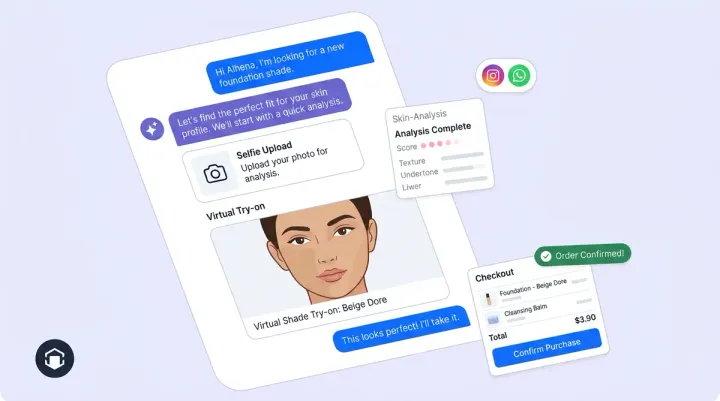
Alhena AI's Shopping Assistant uses this same skin-type and concern data to power its Skin Analyzer feature, matching shoppers to products based on their specific skin profile and concerns, turning the visibility your AEO, GEO, and AI optimization work drives into actual purchases on your site.
5. Routine and Layering Context
Beauty shoppers ask AI how products fit into multi-step routines. "Can I use vitamin C and retinol in the same routine?" and "What order do I apply hyaluronic acid and niacinamide?" are high-intent queries that AI platforms need product-level context to answer accurately.
Product data must include application order (Step 3 of 5 in your evening routine), which products to use before and after, and which actives to avoid combining. For example, retinol and AHA in the same step, niacinamide and direct vitamin C at conflicting pH levels: these interaction warnings are exactly the kind of structured advisory content that AI platforms prioritize when building routine recommendations.
Brands that provide complete routine context get recommended as part of multi-product answers. Brands with isolated product descriptions get skipped in favor of competitors who help AI build a full regimen response. Alhena's Regimen Builder uses this same routine data to assemble personalized multi-step recommendations on-site, converting the routine-seeking shoppers that your AEO strategy attracts.
6. User Reviews Segmented by Skin Type and Concern
Generic five-star ratings give AI minimal matching data. A review that says "Great product! Five stars!" tells an AI nothing about who this product works for or which concerns it addresses.
Reviews that mention specific skin types ("I have oily, acne-prone skin and this didn't break me out"), concerns addressed ("My dark spots faded noticeably after 6 weeks"), and before-and-after experiences give AI platforms rich semantic and sentiment matching criteria. These details drive product-specific recommendations because AI can map review content to shopper queries at the concern level.
Structure your review prompts to surface beauty-specific details. Ask reviewers to select their skin type, primary concern, and how long they've used the product. Display these as structured, filterable data alongside review text. This turns your review section from a generic social proof element into a dense, AI-parseable dataset that improves how often your products get cited and your visibility for long-tail skin-concern queries.
Alhena AI's Product Review tools help brands collect and structure these beauty-specific review signals, making them available to both on-site AI assistants and external AI platforms.
7. Shade, Texture, and Finish Attributes for Color Cosmetics
For makeup products, AI shoppers ask about undertone matching ("best foundation for warm olive undertones"), finish type ("matte vs dewy foundation for oily skin"), coverage level ("light coverage foundation that doesn't settle into fine lines"), and texture ("non-sticky lip gloss with sheer finish").
These attributes must be structured as parseable product data, not buried in marketing copy. "A weightless, buildable formula that gives you that lit-from-within glow" sounds beautiful but gives AI zero filterable attributes. "Dewy finish, light-to-medium buildable coverage, suitable for warm and neutral undertones, non-comedogenic" gives AI four distinct matching criteria.
Create dedicated attribute fields with schema markup for finish type, coverage level, undertone range, and texture on every color cosmetics PDP. AI systems and recommendation engines filter on these attributes when answering specific cosmetics queries, and products without structured attribute data lose to products from competitors that have it, making products without attributes invisible.
How Alhena AI Turns Beauty Visibility into Revenue
Optimizing your product data for AI visibility is step one. Knowing whether it's working, and converting the discovery traffic it drives, is step two.
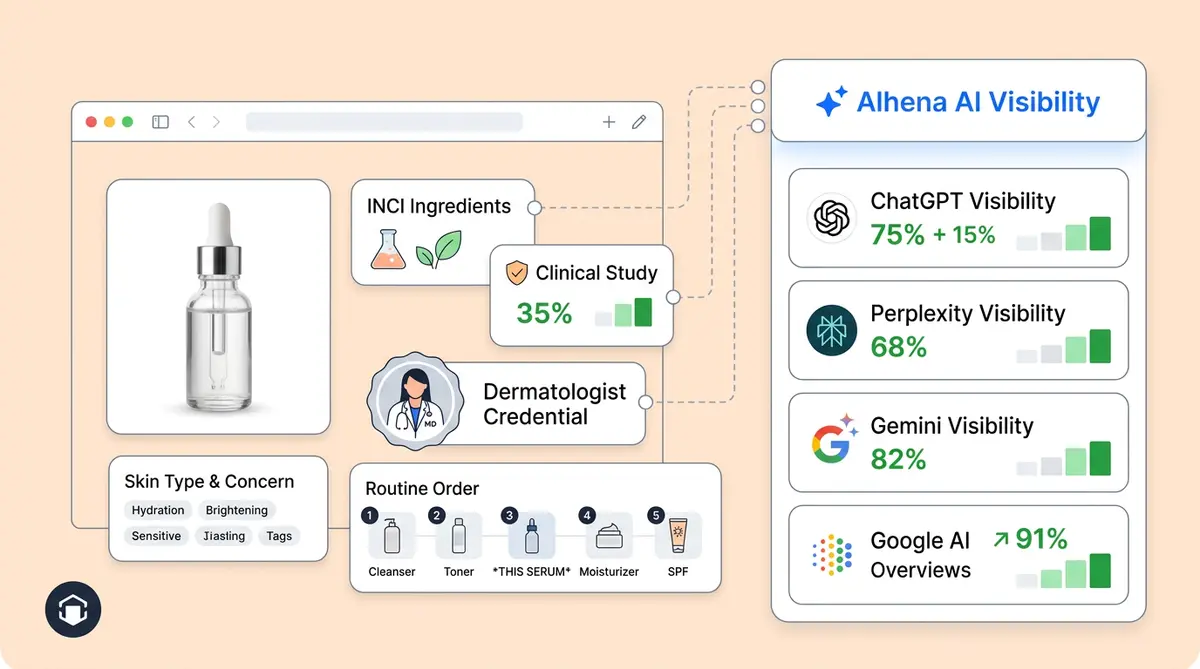
Alhena AI's Visibility platform gives beauty brands SKU-level GEO analysis and tracking across ChatGPT, Perplexity, Gemini, and Google AI Overviews. You can see exactly which products get recommended for which ingredient and concern queries, which bestsellers are missing from AI answers and generative AI generated responses despite strong on-site performance, and what specific product data or clinical evidence gaps need analysis are costing you AI visibility.
On the conversion side, Alhena's beauty AI agents like the Skin Analyzer, Shade Matcher, and Regimen Builder, continue the personalized conversation that started during generative AI search, AI product discovery in 2026's search landscape in the AI search engine. When a shopper arrives after asking an AI about "the best moisturizer or retinol for sensitive skin," Alhena's Shopping Assistant picks up that context and guides them to the right product with personalized recommendations grounded in your verified catalog data.
The results are measurable. A luxury skincare brand using Alhena achieved 3x conversion rates, 38% higher AOV, and 11.4% of total site revenue from AI-assisted conversations. Victoria Beckham saw a 20% AOV increase. These aren't generic chatbot metrics. They're beauty AI outcomes driven by GEO driven by formulation-aware AI that matches products to skin types, concerns, and routines.
Whether you're on Shopify, Salesforce Commerce Cloud, or another platform, Alhena deploys in under 48 hours with no dev resources needed.
Key Takeaways
- Beauty leads all verticals at 5.36% LLM conversion because ingredient, routine, and skin-type queries match how LLMs and generative AI platforms create recommendations.
- Full INCI ingredient lists in crawlable HTML are the single highest-impact optimization. LLMs can't recommend products whose ingredients they can't read.
- Clinical study data with specific outcomes, sample sizes, and durations gives AI the confidence signals to recommend your products over competitors who only cite vague benefits.
- Skin-type suitability, concern mapping, routine context, and structured review data all expand the range of long-tail queries your products can match.
- For color cosmetics, structured shade, texture, and finish attributes are non-negotiable for AI visibility in makeup queries.
- Alhena AI provides SKU-level visibility tracking across AI platforms plus beauty-specific agents that convert the traffic your AEO work drives.
Ready to see how your products appear across AI search, shopping assistants, and discovery platforms? Book a demo with Alhena AI to get SKU-level AI visibility tracking and beauty-specific conversion agents, or start free with 25 conversations.
SEO vs GEO vs AEO: What Beauty AI Systems Actually Prioritize
Traditional SEO optimization helped beauty brands rank in Google's ten blue links. GEO (Generative Engine Optimization) and AEO (Answer Engine Optimization) work differently. AI systems like ChatGPT, Perplexity, and Gemini don't crawl your site the way search bots do. LLMs pull from training data, retrieval-augmented generation (RAG) pipelines, and cited third-party sources to generate AI answers. Your SEO rankings and your GEO visibility can diverge significantly.
CeraVe is a clear example. CeraVe's dominance in AI answers comes from the density of dermatologist-cited clinical data across community forums, retailer sites, and medical publications. CeraVe doesn't need the top SEO position for "best moisturizer" to appear in AI generated answers about ceramide barrier repair (a query where CeraVe dominates). The AI systems that power discovery on LLMs pull CeraVe into recommendations because its ingredient data, clinical backing, and expert citations meet the criteria that generative AI models use to decide which beauty brands to surface.
For beauty AI optimization in 2026, the priority sequence is: first, make your ingredient data machine-readable so AI systems and LLMs can parse it. Second, earn citations and get cited by the sources that generative AI platforms trust. Third, maintain traditional SEO as a foundation, because AI systems still use web-crawled data as one input among many. GEO builds on SEO but goes beyond it. Competitors that focus only on SEO optimization without addressing how LLMs and AI generated answers are produced will lose beauty AI visibility to brands that invest in the full AEO and GEO stack.
Alhena AI's Visibility platform tracks exactly how your beauty products appear in AI answers across ChatGPT, Perplexity, Gemini, and Google AI Overviews. You can see which competitors are cited more often for specific ingredient and concern queries, identify where your GEO gaps are at the SKU level, and get actionable recommendations for improving how AI systems discover and recommend your products. Beauty AI agents like the Skin Analyzer and Regimen Builder then convert the discovery traffic that these optimization efforts drive.
For health and wellness brands facing even stricter YMYL requirements, see our companion guide on AI visibility trust signals for health and wellness ecommerce.
Frequently Asked Questions
How does ingredient-level AI visibility tracking help beauty brands identify which SKUs are missing from AI recommendations?
Alhena AI monitors every product in your catalog across ChatGPT, Perplexity, Gemini, and Google AI Overviews at the SKU level. It flags bestsellers that aren't appearing in AI answers despite strong on-site performance, then identifies the specific ingredient data, clinical evidence, or skin-type mapping gaps causing the visibility loss so you can fix them and recapture those recommendation slots.
What clinical data should skincare brands surface on product pages to improve AEO performance and get cited by AI search, shopping assistants, and discovery platforms?
AI platforms prioritize clinical claims with specific outcomes, sample sizes, durations, and methodology over vague efficacy statements. Surface data like "28% reduction in hyperpigmentation over 12 weeks in a 60-participant double-blind study" directly in crawlable HTML on your PDP. Alhena AI's visibility reports show exactly which competitor products are winning AI citations with stronger clinical evidence so you can close the gap.
How does optimizing skin-type and concern queries for AI improve conversion rates for beauty ecommerce brands?
Beauty converts at 5.36% through AI channels because shoppers ask condition-specific questions like "best moisturizer for dry sensitive skin with rosacea." Products with explicit skin-type suitability and concern mapping and sentiment analysis in structured text match these queries directly. Alhena AI's Skin Analyzer then converts that traffic on-site by matching arriving shoppers to products based on their specific skin profile, driving results like 3x conversion rates and 38% higher AOV.
Why do beauty brands need routine and layering context in product data to appear in AI skincare recommendations?
AI shoppers frequently ask multi-product routine questions like "Can I use vitamin C and retinol together?" or "What order do I apply serums?" Products that include application sequence, compatible pairings, and ingredient interaction warnings get recommended as part of complete conversational routine answers. Alhena AI's Regimen Builder uses this same data to assemble personalized routines on-site, turning routine-seeking AI visitors into multi-product purchases.
What is the revenue impact of beauty-specific AEO optimization compared to general SEO for skincare and cosmetics brands?
LLM-referred traffic converts at 2.47% across verticals with zero ad spend, and beauty outperforms at 5.36%. AI visitors who engage with Alhena AI's beauty-specific agents convert at rates up to 4x higher than standard organic traffic. One luxury skincare brand generated 11.4% of total site revenue from conversational AI-assisted interactions alone, proving that beauty-specific AEO paired with ingredient-aware on-site AI delivers measurable revenue that general SEO optimization cannot match.