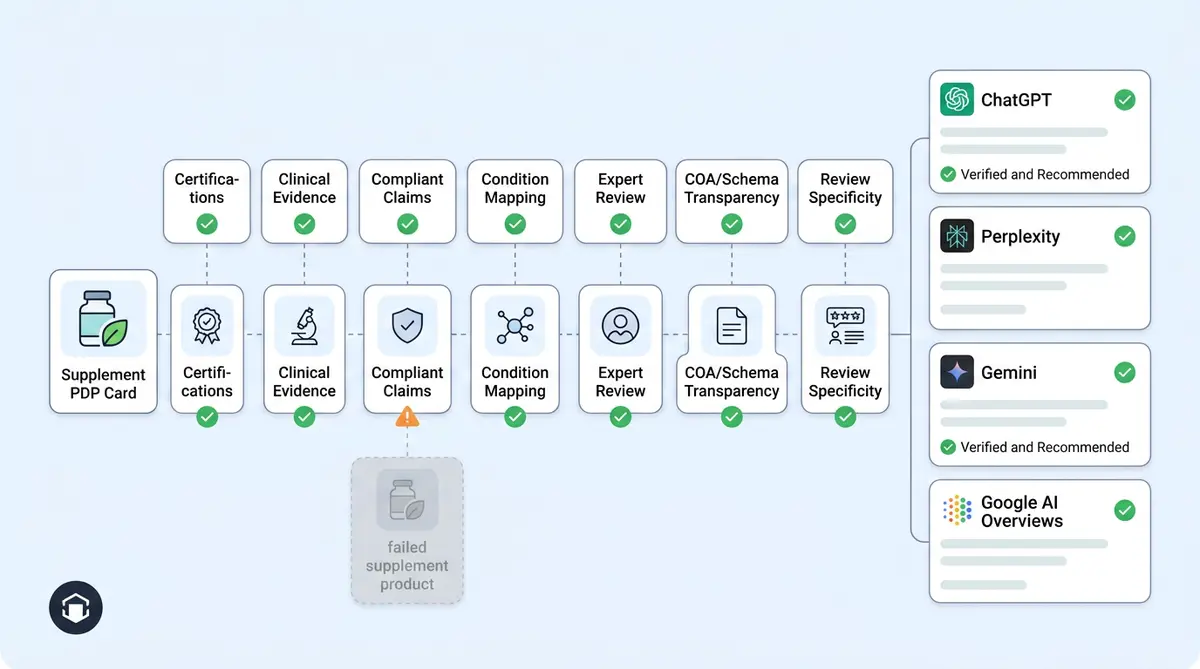
More than 230 million people ask ChatGPT health and wellness questions every week, according to OpenAI. Queries like "best magnesium for sleep" and "which collagen powder actually works" now start in AI chat windows, not Google's search bar. And when an AI engine picks a winner, 74% of the user base follows that recommendation without checking alternatives.
Health and wellness products convert at 4.68% from AI-referred traffic, the second-highest rate across all ecommerce categories (behind beauty's 5.36%). But getting recommended in the first place is harder in the health category than in any other product category. Google classifies health content as YMYL (Your Money or Your Life), and AI engines, including agentic commerce platforms, inherit that scrutiny. They won't recommend a supplement the way they'd recommend a throw pillow. They need proof.
This is the third post in our vertical AI visibility series, following beauty and fashion. Where beauty visibility hinges on ingredient transparency and fashion on catalog enrichment, health and wellness visibility and discoverability depends on something deeper: trust signals strong enough to clear the YMYL bar. Understanding these seven signals is what matters most.
Why YMYL Makes Health AI Visibility Different
YMYL isn't just a Google Search concept. It's baked into how generative AI search engines like ChatGPT, Perplexity, Gemini, and Google AI Overviews (AIO) evaluate health product recommendations. Search Engine Land reports that 44% of YMYL searches already trigger AI Overviews in search results, and those answers draw exclusively from sources that demonstrate expertise, authority, and trust.
For health wellness brands selling supplements, YMYL creates a higher threshold than beauty or fashion faces. A skincare brand needs ingredient lists and dermatologist endorsements. A fashion brand needs occasion tagging and fit data. A health brand needs all of that plus clinical safety evidence, clinical validation, regulatory compliance, third-party lab verification, and safety disclosures and privacy compliance measures. Miss any of these, and AI engines treat your products as too risky to cite.
But here's the flip side most brands overlook: YMYL is a competitive moat. The brands that invest in these trust signals don't just earn AI recommendations. They lock out competitors who can't clear the same bar. While 62% of enterprise brands remain invisible to generative AI search, the few health brands that get their trust signals right dominate a recommendation slot that AI models and large language models limit to just one to three brands per response.
Seven Trust Signals That Drive Health and Wellness AI Recommendations
AI engines don't evaluate health products the way they evaluate beauty or fashion. They apply YMYL-grade checks before citing a supplement or wellness product. These seven signals are the ones that consistently separate recommended brands from invisible ones.
1. Third-Party Certifications and Lab Testing
NSF International, USP Verified, ConsumerLab Approved, GMP Certified, and USDA Organic aren't just packaging claims. They're the strongest trust signals AI systems weight when deciding whether a health product is safe to recommend and making them discoverable. When AI search engines like Perplexity answer "what's a good fish oil supplement?", it gravitates toward products with verifiable, structured certification data.
Make certifications machine-readable. Add them as additionalProperty fields in your Product schema with the certifying body, certification number, and verification URL. AI agents cross-reference these against certification databases. Products with 500+ reviews and third-party certifications consistently benchmark higher than uncertified alternatives in AI citation rates, regardless of price point.
2. Clinical Study Data and Bioavailability Evidence
Beauty brands cite hydration and wrinkle-reduction studies. Health brands need a different kind of evidence: bioavailability data, absorption rates, and measurable health outcomes. A magnesium supplement that references a specific clinical trial with sample size, duration, and results gives AI engines the structured evidence they need to recommend it confidently.
Format matters. "A 2024 randomized controlled trial (n=120) in the Journal of Clinical Sleep Medicine found that 400mg magnesium glycinate reduced sleep onset latency by 17 minutes over 8 weeks" is the kind of statement AI engines can parse, validate, and cite. Generic phrases like "clinically tested formula" give AI systems nothing to work with. Structure your study references with publication name, year, sample size, and key finding, and 44.2% of AI citations come from the first 30% of page content, so place this evidence high on your PDPs.
3. FDA Compliance in Product Descriptions
AI models are cautious about health claims, and they should be. A supplement description that says "cures insomnia" crosses into disease-claim territory that AI engines won't touch. One that says "formulated to support healthy sleep patterns" uses FDA-compliant structure/function language that meets health compliance standards that AI systems can safely recommend.
This isn't about watering down your copy. It's about writing descriptions that pass the same AI compliance check that models run internally. Use the structure/function framework the FTC outlines for health products: describe what the ingredient does in the body without claiming to treat, cure, or prevent a specific disease. Products with compliant content and language appear in search results. Products with aggressive health claims get filtered out entirely.
4. Condition-Matching and Symptom-to-Product Mapping
Shoppers search by health goal, not by ingredient. They ask "what helps with joint stiffness after 50" or "best supplement for brain fog during menopause," not "best glucosamine hydrochloride 1500mg capsule." Your product data needs to bridge that gap without crossing into medical claim territory.
Build structured mappings between wellness concerns and your products using schema-friendly language. Connect "joint mobility and comfort support" to your glucosamine product. Map "cognitive clarity and focus" to your lion's mane mushroom. Use audience and additionalProperty schema fields to tag your target audience by age ranges, activity levels, preferences, and wellness goals and health gains. This is what the PDP optimization checklist calls "query-intent alignment," and it's how AI engines match your product to personalized health queries.
5. Expert Endorsements and Certificates of Analysis
Where beauty brands use dermatologist endorsements, health brands need physician, registered dietitian, naturopathic doctor, and pharmacist authority signals. AI algorithms treat a product reviewed by "Dr. Sarah Chen, PharmD, Board Certified in Nutrition Support" differently from one endorsed by a generic "health expert."
Pair expert endorsements with third-party Certificates of Analysis (COAs). A COA from an independent lab showing heavy metal testing results, potency verification, and contaminant screening gives AI agents an additional layer of trust that no competitor claim can replicate. Use Person schema markup with jobTitle, affiliation, and sameAs (linking to NPI numbers, institutional profiles, or LinkedIn) for every reviewer. The AEO FAQ Engine approach pairs these expert-reviewed answers with structured FAQ schema markup to capture health-specific "People Also Ask" queries.
6. Ingredient Sourcing and Purity Transparency
Consumer insights show that 76% of wellness consumers rank quality as their most important purchasing factor. AI engines reflect this by favoring products that disclose sourcing details other brands hide. Country of origin, extraction method, raw material supplier, organic certification, and purity percentage are all signals that differentiate your product in AI recommendations.
"Wild-caught Alaskan pollock, molecular distillation, third-party tested for 450+ contaminants, IFOS 5-star certified" gives AI engines five distinct trust data points in a single product attribute. Compare that to "premium quality fish oil" and the visibility gap becomes obvious. Structure sourcing data as explicit additionalProperty fields so AI systems can parse each signal individually.
7. Health-Specific Review Optimization
Generic star ratings don't differentiate health products in AI recommendations. Reviews that mention specific outcomes, dosage experience, onset timing, and comparisons to alternatives create the semantic depth AI engines use to match products to natural language queries.
A review stating "I take 2 capsules before bed and noticed deeper sleep within the first week, no grogginess the next morning" gives AI systems three usable data points: dosage timing, efficacy timeline, and side-effect absence. Encourage customers to mention their specific health goal, how long they've used the product, and any changes they noticed. Structure review data with attributes for wellness goal, age range, and duration of use. Reviews that mention specific conditions ("perimenopause sleep support" or "post-surgery recovery") create the exact keyword and semantic connections AI engines match against.
How Health Brands Lose AI Visibility Without Knowing It
Most health brands focus on their own PDPs and assume good on-site content equals AI visibility. It doesn't. Brands are 6.5x more likely to be cited through third-party sources than their own domains. That means the information about your supplements on Amazon, iHerb, Healthline, and WebMD may carry more weight in AI recommendations than your own site.
Three common visibility killers:
- Outdated third-party listings. If your Amazon listing shows an old formulation or your iHerb page has incorrect dosage info, AI engines may pull that data instead of your updated PDP. Audit and optimize your top 10 external product listings quarterly.
- Proprietary blend opacity. Blends that hide individual ingredient dosages behind a total weight are a red flag for AI systems. They can't recommend your product for a specific query ("500mg ashwagandha KSM-66") if they can't confirm the dosage.
- Missing safety disclosures. Allergen declarations, drug interaction notes, and pregnancy advisories aren't just regulatory boxes. They're trust signals that tell AI engines your brand prioritizes consumer safety. Products missing these disclosures often get excluded from recommendations entirely.
How Alhena AI Visibility Tracks and Improves Health Brand Recommendations
Alhena AI Visibility gives health and wellness brands SKU-level tracking across major AI platforms including ChatGPT, Perplexity, Gemini, and Google AI Overviews. Instead of guessing whether your magnesium or your probiotic shows up in AI answers, you see exactly which products are recommended, which are misrepresented, and which are invisible and which are visible, making content monitoring essential.
SKU-level health monitoring and product tracking. Track individual supplements and wellness products in real time across every major AI platform. See whether your CoQ10 appears when someone asks "best CoQ10 for heart health" on Perplexity, and whether the cited dosage, form, and certification data are accurate. For health brands, a single inaccuracy in an AI citation can erode trust across your entire product catalog.
First-party health query intelligence. Alhena's Product Expert Agent handles thousands of on-site conversations about your health products. Questions like "can I stack your ashwagandha with magnesium?" and "is this safe with blood thinners?" help you understand exactly what product insights shoppers and AI engines need. This first-party data feeds directly into your content optimization and AEO strategy, helping you optimize content gaps that third-party monitoring tools can't detect.
Revenue attribution from AI discovery. Connect AI-powered product discovery to actual purchases. Brands using Alhena's full platform have seen results like Tatcha's 3x conversion rate and 38% AOV uplift. For health brands, where customer lifetime value runs high and subscription renewals drive growth, knowing which AI channels and agentic shopping platforms deliver paying customers changes how you allocate your AI marketing and analytics budget.
Hallucination-free product answers. In the health ecommerce space, inaccurate AI responses can cause real harm. Alhena's Support Concierge grounds every response in your verified product data. It won't recommend a supplement for a condition it doesn't support or cite a dosage your product doesn't contain. That same zero-hallucination standard builds the trust signal pattern AI engines look for when deciding which brands to recommend.
Building a Real-Time AI Visibility Workflow
AI visibility for health brands drives better outcomes when you treat it as a continuous workflow, not a one-time content optimization project. Search engines and generative AI platforms update their AI models constantly, which means a product catalog that scores well today can lose visibility next month if competitor content improves or your third-party listings drift out of date.
The most effective health brands run a monthly AI visibility audit. They check search results across ChatGPT, Perplexity, and Google AIO for their top 20 SKUs. They track which AI platforms cite them, which cite competitors, and where product discovery gaps exist. They feed these actionable insights back into their content optimization and AI marketing strategy, closing gaps before they widen. Alhena’s AI assistant makes this process scalable by connecting real-time visibility data to on-site shopper behavior, giving your team the consumer insights needed to prioritize which products and which AI compliance requirements to address first.
Key Takeaways
- YMYL is a moat, not just a hurdle. Health brands that clear the higher AI trust bar lock out competitors who can't meet the same standard. Only 1-3 brands get cited per AI response.
- Third-party certifications are the strongest signal. NSF, USP, GMP, and ConsumerLab verification, structured as machine-readable schema, consistently drives AI recommendations for health products.
- Clinical evidence must be structured, not vague. Publication name, sample size, dosage, and measurable outcome. "Clinically tested" doesn't count.
- FDA-compliant language gets recommended. Structure/function claims pass AI compliance filters. Disease claims get your products excluded.
- Third-party listings may matter more than your own PDP. With 6.5x citation bias toward external sources, audit your Amazon, iHerb, and marketplace listings regularly.
- Health converts at 4.68% from AI traffic. Second only to beauty. Current trends show the revenue opportunity for health brands that invest in AI visibility is significant and growing.
- SKU-level tracking is table stakes. Brand-level AI tools miss the product-specific gaps that keep individual supplements out of recommendations.
Ready to see how your health and wellness products perform in AI search? Book a demo with Alhena AI to get SKU-level AI visibility tracking across ChatGPT, Perplexity, Gemini, and Google AI Overviews. Or start free with 25 conversations to see how the AI assistant handles your health product questions.
Alhena AI
Frequently Asked Questions
What is YMYL and why does it affect health ecommerce AI visibility?
YMYL (Your Money or Your Life) is Google's classification for content that can impact a person's health, safety, or financial well-being. AI engines apply this same scrutiny when recommending health products. Supplements and wellness products face higher trust thresholds than categories like fashion or home goods, meaning brands need stronger signals (certifications, clinical data, expert endorsements) to earn AI recommendations.
Which third-party certifications matter most for supplement AI visibility?
NSF International, USP Verified, ConsumerLab Approved, and GMP Certified carry the most weight with AI engines. These certifications verify that a product contains what it claims and meets quality standards. Products with 500+ reviews and at least one major third-party certification consistently benchmark higher than uncertified alternatives in AI citation rates across ChatGPT, Perplexity, and Google AI Overviews.
How do I structure clinical study data for AI engines to cite?
Include the publication name, year, study type (RCT, meta-analysis), sample size, dosage used, and key measurable outcome. For example: 'A 2024 RCT (n=120) in the Journal of Clinical Sleep Medicine found 400mg magnesium glycinate reduced sleep onset by 17 minutes.' Place this evidence in the top 30% of your PDP, since 44.2% of AI citations come from early page content.
What's the difference between health AI visibility and beauty AI visibility?
Beauty AI visibility focuses on ingredient transparency, skin-type matching, and routine context. Health AI visibility adds layers that beauty doesn't face: FDA structure/function claim compliance, third-party lab testing (COAs), clinical evidence beyond cosmetic studies, and drug interaction disclosures. Health products also undergo stricter YMYL evaluation, requiring more proof before AI engines will recommend them.
How does Alhena AI track health product visibility across AI engines?
Alhena AI Visibility provides SKU-level monitoring across ChatGPT, Perplexity, Gemini, and Google AI Overviews. For each health product, you see whether it appears in AI answers, whether the cited information (dosage, certifications, ingredients) is accurate, and which competitors are being recommended instead. The platform also uses first-party shopper query data to identify content gaps in your PDPs.
Can health brands use AEO and traditional SEO at the same time?
Yes, and they should. Traditional SEO optimizes for organic rankings, while AEO (Answer Engine Optimization) targets AI-generated recommendations where traditional SEO falls short. The tactics overlap significantly: structured product data, expert-authored content, and clinical citations help both SEO and AEO performance. Health brands converting at 4.68% from AI traffic should treat AEO as complementary to SEO, not a replacement.
Why do third-party listings matter more than my own PDP for AI visibility?
Brands are 6.5x more likely to be cited through third-party platforms and sources (Amazon, iHerb, Healthline, WebMD) than their own domains. AI engines cross-reference multiple sources, and outdated or incorrect information on marketplace and AI product listings can block your products from recommendations even if your own website is fully optimized. Audit your top external listings quarterly for accuracy.
How do I write FDA-compliant product descriptions that AI engines can recommend?
Use structure/function claim language: describe what an ingredient does in the body without claiming to treat, cure, or prevent a disease. 'Supports healthy sleep patterns' passes AI compliance filters; 'cures insomnia' gets your product filtered out. The FTC's health products compliance guidance provides the framework. Products with compliant content and language consistently earn more AI citations than those with aggressive health claims.