Luxury has always been about scarcity. But online, that exclusivity falls apart fast. Bots sweep limited drops in seconds. VIP shoppers get the same generic browse experience as first-time visitors. And the white glove service that defines luxury in person barely translates to an online store with a product grid and a shopping cart.
Luxury houses need AI technology that understands scarcity as a business model, treats VIP status as a living signal, and orchestrates digital experiences that feel as intentional as a handwritten note from a personal stylist. This guide covers how artificial intelligence powers luxury e-commerce, from product drops to personalized invitations, and where Alhena AI fits.
The Psychology of Scarcity in Digital Luxury
Scarcity works because of loss aversion. When a luxury brand limits a product to 200 units, it activates that instinct in every shopper who sees the listing. Layer on social proof ("only 12 left"), identity signaling ("you were selected for early access"), and time pressure ("the collection closes at midnight"), and you get the emotional cocktail of urgency that drives luxury demand. Heritage luxury houses have always known this: scarcity is the marketing.
Online, these mechanics break. A static product page can't whisper, "we saved this for you." The culture of exclusivity collapses when every visitor sees the same experience. AI agents change this by adapting the message per visitor. A returning VIP might see: "Welcome back, Ms. Chen. Your stylist set aside two pieces from the Spring capsule." A first-time shopper gets something entirely different. The scarcity is real, but the framing is personal, and that's what makes it feel like prestige rather than hype.
Why Product Drops Fail Online (and What Fixes Them)
Limited-edition drops are a cornerstone of luxury marketing. But online drops routinely go wrong. Websites crash on launch day. Bots sweep inventory before real customers can check out. For a luxury fashion brand built on heritage and elegance, chaotic drops are a brand equity crisis. When bots buy out a collection and resell at markup, the brand loses control of its pricing story, its storytelling narrative, and the prestige that justifies the price tag.
How AI Changes the Drop Lifecycle
An AI-orchestrated drop looks different at every stage:
- Pre-drop: AI-powered agents run a conversational waitlist. Instead of a simple email signup, the agent qualifies intent through natural dialogue, identifies genuine buyers, and ranks them by consumer engagement signals. Bots can't hold a convincing multi-turn conversation.
- During the drop: The AI agent communicates with each consumer individually. VIPs get direct access links through their preferred channel. The experience feels managed, as a client advisor curated it personally.
- Post-drop: Customers who missed out get instant, personalized outreach. The agent knows their browsing history, preferences, and style preferences, so it can aid product discovery by surfacing an in-stock comparable piece or place them on a waitlist for the next drop. An out-of-stock moment becomes a saved relationship. The consumer stays engaged instead of leaving.
Invite-only, managed drops produce better outcomes: higher loyalty sign-ups and stronger long-term community relationships for brands of all sizes. AI makes this kind of innovation possible at scale.
From Static Loyalty Tiers to Dynamic VIP Intelligence
Most loyalty programs still run on annual spend brackets. Hit $5,000, you're Gold. Hit $15,000, you're Platinum. The structure is outdated. A customer who spends moderately but refers five friends and RSVPs to every event is arguably more valuable than someone who makes one large purchase and disappears. Static tiers can't tell the difference.
What Dynamic, AI-Driven Tiering Looks Like
AI agents can weigh multiple behavioral signals in real time:
- Lifetime spend and basket recency
- Engagement depth: time on site, editorial content interaction, lookbook views
- Referral patterns: who they've brought to the brand and those referrals' spending
- Event participation: trunk show RSVPs, livestream attendance
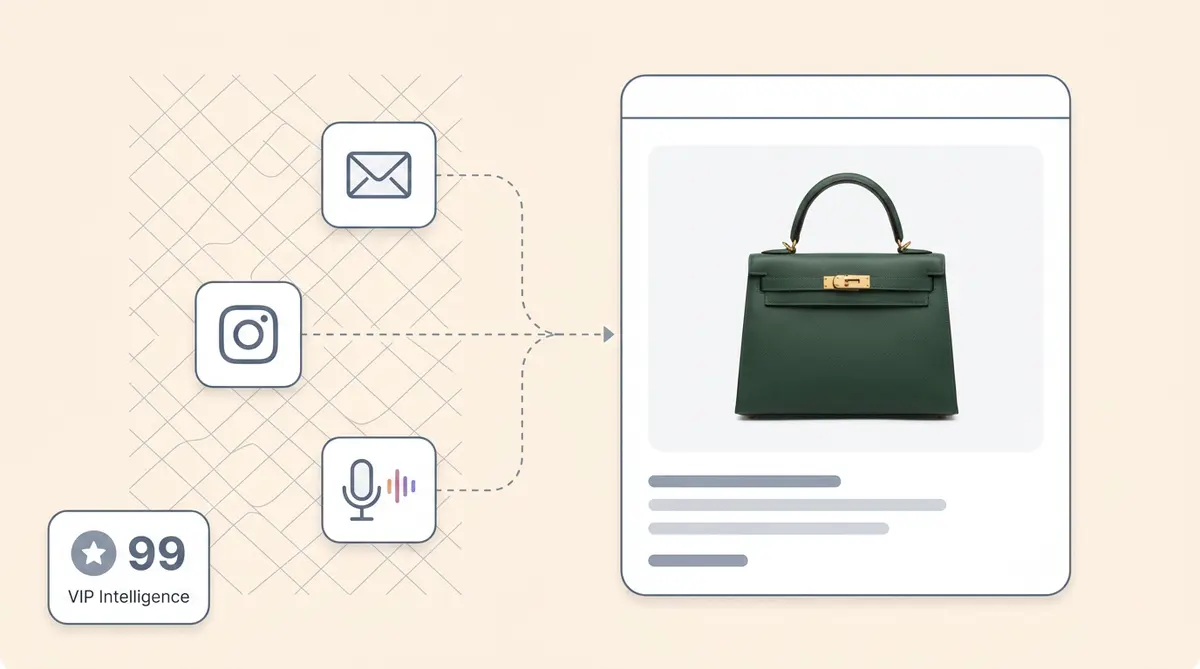
- Channel behavior: do they respond to email, Instagram DMs, WhatsApp, or voice? What are their channel preferences?
For luxury ecommerce, AI-driven tiering means an agent can silently gate experiences. A qualifying VIP shopper sees a private collection tab that doesn't exist for other visitors. A top-tier client gets early access links 48 hours before a public drop. The agent suppresses discount messaging for high-value customers, because in luxury, a coupon code can actually damage the relationship. Alhena's Product Expert Agent handles this kind of contextual personalization natively, adjusting tone, product surfacing, and offer logic to localize and personalize based on engagement signals.
Personalizing the White-Glove Digital Invitation
In luxury retail, the invitation is a product in itself. It's a curated moment with storytelling that makes the recipient feel individually chosen. Replicating that feeling digitally is one of the hardest problems in the luxury e-commerce industry. AI agents solve it by combining three capabilities.
Memory That Spans Months
Luxury purchases involve long consideration cycles. A consumer might browse a watch collection in March, ask about details via chat in April, and buy in June. An AI-powered agent with persistent memory connects those touchpoints. Alhena's unified memory layer maintains this context across web chat, email, Instagram, WhatsApp, and voice. For a deeper look, see our guide on luxury AI concierge workflows.
Channel Intelligence
Not every VIP checks email. AI agents track each consumer’s channel preferences. Alhena's omnichannel architecture means a single virtual agent manages conversations across every touchpoint, making the experience seamless whether the invitation arrives as an Instagram DM, a Meta channel message, or a voice call. Our post on channel-specific AI strategies covers the nuances.
Generative Personalization at Scale
Generative AI tools can produce individually-worded, AI-generated, individually crafted invitations at scale. One client might receive a note referencing the cashmere pieces she browsed last season. Another gets a message about the designer's new palette. The output reads like a message from a human sales associate who knows the customer personally, because the AI, guided by the right prompts and signals, has the same data a stylist would. The technology can do this for thousands of VIPs simultaneously.
How Alhena AI Orchestrates Luxury Exclusivity
Most AI tools in ecommerce were built to deflect support tickets. Luxury customers don't want efficiency. They expect recognition. Alhena's artificial intelligence was built with this distinction embedded from the start.
Alhena's Shopping Assistant functions as a virtual concierge, not a ticket router. This AI-powered system recognizes returning customers across sessions and channels, adapts tone and product recommendations based on behavioral insights, and helps drive better revenue through agentic checkout that populates carts with products and pre-fills checkout fields within the conversation itself.
The success of luxury brands using Alhena speaks clearly. Victoria Beckham saw a 20% increase in average order value after deploying the AI concierge (full case study). Tatcha achieved a 3x conversion rate, 38% AOV uplift, and 11.4% of total site revenue attributed directly to AI-assisted conversations (full case study). For a detailed breakdown, read our Tatcha case study analysis.
Alhena's grounding in verified product data means no hallucinated descriptions. For luxury fashion labels where one inaccurate claim can damage trust, this matters enormously. The Support Concierge handles order management, exchange requests, and post-purchase care with the same precision, so VIP customers get high-touch, white-glove service at every stage.
Alhena deploys in under 48 hours with no dev resources, integrating with platforms like Shopify and Salesforce Commerce Cloud. For luxury houses that move cautiously with new technology, that speed ultimately removes the biggest barrier to adoption.
The Human Handoff: Where AI Steps Aside
If the AI is too good, does it replace the human relationships that define the brand? The answer is no. AI makes humans better, enhancing every conversation. The best luxury brands use AI to arm their client advisors and sales teams with intelligence, not replace them. AI tools simply use AI to give advisors better context.
Alhena's Agent Assist warm-transfers conversations to human sales associates with full context: browsing history, past purchases, questions asked across channels, and products being considered. The client advisor walks into the conversation fully informed, the way a dedicated client advisor should. No "can you repeat your issue?" frustration. Survey respondents and industry survey data consistently show that respondents expect a human option for high-touch decisions, and the brands that win aren't choosing between AI and humans. They're using AI to make every human interaction richer. Our analysis of how premium brands balance AI with the human touch goes deeper on this.
Exclusivity Is an Operating Model, Not a Marketing Layer
The luxury brands gaining ground aren't just running scarcity campaigns. They're building systems where exclusivity is embedded into every customer interaction. The AI agent that recognizes a VIP before they identify themselves, gates private collections by behavioral tier, personalizes drop communications, and hands off to a human client advisor with full context: that's not a chatbot. That's a digital maison. AI-powered and generative AI innovation in the luxury e-commerce industry is just getting started, with the next generation of luxury houses, from Alibaba-powered storefronts to DTC brands, expected to treat AI as a core part of their culture and commerce strategy.
In luxury, generative AI's job isn't to answer faster. It's to make every customer feel like the only customer.
Ready to bring white-glove orchestration to your luxury e-commerce experience? Book a demo with Alhena AI or start for free with 25 conversations.

Frequently Asked Questions
How does AI help luxury brands manage product drops?
AI agents orchestrate the full drop lifecycle: conversational waitlists that filter bots, individual real-time communication during the drop, and personalized post-drop outreach that converts stockouts into saved relationships. Managed, invite-only drops have grown loyalty membership 40% in four months.
What is dynamic VIP tiering in luxury ecommerce?
Dynamic VIP tiering uses AI to evaluate customers across behavioral signals (spend, engagement, referrals, events, channel preferences) rather than a single spend bracket. Tier status recalculates in real time, so high-engagement customers are recognized as VIPs even with moderate spend.
Can AI replicate white-glove service for luxury brands online?
Yes, but the goal isn't full automation. AI agents handle recognition, memory, and personalization at scale, then warm-transfer high-touch conversations to human stylists with full context. Victoria Beckham saw a 20% AOV increase and Tatcha achieved 3x conversion rates using this AI-plus-human approach. The AI makes the human better, not redundant.
How do bots affect luxury product drops?
Bots are a major threat to luxury drops. Nike's SNKRS blocks 12 billion bot calls per month. Queue-it found that 94% of traffic during exclusive drops was untrusted. One documented bot operation created 2,600 fake accounts and attempted 44 million add-to-cart transactions from a single shoe drop. For luxury brands, bots don't just steal inventory; they destroy the curated exclusivity that justifies the price.
What makes Alhena AI different from other ecommerce chatbots for luxury?
Most ecommerce AI tools were built to deflect support tickets. Alhena was built to drive revenue through recognition. Its Shopping Assistant functions as a digital concierge with agentic checkout, unified memory across channels, and hallucination-free product recommendations grounded in verified data. It deploys in under 48 hours and integrates with Shopify and Salesforce Commerce Cloud.
How much revenue do VIP customers generate in ecommerce?
The top 5% of customers generate 35% of total ecommerce revenue, according to Rivo's research. VIP-tier customers produce 73% higher average order values ($435 vs. $291) and buy 3.6x more frequently. Yet only 22% of businesses operate premium loyalty programs, leaving a massive gap for brands that invest in AI-powered VIP management.
Does Alhena AI support human handoff for luxury customer conversations?
Yes. Alhena's Agent Assist feature warm-transfers conversations to human stylists with full context: browsing history, past purchases, questions asked across channels, and products being considered. The stylist enters the conversation fully informed, which eliminates the frustration that 40% of shoppers report when AI-powered service lacks a human option.
What is the ROI of AI personalization for luxury brands?
McKinsey research shows that companies excelling at personalization generate 40% more revenue than their peers. Specific luxury AI results include Tatcha's 11.4% of total site revenue from AI conversations, Victoria Beckham's 20% AOV increase, and LVMH's limited-edition sell-through rates jumping from 68% to 85% after AI deployment.