Beauty shoppers don't search the way they used to. Instead of typing "best moisturizer" into Google, they're asking ChatGPT and Gemini questions like "What's the best niacinamide serum for rosacea-prone skin?" These AI engines don't browse your site the way a human does. They parse structured data, and if your ingredient information is buried in marketing copy or locked inside images, you're invisible. In this article you will learn exactly how to structure your INCI data so AI engines can read, match, and recommend your products to shoppers who are ready to buy.
Why AI Engines Need More Than Marketing Copy
Large language models answer ingredient-led queries by connecting three things: a recognized ingredient name, a skin concern or benefit, and a product that matches both. When your PDP lists "our proprietary hydration complex" instead of "Hyaluronic Acid (Sodium Hyaluronate)," AI has nothing concrete to grab onto.
The result? Your brand gets skipped in favor of a competitor whose ingredient data is explicit, structured, and machine-readable. Ingredient transparency is already the top driver of AI recommendations in beauty, but transparency alone isn't enough. The data has to be structured in a way AI engines actually parse.
INCI: The Universal Language AI Already Understands
INCI (International Nomenclature of Cosmetic Ingredients) is the standardized naming system used on cosmetics and personal care labels worldwide. It's governed by the Personal Care Products Council and recognized by the EU, FDA, and most global regulators. More importantly for your purposes, LLMs are trained on massive datasets that include INCI names. That means "Niacinamide" is a token AI already knows and associates with benefits like redness reduction and oil control.
The problem is that most PDPs don't use INCI names consistently. One page says "Vitamin B3", another says "niacinamide", and a third just says "skin-brightening active". AI sometimes connects these, but it shouldn't have to guess. Standardize on INCI names across every product page, and you remove the guesswork entirely.
The Three-Layer Map: INCI, Common Name, Benefit
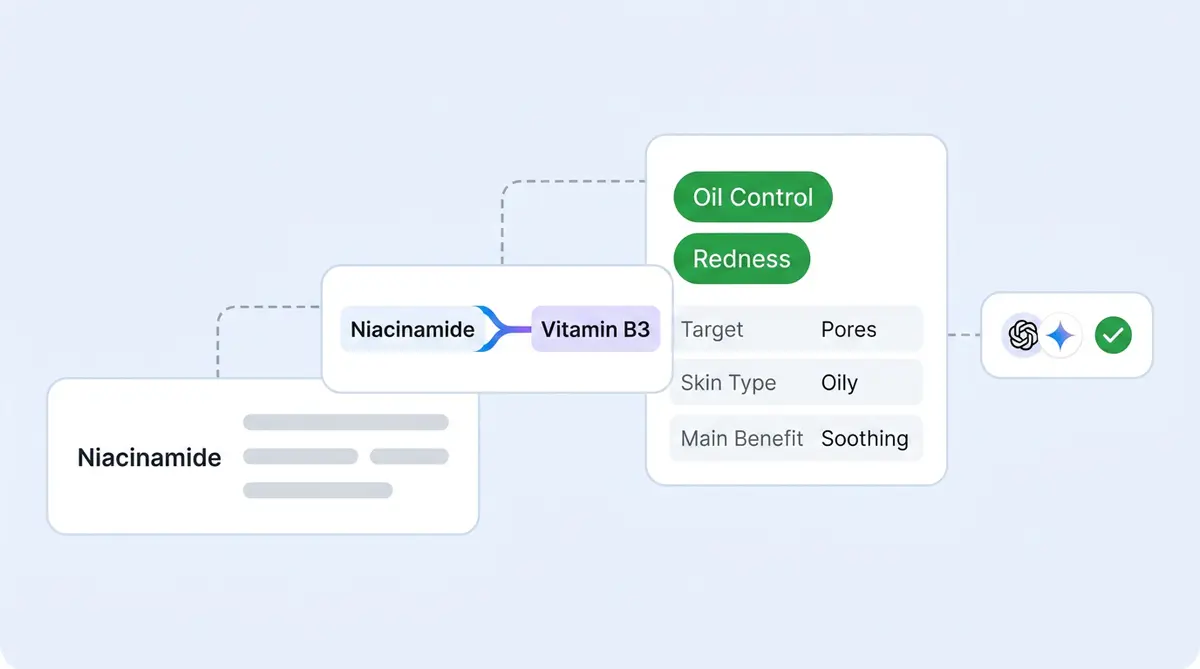
AI engines answer shopper questions by matching a concern to an ingredient to a product. Your data needs to make all three connections explicit. Here's the pattern:
- INCI name: Niacinamide
- Common name: Vitamin B3
- Benefits/concerns: Redness, pore appearance, oil control, uneven skin tone
When all three layers live on the same page in crawlable HTML (not in a PDF, not inside an image), AI engines will confidently match your SKU to a query like "best vitamin B3 serum for large pores". Without that mapping, you're relying on the model to infer connections it may never make.
Apply this three-layer structure to every hero ingredient on every PDP. Start with your top 5 best-selling SKUs and work outward. If you're already building AI-powered skincare routine recommendations, clean ingredient data makes those recommendations sharper too.
Structured Data That AI Can Actually Extract
Beyond on-page text, Schema.org markup gives AI engines an unambiguous, machine-readable layer. For beauty products, the most useful properties include:
- Product schema with
name,description,brand,sku - additionalProperty for ingredient lists, skin type compatibility, and concern tags
- Review schema segmented by skin type when possible
- FAQPage schema for benefit-related Q&As ("Is this safe for sensitive skin?")
A quick note on expectations: Schema.org markup doesn't guarantee a citation in ChatGPT or Gemini. No one can promise that. What it does is make your catalog data unambiguous and easy to extract, which is a prerequisite for being recommended. For a deeper walkthrough of e-commerce schema implementation, see our schema markup guide for AI search.
Content Patterns That AI Engines Tend to Cite
Structured data on PDPs is half the equation. The other half is supporting content that gives AI engines reasons to trust and cite your brand. Three content types perform well:
Ingredient deep-dive pages. One INCI ingredient, one URL. Cover what it does, what skin types benefit, concentration ranges, and which of your SKUs contain it. These pages become the canonical sources AI pulls from when answering "what does niacinamide do?"
Concern-led landing pages. Pages organized around a skin concern ("best products for rosacea") that link to specific SKUs with the relevant ingredients. These match the way consumers actually phrase AI queries.
Citable evidence. References to peer-reviewed research, dermatologist input, or clinical trial results. AI engines weigh pages with verified, verifiable claims more heavily than pages with unsupported marketing language. Keep claims cosmetic-compliant for safety: "helps reduce the appearance of redness" rather than "treats rosacea".
Your PDP optimization checklist covers 15 additional fixes that improve your AI visibility score across all verticals.
Measuring Whether AI Noticed: Where Alhena Fits
You've restructured your ingredient data. You've added Schema.org markup. You've published deep-dive ingredient pages. Now what?
You need a feedback loop. Alhena AI Visibility monitors how your brand appears in ChatGPT and Gemini responses for the ingredient-led and concern-led prompts that matter to your category. Pick 10 to 15 prompts like "best vitamin C face cream for hyperpigmentation" or "fragrance-free moisturizer for eczema", and track your Visibility Score, citations, and Citation Share over time.
The Recommendations tab shows you exactly which prompts your brand is missing, and what content gaps and insights your competitors are filling. Think of it as the measurement layer: you do the structuring work, and Alhena tells you whether ChatGPT and Gemini noticed.
For premium beauty and skincare brands, this closes the loop between catalog work and actual AI-driven digital discovery. And if you're running an AI shopping assistant on your site, clean ingredient data also improves the on-site shopping experience, helping the assistant match shoppers to the right products based on their specific skin concerns.
Your 30-Day INCI Strategy
- Week 1: Audit your top 10 ingredient-led queries in your category. What are shoppers asking ChatGPT about your product type?
- Week 2: Pick 5 hero INCI ingredients across your best sellers. Standardize naming on every PDP where they appear.
- Week 3: Add the three-layer map (INCI, common name, benefits) as crawlable HTML to those PDPs. Add a product and additional property schema.
- Week 4: Publish or refresh one ingredient deep-dive page. Set up weekly AI Visibility tracking to monitor movement.
This isn't a one-time project. As you expand to more ingredients and more SKUs, keep the same structure. Consistency builds a strong foundation that makes your entire catalog AI-readable, not just a handful of hero products.
Ready to see how your beauty brand shows up in AI search today? Book a demo with Alhena AI or start free with 25 conversations.
Frequently Asked Questions
What is INCI and why does it matter for AI visibility?
INCI (International Nomenclature of Cosmetic Ingredients) is the standardized naming system for cosmetic ingredients recognized globally. AI engines like ChatGPT and Gemini are trained on datasets that include INCI names, so using them consistently on your PDPs makes your products easier for AI to identify, match to shopper queries, and recommend.
How do I structure ingredient data so ChatGPT can recommend my products?
Use a three-layer mapping on every PDP: the INCI name (e.g., Niacinamide), the common name (Vitamin B3), and the associated benefits or skin concerns (redness, oil control). All three layers should be in crawlable HTML text, not locked in images or PDFs. Adding Schema.org Product markup with additionalProperty fields for ingredients strengthens the signal further.
Does Schema.org markup guarantee my product will appear in AI answers?
No. Schema.org markup makes your product data unambiguous and machine-readable, which is a prerequisite for AI citation, but not a guarantee. Think of it as making your data eligible for recommendation rather than ensuring it. Pairing structured data with high-quality ingredient content and citable evidence gives you the best chance.
What content types help beauty brands get cited by AI engines?
Three types perform well: ingredient deep-dive pages (one INCI ingredient per URL), concern-led landing pages organized around skin issues like rosacea or hyperpigmentation, and pages with citable evidence such as clinical study references or dermatologist input. These give AI engines specific, trustworthy content to pull from.
How can I track whether AI engines are recommending my beauty products?
Alhena AI Visibility monitors your brand's appearance in ChatGPT and Gemini responses. You select the ingredient-led and concern-led prompts that matter to your category, then track your Visibility Score and Citation Share over time. The Recommendations tab shows specific content gaps where competitors are getting cited and you're not.
How long does it take to see results from INCI data restructuring?
Most brands start seeing measurable changes in AI Visibility scores within 4 to 6 weeks of restructuring their top SKUs. The 30-day starter plan in this guide covers auditing queries, standardizing INCI names, adding structured data, and publishing ingredient content. Ongoing consistency across your full catalog compounds the results over time.