Why Eyewear Ecommerce Has a Conversion Problem
The online eyewear market hit $41.7 billion in 2025 and is growing at over 6% annually, according to Market Research Future. Yet 86% of eyewear purchases still happen in physical stores. The reason is simple: buying glasses with prescription or corrective lenses online is one of the hardest things a shopper can do.
Consider the friction. 47% of shoppers don't have their prescription on hand when they start browsing. 90% don't know their pupillary distance. And even when customers push through checkout, a study by the American Optometric Association found that 44% of prescription eyewear ordered online was incorrect. The result? Conversion rates hover between 2% and 4%, well below the e-commerce average.
For a breakdown of how AI-powered conversion rates differ by ecommerce vertical, eyewear sits in the mid-range with high upside.
AI is changing that equation fast. From virtual try-on tools that cut returns by 28% to AI shopping assistants that guide customers through prescription entry, the technology gap between in-store and online is closing. This guide breaks down how AI solves the three biggest barriers in optical ecommerce: prescription handling, frame fit, and virtual try-on. Virtual Try-On can sit on the frame's product page as an embeddable agent rather than a separate tool.
Whether you run an online eyewear brand, an optical retail chain expanding into ecommerce, or a DTC glasses startup, this guide is for you. Every strategy and tool covered here is built for eyewear retailers looking to improve their online shopping experience.
Prescription Handling: Where Most Online Eyewear Sales Fall Apart
Prescription entry is the single biggest drop-off point in the eyewear purchase funnel. Customers face a form asking for sphere, cylinder, axis, addition power, and PD values, with zero context for what any of it means. Most abandon the page entirely, often opting to visit their optometrist instead.
How AI Fixes Prescription Entry
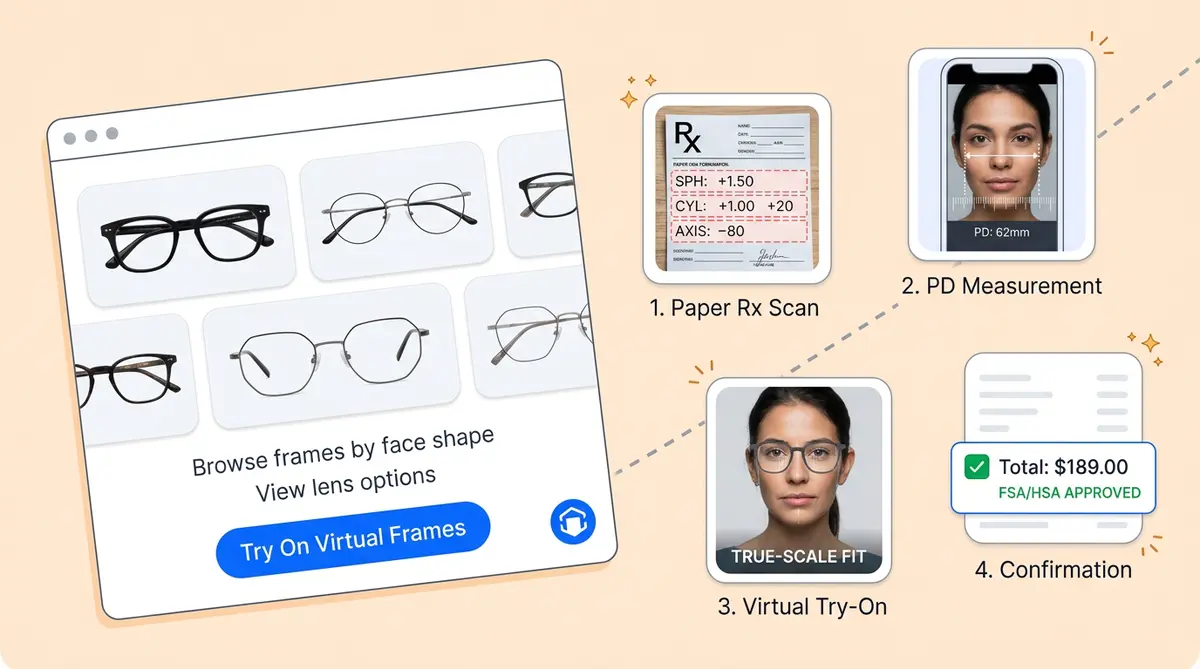
Modern AI tools attack this problem from multiple angles. Prescription scanning lets customers photograph their written Rx and have AI extract the values automatically. Zenni Optical's Prescription Scan feature, for example, eliminates manual entry by reading prescription details from an uploaded image. AI shopping assistants can walk customers through each field in plain language, validate entries against common ranges, and flag potential errors before they result in a wrong order.
Pupillary distance measurement is another area where AI has made real progress. Apps using LiDAR and TrueDepth sensors on newer iPhones now achieve accuracy within 1mm in over 92% of tests. The ANSI Z80.1-2025 standard now formally recognizes digital measurement systems for ophthalmic dispensing, a major validation milestone.
There's an important caveat: progressive lenses and multifocal vision correction still need more precise measurements (segment height and fitting cross) that phone cameras handle less reliably. A good AI chatbot will recognize when a customer's prescription calls for progressives and recommend an in-person fitting for those specific measurements, rather than guessing.
Frame Fit AI: Matching Faces to Frames Without a Mirror
Similar to how AI fit analyzers outperform size charts in apparel, frame fit AI is transforming how eyewear retailers match customers to the right frames without an in-store visit.
Frame fit is the second major barrier. Customers can't touch, bend, or try on frames through a screen. They don't know if a frame is too wide for their face, too heavy on their nose bridge with poorly fitted nose pads, or the wrong shape for their jawline. When the glasses arrive and don't fit, they go back. Eyewear return rates can spike to 50% without fit solutions, per Luna Solutions.
AI-Powered Frame Recommendations
FrameFit AI uses facial analysis to solve this. By scanning a customer's face through their phone or webcam, AI maps jawline shape, cheekbone width, eye spacing, nose bridge dimensions, and forehead proportions. It then matches these measurements against frame specifications to recommend styles that will actually fit.
GlassesUSA's Pairfect Match tool is one of the best-documented examples. It scans facial features in under a minute, combines the results with a style preference quiz, and curates 10 personalized frame matches based on pupillary distance and face shape. The impact: 21% conversion lift, 12% fewer fit-related returns, and 3x higher conversion among quiz completers, according to Digital Commerce 360. Over half of the users were first-time buyers.
India's Lenskart takes it further with an AI system that layers face shape analysis, skin tone matching, browsing history, purchase patterns, and real-time inventory data across 3,000+ stores. The system generates curated recommendations in under 10 seconds and syncs customer profiles across app, website, and physical locations.
Where an Eyewear Chatbot Adds Value
Not every customer wants to upload a selfie. An eyewear chatbot can ask a few targeted questions about face shape, frame preferences, and intended use (daily wear, sports, reading) and narrow down options without requiring a camera. This conversational approach works especially well for customers shopping on desktop or those uncomfortable with facial scanning. For brands selling on Shopify or WooCommerce, an AI assistant plugged into the product catalog can filter hundreds of SKUs down to five or six strong matches in seconds.
Virtual Try-On AI: Seeing Before Buying
This is why vertical-specific AI shopping experiences outperform generic chatbots in categories like eyewear, where product knowledge is everything.
The virtual try-on market reached $7.25 billion in 2025 and is growing at over 15% annually. About 35% of global eyewear retailers have already adopted the technology. The data behind virtual try-on is hard to ignore:
- 18% higher conversion rates (McKinsey, 2024)
- 22% reduction in cart abandonment for stores offering virtual fitting
- 28% decrease in product returns (Deloitte, 2024)
- Nearly 40% fewer returns on AR-assisted purchases overall
Warby Parker's virtual try-on uses AI-driven facial recognition to map PD and face shape from a smartphone camera, delivering true-to-scale frame previews on the phone display. The company's e-commerce sales grew 15% in 2024, driven partly by this technology. In May 2025, Warby Parker added an AI-based Advisor tool that combines virtual try-on with personalized style suggestions.
For optical e-commerce brands without the engineering budget of a Warby Parker, third-party solutions from Fittingbox, Banuba, and GlamAR offer plug-and-play virtual try-on widgets that display frames on any face in real time. The key is integrating these tools with an AI shopping assistant that can guide customers to use the try-on feature at the right moment in the purchase journey, not just bury it on a product page. The easier it is to see how frames look before you wear them, the more likely the sale.
The Lens Option Maze: Where Shoppers Get Overwhelmed
Even after a customer finds the right frame, they face a wall of lens choices: single vision or progressive, standard or high-index material, anti-reflective coating, blue light filtering, Transitions lenses for photochromic tinting, and scratch resistance. Each option adds cost and complexity. Many shoppers either pick the cheapest option (and end up unhappy) or abandon the cart entirely.
An optical e-commerce AI assistant can turn this decision tree into a conversation. By asking about the customer's daily routine, screen time, outdoor activities, and reading habits, the AI recommends a specific lens configuration with clear explanations. "You mentioned working at a computer 8+ hours a day, so I'd recommend adding blue light filtering and anti-reflective coating. Together they'll reduce eye strain and cut glare from your screen. If you spend time outdoors too, Transitions lenses auto-adapt to light conditions."
This consultative approach mirrors what a good optician does in-store. The difference is that an AI assistant handles it at scale, 24/7, across every channel. And because it's grounded in the store's actual product data and pricing, it won't recommend options that aren't available or quote the wrong price for a pair of glasses.
Insurance, FSA, and HSA: The Hidden Conversion Blocker
Vision insurance and vision benefits add another layer of complexity to eyewear purchases. Customers want to know: Does my plan cover this? Can I use my FSA or HSA? How much will I actually pay out of pocket? These questions stall purchases, especially for higher-priced orders.
EyeBuyDirect started accepting vision insurance directly online in December 2025, a sign of where the vision correction industry is heading. An AI chatbot can help customers determine what's covered, explain eligible FSA/HSA expenses (prescription lenses qualify; extended warranties typically don't), calculate remaining benefits, and flag end-of-year deadlines when funds expire. For 2025, FSA limits sit at $3,300 and HSA limits at $4,300 for individuals.
This is exactly the kind of customer-specific guidance where conversational AI outperforms static FAQ pages. A customer asking, "Can I use my HSA for progressive lenses with blue light coating?" gets a direct answer instead of scrolling through a 2,000-word insurance explainer.
How Alhena AI Supports Eyewear and Optical Brands
Alhena AI is purpose-built for e-commerce verticals where product complexity drives cart abandonment and returns. Eyewear is a textbook fit. Here's what the platform brings to optical retailers:
Across all verticals, 329 brands are already using AI to sell, and eyewear is one of the fastest-growing segments.
Guided product discovery. Alhena's Product Expert Agent connects directly to your eyewear catalog and walks customers through frame selection based on their face shape preferences, style, budget, and prescription needs. It filters hundreds of SKUs to a short list of strong pair matches, the same way a skilled optician would in a brick-and-mortar store.
Prescription and lens guidance. The AI handles complex questions about single vision and progressive lenses, coatings, and lens materials without hallucinating. Because Alhena is grounded in your verified product data, it only recommends options you actually carry and quotes accurate prices. When a customer's Rx calls for progressives, the AI can flag that an in-person PD measurement may be needed, reducing error rates.
Order management for custom lenses. Prescription eyewear has longer fulfillment times (7 to 14 days for custom lenses, longer for progressives). Alhena's Order Management Agent provides proactive status updates, explains the manufacturing process, and handles modification requests, all without involving your support team.
Omnichannel reach. Eyewear shoppers browse across the web, social media, and mobile. Alhena works across Instagram DMs, WhatsApp, email, web chat, and voice, so a customer who starts a frame search on Instagram can pick up the conversation on your website without repeating themselves.
Revenue attribution. Alhena tracks every AI-assisted interaction through to purchase, so you can see exactly how many sales and checkout completions your AI assistant influenced. Brands like Tatcha have seen 3x conversion rates and 11.4% of total site revenue attributed to AI-assisted conversations. Victoria Beckham recorded a 20% AOV increase.
Fast deployment. Alhena deploys in under 48 hours with no dev resources required. It integrates with Shopify, WooCommerce, Salesforce Commerce Cloud, and helpdesks like Zendesk, Gorgias, and Intercom.
Selling Smart Glasses: What Optical Retailers Need to Know
The eyewear industry isn't just going digital on the sales side. Smart glasses from Meta, in partnership with Ray-Ban and Oakley, are turning eyewear into wearable AI devices. Ray-Ban Meta AI glasses are the best-selling AI glasses on the market. Ray-Ban Meta glasses and the newer Oakley models pack cameras, speakers, and Meta AI assistants into frames that look like a regular pair of sunglasses. Meta glasses and these AR glasses use waveguide display technology to project a heads-up display directly into the wearer's field of view. These display glasses represent the fastest-growing segment in optical e-commerce.
For optical e-commerce retailers, this creates a new category to sell and support. Smart glasses come with charging cases, display glasses need different care instructions, and customers have questions about compatibility with corrective lenses and vision correction prescriptions. A next-gen AI shopping assistant needs to handle all of this: explaining the difference between standard prescription lenses and smart glasses with prescription, walking customers through display and waveguide specs with Meta AI-level detail, and clarifying what vision insurance covers for wearable eyewear versus single vision corrective lenses.
The smart glasses market is projected to exceed $30 billion by 2030, according to Business of Fashion. As Meta, Meta AI, Oakley, and other platforms push deeper into eyewear, optical ecommerce companies that pair strong product data with AI-powered shopping assistance will capture this growing segment. Whether a customer is shopping for corrective lenses, Transitions lenses, or the latest AR glasses with a charging case, the AI needs to guide them through every option with the same level of expertise.
Key Takeaways
- Prescription entry is the #1 drop-off point in online eyewear. AI scanning and guided entry reduce errors and abandonment.
- Frame fit AI drives measurable results: 21% conversion lift and 12% fewer returns at GlassesUSA.
- Virtual try-on is no longer optional. It cuts cart abandonment by 22% and returns by 28%.
- Lens option overload is a silent conversion killer. Conversational AI turns a confusing decision tree into a simple Q&A.
- Insurance and FSA/HSA questions stall high-value purchases. AI handles them instantly.
- Alhena AI brings all of this together: product guidance, prescription support, order management, and omnichannel reach, deployed in under 48 hours.
The online eyewear market is growing fast, but most retailers are losing the majority of their visitors to friction that AI can solve today. Whether you're selling $7 frames or $500 designer eyewear, an AI shopping assistant built for optical ecommerce can close the gap between browsing and buying.
Ready to see how AI fits into your eyewear store? Book a demo with Alhena AI or start for free with 25 conversations.