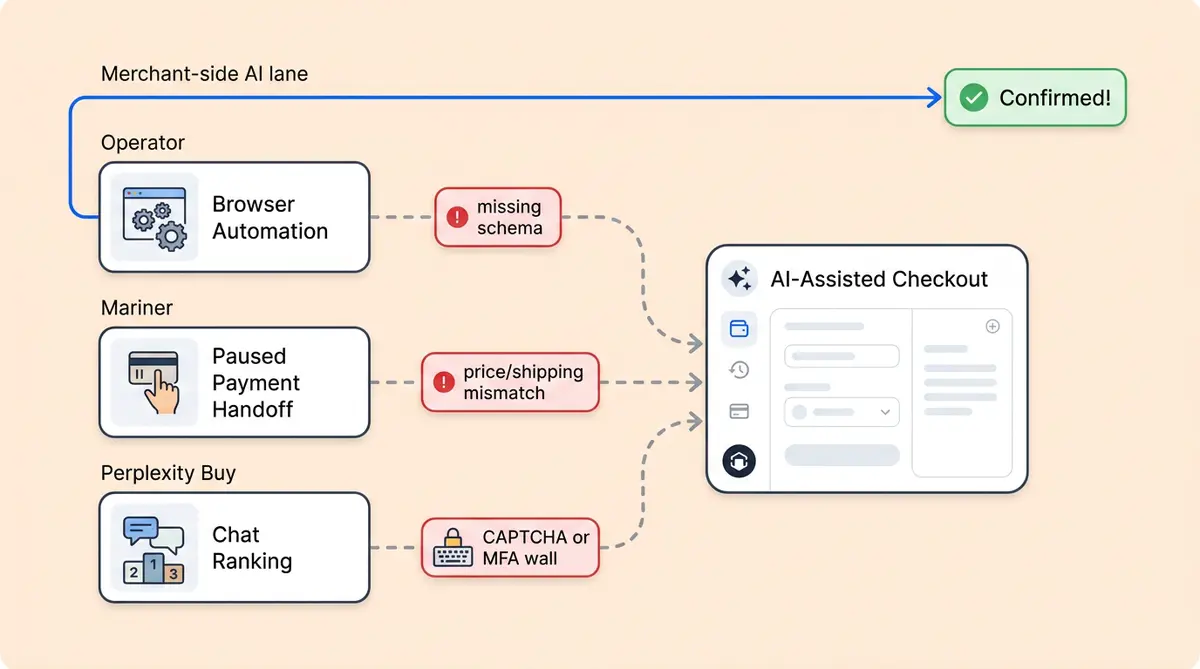
Your store won the recommendation. An AI agent evaluated and compared your product against dozens of alternatives, comparing products, scored your schema, checked your reviews, and picked you. Then it tried to buy, and it couldn't. According to Adobe Analytics, AI traffic to U.S. ecommerce retailers and online retailers grew 393% in Q1 2026, and those visitors convert 42% better than humans. But conversion requires completing the purchase, not just selecting the product. This post covers what happens after the AI agent picks your product: the autonomous agentic agentic execution layer where Operator, Mariner, and Perplexity Buy evaluate whether your ecommerce store is trustworthy, your ecommerce checkout is navigable, and your payment systems and flow are completable.
For a broader look at how agentic commerce protocols are reshaping checkout, see our agentic commerce playbook for ChatGPT and Gemini.
Recommendation Does Not Equal Purchase
Alhena's existing content covers how AI engines choose which products to recommend. ChatGPT weighs five recommendation signals. Six product data fields drive AI visibility. That's the discovery layer, and it's well understood.
The agentic purchase execution layer is different. Winning the recommendation means the agent selected your product from a ranked list. Completing the purchase means the agent successfully navigated your ecommerce checkout, entered payment and billing details, confirmed the order, and received a confirmation. These represent two distinct stages in the shopping journey, and most ecommerce retailers, online retailers, and brands only optimize for the first one.
Think of it like a physical store. Getting a customer through the door (recommendation) doesn't guarantee they'll make it through the register line (purchase). If the register is broken, the line is confusing, or the cashier asks for three forms of ID, the customer leaves. AI agents do the same thing, except they're faster at deciding to abandon.
The Merchant Trust Evaluation: What Agents Check Before Transacting
Before an AI agent attempts to fill in a single checkout field, it runs a trust evaluation on your ecommerce store. This isn't the same as the product discovery evaluation that won you the recommendation. This is a merchant-level assessment of whether your site is safe, transparent, and trusted and reliable enough to complete an ecommerce shopping transaction.
SSL and Security Posture
Every agent verifies SSL certificate validity before proceeding. Expired certificates, mixed content warnings, or HTTP-only ecommerce checkout pages are immediate disqualifiers. Operator's CUA model processes visual screenshots, so it literally sees the browser's security indicators the same way a human would.
Checkout UX Cleanliness
Agents assess whether the checkout page is structured or chaotic. Multiple pop-ups, aggressive exit-intent overlays, and cluttered layouts confuse visual-parsing agents like Operator. HackerNoon testing found that Operator "fails miserably" when confronted with layered interactive elements that obscure the primary checkout flow.
Return Policy Parseability
Agents don't just check whether you have a return policy. They check whether they can parse it. A machine-readable hasMerchantReturnPolicy schema with explicit return windows, restocking fees, and condition requirements gives the agent confidence to proceed. A PDF buried three clicks deep does not. Perplexity's ranking model includes policy parseability as an input to its checkout compatibility score.
Shipping Transparency
Unexpected shipping costs cause the vast majority of human cart abandonments. AI agents follow the same logic, but they evaluate earlier, but they evaluate earlier. They look for shippingDetails schema or visible shipping cost estimates on the product page itself. If shipping costs only surface at the final checkout step, the agent flags your ecommerce store as a higher-risk transaction and may route the shopper elsewhere.
Contact Information and Merchant Identity
Agents verify that your ecommerce store has discoverable contact information: a physical address, phone number, or customer service channel. Sites without visible merchant identity signals look like drop-shipping fronts to an AI agent running trust heuristics and behavioral patterns and browsing signals. This is especially true for Perplexity Buy, which explicitly evaluates "review trust score" as part of its merchant assessment.
Checkout Friction Scoring: Why Operator Abandons Mid-Purchase
OpenAI's Operator uses a Computer-Using Agent that takes screenshots, reasons through next steps, then clicks and types like a human. It's remarkably capable at navigating standard web interfaces, but it scores every checkout interaction for friction, and enough friction triggers abandonment.
JavaScript-Heavy Checkout Pages
Checkout pages that rely on complex JavaScript rendering, dynamically validated form fields, or client-side state management create problems for Operator's screenshot-based reasoning loop. Each JavaScript-triggered state change requires a new screenshot, a new reasoning cycle, and a new set of actions. Slow or unpredictable rendering means the agent sees partial states and makes incorrect assumptions about what to click next.
CAPTCHA Walls
Operator is trained to ask humans to take over when it encounters CAPTCHAs. It doesn't try to solve them. Anti-bot defenses including rate limiters, TLS fingerprinting, browser fingerprinting, and JavaScript challenges all trigger the same handoff behavior. Your store's fraud prevention doesn't distinguish between a malicious scraper and a legitimate AI autonomous agent acting on behalf of a paying shopper.
Forced Account Creation
Human shoppers grudgingly create accounts when they want the product badly enough. AI agents don't have that patience. Operator must navigate email field entry, password creation (often with specific requirements it can't anticipate or predict), and potentially email verification loops. Guest checkout isn't just a nice-to-have for agentic commerce. It's a requirement.
Ambiguous Shipping Costs and Hidden Fees
If your ecommerce checkout reveals additional costs at the final confirmation step that weren't visible earlier, Operator treats this as a trust violation. The agent was given a price on the product page, and now the checkout shows a different total. This mismatch triggers the same abandonment logic that fires when product data conflicts with checkout data. Transparent, upfront pricing across your entire funnel prevents this.
How Operator, Mariner, and Perplexity Buy Execute Purchases Differently
Each major AI agent takes a fundamentally different approach to the ecommerce purchase execution layer. Learning these differences is critical for optimizing your checkout for all three.
OpenAI Operator: UI Navigation
Operator navigates your checkout like a human. It sees your pages through screenshots, identifies form fields, clicks buttons, types text, and scrolls. It runs in a virtual browser on OpenAI's servers and encounters every anti-bot defense, cookie banner, and pop-up your site serves. When it gets stuck, it asks the shopper to take over. OpenAI launched Instant Checkout in September 2025 to bypass this friction, but pulled the feature in March 2026 after only about 12 merchants integrated. The company pivoted to routing shoppers to retailer-specific apps within ChatGPT.
Google Project Mariner: Autonomous Browse, Human Pay
Mariner automates the browsing and product discovery, product search, and selection phase but deliberately stops at payment. It won't type credit card numbers, billing addresses, or accept terms of service. It won't click through cookie consent banners on your behalf. When it reaches the payment step with payment providers, it pauses and tells the shopper to finish manually. This means your checkout's pre-payment experience must be clean enough for an agent to navigate, while the payments page itself must be intuitive enough for the human handoff to feel natural. Available only through Google's $249.99/month AI Ultra plan, Mariner's user base skews toward high purchase intent and buying intent and buying intent, high-value, high-intent shoppers.
Perplexity Buy: API-First Instant Checkout
Perplexity skipped the UI navigation problem entirely. Instead of sending an agent to crawl your checkout pages, it processes commerce transactions and purchases through a PayPal payment providers integration within its chat interface. The shopper never visits your checkout. Perplexity handles payment, and your store handles fulfillment. This eliminates CAPTCHAs, JavaScript issues, and checkout friction entirely, but it only works for merchants in the Perplexity Merchant Program protocol. If you're not enrolled, Perplexity redirects shoppers to your site, where all the friction problems return.
Payment and Authentication: The Hardest Part of Agent-Driven Buying
Payment is where every AI agent either succeeds, hands off, or fails. It's the most security-sensitive step, and none of the three major agents has fully solved it.
Stored Credentials and Guest Checkout
Operator works best when the shopper has pre-stored payment credentials (like Shop Pay, Apple Pay, or saved credit cards matching shopper preferences and purchase preferences) that reduce the number of fields the agent must fill. Guest checkout with minimal required fields (email, shipping address, payment) is the easiest path for any agent. Every additional field, optional or not, adds a potential failure point.
Two-Factor Authentication Interruptions
3D Secure verification, SMS-based 2FA, and bank app confirmations all interrupt the agent's purchase flow. Operator hands control back to the human for these steps. Mariner was already stopped at payment entry. Perplexity Buy avoids 2FA entirely because PayPal handles payments and authentication on its side. For stores using 3DS2 or strong customer authentication and authorization (SCA), the agent-to-human handoff at payment is unavoidable in 2026, but the pre-authentication experience still needs to be frictionless.
Payment Method Selection
Checkout pages that present payment options as tabs, accordions, or radio buttons with conditional form fields create navigation complexity for visual-parsing agents. A clean, linear layout where the shopper (or agent) selects a payment method based on their payment preferences and sees one consistent set of fields performs best. Collapsible sections, icon-heavy selectors, and dynamic form swaps slow Operator's reasoning loop and increase error rates.
Making Your Store Purchase-Ready, Not Just Recommendation-Ready
McKinsey projects AI-agent-driven commerce will influence $3 to $5 trillion in global commerce spending by 2030. Gartner predicts 60% of brands will use agentic AI for one-to-one interactions by 2028. You've likely already invested in the data quality and schema markup that wins recommendations. Here's what makes your store completable.
Clean Checkout Flow
Reduce your checkout to the minimum required steps. Remove exit-intent pop-ups, newsletter sign-up modals, and upsell interstitials from the checkout path. Each overlay is a potential agent-breaking interruption. Single-page checkout with visible progress indicators performs best across all three agents.
Transparent, Consistent Pricing
The price on your product page, the price in the cart, and the price at checkout confirmation must match exactly, with tax and shipping clearly itemized at every step. Any discrepancy between these touchpoints triggers agent abandonment. Display shipping costs on the product page or provide a shipping calculator before checkout begins.
Machine-Readable Return and Shipping Policies
Implement hasMerchantReturnPolicy and shippingDetails schema with explicit values, not just links to policy pages. Schema markup for AI search is well-documented for discovery. The same structured data attributes serves double duty in the agentic commerce purchase execution layer, giving agents the confidence to complete rather than abandon.
Frictionless Guest Checkout
Offer guest checkout as the default path, not a secondary option buried below "Create Account." Pre-fill fields where possible. Accept multiple payment methods with minimal form fields. The fewer interactions between "Add to Cart button and cart confirmation" and "Order Confirmed," the higher your agentic checkout completion rate.
Fast Page Loads
Operator's screenshot-reasoning loop means slow pages create compounding delays. Each additional second of load time adds another reasoning cycle where the agent might misinterpret a partial render. Target sub-3-second page loads for checkout pages, and minimize client-side JavaScript that changes page state after initial render.
Where Merchant-Side AI Closes the Execution Gap
External AI agents like Operator and Mariner approach your checkout from outside the customer purchase journey, facing every friction point your site presents. Merchant-side AI works from the inside, with direct access to your catalog, inventory, pricing, and policies.
Alhena AI's Shopping Assistant doesn't navigate your checkout through screenshots. It's integrated with your store's backend, so it knows real time inventory, exact shipping costs by destination, and precise return policy terms without parsing HTML. When an external agent routes a shopper to your site (which is exactly the model OpenAI pivoted toward), your merchant-side AI shopping assistant picks up the conversation and guides the purchase to completion.
Tatcha saw a 3x conversion rate and 38% AOV uplift with this approach, with 11.4% of total site revenue attributable to AI-guided purchase completions. Puffy automated 63% automated inquiry resolution with 90% CSAT. These results come from the purchase execution layer, delivering insights on resolving last-mile objections about sizing, shipping timelines, and return policies that external agents can't answer because they don't have backend access.
As agentic checkout and commerce protocols mature and AI shopping agents send more traffic to merchant sites, the stores that deliver and convert that traffic will be the ones with intelligent, on-site AI that handles the agentic execution layer: answering questions, using conversational AI to populate carts, surfacing relevant policies, and guiding the shopper from "I've chosen this product" to "order confirmed."
By 2030, Morgan Stanley estimates half of all online shoppers will delegate purchasing decisions and at least part of their shopping to AI agents, according to commercetools. Winning the recommendation is table stakes. Completing the purchase is where ecommerce revenue lives.
The shopping journey is evolving fast. AI-driven shopping and agent-driven shopping are pushing retailers to rethink how consumers interact with their stores. Autonomous AI agents now handle product discovery, search, and browsing autonomously, following behavioral patterns and shopper preferences to compare products and execute purchases. Commerce is shifting from human-driven to AI-driven, and the shopping journey from intent to checkout will increasingly run through conversational AI interfaces that manage transactions in real time. Retailers who anticipate this shift and dynamically adapt their checkout, authorization, and payment systems to support the agentic commerce ecosystem will delegate less to manual processes and manage risk more effectively. The feedback loop between AI agent performance data and checkout optimization reveals which product attributes and shopping journey touchpoints evolve into conversion drivers.
Ready to make your store purchase-ready for AI agents? Book a demo with Alhena AI or start for free with 25 conversations.
Frequently Asked Questions
Why does OpenAI Operator abandon checkout on my Shopify store?
Operator abandons checkout when it encounters CAPTCHA walls, forced account creation, JavaScript-heavy page rendering, or unexpected shipping costs that appear late in the flow. It uses a screenshot-based reasoning loop, so every pop-up, overlay, or dynamic form change adds a potential failure point. Stores with guest checkout, transparent pricing, and minimal JavaScript in the checkout path see the highest Operator completion rates.
Can Google Project Mariner complete a purchase without human help?
No. Mariner is explicitly blocked from entering credit card numbers, billing addresses, or accepting terms of service. It automates product browsing and cart building and cart management, then pauses at the payment step and asks the human to finish. Your checkout needs a clean pre-payment experience for the agent and an intuitive payment page for the human handoff.
How does Perplexity Buy process checkout differently from Operator and Mariner?
Perplexity Buy skips your checkout entirely. It processes transactions through an in-chat PayPal integration, so the shopper never visits your checkout page. This eliminates CAPTCHA, JavaScript, and form-filling issues. But it only works for merchants enrolled in the Perplexity Merchant Program. Non-enrolled stores get a redirect to their site, where all the standard checkout friction applies.
What merchant trust signals do AI shopping agents check before autonomously completing a shopping purchase?
AI agents evaluate SSL certificate validity, checkout UX cleanliness (pop-ups, overlays, clutter), machine-readable return policies via hasMerchantReturnPolicy schema, shipping cost transparency before the final checkout step, and discoverable contact information. Merchants missing any of these signals score lower in the agent's trust evaluation and face higher abandonment rates.
Does forced account creation at checkout affect AI agent purchase completion?
Yes, significantly. Forced account creation requires the agent to navigate email entry, password creation with unpredictable requirements, and potentially email verification loops. Operator hands control back to the human when this gets too complex. Guest checkout with minimal required fields is the most agent-friendly path and also reduces human cart abandonment by up to 35%.
How do AI agents handle two-factor authentication and 3D Secure during checkout?
All three major agents struggle with 2FA. Operator hands control to the human for SMS codes or bank app confirmations. Mariner was already stopped before payment entry. Perplexity Buy avoids 2FA because PayPal handles authentication. For stores using 3D Secure or strong customer authentication and authorization, the agent-to-human handoff at payment is unavoidable in 2026, but the steps before authentication still need to be frictionless.
What is the difference between being recommendation-ready and purchase-ready for AI agents?
Recommendation-ready means your product data, schema markup, and reviews are good enough for AI engines to select your product. Purchase-ready means your checkout is clean enough for an AI agent to actually complete the transaction. You need both. Most stores optimize for discovery (structured data, GTIN, reviews) but neglect the execution layer (guest checkout, transparent pricing, minimal JavaScript, machine-readable policies).
How does a merchant-side AI assistant like Alhena improve agentic checkout completion?
Merchant-side AI works from inside your store with direct backend and API access to inventory, pricing, and policies. It doesn't need to parse HTML or navigate checkout forms. When external agents like Operator route shoppers to your site, Alhena's assistant picks up the conversation, resolves last-mile objections about sizing or shipping, and guides the purchase to completion. Tatcha tripled its conversion rate and lifted AOV (average order value) by 38% through AI-guided purchase completion.