A February 2026 Gartner survey found that 91% of customer service leaders face executive pressure to adopt AI this year. For e-commerce teams still running Zoho Desk, that stat highlights a real gap. Zia, Zoho's AI assistant, sits behind the $40/agent/month Enterprise plan—and even then, its e-commerce capabilities remain shallow. If your customer service software can't auto tag tickets, analyze customer sentiment, or pull order data without third-party workarounds, it's time to explore alternatives.
This guide covers seven Zoho Desk alternatives that deliver stronger AI, smarter automation, and deeper commerce integrations for 2026.
Why E-Commerce Brands Outgrow Zoho Desk
Zoho Desk starts at an attractive $7/agent/month, but e-commerce brands hit ceilings fast. The biggest frustration: generative AI is gated. Zia's sentiment analysis, answer bot, auto tag, and field predictions all require the Enterprise tier. A 10-agent team pays $400/month just to access AI features that competitors include on lower plans.
E-commerce brands also need native order management inside their help desk. Zoho Desk's Shopify integration covers basic ticket creation, but it can't process refunds, browse your product catalog, or pull real-time inventory data without tools like ChannelReply. That means more context switching, slower resolution times, and agents toggling between tabs to resolve a simple "where is my order?" inquiry.
Other common pain points include a cluttered interface that reviewers call overwhelming, reporting locked behind higher tiers, and a knowledge base that can't learn from content stored in Google Docs, Confluence, or Slack. When your incoming ticket volume spikes during peak season, these limitations compound.
7 Best Zoho Desk AI Alternatives for E-commerce
1. Alhena AI
Alhena AI is an AI-native e-commerce platform that treats every customer interaction as a revenue opportunity. Unlike Zia, Alhena includes generative AI on every tier, including a free plan.
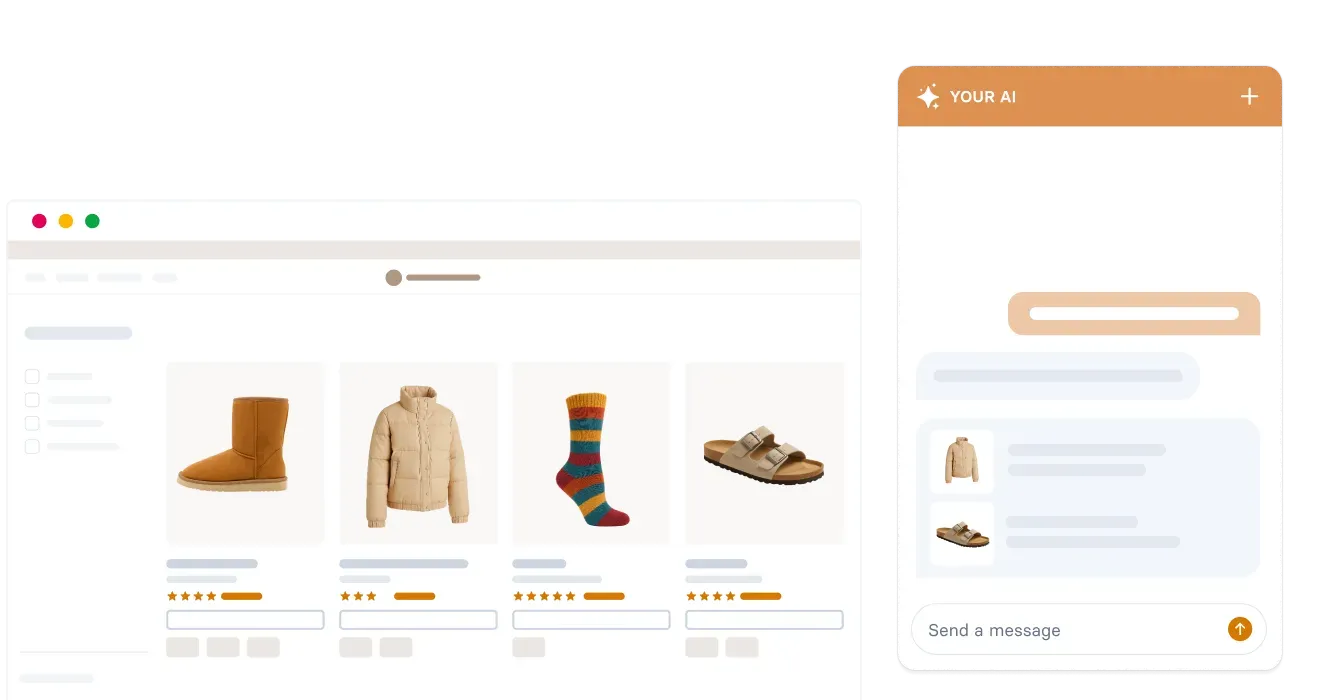
The platform runs five core products. The AI Shopping Assistant replaces static filters with conversational search, guided product discovery, personalized recommendations, Smart Nudges that detect checkout hesitation, and agentic checkout that populates carts and applies discounts directly in chat. The AI Support Concierge automates 80%+ of incoming tickets, WISMO, returns, refunds, exchanges, instantly, 24/7, with less than 3% reopen rates and seamless escalation to human agents with full context.
Agent Assist gives your existing team AI-drafted reply suggestions and real-time product data for 2x faster resolutions, plugging directly into Zendesk, Freshdesk, Gorgias, or Kustomer. AI Social Commerce extends shopping and support to Instagram DMs, WhatsApp, and Messenger, shoppers browse, get sizing help, and check out without leaving the platform. The newest product, AI Visibility, tracks how your products appear across ChatGPT, Gemini, and Perplexity at the SKU level, with an AEO FAQ Engine that identifies missing content aligned with real shopper queries.
Every response is grounded in verified product data through a zero-hallucination architecture. The AI uses NLP to analyze customer sentiment and context, learns from your knowledge base, catalog, and past conversations, and supports 90+ languages. Vertical AI agents are pre-built for fashion (Fit Analyzer, Outfit Builder), beauty (Skin Analyzer, Shade Finder), jewelry, and wellness. Revenue analytics track conversion attribution, AOV impact, and AI vs. human performance by channel. Deploys in under 48 hours, no dev resources needed.
Results: Tatcha: 3x conversions, 38% AOV uplift, 11.4% revenue from AI. Victoria Beckham: 20% AOV increase. Manawa: response time from 40 min to 1 min. Puffy: 63% auto-resolution, 90% CSAT. Crocus: 86% deflection, 84% CSAT.
Pricing: Free tier (25 conversations). Usage-based per conversation, not per agent. See pricing.
Best for: E-commerce brands that want AI to drive revenue, automate support, and personalize every interaction across every channel.
2. Zendesk AI
Zendesk remains the go-to for enterprise teams needing 1,500+ integrations, HIPAA compliance, and mature reporting. Suite plans start at $55/agent/month, with an additional AI add-on for advanced automation and generative AI capabilities. The real cost often runs 2–3x the base price once you add workforce management and quality assurance modules.
For e-commerce, Zendesk works but requires significant configuration. It wasn't built for order lifecycle management, so you'll need marketplace apps to streamline returns or pull order data into tickets. For a detailed breakdown, read our AI customer service guide.
Pricing: $55–$169+/agent/month. AI add-on extra.
Best for: Enterprise brands (50+ agents) prioritizing scalability and compliance.
3. Freshdesk Freddy AI
Freshdesk offers a free tier for up to 2 agents, with paid plans from $15/agent/month. The interface is more intuitive than Zoho Desk's, and basic workflow automation works well out of the box.
The catch: Freshdesk's AI chatbot, Freddy, charges per session ($100–$1,000 per 1,000 sessions), and unused sessions don't roll over. E-commerce integrations aren't native, and its self-service bot relies heavily on your knowledge base quality. Our Freshdesk Freddy AI alternatives guide covers what dedicated AI can handle that basic automation can't.
Pricing: Free for 2 agents. $15–$79/agent/month.
Best for: SMB e-commerce brands looking for affordable ticketing with room to grow.
4. Gorgias AI
Gorgias delivers the deepest Shopify integration of any help desk. Agents can browse catalogs, tag tickets by issue type, view inventory, and process refunds without leaving the app. Ticket-based pricing starts at $10/month for 50 tickets, which aligns with actual usage.
The downside: Gorgias's AI agent is double-billed at roughly $0.90–$1.00 per conversational AI resolution on top of your ticket cost. During Black Friday, that adds up fast. The integration ecosystem is also limited to around 100 apps.
Pricing: $10–$900/month (ticket-based). AI costs extra.
Best for: Shopify-first DTC brands with 300–5,000 monthly tickets.
5. HappyFox
HappyFox is a solid customer service software option for teams that want a clean, intuitive interface without the complexity of enterprise platforms. It consolidates incoming requests from email, web forms, chat, and social channels into a single dashboard, and its smart rules deliver reliable ticket assignment and workflow automation.
HappyFox's AI capabilities come through its Assist AI add-on ($1–$4/user/month), which can summarize ticket threads, draft reply suggestions, and predict ticket priority. The platform also offers a built-in knowledge base for self-service, helping resolve issues before they become tickets.
The trade-off: AI features are add-ons with separate pricing, the bot ecosystem isn't e-commerce-specific, and advanced reporting requires higher-tier plans. HappyFox works well for general support operations but lacks native order management or product catalog integration.
Pricing: From $9/agent/month. AI add-on extra.
Best for: Mid-size teams wanting an intuitive, multi-channel help desk with solid automation.
6. Intercom Fin AI
Intercom's Fin AI agent is included at every tier and charges $0.99 per successful resolution—you only pay when AI actually solves the problem. Proactive messaging and onboarding flows are best-in-class, and the conversational approach personalizes every customer interaction.
The trade-off: Intercom wasn't designed for e-commerce. Shopify integration is weak, and there's no native order or returns management. At scale, 2,000 AI resolutions per month adds $1,980 to your bill. For more context, see our Intercom alternatives comparison.
Pricing: $29–$139/seat/month. Fin AI at $0.99/resolution.
Best for: Tech-forward brands with high-value customers.
7. Help Scout
Help Scout takes a refreshingly simple approach: unlimited users on every plan, usage-based pricing, and AI tools included even on the free tier. The interface feels like email, making it instant for new agents to get started. Its "Fair Billing Policy" averages your contact volume over three months to smooth out seasonal spikes.
For e-commerce, Help Scout handles email-heavy support well but lacks native order management. It's a strong fit for small teams that want a clean help desk with a capable knowledge base and built-in AI, without the complexity.
Pricing: Free tier available. Paid from $50/month.
Best for: Small teams (under 10) that value simplicity over deep commerce automation.
How to Choose the Right Zoho Desk AI Alternative
The right pick depends on your stack, team size, and what you need from your service operations. If you're running Shopify and want native commerce features, Gorgias fits. If compliance is non-negotiable for your enterprise, Zendesk works. If you need an intuitive, affordable starting point, Freshdesk or HappyFox will do. If you want multi-channel ticketing with ChatGPT-era AI, Help Scout or Intercom are worth evaluating.
But if your goal is to turn support from a cost center into a revenue driver, with an AI agent that guides shoppers, handles orders, and tracks its own contribution to sales, Alhena AI is the clear choice. Brands like Crocus (86% deflection, 84% CSAT) and Puffy (63% automated resolution, 90% CSAT) prove that AI-first support doesn't sacrifice customer satisfaction.
Use the ROI Calculator to estimate what Alhena could save your team before switching.
Key Takeaways
Zoho Desk's Zia requires the $40/agent/month Enterprise plan, making generative AI expensive for teams that need automation and accurate responses. E-commerce brands need native order management inside their customer service software, not third-party workarounds. Usage-based pricing (Alhena AI, Help Scout, Gorgias) often costs less than per-agent models for growing teams. Alhena AI is the only alternative that treats support as a sales channel, with revenue attribution, agentic checkout, and zero-hallucination AI. With 91% of service leaders under pressure to adopt AI in 2026, any alternative you choose should deliver robust AI capabilities from day one.
Ready to see how AI-driven support can grow your revenue? Book a demo with Alhena AI or start free with 25 conversations.