Deflection rate measures the percentage of customer support tickets resolved by self-service tools, like AI chatbots and knowledge bases, without ever reaching a human agent. Brands using Alhena AI regularly hit 80%+ deflection rates while keeping CSAT above 84%. Below you'll find the deflection rate formula, industry benchmarks, and five proven ways to improve yours.
Self-service is a powerful tool to improve customer service. Are you taking full advantage of it?
Whether it’s a convenient and powerful AI chatbot or a knowledge base with helpful content, self-service options have evolved to include a variety of useful tools.
If you’re already taking advantage of self-service options, the next step is tracking and measurement.
That’s where deflection rate comes in, which allows you to tell how effective your self-service options are at deflecting support requests away from your support team.
So, what is deflection rate and how can you use it? Read on to learn more.
What Is Deflection Rate?
The deflection rate meaning refers to the percentage of all support issues that were successfully handled by self-service tools and not escalated to your customer support team.
(Hence, these requests were “deflected” by your self-service tools.)
The higher your deflection rate, the more support requests your self-service options can take off of your call center or CS team’s back and improve CS operating efficiency.
These self-service tools include:
- AI Chatbots
- Knowledge bases, tutorials, and other related content
- Community forums
- Portals
If your only or primary self-service tool before interacting with a live agent is a chatbot, then your deflection rate is the same as your chatbot deflection rate.
Knowing your deflection rate is incredibly valuable, as the more support requests your customers handle on their own, the fewer requests your team has to handle.
As a result, your team’s time is better optimized and they can focus more on escalations and more complex customer issues.
It’s important to note, however, that your deflection rate on its own is only a single metric with a limited perspective.
In particular, it’s important to know the difference between deflection rate and resolution rate.
Here are some questions to consider to make sure you’re effectively tracking the success of your self-service support:
- What do you define as a successful support request deflection?
- How are you measuring the number of requests deflected?
- How are you determining– and tracking– whether a deflected support request was resolved?
Deflection Rate Formula
Calculating deflection seems pretty straightforward, but there can be a few complexities.
Simple Example
To calculate deflection rate, divide the number of support requests resolved through self-service tools divided by the total number of all support requests received:
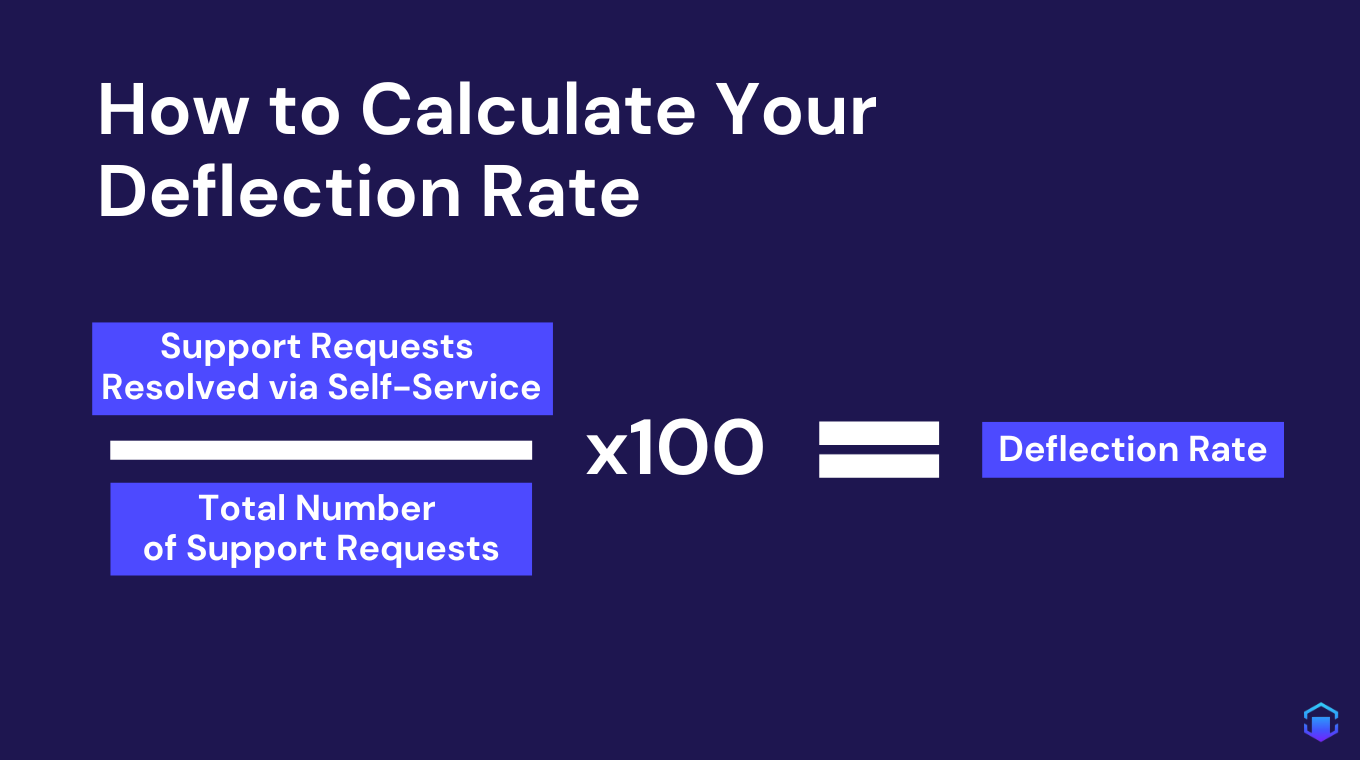
( [Support Requests Resolved via Self-Service] / [Total Number of Support Requests] ) x 100 = Deflection Rate
If we plugged in an example of:
- 100 total support requests
- 33 of those support requests were resolved via self-service
We’d end up with this:
( 33 / 100 ) x 100 = 33%
So, in this simple example, 33% of all support requests were successfully resolved via self-service tools.
Teasing Out Total Support Requests
When calculating Total Number of Support Requests, it's important to not calculate Total Support Requests as:
Total Support Requests = Self-Service Support Requests + Support Requests Handled by Customer Service Team
This equation double-counts customers who engage in self-service but then escalate to your customer service team.
But what if you only measure Self-Service Sessions and Support Requests Handled by CS Team?
To eliminate double-counting of these escalations, you need to estimate a self-service resolution rate, i.e., what percentage of self-service sessions don't result in an escalation to your CS team.
Self-Service Resolution Rate = [# of self-service sessions that are resolved] / [Total self-service sessions]
For example, a Self-Service Resolution Rate of 90% means that 10% of all self-service sessions result in an escalation to your CS team.
To eliminate the double-counting, Total Support Requests becomes:
Total Support Requests = Self-Service Support Requests x (Self-Service Resolution Rate) + Support Requests Handled by Customer Service Team
For a full example, let's assume, for a given month:
- Self-Service Sessions is 1,000 in a month
- The self-service resolution rate is 90%
- Support Requests handled by the CS team is 200
Total Support Requests = 1,000 x (90%) + 200 = 1,100
Deflection Rate = Resolved Self-Service Issues / Total Support Requests
= 900 / 1,100
= 81.8%
How to Improve Your Deflection Rate?
5 Key Tips
Improving your deflection rate is similar to asking "How can we improve our customer self-service options?"
There are fundamentally 4 key strategies to improving your deflection rate. They are:
Tip 1: Increase the amount of self-service content
The more self-service content you publish to your support knowledge base, the more likely it is that customers will be able to service themselves.
Related reading: pre-ticket deflection that Zendesk can't see.
The self-service content should cover common customer use cases, and those use cases shouldn't already be covered in existing content.
Tip 2: Improve the quality of your self-service content
Remember: when you deflect customers to self-serve, you want to do everything you can to help them resolve their issues (and increase the self-service resolution rate).
As such, you need to make sure your self-service content is as helpful as possible. For example:
- Include screeenshots or photos whenever possible.
- Include step-by-step instructions.
- Sometimes, customers only know the symptoms, but they don't know the root causes behind a problem. Give your customers the ability to self-diagnose root causes, as well as the ability to resolve those problems.
- Include videos if necessary.
Tip 3: Improve the accessibility of your self-service content
More content isn't always a good thing.
Too often, more content results in more links on a search results page and even more confusion for your customers.
When you add more self-serve content, you need to make sure that content is easily accessed.
To improve the accessibility of your self-service content, you can implement 2 different strategies, or both in combination:
- Manually improve the organization of your self-service content. This can include organizing your content into different folders or directories, or adding different tags to you self-serve content.
- Deploy a generative AI chatbot like Alhena AI to ingest all your self-service content. Generative AI chatbots are great at automatically "understanding" large bodies of self-service content. A generative AI chatbot will ingest all of your self-service content and, regardless of how that content is organized or tagged, it will recognize similar or related content.
Get a demo of Alhena AI, or create a free generative AI chatbot now.
Tip 4: Expand Your Self-Service Capabilities
Remember: self-service isn't just about reading content. Self-service often means allowing the customer to take actions on their own behalf.
For example, common customer issues might include actions like:
- Looking up the status of a delivery
- Changing the delivery address on an order
- Asking for an RMA # for a return
- Cancelling or changing an item in an order
- Updating a method of payment
- etc.
Rather than involving a customer service agent, exposing as many self-service capabilities online as possible will increase your deflection rate.
In addition, with a leading generative AI chatbot like Alhena AI, customers will be able to take many of these actions within the context of a generative AI conversation.
Tip 5: Encourage Self-Service
The more you encourage customers to self-serve, the higher your deflection rate.
Just remember: prior to forcing customers to self-serve, you need your self-service capabilities to be up to the mark, i.e., you need
- A wide variety of self-service content
- Quality self-service content
- Self-service content that is easily accessible
- A wide variety of self-service capabilities
If you attempt to increase your deflection rate without these things, your CSAT scores and your NPS scores will likely plummet.
Elevate Your Self-Service Game with Alhena AI
Deflection rate is an exciting metric.
After all, the higher you can get it, the more you can free up the time of your agents and all-around become more efficient.
However, you need to understand that it’s only one piece of the puzzle when it comes to determining the effectiveness of your self-service features.
One of the best ways to improve your deflection rate and average resolution time is by using Alhena AI’s generative AI chatbot.
Deflection is only one part of the equation. Metrics like Resolution Rate and CSAT also shape how successful your self-service truly is.
With Alhena AI, you can improve your deflection rate by offering a convenient, lightning-fast chatbot that’s there for you 24/7.
But more than that, it’s designed to delight your customers with great ease-of-use and high resolution rates for the perfect one-two punch of deflection + resolution.
With streamlined onboarding, seamless integration with all your preferred support channels, and fully secure data privacy, you’ve got nothing to lose and a whole lot to gain.
Learn more about Alhena AI by scheduling a demo to see how it can help you elevate your support team’s efforts today, or create a free generative AI chatbot now.
Alhena AI
Frequently Asked Questions
What is a good deflection rate?
A good deflection rate sits between 40% and 60%. Top-performing teams with AI-powered self-service tools regularly exceed 80%. For example, Crocus achieved an 86% deflection rate using Alhena AI while maintaining 84% customer satisfaction. The right benchmark depends on your industry, ticket complexity, and the maturity of your self-service channels.
How do you calculate deflection rate?
Divide the number of support requests resolved through self-service by the total number of support requests, then multiply by 100. The formula is: (Self-Service Resolutions / Total Support Requests) x 100. Be careful not to double-count customers who try self-service but still escalate to an agent.
What is chatbot deflection rate?
Chatbot deflection rate is the percentage of customer inquiries fully resolved by a chatbot without human involvement. If your chatbot is the primary self-service channel before a live agent, your chatbot deflection rate equals your overall deflection rate. AI chatbots like Alhena AI can push this number above 80% by combining product knowledge with order management actions.
What is the difference between deflection rate and containment rate?
Deflection rate measures tickets that never reach a human agent. Containment rate measures conversations the AI handles end-to-end without escalation, including follow-up questions. Containment is a stricter metric because a "contained" conversation must be fully resolved, not just redirected. Read our full breakdown in the containment rate vs deflection rate guide.
How does AI improve deflection rates?
AI improves deflection rates by understanding customer intent in natural language, pulling answers from your entire knowledge base instantly, and handling actions like order tracking or returns without a human. Alhena AI's Product Expert Agent and Order Management Agent together cover both informational and transactional queries, which is why brands see deflection rates jump from 30% to over 80% after deployment.
What is deflection rate in a call center?
In a call center, deflection rate refers to the percentage of inbound calls diverted to self-service channels like IVR systems, chatbots, or help centers before reaching a live agent. Call deflection reduces cost per interaction significantly since a human-handled call costs $5 to $12, while an AI-handled interaction costs under $1. Many call centers now use AI voice agents to boost deflection without hurting caller experience.
What is ticket deflection rate?
Ticket deflection rate is the share of support tickets that get resolved automatically before they enter your helpdesk queue. Tools like Alhena AI's Support Concierge intercept common questions (shipping status, return policies, product details) and resolve them in real time, so a ticket is never created. Puffy achieved 63% automated inquiry resolution using this approach.
Can you have a deflection rate that is too high?
Yes. A deflection rate above 90% without matching resolution and CSAT scores can signal that customers are being blocked from reaching agents rather than genuinely helped. Always pair deflection rate with resolution rate and customer satisfaction. The goal is resolved deflection, not forced deflection. Alhena AI tracks both metrics together so you can spot the difference.