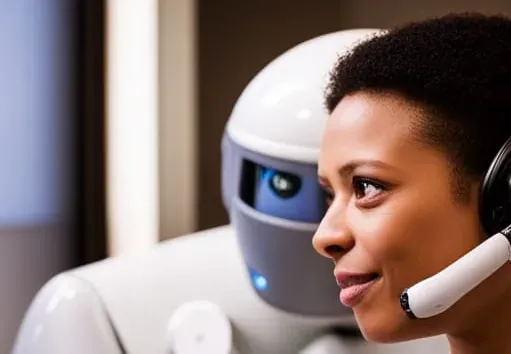
Gartner predicts that no Fortune 500 company will fully eliminate human agents from customer service operations by 2028. That prediction stands even as AI now resolves 60 to 86 per cent of routine support queries without human help.
So the question isn't really whether AI should replace humans in customer support. The better question is: what should AI handle, what should humans handle, and where does the line sit for your business? This post breaks down the data, the capabilities, and a practical framework for getting the split right.
The Real Data: Can AI Replace Customer Service Jobs?
The numbers tell a clear story. AI is already doing much of the work, but "much" isn't "all."
According to a PwC survey, 75 per cent of consumers prefer human interaction for complex service issues. At the same time, Crocus automated 86 per cent of its support volume with Alhena AI while keeping CSAT at 84 per cent. Puffy hit 63 per cent automated resolution with a 90 per cent CSAT score.
The pattern across every deployment is the same: AI handles the high-volume, repetitive work through automation. Humans handle the exceptions. Neither does the other's job well.
Will AI replace customer service jobs entirely? The data says no. Gartner also found that by 2027, half of companies planning to shrink their support teams because of AI will reverse course once they see how complex the remaining interactions become. The job changes, but it doesn't disappear.
What AI Does Better Than Humans in Customer Service
AI wins on speed, scale, and consistency. Here's where it outperforms human agents every time:
- 24/7 availability. AI doesn't take breaks, call in sick, or clock out at 5 PM. For brands with global customers, that alone is a major gap to fill. Manawa dropped response times from 40 minutes to under 1 minute after deploying Alhena AI.
- Multilingual support. Modern AI handles dozens of languages natively. You don’t need to hire regional teams for each market.
- Repetitive queries at scale. Order status, return policies, shipping timelines, password resets. These questions don't need human judgment. They need fast, accurate answers.
- Cost per interaction. A human-handled support ticket costs $5 to $15 on average. An AI-resolved query costs a fraction of that. See how this math works for your team with the Alhena ROI Calculator.
- Consistency. AI gives the same accurate answer at 3 AM on a Saturday that it gives at 10 AM on a Tuesday. No bad days, no mood swings, no training ramp. AI systems don’t call in sick.
What Humans Do Better Than AI in Customer Support
This weekend, The Guardian published a great article by Ben Tarnoff about Joseph Weizenbaum, the creator of the world's first chatbot, entitled "'A certain danger lurks out there': How the inventor of the first chatbot turned against AI."
If you're fascinated by AI and have the time, you should read it. (Heads up, it's pretty long.)
In the TL;DR version: Weizenbaum was born in 1923, grew up Jewish in Nazi Germany, and then moved to Detroit in 1936. In 1963, he became a professor at MIT and that same year, MIT launched Project MAC (short for "Machine Aided Cognition") with a $2.2M grant from the Pentagon. Three years later, as part of Project MAC, he created ELIZA, the world's first chatbot. ELIZA had the persona of a psychotherapist.
The Pentagon's funding of ELIZA troubled Weizenbaum. Worried that his creation would be used for political or military purposes, he became deeply involved in the anti-war movement. In 1976, he published Computer Power and Human Reason: From Judgment to Calculation. Tarnoff summarizes Weizenbaum's position: we should never "substitute a computer system for a human function that involves interpersonal respect, understanding and love."
Weizenbaum's warning still holds. Here's what humans do that AI can't replicate:
- Make exceptions. For example, a loyal customer's return is two days past the window. A human agent reads the situation, checks the account history, and makes a judgment call. AI follows rules. Humans bend them when it's the right thing to do.
- Show real empathy. For example, a frustrated customer who just received a damaged gift for their child doesn't want a policy recitation. They want someone who genuinely understands the situation.
- Advocate internally. When a product defect keeps appearing, human agents escalate it to product teams. They become the voice of the customer inside your company.
- Handle ambiguity. "This doesn't feel right" isn't a query an AI chatbot can parse well. Humans read between the lines, ask clarifying questions, and navigate uncertain situations.
AI vs Human Customer Service: A Side-by-Side Comparison
Here's how AI and human agents stack up across the capabilities that matter most in customer service:
- Speed: AI responds in seconds. Humans average 4 to 12 minutes for first response.
- Availability: AI operates 24/7/365. Humans work in shifts with limited coverage.
- Languages: AI supports 50 or more languages natively. Humans need regional hiring or translation tools.
- Empathy: Humans excel at genuine emotional connection. AI can detect sentiment but can't truly empathize.
- Judgment calls: Humans can bend policies, make exceptions, and use discretion. AI follows programmed rules.
- Scalability: AI handles thousands of simultaneous conversations. Humans handle one at a time.
- Consistency: AI gives the same answer every time. Human quality varies by agent, mood, and workload.
- Complex problem-solving: Humans connect dots across departments and use creativity to improvise solutions. AI works within defined boundaries.
- Cost per interaction: AI costs pennies per query. Humans cost $5 to $15 per ticket on average.
The takeaway: AI and humans aren't interchangeable. They're complementary. The best customer service operations use each where it's strongest.
What Makes Generative AI Chatbots Different
Generative AI-based chatbots represent a new type of AI chatbot for customer service. Unlike rule-based bots that follow rigid scripts, generative AI understands natural language, handles complex questions, and carries on real conversations. Specifically:
For a deeper look at this topic, see our analysis of the key generative AI risks critics raise and where they fall short.
- They're available 24/7 and respond in real time.
- They speak hundreds of languages.
- They can understand arbitrarily complex and technical customer questions.
- They can provide highly accurate and relevant responses and even act on customers' behalf.
But can generative AI chatbots do everything a customer service agent does?
- Can they listen to a customer's difficult situation and make exceptions to policies and procedures?
- Can they empathize with a customer's problems and advocate internally to ensure their problem is addressed?
- Can they use human judgment to determine if a product is in returnable condition?
At Alhena, we're confident that generative AI chatbots can do much of what customer service agents can do. But the ethical question is, should they?
Five Ethical Principles for AI in Customer Service
At Alhena, we believe AI in customer service should be deployed responsibly. Here are five principles every brand should follow. For more on this topic, read CX Automation Platforms and the Impact of Generative AI.
- Transparency. Never try to pass an AI chatbot off as a human agent. Customers should always know they're talking to a bot, not a person. Alhena clearly identifies itself as an AI assistant in every conversation.
- Seamless handoff. When a customer asks for a human agent, the AI should transfer the full conversation context so the customer doesn't repeat themselves. Alhena integrates with Zendesk, Gorgias, Intercom, and other service providers to make this transfer instant.
- Accuracy. AI should not make things up. Fabricated answers risk confusing customers and erode brand trust. Alhena's hallucination-free architecture grounds every response in verified product data, not guesses. Learn more about why this matters: Everything You Need to Know About Chatbot Hallucination.
- Freedom from bias. AI chatbots should treat customers the same regardless of gender, race, or religion. Brands should not feed demographic variables into AI that could introduce discriminatory patterns.
- Privacy concerns. All conversations with an AI chatbot should be treated as confidential and should not be used to inform third-party systems and systems that could leak private data.
How Alhena AI Gets the AI-to-Human Balance Right
Alhena AI is purpose-built for ecommerce, and that means it's built around the reality that AI and human agents need to work together. Here's how the balance works in practice:
The AI handles what it's best at. Alhena's Product Expert Agent answers product questions, makes personalized recommendations, and even populates shopping carts through agentic checkout. The Order Management Agent handles order status, returns, exchanges, and tracking updates. These two agents automate the high-volume queries that eat up your team's time.
Humans handle what they're best at. When a conversation needs empathy, discretion, or a policy exception, Alhena routes it to your team with full context. Agent Assist gives your human agents AI-drafted responses they can review and send in one click, so even human-handled tickets move faster within your existing workflow.
The results speak for themselves. Tatcha saw a 3x conversion rate and 38 per cent AOV uplift after deploying Alhena. Victoria Beckham saw a 20 per cent AOV increase. These aren't just support metrics. They're revenue numbers that prove AI and humans together outperform either alone.
Alhena deploys in under 48 hours with no dev resources needed and works across web chat, email, Instagram DMs, WhatsApp, and voice through Social Commerce and Voice AI.
Key Takeaways
- AI can handle 60 to 86 per cent of routine customer service queries today, but it can't replace humans entirely.
- Gartner predicts no Fortune 500 company will fully remove human agents by 2028.
- AI wins on speed, cost, scale, and consistency when handling routine requests. Humans win on empathy, judgment, and complex problem-solving.
- The best brands run a hybrid customer service model where AI handles Tier 1 volume and humans focus on high-value interactions.
- Ethical AI deployment requires transparency, seamless handoff, accuracy, bias prevention, and privacy.
- Alhena AI is built for this hybrid model with purpose-built ecommerce agents and native helpdesk integrations.
Ready to see how AI and human agents work together in practice? Book a demo with Alhena AI or start for free with 25 conversations.

Frequently Asked Questions
Will AI replace customer service jobs entirely?
No. Gartner predicts no Fortune 500 company will fully remove human agents by 2028. AI handles 60 to 86 percent of routine requests, but complex issues requiring empathy, judgment, and policy exceptions still need humans. The role shifts from answering repetitive questions to handling high-value interactions.
What percentage of customer support can AI handle automatically?
Current deployments show AI resolving 60 to 86 percent of standard support requests. Alhena AI customers like Crocus hit 86 percent deflection with 84 percent CSAT, and Puffy reached 63 percent automated resolution with 90 percent CSAT. The exact percentage depends on your product complexity and request mix.
Is AI or human customer service better?
Neither is universally better. AI outperforms humans on speed, cost, 24/7 availability, and consistency. Humans outperform AI on empathy, judgment calls, policy exceptions, and complex problem-solving. The best results come from using both together in a hybrid customer service model.
How much does AI customer service cost compared to human agents?
A human-handled support ticket costs $5 to $15 on average. AI-resolved interactions cost a fraction of that. Alhena AI offers a free tier with 25 conversations, and you can estimate your savings with the Alhena ROI Calculator at alhena.ai/roi-calculator.
Can AI chatbots handle returns and refunds?
Yes. Modern AI agents like Alhena’s Order Management Agent process return requests, check eligibility against your policies, generate return labels, and issue refunds without human involvement. For edge cases like damaged items that need visual inspection, the AI triggers an escalation to a human agent with full context.
How does Alhena AI handle the handoff from AI to human agents?
Alhena transfers the full conversation context, customer history, and order details to your human agents through native integrations with Zendesk, Gorgias, Intercom, Freshdesk, and other service providers. The customer doesn’t repeat themselves and the agent sees everything the AI discussed.
What is a hybrid AI-human customer service model?
A hybrid customer service model uses AI to handle high-volume, repetitive requests (order status, FAQs, product questions) and routes complex or emotionally sensitive issues to human agents. Brands like Tatcha use this model to achieve 82 percent chat deflection while still providing personal human support where it matters most.
How long does it take to deploy AI customer service?
Alhena AI deploys in under 48 hours with no developer resources needed. It connects to your existing ecommerce platform (Shopify, WooCommerce, Magento, Salesforce Commerce Cloud) and helpdesk, gets trained on your product catalog and knowledge base, and goes live across web chat, email, social, and voice channels.