Retail AI agent adoption in 2026 comes down to a single gap: 88% of US business leaders are raising AI budgets because of agentic AI, while only 2% of organizations run AI agents at full scale. Intent is near-universal. Deployment is rare.
That gap is not a technology problem. Every retailer in the 88% has access to the same models. The difference is that most have not yet put an agent in front of a single customer.
This report covers where the gap comes from, what separates a real deployment from a pilot, the four things that actually block go-live, and a seven-point check for which side of the line your store is on.
How many retailers have actually deployed AI agents?
Very few. 2% of organizations run AI agents at full scale, 12% at partial scale, and 23% are running pilots, according to Capgemini Research Institute's Rise of Agentic AI (July 2025, 1,500 executives at $1B+ companies across 14 countries). Roughly 61% are still exploring.
Read that distribution carefully. Add the three deployed tiers together and you get 37% — and only the top 2% have agents running across the business rather than in one corner of it.
Meanwhile the intent numbers point the other way. PwC's AI Agent Survey found 88% of executives plan to raise AI budgets specifically because of agentic AI, and Salesforce's Connected Shoppers Report found 75% of retailers say AI agents will be essential to compete by 2026.
Why are 88% of leaders raising AI agent budgets?
Because agentic AI moved the business case from cost-saving to revenue. PwC's survey, fielded 22–28 April 2025 across 308 US executives, found 88% plan to increase AI-related budgets in the next 12 months specifically because of agentic AI — and more than a quarter plan increases of 26% or more.
Earlier AI budgets were justified by deflection: fewer tickets, lower cost per contact. Agentic budgets are justified differently, because an agent that reads live inventory and adds to cart sits on the revenue line, not the support line.
The competitive framing matters too. When three quarters of retail decision-makers say agents are table stakes by 2026, budget approval becomes a defensive move as much as a growth one.
What actually counts as a “deployed” AI agent?
Three very different things get reported as “AI deployment”: an internal pilot, a passive chatbot, and a customer-facing agentic agent. Only the third moves revenue, and only the third requires the readiness work below.
| Tier | Who sees it | What it can do | Revenue impact |
|---|---|---|---|
| 1. Internal pilot | Support staff only | Triages, tags and summarizes tickets for human agents | None directly — efficiency only |
| 2. Passive chatbot | Customers, on request | Answers FAQs from a static knowledge base; no memory between sessions | Deflection only |
| 3. Customer-facing agentic agent | Every shopper, at the decision moment | Holds memory across sessions, reads live catalog and order data, adds to cart, processes returns and refunds | Attributable revenue, AOV lift, cart completion |
Most “70% of retailers are deploying AI” headlines are counting tiers one and two. When Capgemini asks specifically about agents at scale, the number collapses to 2%.
What do retailers get once they reach tier three?
Three things a chatbot structurally cannot deliver: memory that persists across sessions, first-party conversation data you can attribute to revenue, and upsell that happens inside a support moment.
Does memory across sessions change outcomes?
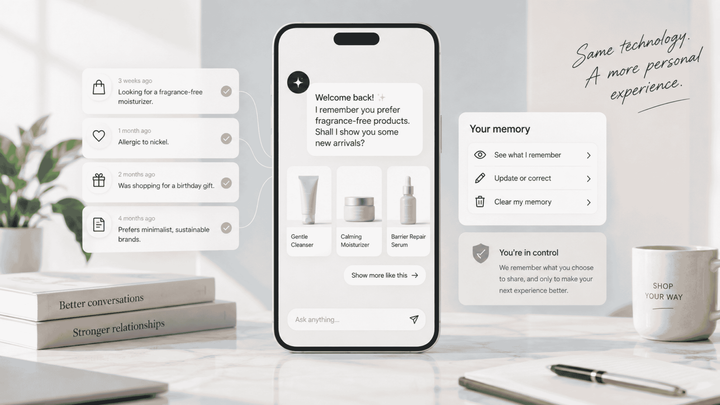
Yes, because it changes what the agent can recommend. A retrieval-only chatbot answers each query from scratch; an agentic system knows a shopper bought a moisturizer last month and can position a serum against it.
Alhena's Product Expert Agent works this way, and that continuity is what drove a 38% AOV uplift for Tatcha, alongside 3x conversion and 11.4% of total site revenue attributed to AI.
What data do you get that ad platforms cannot give you?
Conversation-level intent. Every session records which product comparison led to a cart add, which objection ended the session, and which question preceded checkout.
That is first-party behavioral data no ad network holds. Alhena surfaces it as revenue attribution, which is the difference between reporting deflection rate and reporting dollars.
Does it lift AOV or just deflect tickets?
Both, but the AOV effect is the one that justifies the budget. Victoria Beckham saw a 20% AOV increase by letting the agent recommend and pre-fill rather than simply answer.
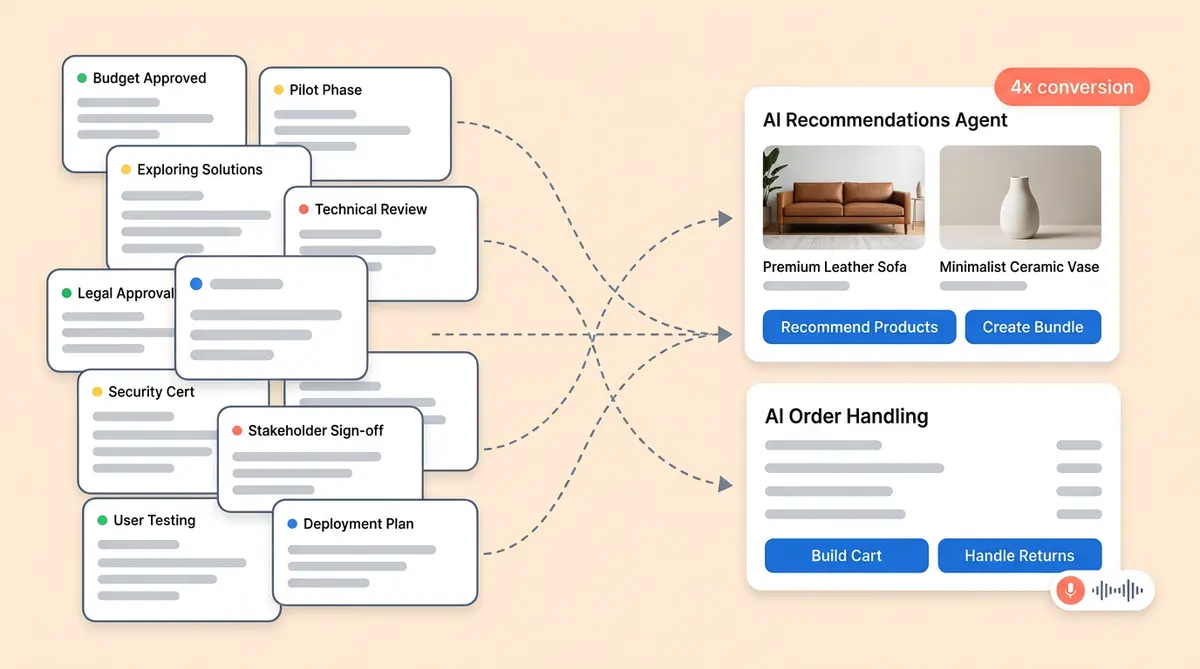
The underlying conversion spread across Alhena's platform is roughly 4x between AI-assisted and unassisted shoppers. The full 329-brand breakdown by channel and vertical lives in our State of AI Commerce benchmark.
What actually blocks AI agent deployment?
Not model quality. In practice, four unglamorous blockers stall retail deployments: messy helpdesk data, unowned brand voice, ticket-first architecture, and unapproved refund authority.
Helpdesk data hygiene
Forty contradictory Zendesk or Freshdesk macros become forty contradictory agent answers. Dedupe the tag taxonomy first.
Unowned brand voice
If Marketing, CX and Legal all approve tone, nobody does. The fastest deployments name one voice owner with sign-off authority.
Ticket-first lock-in
Legacy systems open a ticket before the agent can speak. That turns a shopping conversation into a support queue and kills the sale.
Unapproved refund authority
Letting an agent refund up to $50 without a human needs legal sign-off. Start that conversation before build, not after.
Is your store ready for an AI agent?
Score yourself against these seven checks. Zero to three means fix foundations first. Four to five means run a customer-facing pilot now. Six or seven means you are ready to evaluate vendors.
- Helpdesk macros audited and deduplicated within the last 90 days
- A single brand-voice owner named, with sign-off authority
- Product catalog APIs return live price, inventory and variant data
- Refund and exchange autonomy thresholds approved by legal
- A conversation data pipeline exists — not just ticket logs
- KPIs defined beyond deflection: attributed revenue, AOV lift, cart completion
- Cross-channel identity resolution in place (email + chat + social = one customer)
If you scored four or higher, the sequencing question comes next — which decision moment to cover first, and in what order. Our 12-month agentic ecommerce roadmap maps that phase by phase.
What should retailers do this quarter?
Four moves, in order: score readiness, pilot customer-facing rather than internal, instrument revenue from day one, and start optimizing product data for AI retrieval.
Run the readiness score first
Fix the gaps before evaluating vendors. A dirty knowledge base makes every demo look the same.
Pilot customer-facing, not internal
Internal pilots teach you about AI. Customer-facing pilots teach you about revenue. Alhena goes live in under 48 hours with no dev resources.
Instrument revenue on day one
Track attributed revenue, transactions and cart completion. If a vendor cannot show those, you are buying a support bot.
Start the AEO conversation
Product feeds are becoming the retrieval layer for AI shopping answers. Optimize them now, before the citations settle.
What changes by 2027?
Three shifts are already in motion. Each has a tripwire — a specific, observable event that tells you the timeline has accelerated.
| Prediction for 2027 | What it means | Tripwire to watch |
|---|---|---|
| Voice-first commerce rises from under 2% to roughly 15% of AI-assisted orders | Voice moves from handling support calls to guiding product selection and checkout | Shopify or Amazon shipping a native voice-checkout SDK by Q2 2027 |
| Answer Engine Optimization displaces keyword SEO for roughly 30% of retail queries | Shopping answers in ChatGPT, Perplexity and Gemini pull from structured product data, not blog posts | Google AI Overviews covering more than 40% of commercial queries |
| A major helpdesk vendor acquires or white-labels an agent platform | Bolt-on AI features were not built for agentic commerce protocols; buying beats building | Acquisition announcements timed to NRF 2027 or Shoptalk |
The second prediction has the shortest fuse. If discovery moves into AI assistants before your product data is retrievable, you lose the citation regardless of how good your on-site agent is — which is the problem Alhena AI Visibility exists to solve.
Key takeaways
- 88% of leaders are raising AI budgets because of agentic AI (PwC, April 2025, 308 US executives), and 75% of retailers say agents are essential to compete by 2026 (Salesforce).
- Only 2% run agents at full scale, 12% at partial scale and 23% at pilot stage (Capgemini, July 2025). About 61% are still exploring.
- Three different things get called “deployment.” Internal pilots and passive chatbots inflate the headline. Only customer-facing agentic agents move revenue.
- The blockers are operational, not technical: helpdesk data hygiene, unowned brand voice, ticket-first architecture and unapproved refund authority.
- Score four or higher on the seven-point check and you are ready to pilot customer-facing today rather than next quarter.
See where your store actually scores
Alhena deploys a customer-facing agent in under 48 hours, with no developer resources — and reports attributed revenue from day one.
Frequently asked questions
Only 2% of organizations run AI agents at full scale, with 12% at partial scale and 23% running pilots, according to Capgemini's Rise of Agentic AI (July 2025, 1,500 executives at $1B+ companies). Roughly 61% are still in the exploring phase. Adoption intent is far higher than deployment reality.
It comes from PwC's AI Agent Survey, fielded 22–28 April 2025 among 308 US business executives (33% C-suite, 13% VP, 54% director-level). It measures the share who plan to increase AI-related budgets over the next 12 months specifically because of agentic AI. It spans all industries, not retail alone.
A chatbot retrieves pre-written answers one query at a time, with no memory between sessions. An AI agent holds context across conversations, reads live catalog and order data, and takes actions — adding to cart, tracking orders, processing refunds. That action capability is why agents sit on the revenue line and chatbots sit on the support line.
Score yourself on seven checks: deduplicated helpdesk macros, a named brand-voice owner, live catalog APIs, legal-approved refund thresholds, a conversation data pipeline, KPIs beyond deflection, and cross-channel identity resolution. Zero to three means fix foundations first. Four to five means pilot now. Six or seven means you are ready to evaluate vendors.
Alhena deploys in under 48 hours with no developer resources. Setup covers product catalog ingestion, knowledge base training, helpdesk integration and brand voice configuration. Most brands see the agent handling live customer conversations by the end of day two.
Results vary by vertical and by how much of the journey the agent covers. On the Alhena platform, Tatcha recorded 3x conversion, a 38% AOV uplift and 11.4% of total site revenue attributed to AI, while Victoria Beckham achieved a 20% AOV increase. Across all 329 brands, the roughly 1% of visitors who engage an agent drive around 10% of total site revenue.
Buy if you score six or seven on the readiness check and need revenue impact this quarter — the integration surface (catalog, helpdesk, orders, identity) is where build timelines slip. Build only if agent behavior is itself a differentiator for your category. The same logic explains why helpdesk vendors are more likely to acquire agent platforms than build them.
Not entirely, but the shift is accelerating. AI shopping answers pull from structured product data rather than blog content, and the working prediction is that AEO handles roughly 30% of retail queries by 2027. Brands investing in structured product feeds and AI visibility now will own those citations.
Data note: PwC AI Agent Survey, 22–28 April 2025, 308 US business executives. Salesforce Connected Shoppers Report, 6th edition, 8,350 shoppers and 1,700 retail decision-makers across 21 countries, fielded 27 November – 26 December 2024. Capgemini Research Institute, Rise of Agentic AI, July 2025, 1,500 executives at $1B+ organizations across 14 countries. Alhena platform figures are aggregated, anonymized data from 329 ecommerce brands across 9 traffic channels and 8 product verticals, Q4 2024 – Q1 2026, measured via Alhena's analytics engine. Named brand results published with client permission.