The Scale Problem Nobody Plans For
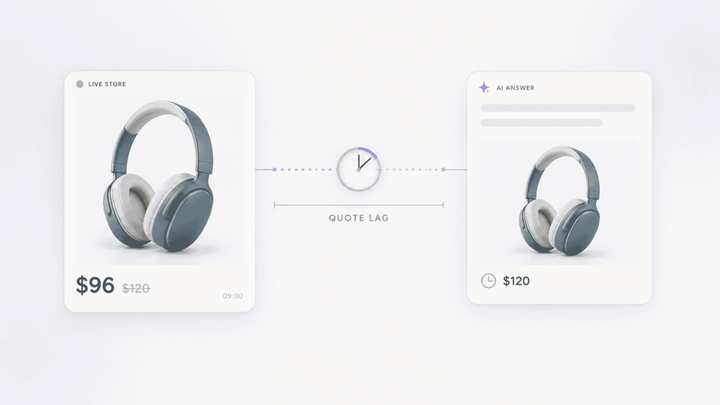
Your AI support concierge handles thousands of conversations a day. It's fast, consistent, and customers love it. Then someone updates the knowledge base on a Tuesday afternoon, a discontinued promotion stays live, and 500 customers get told they qualify for 30% off an item that's been full price since last month.
You won't hear about it from most of them. According to Qualtrics' 2026 Consumer Experience report, in 2026, only 29% of customers give direct feedback after a bad experience. The other 71% reduce spending or leave quietly. That's what makes AI errors at scale so dangerous: the blast radius is invisible until sales dip weeks later.
This post covers the six-step ecommerce playbook for when it happens to you: detecting the problem, assessing the damage, deciding who to contact, crafting the message, fixing the root cause, and measuring whether trust actually comes back.
Step 1: Detecting That It Happened
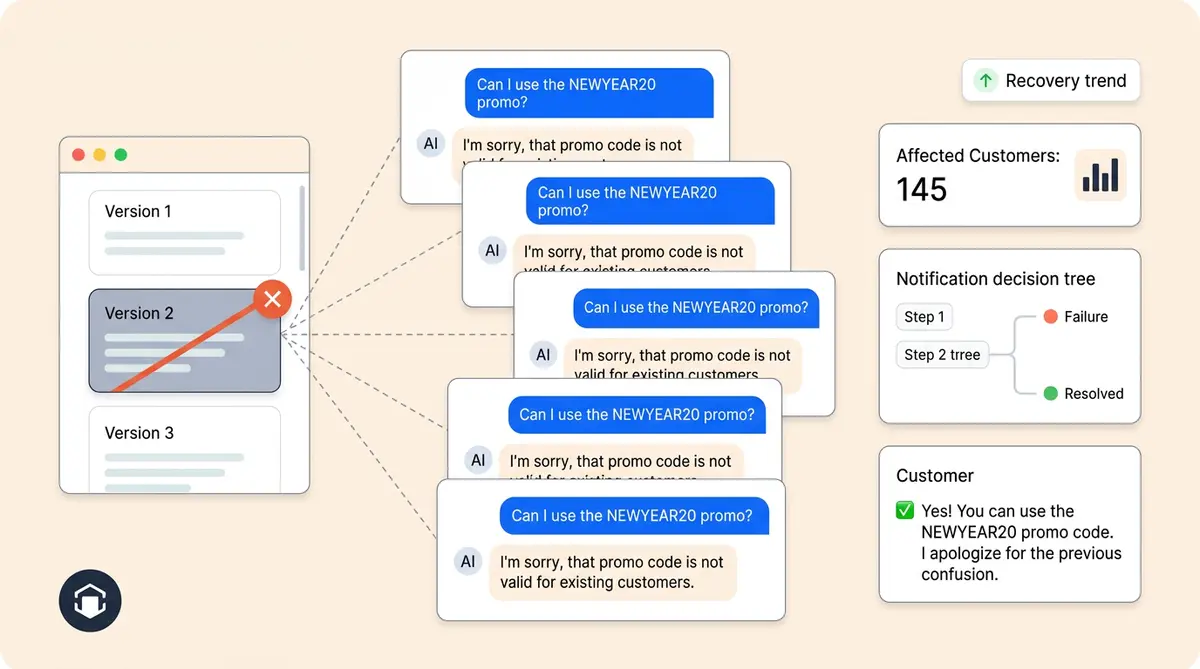
Individual bad answers get caught by quality controls like smart flagging systems that score every response for faithfulness. The harder problem is systemic errors, where a knowledge base update pushes wrong information into hundreds of ecommerce conversations before retailers notice.
Common triggers include stale checkout promotions that weren't removed, discontinued products still being recommended, and policy changes (new return windows, updated shipping timelines) that didn't propagate to the AI's training data. Gartner's 2026 data estimates that inaccurate product information costs e-commerce retailers $9.7 million annually on average.
The fix starts with automated monitoring. Set faithfulness score thresholds that trigger alerts when multiple conversations in the same topic cluster drop below baseline. If your AI normally scores 95%+ on product pricing accuracy and suddenly drops to 80%, that's your early warning. Pair this with regular QA audits that test known-good queries after each knowledge base update.
Step 2: The First 60 Minutes
Once you know something went wrong, the clock starts. Your first job isn't fixing the answer. It's scoping the damage.
Pull e-commerce conversation analytics to answer three questions: How many customers got the wrong answer? What exactly was said? And how severe is the misinformation? A wrong delivery estimate is different from a wrong price quote, which is different from a safety claim about a product ingredient.
Export the affected conversation IDs. Tag them by severity. If your AI told 50 people a product was hypoallergenic when it isn't, that's a same-day emergency. If it quoted a 14-day return window that's actually 30 days, that's urgent but less dangerous since the error works in the customer's favor.
During this window, patch the knowledge base to stop the bleeding. Each minute the wrong answer stays live, more customers get hit.
Step 3: The Notification Decision Tree
Not every wrong answer warrants proactive outreach. Contacting everyone isn't the right move. Contacting 500 people about a minor shipping estimate variance can create more alarm than the error itself. Here's how to decide:
- Always reach out proactively: Wrong prices or price quotes (customers may have made checkout decisions based on them), cart abandonment from wrong pricing), incorrect safety or health claims, wrong return/refund policies that disadvantage the customer, and any information that could cause financial harm or lost sales.
- Correct on next contact: Minor delivery or shipping estimate variances, slightly outdated product descriptions, and feature details that don't affect the purchase decision.
- Monitor and log: Cosmetic errors (wrong color name for a shade that's visually identical) and outdated but still-accurate-enough specifications.
2026 research backs the proactive approach for serious errors. Studies show up to 95% of customers will buy again if an issue is resolved quickly and in their favor, compared to 70% when complaints are merely resolved. It's speed and ownership that matter more than perfection.
Step 4: Trust Repair Communications
The outreach message needs three things: acknowledge what happened, correct the information, and offer a personalized remedy through clear, personalized messaging. Skip the corporate hedging.
What works: "Earlier today, our AI assistant gave you incorrect information about [specific detail]. The correct [price/policy/detail] is [X]. We're sorry for the confusion, and here's [specific remedy: discount code, extended return window, price match]."
What doesn't work: "We recently identified a potential discrepancy in some automated responses..." Nobody trusts a brand that can't say "we got it wrong" in plain language.
Channel selection matters too. Use email for documented corrections where the customer needs a written record. Use chat or SMS for active conversations where real-time correction prevents a bad outcome, like someone mid-checkout or about to confirm payment based on a wrong price.
Step 5: The Knowledge Base Fix Sprint
Fixing the e-commerce customer-facing problem is half the job. The other half is making sure it doesn't repeat.
Trace the root cause through your conversation debugger. Was it a stale FAQ entry? A product listing that wasn't updated after a catalog change? A policy document that referenced old terms? A checkout flow with outdated pricing? Knowledge base ops helps when it includes version control and change logs so you can pinpoint exactly which update introduced the error.
After patching, run test queries targeting the corrected information. Don't just test the exact question that failed. Test variations, because customers ask the same thing dozens of ways. Then set up a monitoring window: watch faithfulness scores on the affected topic cluster for 48 to 72 hours to confirm the fix holds.
Feed the incident back into your continuous learning loop. The best e-commerce AI systems treat each error as training data for better guardrails. If a stale promotion caused the issue, build an automated check that flags promotions past their end date before they reach the AI's knowledge base.
Step 6: Measuring Whether Trust Actually Recovers
Trust recovery isn't a single metric. Track these across the affected customer cohort versus a control group:
- CSAT trajectory: Expect a dip in the first week. Most teams see measurable improvement within 30 days with structured recovery, according to Retently's benchmarks.
- Repeat engagement rate: Are affected customers showing re-engagement by coming back to chat or avoiding it? A drop in AI channel engagement among the affected group signals lasting distrust.
- Churn comparison: Compare 60-day and 90-day retention between affected and unaffected customers. Minor incidents converge by week 4. Major ones (wrong safety claims, price errors) take 6 to 8 weeks.
- Reorder rate: The ultimate test. If affected customers keep buying at the same rate, trust and sales recovered. If not, the remedy wasn't enough.
One critical insight from the data: 32% of e-commerce customers abandon a brand entirely after a single negative experience. That number drops dramatically when companies respond quickly and transparently. The perceived difference between a trust crisis and a trust-building moment is how fast you own it to protect sales.
How Alhena AI Prevents and Recovers From Wrong Answers
Alhena's architecture is built to minimize these incidents and speed up recovery when they happen. The Product Expert Agent grounds every response in verified product data, not general language model knowledge. Each answer runs through a faithfulness scorer that extracts each factual claim, validates it against the source knowledge base in two stages (with a higher-reasoning model for edge cases), and calculates a faithfulness percentage. Responses that fall below threshold are auto-disabled before they reach customers. That drops hallucination rates to near zero compared to the 18% enterprise average for ungrounded systems.
When something does slip through, Alhena's Smart Flagging helps catch it at three levels. All responses are auto-classified as ANSWER_PROVIDED, ANSWER_NOT_PROVIDED, or CLARIFICATION_QUESTION_ASKED, so your analytics dashboard shows the true percentage of questions fully answered, not vanity volume. Each answer also carries a visible "Knowledge Used" trail linking back to the exact FAQs and documents the AI consulted. And flagged conversations surface with full context, so your customer service team can assess blast radius and filter by topic, time window, or confidence score to identify exactly which customers were affected.
On the prevention side, knowledge base syncing with Shopify, WooCommerce, and other platforms means product and policy data stays current automatically. Ecommerce businesses like Tatcha and Puffy (90% CSAT) run on this system at scale, with the kind of accuracy that means brands can stay competitive, protect sales, and keep trust incidents rare and recoverable.
The transparency controls go further than disclosure. When the AI reaches its competence limit, it doesn't fake an answer. It routes to a human agent with the full conversation attached to the helpdesk ticket. And when an admin spots a wrong answer, they can type a correction that auto-generates a new FAQ entry, indexed into retrieval within minutes. The next customer asking the same question gets the corrected answer with no retraining cycle and no deploy.
Ready to build an e-commerce AI customer service system where trust incidents are rare and recovery is fast? Book a demo with Alhena AI or start for free with 25 conversations.
Frequently Asked Questions
How do you detect when an AI chatbot gives wrong answers at scale?
Set faithfulness score thresholds that trigger alerts when multiple conversations in the same topic cluster drop below baseline. Smart flagging systems score every AI response in real time, but systemic errors need cluster-level monitoring to catch patterns across hundreds of conversations.
What should you do in the first 60 minutes after discovering an AI error?
Scope the blast radius first: pull conversation analytics to count affected customers, identify what was said, and categorize severity. Patch the knowledge base immediately to stop new customers from getting the wrong answer. Export affected conversation IDs for the notification decision.
Should you proactively notify customers who got wrong AI answers?
It depends on severity. Always reach out proactively for wrong price quotes, incorrect safety claims, and policies that disadvantage the customer. For minor shipping estimate variances or cosmetic errors, correct on next contact instead instead. Research shows 95% of customers buy again when issues are resolved quickly and in their favor.
How long does it take to recover customer trust after an AI error?
For minor incidents (wrong shipping estimates, outdated descriptions), CSAT typically recovers within 2 to 4 weeks with structured outreach. Major incidents involving price errors or safety claims can take 6 to 8 weeks. The speed and transparency of your response determines the timeline more than the error itself.
What percentage of customers leave after a bad AI experience?
According to industry research, 32% of e-commerce customers abandon a brand entirely after a single negative experience. Worse, 56% leave silently without ever complaining. Only 29% of customers provide direct feedback after a bad experience, which means most AI errors go unreported by the people they affect.
How does Alhena AI prevent chatbot hallucinations in ecommerce?
Alhena grounds every response in verified product data with built-in personalization rather than general language model knowledge. The Product Expert Agent pulls from synced catalog and policy data, while Smart Flagging scores each response for faithfulness in real time. Knowledge base syncing with platforms like Shopify and WooCommerce keeps product information current automatically.
What is the best way to communicate an AI error to affected customers?
Keep it direct: acknowledge the specific error, provide the correct information, and offer a concrete remedy (discount code, extended return window, or price match). Use email for documented corrections where customers need a written record. Avoid vague corporate language. Customers trust brands that say we got it wrong in plain terms.