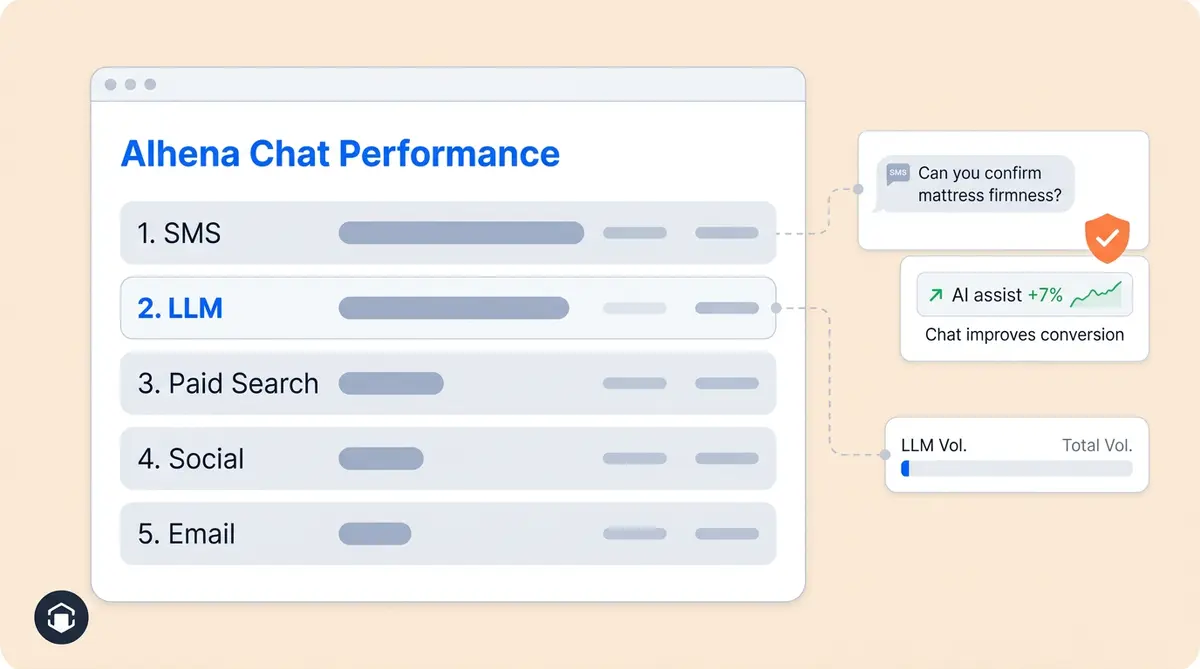
LLM visitors post the second-highest engagement rate of any ecommerce channel at 2.69%, behind only SMS at 4.43%. That puts LLM traffic ahead of email (2.44%), Google Shopping (1.91%), Google Ads (1.87%), affiliate (1.38%), and every social channel. The data comes from 329 brands across the US and EU tracked by Alhena AI's 2026 Commerce Report, and it flips the script on how most ecommerce teams think about AI referral traffic.
Most brands aren't tracking LLM as a channel at all. The ones that are have discovered something the benchmarks make clear: LLM visitors don't just convert well. They engage with on-site AI at rates that beat nearly every paid and owned channel. This post breaks down the full 9-channel AI engagement rate ranking, explains why LLM traffic behaves this way, and gives you a practical framework to benchmark your own performance against best-in-class.
The Full 9-Channel AI Engagement Rate Benchmark
AI engagement rate measures the percentage of visitors from each channel who actively interact with an AI shopping assistant during their session. It captures clicks, conversations, product questions, and cart actions triggered through AI. Here is how each channel ranks across 329 ecommerce brands:
- SMS: 4.43%
- LLM (ChatGPT, Perplexity, Gemini, Claude): 2.69%
- Email: 2.44%
- Google Shopping: 1.91%
- Google Ads: 1.87%
- Affiliate: 1.38%
- Direct and Organic: 0.79%
- Meta Ads: 0.67%
- TikTok Ads: 0.15%
The gap between the top and bottom is massive. SMS visitors engage with AI at nearly 30x the rate of TikTok Ads visitors. But the real story is LLM sitting in the number two spot, beating every paid channel and even email, a channel ecommerce teams have spent years optimizing.
Why LLM Visitors Engage at Such High Rates
LLM visitors arrive from a conversational AI experience. They've just spent minutes asking ChatGPT or Perplexity detailed product questions: "best running shoes for flat feet under $150" or "gentle retinol serum for sensitive skin." By the time they click through to your store, they're mentally primed for dialogue.
An on-site AI shopping assistant feels like a natural continuation of that research journey, not an interruption. The visitor's mental model is already set to "ask and receive." They expect to keep the conversation going. When your site offers that experience through a Product Expert Agent that can answer follow-up questions, compare variants, and populate the cart, engagement happens almost reflexively.
Compare that to a TikTok Ads visitor who arrives from a 15-second video with zero conversational context. Or a Meta Ads visitor who clicked a carousel image. These visitors land in browse mode, not dialogue mode. The AI shopping assistant is something they discover by accident, if they discover it at all.
This is why the engagement rate gap between LLM and social channels is so wide. It's not about traffic quality in the traditional sense. It's about cognitive priming. LLM visitors are already in a conversation. Your AI just needs to continue it.
The Dark Horse Channel Brands Keep Ignoring
Here's the tension: LLM referral traffic represents roughly 0.2% of total ecommerce sessions. That's 200x smaller than Google organic. Most analytics dashboards bury it under "referral" or misattribute it as "direct." So most brands don't see it, don't track it, and don't optimize for it.
But the conversion data tells a different story. LLM visitors convert at a 2.47% baseline rate, already ahead of Google Ads (1.82%) and Meta (0.52%). When those visitors engage with an AI shopping assistant, conversion jumps to 9.84%, a 4x lift that outpaces every other channel's AI-assisted conversion gain.
The math is simple. A channel that costs zero ad spend, converts at 2.47% baseline, and hits 9.84% with AI engagement is not a rounding error. It's a signal. The brands reading it correctly are the ones building their AI commerce strategy around capturing this traffic, not just counting it.
What Engagement Rate Actually Means (And Why It's Your Most Powerful Lever)
Engagement rate determines how many of your visitors AI can actually influence. It's the top of the AI conversion funnel. If your engagement rate is 0.5%, your AI shopping assistant is only touching 1 in 200 visitors. If it's 3%, it's reaching 6x more potential buyers from the same traffic.
This makes engagement rate the most powerful lever available to ecommerce brands running AI. You can increase ad spend to get more visitors. You can optimize landing pages to convert a higher percentage. But increasing AI engagement rate multiplies the impact of your existing traffic at near-zero marginal cost.
Think of it this way. The gap between your current engagement rate and the best-in-class benchmark for each channel represents untapped revenue sitting on the table. If your Google Ads engagement rate is 0.8% and the benchmark is 1.87%, you're leaving more than half your AI-influenced revenue potential untouched, without spending a single additional dollar on clicks.
The Engagement Gap: Where the Biggest Opportunities Hide
Not all channels have the same room to grow. The engagement gap, the difference between a brand's current AI engagement rate and the channel benchmark, varies dramatically:
- TikTok Ads and Social Organic: Very high gap. Most brands sit near 0% AI engagement from these channels. The benchmark of 0.15% for TikTok may look small, but top performers reach 0.5%+ through proactive deployment. The gap here is almost entirely untapped.
- Meta Ads and Direct: High gap. Engagement rates cluster below 0.3% for most brands, well under the 0.67% and 0.79% benchmarks. Proactive nudges on landing pages and PDPs close this gap fastest.
- Google Ads and Google Shopping: Medium gap. Many brands already see some AI interaction from search visitors, but few reach the 1.87% to 1.91% benchmarks. Smart product page integration and cart-stage prompts move the needle here.
- Email and LLM: Low to medium gap. These channels already deliver high-intent visitors. Optimization is about consistency: ensuring every session surfaces the AI assistant at the right moment.
- SMS: Low gap. SMS is the benchmark. These visitors arrive primed to act, and top brands already capture most of the available AI engagement from this channel.
The takeaway: closing the engagement gap through proactive AI deployment is a higher-ROI move than increasing ad spend. You're not buying new traffic. You're activating visitors who already arrived.
Benchmark Your Own Engagement Rate: A Self-Assessment Checklist
Use these questions to measure how your AI engagement rate stacks up against the channel benchmarks from 329 brands:
- What is your AI engagement rate by channel? Break it out in GA4 or your analytics platform. If you can't answer this question, you're flying blind on your highest-use metric.
- Is your AI deployed proactively or passively? A hidden chat widget in the corner produces engagement rates below 0.5%. Proactive deployment with PDP integration, smart nudges, and inline product recommendations pushes rates above 2%.
- How do your rates compare to the 3% to 6% best-in-class range? Top-performing brands across the Alhena dataset reach engagement rates of 3% to 6% on their highest-performing channels. If you're below 1%, the gap is structural, not traffic-related.
- Which channels have the widest gap between current engagement and AI-assisted conversion? Focus optimization on channels where the engagement gap is largest and the AI-assisted conversion rate is highest. LLM and email are often the fastest wins.
- Are you using proactive features? PDP FAQs, smart nudges, inline recommendations, and cart-stage prompts are the specific deployment tactics that top-performing brands use to reach 6% engagement. Passive chat widgets alone won't get you there.
How Alhena AI Powers Channel-Level Engagement Benchmarking
Alhena AI is the platform behind these channel-level engagement benchmarks. The dataset spans 329 brands across the US and EU, covering nine traffic channels from SMS to TikTok Ads. Every benchmark in this report comes from real store data, not surveys or estimates.
Beyond benchmarking, Alhena gives ecommerce teams the deployment tools to close the engagement gap. The Product Expert Agent handles product questions, variant comparisons, and sizing recommendations grounded in verified catalog data with zero hallucination. The Order Management Agent resolves post-purchase inquiries across order tracking, returns, and exchanges.
Proactive features drive the engagement rate difference between average and best-in-class brands. PDP FAQs surface common questions before visitors think to ask. Smart nudges trigger based on browse behavior, time on page, and exit intent. Inline recommendations appear within the conversation flow. Cart-stage prompts catch hesitation at checkout and address objections in real time.
Tatcha saw a 3x conversion rate and 38% AOV uplift after deploying Alhena. Puffy reached 63% automated inquiry resolution with 90% CSAT. These aren't outliers. They're the result of closing the engagement gap with the right AI deployment strategy.
Engagement Rate Is the Metric That Separates Winners
AI engagement rate is the single metric that separates brands extracting full value from AI commerce and brands leaving it on the table. The 2026 channel benchmarks prove that the opportunity is not about finding new traffic. It's about activating the visitors already arriving.
LLM traffic is the clearest example. A channel that represents 0.2% of sessions, costs nothing to acquire, and delivers 2.69% AI engagement (with 9.84% conversion when engaged) is not something to ignore. It's something to build around.
The brands that benchmark their engagement rates by channel, deploy AI proactively across every touchpoint, and close the gap between their current performance and best-in-class will capture disproportionate value from AI commerce in 2026 and beyond.
Ready to see your channel-level engagement benchmarks? Book a demo with Alhena AI or start free with 25 conversations to measure where your brand stands.
Frequently Asked Questions
What is a good AI engagement rate for ecommerce by traffic channel?
Based on Alhena AI's 329-brand benchmark, top-performing channels reach 3% to 6% AI engagement. SMS leads at 4.43%, LLM traffic sits at 2.69%, and email at 2.44%. Paid social channels like Meta (0.67%) and TikTok (0.15%) have the widest gap between current rates and best-in-class, representing the largest untapped opportunity for AI-assisted conversion.
Why do LLM visitors engage with AI shopping assistants more than other channels?
LLM visitors arrive from a conversational AI experience where they've already been asking product questions. That cognitive priming makes an on-site AI shopping assistant feel like a natural continuation of their research. Alhena AI's data shows this translates to a 2.69% engagement rate, beating Google Ads, email, and every social channel because visitors are already in dialogue mode when they land.
How can ecommerce brands increase their AI engagement rate across paid channels?
Proactive deployment is the key differentiator. Alhena AI's top-performing brands use PDP FAQs, smart nudges triggered by browse behavior, inline product recommendations within the chat flow, and cart-stage prompts to push engagement rates from below 0.5% to the 3% to 6% best-in-class range. Passive chat widgets alone rarely exceed 0.5% engagement.
What conversion rate do LLM visitors reach when they engage with AI on an ecommerce site?
LLM visitors convert at a 2.47% baseline, but that rate jumps to 9.84% when they interact with an AI shopping assistant. Alhena AI's Product Expert Agent drives this 4x lift by continuing the conversational research journey with product comparisons, sizing guidance, and direct cart population, all grounded in verified catalog data.
How does Alhena AI benchmark engagement rates across different ecommerce traffic channels?
Alhena AI tracks AI engagement rate across nine channels (SMS, LLM, email, Google Shopping, Google Ads, affiliate, direct and organic, Meta Ads, TikTok Ads) using real session data from 329 US and EU brands. The platform provides channel-level benchmarks so ecommerce teams can identify which traffic sources have the highest untapped AI engagement potential and deploy proactive features to close the gap.