Most ecommerce brands understand SEO. Some have started with Answer Engine Optimization (AEO). But GEO, generative engine optimization, is the strategic layer above both that determines whether AI platforms trust your brand enough to recommend it. If your products don't show up when shoppers ask ChatGPT, Google AI Overviews, or Perplexity what to buy, you're losing revenue you'll never see in your analytics.
AI-referred traffic to retail sites grew over 300% in the past year alone, according to Euromonitor. Gartner predicts traditional search volume will drop 25% by the end of 2026. The discovery layer is shifting, and businesses that only optimize their own websites are playing half the game.
This guide breaks down what generative engine optimization means for ecommerce, how it connects to AEO, which external sources matter most, and how to audit your brand's GEO position today.
What Is Generative Engine Optimization (GEO)?
Generative engine optimization is the practice of managing your brand's total presence across every source AI systems draw from when generating answers. That means going beyond your own website to include the entire ecosystem of third-party content that shapes how AI perceives and recommends your products to high-intent shoppers.
When a shopper asks an AI assistant "what's the best moisturizer for dry skin under $50," the AI doesn't just pull from one product page. It synthesizes information from review sites, editorial articles, Reddit threads, YouTube transcripts, and affiliate comparison posts. GEO is the technology discipline of ensuring those sources consistently validate, recommend, and speak positively about your brand.
A Princeton University study (Aggarwal et al., ACM SIGKDD 2024) found that targeted GEO strategies, like adding verifiable statistics and expert citations, increased visibility in ai-generated responses by up to 40%. For ecommerce businesses, that visibility translates directly into product recommendations and revenue.
How AEO and GEO Work Together
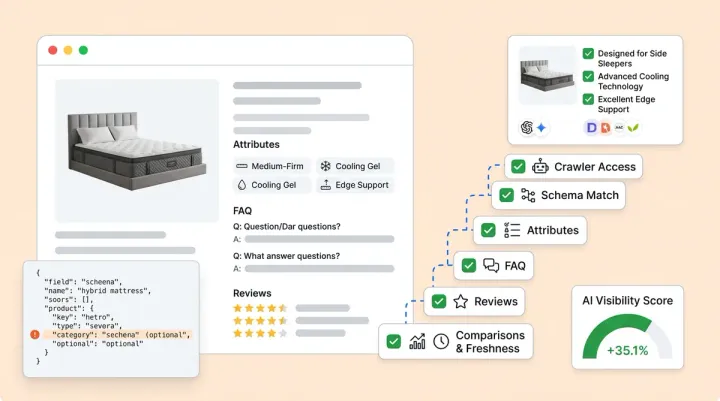
Think of AEO and GEO as two halves of your AI visibility strategy. Answer engine optimization handles on-site clarity. Your product pages, schema markup, FAQ blocks, and structured data are all tuned so AI systems can read, extract, and cite your content accurately. AEO makes your structured data machine-readable for ai-generated answers.
GEO handles external authority. It focuses on the third-party sources AI pulls from to decide whether your brand is trustworthy enough to recommend. A product page with perfect schema markup but thin review coverage and negative Reddit sentiment will lose to a competitor with stronger off-site signals every time.
The numbers back this up: research from multiple sources shows that roughly 91% of AI citations come from third-party content, not brand-owned websites. Brands mentioned across four or more external platforms are 2.8x more likely to appear in AI-generated answers. AEO gets your house in order. GEO builds the neighborhood reputation that AI actually listens to. You need both. For a deeper comparison of how these strategies layer, see our AEO vs GEO vs SEO breakdown.
The External Sources That Shape AI Recommendations
AI platforms cross-reference multiple sources before recommending a product. Here are the five signal categories that matter most for e-commerce brands building a GEO citation strategy.
Third-Party Review Sites
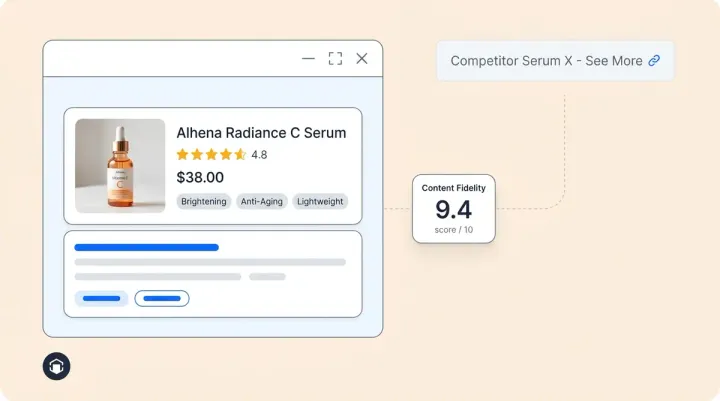
Review volume, sentiment, and recency across platforms like Trustpilot, G2, and marketplace review sections directly influence AI recommendation confidence. When your product has a 4.8 rating on your own site but a 3.9 on an aggregator, AI models synthesize that gap into a weaker recommendation. Consistency on review platforms is a core GEO signal.
Editorial Coverage
Mentions in trusted publications signal brand authority to AI models. Earned media distribution can increase AI citations by up to 325%, according to industry analysis. Getting featured in buyer guides, roundup articles, and expert reviews in credible outlets tells AI that independent sources vouch for your products.
Reddit and Forum Discussions
Authentic user discussions on Reddit carry outsized weight in LLM training data. OpenAI licensed Reddit data specifically for training, and Google pays $60M per year for access. The problem: 63% of branded Reddit threads contain negative sentiment, and 71% of that negativity comes from older threads with persistent ranking power. Monitoring these external sources is no longer optional for ecommerce brands.
Affiliate Content and Product Comparisons
Detailed product comparisons and recommendation posts create recommendation-rich signals that AI platforms reference heavily. A study of over 768,000 citations found that product content (specs, feature matrices, pricing comparisons and product attributes) earns between 46% and 70% of AI citations in product categories. Affiliate content is constantly refreshed with updated reviews and rankings, making it a high-recency signal source.
YouTube Transcripts
As of early 2026, YouTube surpassed Reddit in LLM citation share (16% vs 10%). AI language models parse video transcripts to extract product sentiment, comparison context, and demonstration insights. The YouTube-Commons dataset alone contains nearly 30 billion words of transcript data used in LLM training. Most brands never monitor how their products appear in video content, which means they're blind to one of the largest GEO signal sources. Automation of this monitoring is the only scalable solution.
Why On-Site Optimization Alone Falls Short
If you've invested in schema markup, structured data, product feeds, and AEO best practices, you've built a strong foundation. But AI platforms don't take any single source at face value. They cross-reference multiple sources to build confidence before making a recommendation.
Here's the gap: fewer than 10% of sources cited in AI-generated answers rank in the top 10 organic Google results for the same query. Strong SEO rankings don't guarantee AI visibility. Audit data shows that 54% of brands that rank well on Google are not cited by AI systems at all.
For discovery queries like "best laptop for college students" or "top serums for oily skin," AI prefers marketplaces and third-party roundups over brand-owned pages. Your product page only surfaces for branded searches. The queries where new customers are won, the ones where AI recommends specific products, are answered almost entirely by third-party content.
A Practical GEO Audit Framework for Ecommerce
Assessing your brand's generative engine optimization position starts with understanding where you stand across each external source category. Here's a framework you can run today.
1. Establish Your Citation Baseline
Test 20 product-related queries on ChatGPT, Gemini, and Perplexity. Track how often your brand appears, your share of voice compared to competitors, and whether the sentiment is accurate. This gives you a starting recommendation rate to improve against.
2. Map Your External Signal Strength
For each of the five source categories (reviews, editorial, forums, affiliate content, YouTube), document your current presence. How many recent reviews do you have on third-party platforms? Are you featured in relevant buyer guides? What does Reddit say about your products? Which YouTube creators have reviewed your products in the last six months?
3. Identify Competitor Gaps
Run the same queries and note which brands AI recommends instead of yours. Map their third-party coverage. If a competitor appears in three buyer guides you're absent from, or has twice your review volume on key platforms, those are your priority gaps.
4. Prioritize by AI Platform Weight
Not all sources carry equal weight. Editorial mentions and review sites tend to have the strongest influence on AI recommendation confidence. YouTube transcripts are growing fast in importance. Forum sentiment acts more as a disqualifier: negative Reddit threads can prevent a recommendation even if every other signal is positive. Prioritize fixing negative signals first, then building positive ones.
One documented case study showed a brand moving from a 4% citation rate to 31% in 90 days by combining schema updates with three editorial placements and restructuring four key product pages with original data.
How Alhena AI's GEO Citation Strategy Gives Brands an Edge
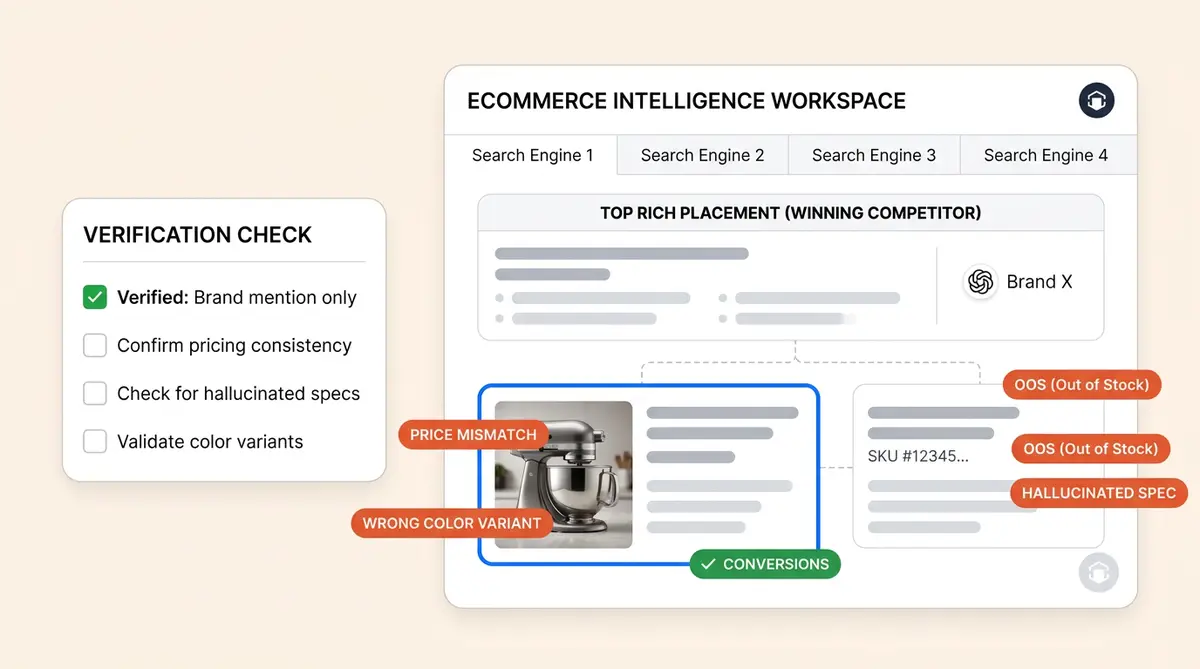
Alhena AI gives ecommerce brands visibility into exactly which external sources AI platforms pull from when generating product recommendations. Instead of guessing why your products aren't being recommended, you can see how your brand appears across review sites, editorial coverage, forums, affiliate content, and video platforms compared to your competitors.
Alhena's approach combines external source monitoring with on-site AEO optimization into a unified AI visibility strategy built on real product data. You get specific, actionable insights into what's strengthening or weakening your GEO position, along with clear resources and steps to improve your AI recommendation rates.
Brands using Alhena AI have seen measurable revenue impact from AI-driven shopping. Tatcha achieved a 3x conversion rate with AI-engaged shoppers, while Victoria Beckham saw a 20% increase in average order value. These results come from treating AI visibility as a revenue channel, not just a marketing metric, and managing both the on-site and off-site signals that drive AI recommendations.
The GEO for product brands playbook inside Alhena connects external citation data with on-site optimization recommendations, so you're never working on one side without understanding the other.
GEO Is Not Optional for Ecommerce
Euromonitor projects that AI-powered search will influence over $595 billion in retail e-commerce by 2028. An IBM-NRF study of 18,000 consumers found that 45% already use AI tools during their buying journeys. This isn't a future trend. It's happening now.
AI platforms don't just read your website. They read everything the internet says about you. Brands that only optimize their own pages are controlling half their AI narrative at best. The brands that manage the full generative engine optimization picture, from on-site AEO to off-site GEO signals, will own the recommendation when it counts.
Ready to see how your brand appears across the AI sources that matter? Book a demo with Alhena AI or start for free with 25 conversations and take control of your AI visibility strategy today. As genai reshapes product discovery, the brands that act now will own the recommendation..
Frequently Asked Questions
What is generative engine optimization and why does it matter for ecommerce?
Generative engine optimization (GEO) is the practice of managing your brand's presence across every source AI systems use when generating product recommendations. For ecommerce brands, GEO matters because 45% of consumers now use AI during their buying journey, and AI-referred traffic to retail sites has grown over 300% year-over-year. Alhena AI helps brands monitor and strengthen these external signals to increase AI recommendation rates and drive measurable revenue.
How is GEO different from AEO for ecommerce brands?
AEO (answer engine optimization) focuses on making your own website AI-readable through schema markup, structured data, and FAQ blocks. GEO focuses on the external sources AI uses to validate your brand, including review sites, editorial coverage, Reddit discussions, and YouTube transcripts. Alhena AI combines both into a unified AI visibility strategy, so brands can manage on-site clarity and off-site authority from one platform.
Which external sources have the biggest impact on AI product recommendations?
The five most influential source categories are third-party review sites, editorial and publication mentions, Reddit and forum discussions, affiliate comparison content, and YouTube video transcripts. YouTube surpassed Reddit in LLM citation share in early 2026 at 16% vs 10%. Alhena AI's GEO citation strategy monitors all five categories so ecommerce brands can see exactly where their AI visibility gaps are.
How can I audit my brand's GEO position for AI search visibility?
Start by testing 20 product queries across ChatGPT, Gemini, and Perplexity to establish your recommendation baseline. Then map your presence across review sites, editorial coverage, forums, affiliate content, and YouTube. Compare your signals against competitors who AI recommends instead of you. Alhena AI automates this process with external source monitoring that tracks how your brand appears in third-party sources compared to competitors.
Can generative engine optimization directly increase ecommerce revenue?
Yes. AI-engaged shoppers convert at nearly 4x the rate of standard LLM-referred traffic, and AI search orders carry a 30% higher average order value. Brands like Tatcha have seen 3x conversion rates through AI-driven shopping with Alhena AI. Investing business resources in GEO increases the frequency and confidence of AI recommendations, which translates directly into product discovery and sales.