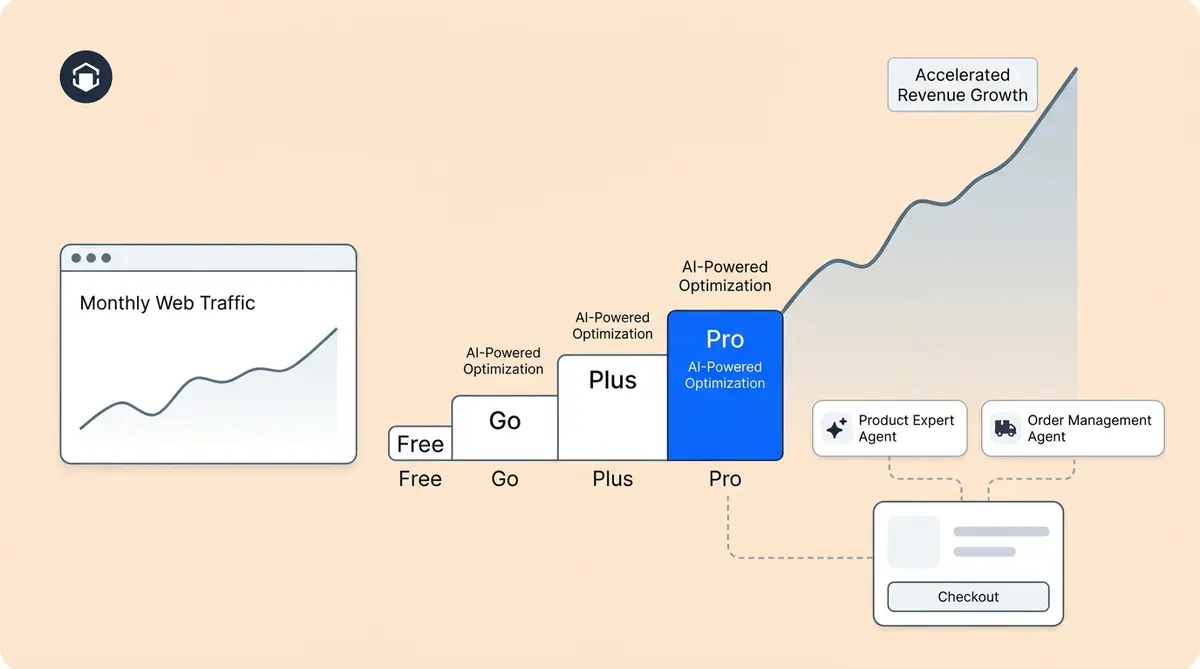
ChatGPT referral traffic to ecommerce sites grew about 40% over the past year. Revenue from that same traffic grew about 130%. When revenue outpaces traffic by three to one, the channel isn't just getting bigger — each visitor is becoming worth more.
That gap is the most useful signal in AI commerce right now, and most brands aren't measuring it. They track how many visitors ChatGPT sends. They don't track whether those visitors are becoming more valuable.
[SOURCE] — attach the named source and measurement window for the 130% / 40% figures here before publishing.
What does the 130% versus 40% gap actually mean?
If traffic grows 40% and conversion stays flat, revenue grows 40%. That's addition.
But if traffic grows 40% while conversion rate and average order value both improve, the effects multiply. Traffic up 40%, conversion up 25%, and AOV up 15% compounds to revenue growth above 100% — from the same traffic number.
No paid channel behaves this way. Google Ads and Meta Ads scale by spending more; per-visitor value stays roughly flat. AI referrals grow in volume and in per-visitor value at the same time.
Why is conversion quality rising?
Three mechanisms, each independently observable.
1. Shopping integrations matured
A year ago ChatGPT's product recommendations were close to a conversational web search. Today the platform reads structured product feeds, parses specifications, and presents shortlists matched to stated requirements.
By the time a shopper clicks through, they have seen your specs, a summary of your reviews, and confirmation the item fits their needs. They arrive further down the funnel than any paid search click.
2. Recommendation accuracy compounds
Each interaction refines what "good fit" means for a given query. The same question asked in March 2026 gets a better answer than it did in March 2025 — not because products changed, but because intent parsing improved.
Better recommendations produce higher conversion. Higher conversion generates more transaction signal. More signal trains better recommendations.
3. Shopper behaviour shifted from browsing to buying
Early AI shoppers were explorers who treated ChatGPT as a research tool. Today's arrive knowing the product name, the variant and the expected price.
Adobe's 2025 holiday analysis found AI-referred visitors bounced less, viewed more product pages and stayed longer on site than visitors from traditional channels.
Verify the exact Adobe percentages and link the source directly rather than paraphrasing.
What does this look like in Alhena's own data?
Our study of 310 brands measured the same pattern from the merchant side. Three conversion rates, all from one dataset, US, October 2025 to April 2026.
| Visitor segment | Conversion rate | Versus organic |
|---|---|---|
| Organic search | 1.07% | baseline |
| All LLM-referred traffic | 2.68% | 2.5x |
| LLM-referred + engaged with on-site assistant | 9.84% | 9.2x |
Two things are stacking here. AI referrals arrive with more intent than organic search — that's the 1.07% to 2.68% step. Then engagement with an on-site assistant coincides with a further large increase.
That second step is an association, not a proven cause. Shoppers who choose to engage with an assistant are already further along in their decision, so some of the gap reflects who engages rather than what engagement does. We report it as a correlation because that is what the data supports.
Provider matters too. Perplexity's average order value ran 82% above ChatGPT's in the same dataset — which is why volume and value need separate forecasts.
What changes over the next 12 to 24 months?
Three developments will push per-visitor value higher.
- Checkout keeps moving. OpenAI discontinued in-chat Instant Checkout in March 2026, but Google and Shopify's Universal Commerce Protocol is pushing the opposite direction in AI Mode and Gemini. Wherever checkout friction falls, conversion rises.
- Product data parsing is getting granular. Engines are moving past title-and-price scraping into fabric composition, compatibility matrices, ingredient breakdowns and fit prediction. Rich structured data becomes a ranking asset, not a compliance chore.
- Recommendations are spreading across surfaces. Voice assistants, social channels and messaging platforms each add touchpoints where high-intent shoppers can discover and buy.
What can you actually control?
Product feed quality
Clean titles, accurate pricing, complete variant data, high-resolution images. Feeds treated as compliance documents lose to feeds treated as sales assets.
Structured data completeness
Schema markup and specification tables give engines the raw material to match products to queries. Missing attributes mean missed recommendations.
Review depth, not just volume
Engines weigh recency, specificity and sentiment. Two hundred detailed reviews outperform two thousand vague ones.
On-site continuation
The Alhena AI Shopping Assistant picks up where the AI conversation left off — grounded in your catalogue, no invented answers.
The first three determine whether you get the click. The fourth determines what happens to it.
Key takeaways
- Revenue from ChatGPT traffic is growing roughly three times faster than the traffic itself — the channel is improving in quality, not just scale.
- Small compounding gains produce large results. 40% traffic × 25% conversion × 15% AOV is roughly 100% revenue growth.
- Alhena's 310-brand data shows the same pattern: organic converts at 1.07%, LLM traffic at 2.68%, engaged LLM visitors at 9.84%.
- The engagement lift is a correlation, not proof of causation — shoppers self-select into engaging.
- Traffic volume is the wrong headline metric. Track revenue per AI session and whether it is rising quarter over quarter.
Measure revenue per session, not sessions
Alhena separates AI channel performance from everything else, so you can see whether each cohort is getting more valuable.
Frequently asked questions
Because conversion rate and average order value are rising at the same time as visitor volume, and those effects multiply rather than add. Traffic up 40%, conversion up 25% and AOV up 15% compounds to roughly 100% revenue growth. Shopping integrations maturing, recommendation accuracy compounding, and shoppers arriving with transactional rather than exploratory intent all contribute.
Across 310 brands in the US from October 2025 to April 2026, LLM-referred traffic converted at 2.68%, versus 1.07% for organic search — ranking fourth of 13 tracked channels, ahead of Google Ads at 1.87%. LLM visitors who engaged with an on-site assistant converted at 9.84%, though that is an association rather than a proven causal effect, since engaged shoppers self-select.
Track three things separately by AI source: revenue per session, conversion rate trend over time, and average order value trajectory. A rising session count with flat revenue per session means the channel is scaling but not improving. Alhena's revenue attribution separates AI channel performance from other traffic so you can see whether each cohort is becoming more valuable.
Prioritise clean product titles, complete variant data, real-time accurate pricing, detailed attribute markup and high-resolution images. AI platforms match products to queries using structured data rather than marketing copy, so missing attributes translate directly into missed recommendations. Feed accuracy matters more than feed size.
For volume, yes — ChatGPT accounts for roughly 96% of LLM referral traffic to ecommerce sites. For value per visitor, no. Perplexity's average order value ran 82% higher than ChatGPT's in the same dataset. The right allocation depends on your price point and how much research your buyers do before purchasing.