Site search users convert 4-6x higher than browsers. They're ready to buy and account for up to 30% of online revenue despite making up only 10-15% of traffic. Yet most online stores still rely on keyword-matching search engines built a decade ago.
If you're ready to explore site search solutions right now, the choices can feel overwhelming. Native platform search, third-party tools like Algolia, AI-powered engines. Each promises better results. But the differences in how they work, what they cost, and what they deliver for revenue are significant.
This 2026 guide breaks down the three main approaches to site search, compares them on the criteria that matter most, and gives you a decision framework for picking the right one.
How Ecommerce Site Search Works Today
Not all search engines work the same way. The market breaks into three tiers, each with different capabilities, price points, and tradeoffs.
Native Platform Search
Every major store platform ships with built-in search. Shopify, WooCommerce, and Magento all offer basic keyword matching out of the box. It's free, offers basic instant search, and requires zero setup. But "free" comes with limits: no synonym handling, no typo tolerance, and poor results for anything beyond exact product-title matches.
For stores with fewer than 200 SKUs and simple catalogs, native search can work. Once your catalog grows or your customers start asking real questions, it breaks down fast.
Dedicated Search Tools
Algolia, Bloomreach, Searchspring, and Klevu represent the second tier. These brands serve mid-market stores. These site search solutions add autocomplete, instant search results, synonym dictionaries, faceted filtering, and merchandising rules. They're a major step up from native search and handle most standard queries well.
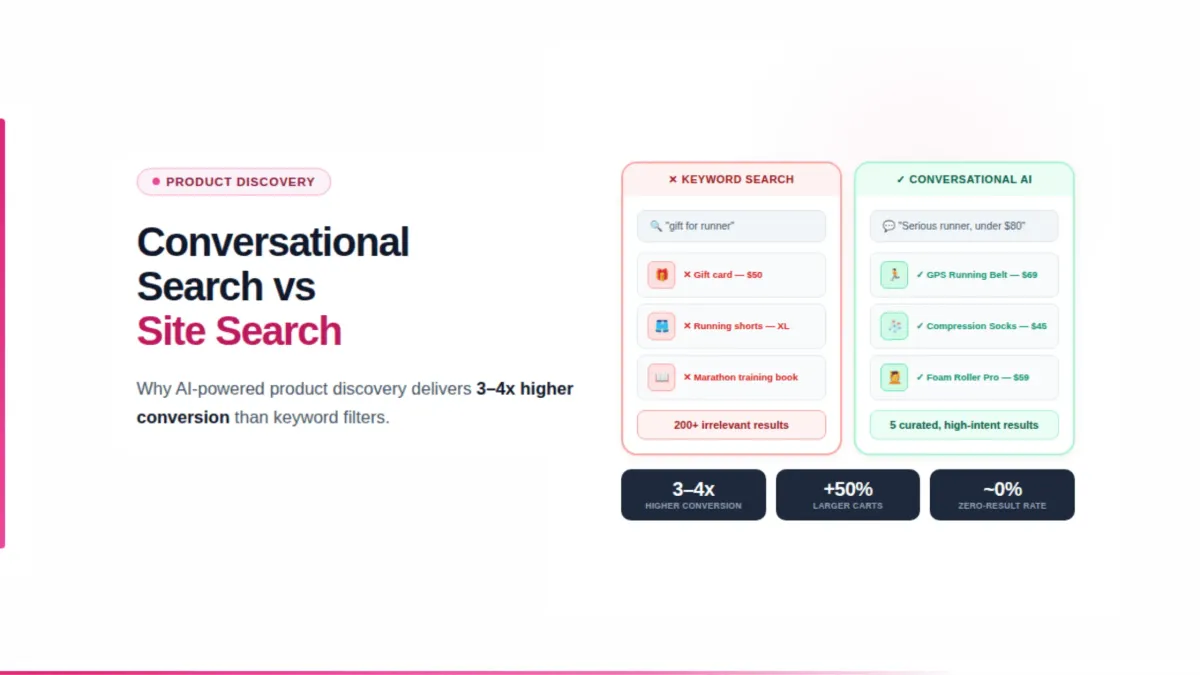
The catch: they're still rule-based at their core. Every synonym, redirect, and merchandising rule needs manual configuration. When a shopper types "something warm for a ski trip," these tools don't understand intent. They match keywords.
AI-Powered Conversational Search
The newest tier uses large language models and deep catalog integration to understand what customers actually mean. Instead of matching keywords to product titles, an AI-powered AI search engine interprets intent, handles follow-up questions, and guides customers toward the right product.
This is where the market is heading. Gartner projects that by 2026, over 50% of online search interactions will involve some form of AI-driven understanding beyond simple keyword matching. Forward-thinking brands are already seeing the revenue impact, creating cross-sell opportunities, which is why this category is growing faster than any other ecommerce site search segment.
Why Keyword-Based Ecommerce Site Search Fails
The gap between what shoppers type and what keyword search engines return is the single biggest source of lost revenue in online retail. Here's where it breaks down.
Zero-Result Queries Kill Conversions
Industry data shows that 10-15% of site searches return zero results. That's not because the store doesn't carry what the shopper wants. It's because the search engine can't match the query to the right products. A customer searching "moisturizer for dry winter skin" gets nothing, even though the store carries five relevant products listed under "hydrating cream" and "intense moisture balm."
Each zero-result page is a lost sale. Baymard Institute research shows that 68% of visitors leave a site after a failed search rather than trying a different query.
Keyword Matching Ignores Context
Traditional search engines treat every query as an isolated string of words. They can't tell the difference between "light jacket" (weight) and "light jacket" (color). They don't understand that "gift for my mom who likes cooking" requires reasoning about multiple attributes: recipient, occasion, and interest category.
This forces visitors into a frustrating loop, making it harder to explore products through filtering and re-searching. Baymard's UX research found that 70% of search engines can't return useful results for product-type queries that use subjective or compatibility-related terms.
Filter Fatigue Drives Abandonment
When search fails, stores push users toward filters. But filter-heavy interfaces create their own problems. The average online store offers 6-10 filter categories, and users who don't know the exact brand, material, or product-type name get stuck.
Mobile buyers, who now make up over 60% of online traffic, face an even worse experience scrolling through filter menus on small screens. The result: higher bounce rates and lower revenue per session and product discovery on the devices where most of your traffic comes from.
What to Look for in an Ecommerce Site Search Solution
Whether you're upgrading from native search or switching from an existing tool, here's what separates a good search engine for your store from a great one.
Semantic Understanding
Synonym dictionaries aren't enough. The best site search software uses natural language processing to understand intent, not just keywords. "Breathable running shoes for flat feet" should return results ranked by relevance to all three attributes, not just products with "running shoes" in the title.
Multi-Turn Conversation Support
Real shopping decisions happen over multiple exchanges. A customer starts with "winter boots," then narrows to "waterproof," then asks "do these run large?" The best site search holds context across these exchanges instead of treating each query as brand new. Learn more about how conversational commerce changes how customers buy.
Deep Catalog Integration
Surface-level search indexes product titles and maybe descriptions. A strong product search engine indexes down to the SKU level: variant attributes, inventory status, pricing tiers, reviews, and structured specifications. This depth is what allows AI search to deliver personalization and answer "which of your vitamin C serums has the highest concentration?" with a precise answer.
Conversion Analytics and Revenue Attribution
You can't improve what you can't measure. Look for site search solutions that track revenue per search session, not just click-through rates. The difference matters: a search tool might show high CTR on autocomplete suggestions while actually directing buyers toward lower-margin products.
The best site search engines also surface zero-result query reports, popular search terms, and conversion funnels by search path. This data reveals revenue opportunities, tells you not just how search performs, but where your catalog has gaps and which product pages need better content.
Omnichannel Support
Your search engine shouldn't live only on your website. Shoppers interact across email, SMS, social, and chat. An ecommerce site search solution that extends to these channels creates a consistent experience everywhere your customers are.
Setup Time and Maintenance
Some search tools require months of configuration, synonym tuning, and ongoing rule management. Others deploy in days and learn from your catalog automatically. Factor in the total cost of ownership, including the engineering hours you'll spend maintaining rules and mappings, not just the subscription price. Check out our setup and deployment guide for a deeper look at the technical side.
Comparing Ecommerce Site Search Approaches
Choosing a search engine for your online store means weighing cost, capability, and maintenance burden. Here's how the three main approaches stack up across the criteria that matter most for revenue.
Native Platform Search (Shopify, Magento, WooCommerce)
- Cost: Free, included with platform
- Semantic understanding: None. Exact keyword matching only
- Typo tolerance: Minimal or none
- Synonym handling: Manual, limited
- Conversational queries: Not supported
- Setup time: Zero
- Best for: Small catalogs under 200 SKUs with simple, well-named products
Dedicated Search Tools (Algolia, Bloomreach, Searchspring, Klevu)
- Cost: $500-$5,000+/month depending on query volume
- Semantic understanding: Limited. Relies on configured synonyms and rules
- Typo tolerance: Good
- Synonym handling: Manual dictionaries, requires ongoing maintenance
- Conversational queries: Basic autocomplete, no multi-turn support
- Setup time: 2-8 weeks for full configuration
- Best for: Mid-market stores that need better search but have resources to manage rules
AI-Powered Search (Alhena AI)
- Cost: Varies by plan; ROI-positive within weeks for most stores
- Semantic understanding: Full natural language understanding via LLMs
- Typo tolerance: Excellent, understands intent beyond typos
- Synonym handling: Automatic. No manual dictionaries needed
- Conversational queries: Full multi-turn conversation with context retention
- Setup time: 48 hours to live
- Best for: Stores that want search to actively drive revenue, not just return results
The ROI of Better Ecommerce Site Search
Upgrading your store's search engine directly impacts revenue. The data is clear across multiple studies and real-world case studies. Here are the four biggest areas where better better site search moves the needle.
Conversion lift: Stores that move from keyword-based to AI-powered site search see 3-4x higher conversion rates among search users. Tatcha, the luxury skincare brand, saw measurable conversion increases after deploying AI-powered search and support.
Average order value: AI AI search engines can recommend complementary products within the search conversation. This drives 25-50% higher average order values compared to standard search. Victoria Beckham Beauty saw similar AOV gains through AI-guided product discovery.
Support cost reduction: When search actually works, fewer customers contact support with "I can't find X" queries. Puffy reduced support ticket volume while increasing conversion after adding AI-powered search. The AI support concierge handles the queries that do come through.
Reduced bounce rate: Zero-result pages are the number one cause of search-related bounces. AI-powered search virtually eliminates them by understanding intent rather than matching exact strings.
Faster time to purchase: AI-powered site search engines reduce the number of searches per session by getting shoppers to the right product faster. Less searching, reduced filter adjustments, and minimal dead ends mean a shorter path from landing page to buy and checkout. Use the ROI calculator to estimate the total revenue impact for your store.
How Alhena AI Delivers the Best Ecommerce Site Search
Alhena AI was built specifically as an site search engine that sells, not just one that returns results. Here's what makes it different from both native search and rule-based tools.
Hallucination-Free Product Answers
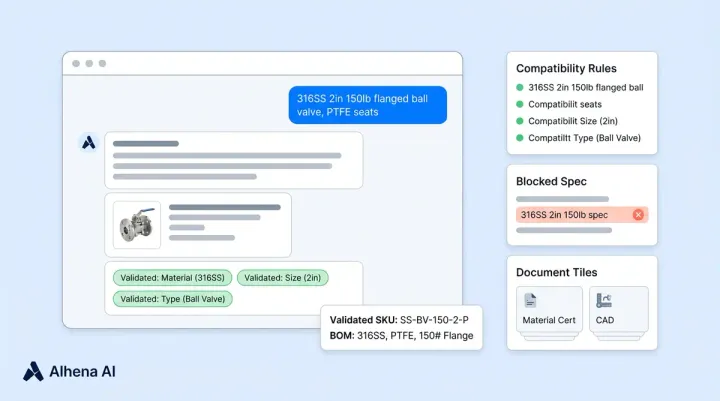
Unlike general-purpose AI chatbots, Alhena grounds every response in your actual catalog data. It won't invent product features, fabricate availability, or recommend items you don't carry. Every answer maps directly to real SKUs with real attributes, enabling true personalization. This is a critical distinction: many AI search tools bolt a language model on top of existing search without verifying accuracy, which leads to wrong recommendations and eroded shopper trust.
SKU-Level Catalog Sync
Alhena indexes your entire catalog down to individual variants: sizes, colors, stock levels, pricing, and specifications. When inventory changes, the search index updates automatically. No manual re-indexing or stale results. Instant search updates keep results accurate. A shopper asking "do you have the blue version in size 8?" gets a real-time answer based on current stock, not last week's data.
Omnichannel Deployment
The same AI search engine powers your website, email responses, SMS interactions, and social channels. A shopper who starts a search on your Salesforce Commerce Cloud site can continue the conversation on chat without losing context.
48-Hour Setup
Most site search software takes weeks to configure. Alhena lets you connect to your catalog, learns your product data, applies personalization automatically, and goes live in under 48 hours. No synonym dictionaries to build, no merchandising rules to write, no engineering sprint required. Your team can focus on selling, not configuring search rules.
Revenue Attribution Built In
Every search session tracks through to purchase. You can see exactly which search queries generate revenue, which products get recommended most, and where customers drop off. This closes the loop between search performance and business outcomes. Read more about how AI shopping agents fix the missing revenue layer in retail tools.
Making the Switch: Migration Considerations
If you're running Algolia, Searchspring, or native platform search today, switching to AI-powered site search is simpler than you might expect.
Data migration: Alhena lets you pull directly from your store platform's product feed. There's no need to manually export and re-import catalog data. If you're on Shopify or WooCommerce, the integration with your online store is native.
Existing search analytics: Export your top search queries and zero-result queries from your current tool before switching. This gives you a baseline to measure improvement against.
Phased rollout: You don't have to go all-in on day one. Many stores run AI search alongside their existing tool for a test period, directing a percentage of traffic to each. The conversion data reveals clear opportunities and speaks for itself within weeks.
SEO considerations: Your search engine can impact SEO if search result pages are indexed. Make sure your new search tool supports proper canonical tags and doesn't create duplicate content issues with search-generated URLs.
Team training: AI-powered search requires less ongoing management than rule-based tools, but your merchandising team should still understand how the system works. Most teams find the transition straightforward since there are less rules to maintain, not more.
Learn more about how virtual shopping assistants work alongside your existing tech stack.
The Bottom Line
Site search is no longer a "good enough" feature. It's a revenue channel. In 2026, the stores that treat it as one, by investing in search that understands intent, enables search personalization, guides product discovery, and measures results, consistently outperform those that don't.
Native platform search is fine for tiny catalogs. Dedicated tools like Algolia and Bloomreach improve the basics. But if you want an website search engine that actually sells, AI-powered site search is the clear next step.
Book a demo to see how Alhena AI can boost your search performance and turn your site search into your top-performing sales channel. Or start your free trial and go live in 48 hours.

Frequently Asked Questions
What is ecommerce site search?
Ecommerce site search is the search functionality on an online store that helps shoppers find products. It ranges from basic keyword matching (built into platforms like Shopify and Magento) to AI-powered search engines that understand natural language and shopper intent. Better site search directly increases conversion rates and average order values.
What is the best ecommerce site search solution?
The best ecommerce site search solution depends on your store's size and goals. For small catalogs, native platform search works. For mid-market stores, tools like Algolia and Bloomreach add autocomplete and synonyms. For stores focused on maximizing revenue per search session, AI-powered solutions like Alhena AI deliver the highest conversion rates through semantic understanding and conversational search.
How does AI-powered ecommerce site search differ from Algolia or Bloomreach?
Algolia and Bloomreach rely on manually configured synonym dictionaries and merchandising rules. AI-powered ecommerce site search uses large language models to understand shopper intent without manual rules. It handles complex queries like 'gift for my mom who likes gardening,' supports multi-turn conversations, and learns from your catalog automatically instead of requiring ongoing rule management.
How much does ecommerce site search software cost?
Native platform search is free. Dedicated tools like Algolia and Searchspring typically cost $500-$5,000+ per month depending on query volume and features. AI-powered ecommerce site search solutions vary by plan and store size. The key metric isn't subscription cost but ROI: stores using AI search typically see 3-4x higher conversion rates among search users, making the investment pay for itself quickly.
Can I use an ecommerce search engine on Shopify?
Yes. Most ecommerce site search solutions integrate with Shopify, either through native apps or API connections. Alhena AI offers a direct Shopify integration that connects to your product catalog, syncs inventory in real time, and goes live in under 48 hours without requiring any custom development.
What is a good conversion rate for ecommerce site search?
Shoppers who use site search convert at 4-6x the rate of shoppers who browse without searching. With basic keyword search, conversion rates among searchers typically range from 4-8%. AI-powered ecommerce site search can push search-user conversion rates to 12-20% or higher by understanding intent and guiding shoppers to the right products.
How long does it take to set up an ecommerce site search solution?
Setup time varies widely. Native platform search requires no setup. Dedicated tools like Algolia typically take 2-8 weeks for full configuration, including synonym dictionaries and merchandising rules. AI-powered solutions like Alhena AI can go live in 48 hours by connecting directly to your product catalog and learning your data automatically.
Does ecommerce site search work on mobile?
It should, but many search tools weren't designed for mobile-first experiences. With over 60% of ecommerce traffic coming from mobile devices, your search engine for ecommerce needs to work well on small screens. AI-powered conversational search is especially effective on mobile because shoppers can describe what they want in natural language instead of scrolling through filter menus.