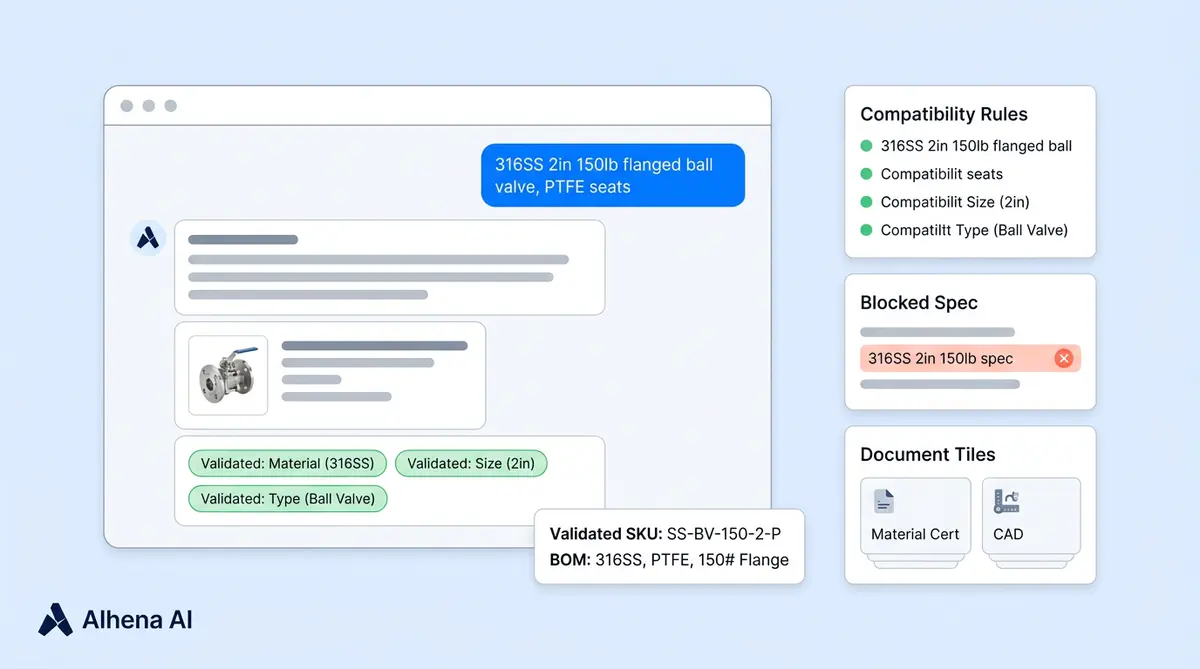
A buyer needs a 316 stainless steel valve, 2-inch flange connection, rated to 150 PSI, with PTFE seals. In most B2B catalogs, that's four separate filter menus, a compatibility matrix buried in a PDF, and a phone call to confirm the assembly actually works. According to McKinsey, B2B companies lose 20 to 30 percent of potential revenue to process inefficiencies like these. AI guided selling solutions for product configuration change the math by turning that multi-step research project into a single conversation that helps close deals.
This post covers how conversational AI handles configurable products, validates technical specs in real time, and catches errors before they reach the quote stage. It's the configuration-specific companion to our broader guide on AI for B2B ecommerce.
The B2B Configuration Problem
Configurable products are the norm in industrial distribution, manufacturing, MRO, and B2B ecommerce. A single product family can have hundreds of valid combinations across dimensions like size, material, finish, pressure rating, and connection type. Buyers and customers spend hours cross-referencing spec sheets, and sales reps field the same compatibility questions from users repeatedly, pulling sales reps away from sales enablement activities.
The cost isn't just time. Configuration errors slip through when buyers pick incompatible options, and those mistakes surface as returns, rework, and stalled projects. For complex assemblies with ten or more components, the error rate on manual configurations can run above 15 percent.
Traditional product configurators help, but they're rigid. They force buyers through dropdown trees that don't account for how engineers actually think about specs. A buyer doesn't start with "Category > Subcategory > Option A." They start with "I need something that handles 400°F and bolts onto an ANSI Class 300 flange."
How AI Guided Selling Works for Configurable Products
A complex, AI powered product configurator flips the interaction. Instead of navigating menus, buyers describe what they need in plain language. The AI agent maps that description and buyer behavior against a product knowledge graph, delivering personalized results that encodes every valid SKU combination, material property, and dynamic compatibility rule.
Say a buyer types: "I need a 316SS ball valve, 2-inch, 150 lb flange, with PTFE seats." The AI parses each parameter, validates that 316 stainless steel is available in that size and pressure class, confirms PTFE seat compatibility, and delivers the exact SKU with a complete assembly breakdown.
Alhena's AI Shopping Assistant works this way. It connects to your existing enterprise ERP or CPQ system and layers conversational guided selling on top. The product knowledge graph holds your full catalog, including configurable attributes, valid combinations, and interdependencies between components. Customers get personalized guidance and answers without waiting for a rep to check the catalog manually.
BOM Queries and Compatibility Checks in Real Time
One of the most time-consuming tasks in B2B buying is verifying that parts work together. "Does this compression fitting work with 1/2-inch 316 tubing?" "What gasket material do I need for a steam application at 250°F?" These questions typically go to engineering or applications teams, and answers take hours or days. When you use AI to handle them, the wait disappears.
A technical product configuration chatbot handles them instantly. The AI agent cross-references bill-of-materials data, material compatibility tables, and dimensional specs to confirm or flag mismatches on the spot. If a buyer selects a fitting that doesn't match their pipe gauge, the AI catches it immediately, gives the customer a clear decision point, and speeds up product discovery by suggesting a personalized alternative.
This is the same knowledge base architecture that powers Alhena's product expertise across ecommerce, applied to the specific demands of industrial ecommerce catalogs.
Spec Sheet and Technical Document Retrieval
B2B buyers don't just want product recommendations. They need supporting documentation: material data sheets, pressure-temperature ratings, certifications (ASME, CE, UL), installation guides, and CAD files. Traditionally, that means digging through a document library or emailing a rep.
With AI, the customer asks "Show me the material cert for this valve" or "I need the CAD file for the 4-inch version," and the AI surfaces the right document from your content library. No portal navigation, no waiting, no bottleneck. Sales agents and buyers both save time when they use AI for document retrieval. The intelligence is built into the conversation. Alhena's AI indexes your full document set alongside product data, so technical document retrieval is part of the same conversation as configuration.
Cross-Sell and Upsell During Configuration
When a buyer configures a valve assembly, they almost certainly need gaskets, bolting, and possibly actuators. A guided selling AI recognizes these patterns and suggests personalized complementary parts, accessories, and maintenance kits based on what's being built.
This isn't generic "customers also bought" logic. The recommendations are configuration-aware, personalized to the buyer’s application, and they lift AOV by bundling the right accessories at the point of configuration. If the buyer selects a high-temperature application, the AI recommends graphite gaskets instead of rubber. If they're building a control loop, it suggests the compatible positioner or a bundle of related components. The approach mirrors how guided selling works in DTC, but adapted for complex product relationships.
Reducing Configuration Errors Before the Quote Stage
Every invalid configuration that reaches a quote creates rework. Sales reps catch the error, email the buyer, and the cycle restarts, wasting sales reps’ time and lead generation effort. When it slips past the quote into an order, the cost multiplies through returns, restocking, and project delays.
An AI custom product builder validates every selection against your business rules in live, real-time checks. Invalid combinations are automatically blocked with a clear explanation ("316SS isn't available in 6-inch for this product line, but 304SS and duplex are"). The buyer makes a faster decision and corrects course immediately, not three days later when a rep reviews the order.
For companies evaluating whether to build this capability in-house or adopt a solution, our build vs. buy framework breaks down the tradeoffs.
Where Alhena Fits in Your Stack
Alhena's ecommerce AI sits as a guided selling layer on top of your existing ecommerce systems. It connects to your enterprise ERP for inventory and pricing data, your CPQ for configuration rules, and your CMS, PIM, CRM, or other platforms for product content and documents. The AI doesn't replace those systems. It makes them accessible through conversation, turning your product catalog into a sales enablement and buyer enablement tool that works 24/7.
Deployment takes under 48 hours, and you can optimize the AI’s responses as your catalog changes. Once you use AI this way, your catalog, configuration rules, enablement content, and product documents are indexed into Alhena's product knowledge graph. From there, users interact through web chat, email, or WhatsApp, and every response is grounded in your verified data, not hallucinated specs. Your sales agents and buyers both benefit from the same single source of truth, and built-in analytics show which configurations convert best. Configuration analytics also reveal which product combinations generate the highest AOV, giving your sales teams actionable analytics to close deals more effectively.
Ready to give your B2B buyers a faster path through complex configurations? Book a demo with Alhena AI or start for free with 25 conversations.

Alhena AI
Frequently Asked Questions
What is AI guided selling for product configuration?
AI guided selling uses conversational AI and a product knowledge graph to walk B2B buyers through configurable product selections. Instead of navigating dropdown menus, buyers describe their requirements in natural language, and the AI validates every parameter against your catalog's compatibility rules before returning a matched SKU.
How does a technical product configuration chatbot handle BOM queries?
The AI powered chatbot cross-references bill-of-materials data, material compatibility tables, and dimensional specifications in real time. When a buyer asks whether a specific fitting works with a given pipe gauge or tubing size, the AI confirms compatibility or flags the mismatch instantly, with no need to route the question to engineering.
Can AI guided selling reduce configuration errors in B2B orders?
Yes. AI validates every selection against your business rules before the configuration reaches the quote stage. Invalid combinations are blocked with clear explanations and alternative suggestions. This catches errors that would otherwise result in returns, restocking costs, and project delays, helping sales reps close deals cleanly.
How does Alhena AI connect to existing ERP and CPQ systems?
Alhena sits as a conversational layer on top of your existing stack. It connects to your enterprise ERP for inventory and pricing data, your CPQ for configuration rules, and your PIM or CMS for product content. Once you use AI this way, your catalog, configuration rules, enablement content, and product documents are indexed into Alhena's product knowledge graph, and deployment takes under 48 hours.
What types of technical documents can AI retrieve during a product configuration conversation?
AI can surface material data sheets, pressure-temperature ratings, certifications like ASME and CE and UL, installation guides, and CAD files. Buyers ask for specific documents in the same chat where they're configuring products, and the AI pulls the right file from your indexed content library.
How does AI cross-sell during complex product configuration?
The AI recommends complementary parts, accessories, and maintenance kits based on the specific configuration being built. Recommendations are context-aware. For a high-temperature valve assembly, the AI provides tailored suggestions, the AI suggests graphite gaskets instead of rubber, and for a control loop, it recommends the compatible positioner.
Is AI guided selling only for industrial or manufacturing products?
No. Any enterprise selling configurable products benefits from AI guided selling, including furniture manufacturers with custom dimensions, industrial manufacturers with modular assemblies, electronics distributors with modular components, and commercial HVAC suppliers. The approach works wherever buyers need to select from multiple interdependent product attributes.