Shopping queries on AI platforms grew 4,700% between 2024 and 2025. ChatGPT now drives 97% of all LLM-referred commerce traffic, and AI-referred traffic converts at 2.47%. If you sell products online, the question isn't whether to invest in an AEO tool for ecommerce. The question is which one.
Profound and Alhena AI Visibility both track how brands achieve search visibility in AI answers, but they come at the problem from opposite directions. Profound built the category's most powerful brand-monitoring engine, backed by $58.5 million in funding from Sequoia and Kleiner Perkins. Alhena built a commerce-native platform that tracks individual products, not just brand mentions, and connects visibility data to actual revenue.
Among the growing category of AEO and GEO tools for ecommerce, these two AEO tools take fundamentally different approaches to optimization. AEO tools built for brand monitoring solve a different problem than AEO tools built for product catalogs. This post breaks down both across five dimensions: who they're built for, tracking depth, ecommerce features, revenue attribution, and content tools. If you're evaluating a geo tool for ecommerce or searching for a Profound alternative built for retail and ecommerce, this comparison will help retailers and ecommerce leaders decide.
Alhena AI Visibility vs Profound: At a Glance
| Alhena AI Visibility | Profound | |
|---|---|---|
| Built for | Ecommerce / DTC brands | B2B / Enterprise (ecommerce add-on) |
| SKU-Level Tracking | Core feature | Add-on module (Shopping Analysis) |
| AI Engines Covered | 5+ (ChatGPT, Gemini, Perplexity, Google AI Overviews) | 10+ (adds Copilot, DeepSeek, Grok, Meta AI) |
| Revenue Attribution | Yes, tied to on-site conversions | No |
| Ecommerce Integrations | Shopify, WooCommerce, Magento, SFCC | None |
| Catalog Sync | Real-time pricing, inventory, variants | No |
| Content Tools | AEO FAQ Engine + GEO Citation Strategy | Prompt gap analysis + content agents |
| Best For | Product revenue from AI channels | Brand share of voice in AI answers |
What Profound Does Well
Profound earned its G2 Leader badge and 500+ enterprise clients for good reasons. The platform tracks brand visibility across 10+ AI engines: ChatGPT, Perplexity, Google AI Overviews, Google AI Mode, Gemini, Microsoft Copilot, DeepSeek, Grok, and Meta AI. That's the widest engine coverage of any AEO tool on the market.
Three proprietary data vectors set Profound apart. First, the company sends millions of daily prompts to answer engines like ChatGPT and Perplexity and collects real-time citation data. Second, CDN integrations with Cloudflare, Vercel, Fastly, and others analyze AI crawler behavior across billions of data points. Third, Profound taps into 130 million+ GDPR-compliant user conversations, updated weekly.
The result is a dataset no competitor can match at the brand level: 2.6 billion total AI citations analyzed, 5 million+ new citations daily, and 400 million+ real user conversations. Their "Prompt Volumes" feature works like keyword research for AI search, showing brands which queries surface their competitors. For B2B companies like Ramp, DocuSign, MongoDB, and Figma, this intelligence is gold.
Profound also launched a Shopping Analysis module in 2026, signaling that the company recognizes ecommerce and agentic commerce as its next frontier. The module tracks which products appear in AI shopping conversations, captures product images and placement, and monitors visibility rates.
Where Brand-Level AEO Falls Short for Ecommerce
Here's the core problem: knowing your brand was "mentioned" by ChatGPT tells ecommerce teams almost nothing actionable.
Say you run a skincare brand with 200 SKUs. A brand-level AEO tool tells you ChatGPT mentioned your brand 47 times last week. That sounds positive. But which products did it recommend? Was the pricing accurate? Did it surface your $120 serum or your $8 travel-size moisturizer? Did it render a clickable product card with ratings, or just drop your name in a text paragraph? Was the product even in stock?
Brand-level monitoring can mark a "mention" as a win while the AI actually recommends a discontinued item, a low-margin accessory, or positions a competitor as the better choice. As the case for SKU-level visibility shows, a product rendered as a rich card with image, price, and ratings converts at a fundamentally different rate than one buried in a text paragraph.
Profound's Shopping Analysis module is a step toward solving this. But it's an add-on to a platform built for B2B brand monitoring, not a core architecture designed around product catalogs from day one. It doesn't connect to your ecommerce platform, doesn't sync with your live catalog, and doesn't attribute visibility to revenue.
What Alhena AI Visibility Does Differently
Alhena AI Visibility was built for one use case: helping ecommerce brands understand and improve how their products appear in AI search. Every feature traces back to the product catalog.
SKU-Level Product Tracking
Instead of monitoring brand mentions, Alhena tracks individual products across ChatGPT, Gemini, Perplexity, and Google AI Overviews. The platform shows which SKUs get recommended for which shopper queries, whether pricing and availability are accurate, and how each product is positioned (premium, affordable, best value). If ChatGPT recommends your competitor's running shoe when someone asks for "best cushioned running shoes under $150," you'll know.
Product Rendering Analysis
Not all AI citations are equal. Alhena's rendering analysis evaluates whether products display as full product cards (image, price, ratings, buy button) or as plain text mentions. This distinction drives real differences in click-through and conversion rates. The platform also checks if the displayed price, rating, and specs actually match your current catalog data.
Invisible Bestseller Detection
This is one of the most immediately actionable features in the AI visibility category. Alhena cross-references your on-site sales data with AI discoverability. Products that sell well on your store but never appear in AI answers get flagged automatically. These are your biggest untapped answer engine optimization opportunities: proven demand, zero AI presence.
First-Party Data Advantage
Alhena operates on both sides of the customer journey. Its AI Shopping Assistant and Support Concierge handle real conversations with consumers and shoppers across web chat, email, Instagram DMs, and WhatsApp. That first-party behavioral data (which products shoppers ask about, what questions they raise, what drives conversions) feeds directly into the AI Visibility intelligence layer. Profound relies entirely on external observation. Alhena sees what happens on your storefront.
Head-to-Head: Tracking Depth
Profound's tracking breadth is wider. Ten-plus AI engines vs. Alhena's five-plus. If you need to monitor DeepSeek, Grok, or Meta AI alongside the major platforms, Profound is the only option today.
Alhena's tracking goes deeper on the engines it covers. Where Profound tells you "your brand appeared in a ChatGPT shopping conversation," Alhena tells you "ChatGPT recommended your Vitamin C Serum (SKU: VC-30ML) at $48, rendered as a product card with 4.6 stars, positioned as 'best for sensitive skin,' and the user clicked through." That level of product-layer detail is what ecommerce merchandising, product management, and growth teams need.
For B2B brands tracking share of voice across every AI engine, Profound wins on breadth. For ecommerce brands tracking how specific products perform in AI recommendations, Alhena wins on depth.
Head-to-Head: Ecommerce Features
This is where the gap widens.
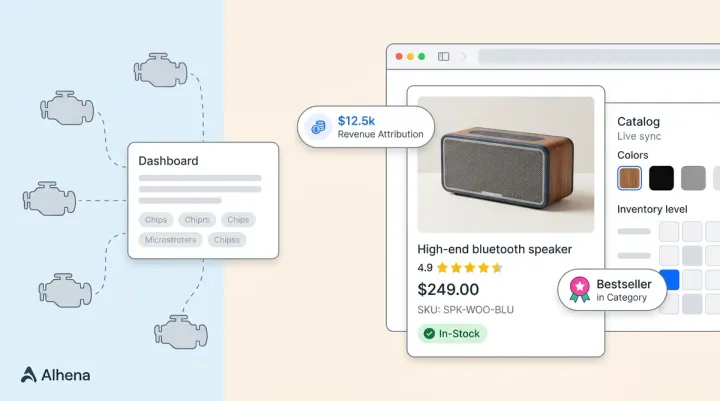
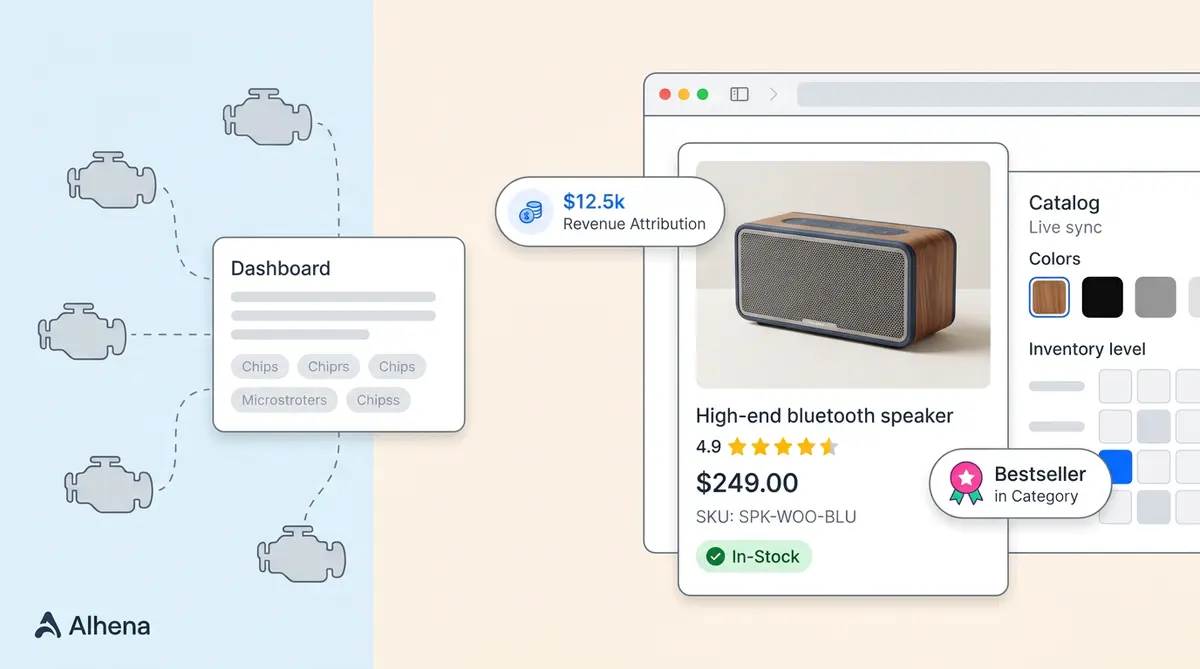
Alhena integrates directly with Shopify, WooCommerce, Magento, and Salesforce Commerce Cloud. Your product catalog syncs in real time: pricing, inventory, variants, product hierarchies. When a SKU goes out of stock, Alhena knows. When ChatGPT recommends that out-of-stock SKU, Alhena flags it. When you launch a new product, Alhena starts tracking its AI visibility immediately.
Profound has no ecommerce platform integrations. No catalog sync. No inventory awareness. The Shopping Analysis module captures what it observes from the outside, but it can't cross-reference against your live product data to identify accuracy gaps, stock mismatches, or pricing errors.
The invisible bestseller detection alone gives Alhena a distinct edge for retail operations teams. Imagine running a home furnishing store with 3,000 SKUs. Your best-selling $899 sofa never appears in AI answers because its product page lacks structured FAQ data and review schema. A brand-level tool won't catch that. Alhena flags it, tells you why, and shows you what to fix.
Head-to-Head: Revenue Attribution
Revenue attribution is where most AI visibility tools for ecommerce and AEO tools for ecommerce fall flat. According to a Conductor report, 94% of CMOs plan to increase their digital AEO and GEO investment in 2026. But without revenue attribution, proving ROI to the board means showing visibility scores and hoping leadership connects the dots.
Profound provides visibility scores, share of voice metrics, and competitive benchmarking. These are useful directional signals. They do not tell you which AI engine drove $47,000 in sales last month, or which product categories convert best from AI referral traffic.
Alhena closes this loop. Because the platform has first-party data from its shopping assistant (which handles real purchase journeys), it connects AI visibility to on-site behavior and actual conversions. You can see that ChatGPT-referred visitors who viewed your recommended running shoe converted at 9.84%, or that Perplexity referrals had a 57% higher average order value than ChatGPT referrals. As the LLM traffic attribution guide explains, monitoring without revenue attribution is a reporting exercise, not a growth strategy. Ecommerce teams need growth metrics tied to AI channels..
Head-to-Head: Content and Optimization Tools
Both platforms offer content optimization, but with different philosophies.
Profound's content tools analyze what prompts your brand is missing, then generate content recommendations and automated drafts to close the gap. The platform identifies 10-50 missing high-value prompts per brand and supports 30+ languages. This is strong for enterprise marketing teams running global brand campaigns. Growth teams and retail teams managing multilingual catalogs also benefit from the breadth..
Alhena offers two commerce-specific tools. The AEO FAQ Engine generates shopping-aligned Q&A pairs from your actual product data: ingredients, materials, sizing, compatibility, care instructions, and other product attributes. These aren't generic brand talking points. They're the specific questions shoppers and buyers ask before buying, formatted so AI engines can extract, trust, and cite them.
The GEO Citation Strategy tool maps which third-party publishers and review sites influence AI answers in your product categories. It identifies external sources causing "source pollution" (outdated reviews and product reviews with incorrect specs feeding into AI answers) and recommends targeted outreach. For brands in competitive verticals like beauty or fashion, knowing which publications drive AI citations is the difference between appearing and being invisible.
When to Choose Profound
Profound is the right choice when:
- You're a B2B or SaaS brand tracking share of voice across the widest set of AI engines
- You need enterprise security (SOC 2 Type II, HIPAA compliance, and trust certifications) as a procurement requirement
- Brand-level visibility is your primary KPI, not product-level performance
- You want the deepest prompt volume data for AI-specific keyword research
- You operate in regulated industries where compliance certifications are non-negotiable
Profound's client roster (Ramp, U.S. Bank, Indeed, DocuSign) reflects its strength: enterprise B2B brands that care about category authority in AI answers.
When to Choose Alhena AI Visibility
Alhena is the right choice when:
- You sell products online and need to track visibility at the SKU level, not just brand level
- You run on Shopify, WooCommerce, Magento, or Salesforce Commerce Cloud and want catalog-connected tracking
- Revenue attribution matters to your team, not just visibility scores
- You want to find invisible bestsellers that sell well on your store but never appear in AI answers
- You already use (or plan to use) an AI shopping assistant and want unified first-party data
- You operate in fashion, beauty, home furnishing, or DTC where product-level detail drives purchasing decisions
Alhena's client roster (Tatcha, Victoria Beckham Beauty, Huckberry, Ettitude) reflects its strength: ecommerce and DTC brands where every SKU counts. Tatcha saw 3x conversion rates and 38% AOV uplift using Alhena's AI platform.
The Bottom Line
Profound built the best brand-level AEO monitoring platform on the market. If you're tracking how your company appears across 10 AI engines and your primary concern is brand share of voice, it's hard to beat their data scale and engine coverage.
But for ecommerce, brand-level AEO misses the product layer. Knowing your brand was mentioned is not the same as knowing which product was recommended, whether the price was right, whether it rendered as a clickable card, or whether it drove a sale. Alhena AI Visibility was built from the ground up to answer those questions.
The AEO tool your ecommerce brand needs depends on what you're optimizing for. If the answer is "product revenue from AI channels," Alhena is the purpose-built solution for that job. As agentic commerce reshapes how consumers buy, McKinsey projects AI agents could mediate $5 trillion in commerce by 2030. The brands that track and improve their product-level AI visibility today will capture disproportionate share of that spend.
With agentic commerce protocols from OpenAI and Google connecting shoppers directly to product catalogs, AI visibility is no longer optional for retailers. Ready to see how your products appear in AI search? Book a demo with Alhena AI or start your free AI Visibility audit today.
Frequently Asked Questions
What is an AEO tool for ecommerce?
An AEO (Answer Engine Optimization) tool for ecommerce tracks how your products and brand appear in AI-powered search engines like ChatGPT, Perplexity, and Google AI Overviews. Unlike traditional SEO tools that monitor webpage rankings, an ecommerce AEO tool monitors whether AI engines recommend your specific products, display accurate pricing, and render clickable product cards. AI shopping traffic grew 4,700% between 2024 and 2025, making AEO a critical channel for online retailers.
How does Alhena AI Visibility differ from Profound for ecommerce?
Alhena AI Visibility tracks individual products at the SKU level, syncs with your ecommerce platform (Shopify, WooCommerce, Magento), and connects AI visibility to actual revenue through first-party data. Profound monitors brand-level mentions across 10+ AI engines with the industry's largest citation dataset (2.6 billion+). For ecommerce brands that need product-level tracking and revenue attribution, Alhena is purpose-built. For B2B brands focused on brand share of voice across the widest set of AI engines, Profound has stronger coverage.
What is the difference between AEO and GEO for ecommerce?
AEO (Answer Engine Optimization) focuses on getting your content cited as direct answers in AI-powered search results. GEO (Generative Engine Optimization) is broader: it covers all strategies for improving brand and product search visibility across generative AI experiences, including ChatGPT Shopping, Google AI Overviews, and Perplexity. For ecommerce, both matter. AEO helps your product pages become the source AI cites. GEO helps your products gain search visibility as recommendations when shoppers ask AI for buying advice.
Does Profound support Shopify or WooCommerce integration?
No. Profound does not integrate with ecommerce platforms like Shopify, WooCommerce, Magento, or Salesforce Commerce Cloud. Its Shopping Analysis module observes AI shopping conversations externally but cannot cross-reference product recommendations against your live catalog data, inventory levels, or pricing. Alhena AI Visibility connects directly to these platforms for real-time catalog sync.
What is SKU-level AI visibility tracking?
SKU-level AI visibility tracking monitors individual products (not just brand names) across AI search engines. It shows which specific products get recommended for which queries, whether pricing and specs are accurate, how each product is positioned relative to competitors, and whether the AI renders a rich product card on your digital shelf or a plain text mention. Brand-level tools only tell you your brand was mentioned. SKU-level tools tell you which product, at what price, in what position, and whether that drove a sale.
How much does Profound cost compared to Alhena AI Visibility?
Profound starts at 99/month for its Lite plan (ChatGPT only, 50 prompts, 1 seat) and 99/month for Growth (3 platforms, 100 prompts, 3 seats). Enterprise plans run ,000-5,000+ per month. Alhena AI Visibility pricing is not publicly listed but is bundled with its ecommerce AI platform. The average AI visibility tool costs 37/month according to industry benchmarks. Contact Alhena for a custom quote based on your catalog size.
Can AI visibility tools track how products appear in ChatGPT Shopping?
Yes. Both Alhena and Profound track product visibility in ChatGPT, which drives 97% of all LLM-referred commerce traffic. Alhena goes deeper by analyzing whether your products render as rich product cards (with images, prices, and ratings) or as text-only mentions, and checks if displayed information matches your live catalog. This rendering distinction matters because product cards convert at significantly higher rates than text mentions.
What is invisible bestseller detection?
Invisible bestseller detection is a feature in Alhena AI Visibility that automatically identifies products selling well on your store but receiving zero search visibility in AI. These products have proven customer demand but aren't being recommended by ChatGPT, Perplexity, or other AI engines. Fixing these gaps (often through better product page schema, FAQ content, or review signals) is the fastest way to grow AI-attributed revenue because the product-market fit already exists.
Is a Profound alternative worth considering for online stores?
If you run an online store, yes. Profound excels at brand-level monitoring across 10+ AI engines, but it lacks ecommerce platform integrations, catalog sync, revenue attribution, and product rendering analysis. For online retailers, these gaps mean you can't connect AI visibility to actual sales or verify that product data in AI answers is accurate. A commerce-native AEO tool like Alhena fills these gaps with SKU-level tracking tied directly to your store's catalog and revenue.
How do I measure ROI from an AI visibility tool?
The most reliable way is through closed-loop attribution: tracking which products AI engines recommend, then measuring whether those recommendations drive visits, add-to-carts, and purchases on your site. This requires first-party data from your storefront, not just external monitoring. Alhena connects AI visibility data to on-site conversion events. You can measure metrics like AI-referred revenue by engine, conversion rates by product category, and revenue impact of visibility improvements over time.