U.S. retailers processed $890 billion in returns in 2024, according to the National Retail Federation. For furniture brands, the math is brutal: shipping a sofa back costs $350 or more, and processing a single return can eat 20 to 65 percent of the item's original price. A $2,000 sectional return can cost a retailer up to $1,300.
The core problem is simple. Customers shopping online can't touch, sit on, or visualize furniture in their room. They're left guessing whether a dining table fits their breakfast nook or whether the fabric matches their wall color and existing decor. AI interior design technology is changing that equation — and the results are dramatic
The Imagination Gap in Online Furniture Shopping
The furniture industry calls it the "imagination gap." When a customer browses a product page, they see flat 2D photos on a white background. Even polished photography can't convey how a piece fits a living room layout, whether the rug coordinates with the floor, or how the cabinet color pairs with existing decor. Without a way to visualize scale and design style in context, customers either abandon their carts (the industry averages a 69.57 percent abandonment rate) or buy on impulse and return when reality doesn't match.
This gap is especially painful because furniture is a high-consideration purchase. A customer might spend weeks researching a dining set. If the piece arrives and doesn't fit the room, that's a costly return and a lost customer — NRF reports 71 percent of consumers avoid stores where they had a bad return experience.
The top reasons customers return furniture
- Size and spatial fit issues: the piece doesn't fit the room, doorway, or intended spot
- Color or style mismatch: the item looks different in person than it did on screen
- Quality or durability concerns: materials don't meet expectations set by product photos
- Transit damage: roughly 80 percent of furniture returns involve shipping damage
- Post-purchase doubt: buyers second-guess a high-ticket purchase without in-store validation
AI can directly address the first three causes, which together account for the majority of preventable returns.
How AI Product Recommendations Solve the Fit Problem
AI product recommendations for home furnishing go far beyond "customers who bought this also bought that." The concept behind modern recommendation engines is analyzing room layouts and dimensions, style preferences, existing decor, and budget constraints to surface products that genuinely fit the customer's space and taste.
Visual search and style matching
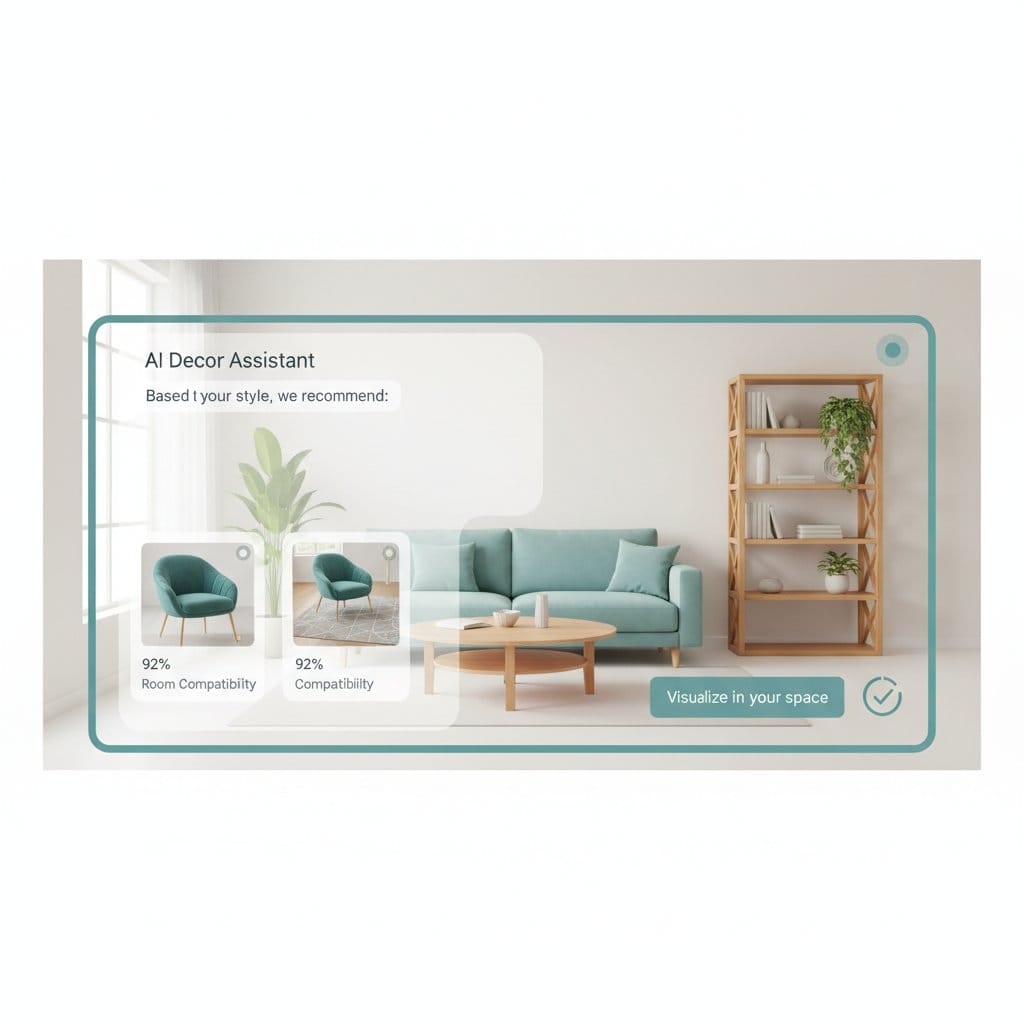
Customers upload a photo of their room, and AI identifies the style, color palette, and spatial layout. It then recommends furniture pieces that complement what's already there, rather than items that just happen to be popular. This approach cuts color and style mismatch returns by up to 58 percent, according to data from 1Center's AR research.
Size-aware recommendations
AI systems can factor in room measurements (provided by the customer or captured via phone camera) and filter out products that won't physically fit. This tackles the number-one reason for furniture returns head-on. With stunning product visuals paired with spatial-aware AI, brands have seen size-related returns drop by 71 percent.
Complete-the-look suggestions
Instead of selling one nightstand, AI recommends a coordinated bedroom set, matching the wood tone, hardware style, and design era. This "room solution" approach is something furniture retail analysts at Vaimo highlight as key to reducing mismatch returns while boosting average order value.
McKinsey reports that companies leading in personalization generate 40 percent more revenue than average performers. For home furnishing brands, personalized AI recommendations aren't just a return-reduction play; they're a growth engine.
AI Shopping Assistants: The Virtual Design Consultant
Product recommendations are powerful, but they're passive. They wait for the customer to browse. AI shopping assistants take a more active role, guiding customers through the decision-making process the same way a showroom associate would.
Think of it this way: a customer lands on your site looking for a sofa. An AI shopping assistant can ask what room it's for, what size works, whether they have kids or pets, and what style they prefer. Based on the answers, it helps shoppers explore the catalog and narrows 200 sofas to the perfect three in seconds the customer's life. That kind of guided discovery is what virtual shopping assistants do best.
The results speak for themselves. Customers who interact with AI chat during their shopping journey are 4x more likely to convert, according to Envive AI research. When customers feel confident in their choice, they keep what they buy.
How the best furniture brands use AI assistants
- Pre-purchase guidance: answering questions about dimensions, materials, fabric care, and delivery timelines before the customer commits
- Budget-adjusted suggestions: recommending alternatives that meet the customer's needs without pushing them past their price range
- Bundle building: helping customers assemble a cohesive room with matching pieces, driving multi-item purchases that have lower return rates than single-item buys
- Post-purchase support: handling delivery tracking, assembly questions, and care guidance so customers feel supported after the sale
The key difference between a generic chatbot and an AI shopping assistant built for ecommerce is product knowledge. A purpose-built shopping AI agent pulls from your actual product catalog, knows what's in stock, understands material differences, and can explain why a performance fabric is worth the upgrade for a family with young kids.
How Alhena AI Helps Home Furnishing Brands Cut Returns
Alhena AI's home furnishing solution is purpose-built for the challenges furniture brands face online. It combines a Product Expert Agent with an Order Management Agent to cover the full customer journey, from "which sofa should I buy?" all the way to "where's my delivery?"
Visual discovery and style matching
Users can upload room photos or style references and instantly get product matches for their spaces. Alhena's AI matches products to the customer's aesthetics, space, and mood board, reducing the sizing and style mistakes that drive returns. This isn't generic recommendation logic; it's grounded in your actual product data, so every suggestion is something you carry and can ship.
Guided selling that builds confidence
Alhena asks the right questions: room size, style preference, material needs, budget range. It then narrows your catalog to the best-fit options and explains why each one works. For home furnishing brands, this replaces the showroom experience that online shopping has always lacked. Brands like Tatcha have seen 3x conversion rates with this guided approach, and Alhena's home furnishing clients report similar lift in purchase confidence.
Smart upsells that reduce regret
"Complete the look" suggestions drive multi-room purchases while ensuring every piece coordinates. When customers buy a curated set rather than a single item, return rates drop because the whole room comes together as expected. Alhena's bundling intelligence has driven 20 percent average order value increases for brands like Victoria Beckham, and the same logic applies to home furnishing: bigger, more intentional carts mean fewer returns.
Hallucination-free product answers
One of the biggest risks with AI in ecommerce is hallucination, when the AI makes up product details that don't exist. A chatbot that tells a customer "this sofa is 84 inches wide" when it's actually 96 inches guarantees a return. Alhena is built with hallucination-free architecture, grounding every answer in verified product data. If a dimension, material, or delivery estimate comes from Alhena, it's accurate.
Omnichannel, not just on-site
Customers research furniture everywhere: on your website, through Instagram, via WhatsApp messages to friends, and over email. Alhena's social commerce capabilities let customers get the same guided shopping experience on Instagram DMs and WhatsApp that they get on your website. The AI remembers context across channels, so a conversation started on Instagram can continue on your site without starting over.
Real Results: What the Numbers Say
The business case for AI in home furnishing is backed by hard data from both industry research and real brand deployments.
Industry benchmarks
- AR and 3D visualization tools reduce furniture return rates by up to 40 percent (iEnhance)
- Customers who engage with AR are 11x more likely to purchase (Wayfair data via 1Center)
- AI personalization delivers 6 to 10 percent revenue lifts (McKinsey)
- Up to one-third of online furniture revenue comes from AI-driven product recommendations (Blueport Commerce)
- 98 percent of retailers say personalization raises average order value (Blueport Commerce)
Brand results
- IKEA Kreativ: buyers who visualize items in AR are 65 percent more likely to purchase, with 3x higher engagement than traditional browsing
- Wayfair Muse: AI-powered search and discovery tool that curated over 175,000 room designs since 2023, driving 8.1 percent year-over-year revenue growth
- West Elm: 40 percent conversion increase on AR-enabled product pages
- Macy's furniture division: VR/AR visualization pilot delivered 60 percent larger average basket and 25 percent fewer returns
- Build.com: AR reduced return rates by 22 percent
On the Alhena side, brands using Alhena's AI Shopping Assistant report results that directly translate to the home furnishing vertical: 82 percent chat deflection at Tatcha, 63 percent automated inquiry resolution at Puffy (a mattress and home brand), and 86 percent deflection rates at Crocus. When customers get accurate answers before buying, they don't need to return.
Getting Started: A Practical Roadmap
You don't need a Wayfair-sized budget or complex features to bring AI into your home furnishing store. Here's a simple, easy-to-follow approach that works for brands of any size.
Step 1: Audit your return data
Pull your returns from the last 12 months and categorize them by reason. If most returns come from size or style mismatches (the preventable ones), AI can make an immediate impact. If most returns are from transit damage, focus on packaging and logistics first.
Step 2: Clean up your product data
AI is only as good as the data it learns from. Make sure your product catalog includes everything required: accurate dimensions, material descriptions, weight, fabric content, and assembly requirements. The more detail you provide, the better AI can match products to customers.
Step 3: Deploy an AI shopping assistant
Start with a conversational AI tool that can guide customers through your catalog. Alhena deploys in under 48 hours with no dev resources needed. It connects to Shopify, WooCommerce, and Magento, pulling product data automatically.
Step 4: Expand to social channels
Once your on-site AI is running, extend it to Instagram DMs and WhatsApp where customers are already browsing and sharing furniture inspiration. Alhena's social commerce module makes this a single toggle, not a separate integration project.
Step 5: Measure and optimize
Track return rates by product category and control for seasonal changes before and after AI deployment. Use Alhena's ROI calculator to project impact, then compare against actual results. Alhena's built-in revenue attribution analytics show exactly how much revenue AI-assisted conversations generate.
Key Takeaways
- Furniture returns cost 20 to 65 percent of item value to process, making even small return rate improvements worth six figures annually
- The "imagination gap" is the root cause of most preventable furniture returns: customers can't visualize products in their space
- AI product recommendations reduce style mismatch returns by up to 58 percent and size-related returns by up to 71 percent
- AI shopping assistants act as virtual design consultants, guiding customers to the right product and building purchase confidence
- Alhena AI is purpose-built for ecommerce, offering hallucination-free product answers, omnichannel support, and automated returns handling
- Brands using AI-guided shopping see 4x higher conversion rates and up to 40 percent fewer returns
Ready to help your customers choose the right furniture the first time? Book a demo with Alhena AI to see how AI product recommendations and guided selling work for your catalog. Or start free with 25 conversations and test the impact on your return rates today.
Frequently Asked Questions
How does AI reduce furniture return rates?
AI reduces furniture returns by helping customers make better purchase decisions before checkout. Product recommendation engines match furniture to room dimensions, style preferences, and existing decor. AI shopping assistants guide customers through sizing, materials, and fit questions the same way a showroom associate would. Brands using AI-powered product matching report return rate reductions of 40 to 71 percent on size and style-related returns.
What is an AI shopping assistant for home furnishing?
An AI shopping assistant for home furnishing is a conversational tool that guides customers through furniture purchases. It asks about room size, style preferences, budget, and lifestyle needs, then recommends products that fit. Unlike basic chatbots, a purpose-built ecommerce AI like Alhena pulls from your actual product catalog and provides hallucination-free answers about dimensions, materials, and delivery timelines.
How do AI product recommendations work for furniture brands?
AI product recommendations for furniture analyze customer preferences, browsing behavior, room photos, and spatial data to suggest products that genuinely fit. Modern systems go beyond "customers also bought" logic. They consider style compatibility, size constraints, color palettes, and budget ranges. McKinsey reports that companies leading in AI personalization generate 40 percent more revenue than average performers.
Can AI help customers visualize furniture in their home?
Yes. AI-powered AR and 3D tools let customers place true-to-scale furniture models in their actual rooms using a smartphone camera. IKEA Kreativ and Wayfair View in Room are leading examples. Customers who visualize furniture in AR are 11x more likely to purchase and report 71 percent fewer size-related returns. Even without AR, AI shopping assistants can ask about room dimensions and flag potential fit issues before purchase.
How much do furniture returns cost retailers?
Processing a single furniture return costs 20 to 65 percent of the item's original value. Shipping a sofa back runs 50 or more, compared to roughly for a small item. A ,000 sectional return can cost a retailer up to ,300 when you factor in reverse shipping, inspection, restocking, and potential markdowns. The NRF reported 90 billion in total U.S. retail returns for 2024.
How quickly can a furniture brand deploy AI for returns reduction?
With platforms like Alhena AI, deployment takes under 48 hours and requires no developer resources. Alhena connects to Shopify, WooCommerce, and Magento, automatically pulling product catalog data. Brands can start with 25 free conversations to test the impact before committing to a full rollout. The AI learns from your product data and customer interactions from day one.
Does Alhena AI work for home furnishing brands specifically?
Yes. Alhena AI has a dedicated home furnishing solution that includes visual discovery, style matching, personalized room styling, smart bundling for multi-room purchases, and post-purchase support for delivery and assembly questions. It operates across web chat, email, Instagram DMs, and WhatsApp, giving furniture customers guided shopping wherever they browse.
What ROI can furniture brands expect from AI shopping assistants?
Furniture brands using AI-guided shopping typically see 4x higher conversion rates, average order value increases of 20 to 50 percent through smart bundling, and return rate reductions of 25 to 40 percent. For a mid-size furniture brand doing million in annual revenue with a 10 percent return rate, cutting returns by even 3 percentage points saves over 00,000 per year in processing costs alone. Alhena offers an ROI calculator to project impact for your specific business.