A $152 Billion Industry With a Product Matching Problem
The U.S. pet industry reached $152 billion in 2024, according to the American Pet Products Association (APPA). Online sales drove nearly all that growth, fueled by rising demand for smart, personalized shopping, rising 9% while brick-and-mortar crept up less than 1%. Pet industry trends confirm this shift. AI powered pet care tools are following the same trajectory: pet parents are shopping online more than ever, and marketing teams are racing to keep up, and 94 million U.S. households now own at least one pet.
But here's the problem most pet ecommerce brands face: a 10-pound senior Chihuahua with grain allergies needs a completely different pet food, harness, and pet care regimen. Every pet product in your catalog carries breed and size constraints. Pet care decisions depend on matching the right pet product to the right animal profile than a 90-pound young Labrador. Generic product grids and basic filters don't cut it. Shoppers bounce, cat owners can’t find the right formula, inventory sits unsold, and conversion rates stay stuck at 1-2%.
When pet ecommerce brands use AI, they change that equation entirely. AI helps drive sales while giving customer services a real upgrade. From breed-aware product recommendations to 24/7 customer support that actually knows the difference between a puppy and a senior dog, AI gives pet ecommerce stores the tools to match products accurately, answer questions instantly, and turn browsers into buyers. This guide covers how pet brands use AI for product matching and support, why AI helps this vertical more than most, and what it takes to get started.
Why Pet Product Recommendations Are Uniquely Complex
Most ecommerce product recommendations rely on purchase history and browsing behavior. "People who bought X also bought Y." That works fine for phone cases. It falls apart for pet products.
Every pet is different. A product recommendation for a dog needs to account for breed, age, weight, activity level, health conditions, and dietary restrictions. A Great Dane puppy needs large-breed pet food with controlled calcium levels. A senior cat with kidney issues needs low-phosphorus wet food. Brands that use AI for these decisions see dramatically better results. Recommending the wrong product isn't just unhelpful, it could harm the animal.
The Multi-Pet Household Challenge
Modern pet parents, from dog owners to cat owners, keep growing in number. Gen Z pet owners now make up 20% of pet-owning households, a 43.5% increase from 2023, according to APPA. And 70% of Gen Z pet owners have two or more pets. That means a single customer might need food for a puppy and a senior cat, plus treats for both, plus a supplement for the cat's joint health.
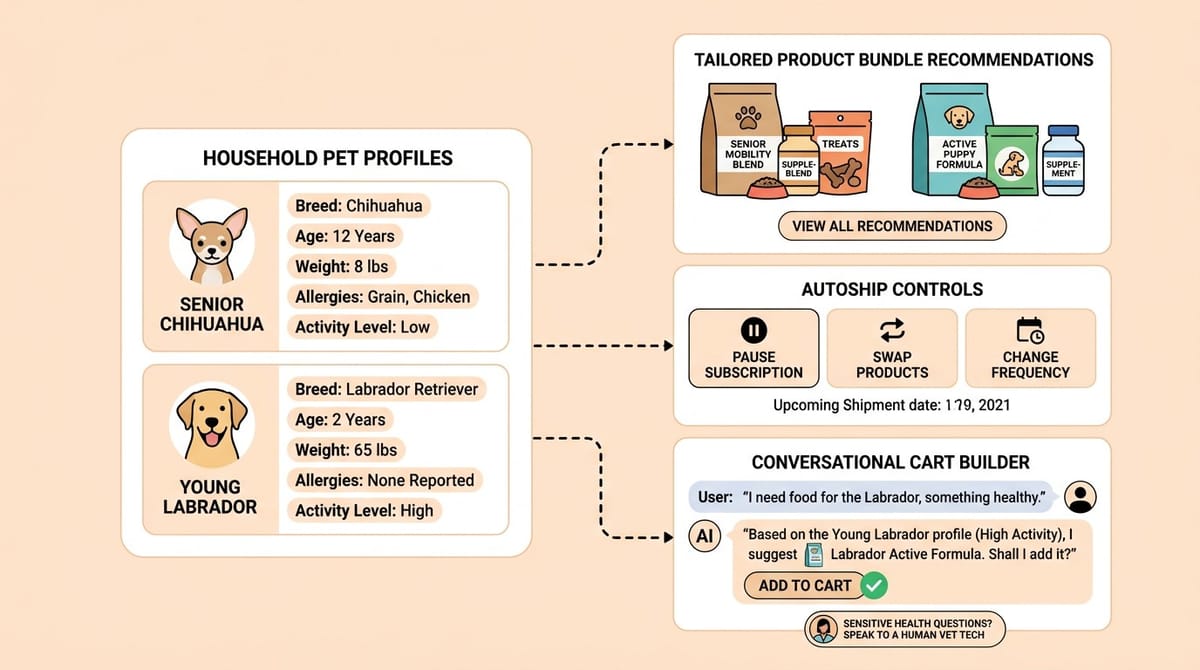
Traditional recommendation engines can't handle that complexity. They see one customer, not a household of pets with overlapping and conflicting needs. AI solves this by building pet profiles rather than just customer profiles, tracking each animal's breed, age, weight, and preferences separately.
Subscription and Autoship Complexity
Between inventory management challenges, inventory forecasting, pet care logistics, and subscription complexity, pet brands juggle more than most retailers. Subscriptions dominate pet ecommerce. Chewy's Autoship program generated $9.4 billion in fiscal 2024, accounting for 79.2% of the company's total revenue. The pet subscription box market is growing at 13.5% CAGR, projected to reach $2.78 billion by 2033, per Market.us.
But subscriptions create support complexity. Puppies grow fast and need food transitions every few months. Allergies surface after weeks on a new formula. Customers need to swap products, adjust portions, pause shipments, and manage billing. Without AI, each of those requests is a manual support ticket.
How AI Matches Pets to the Right Products
AI-powered product recommendations for pet brands work differently than standard ecommerce personalization. The algorithms behind them use natural language intelligence and pattern analysis on pet-specific data points, not just browsing patterns. That gives you an edge over competitors still relying on basic filters. Instead of relying solely on "customers also bought" signals, pet-focused AI builds a structured understanding of each animal.
Pet Profile Intelligence
The best AI systems collect and store pet-specific data points: species, breed, age, weight, spay/neuter status, activity level, known allergies, and current diet. When a customer asks "what food is best for my dog?", the AI doesn't show a generic best-seller list. It asks the right follow-up questions, then filters and ranks products based on the pet's actual profile.
This mirrors what DTC brands like The Farmer's Dog and Ollie already do with their onboarding quizzes, but AI makes it conversational, dynamic, and available at every touchpoint, not just during initial signup.
Cross-Sell and Upsell With Context
Pet product cross-selling is a massive revenue opportunity when done right. A customer buying grain-free dog food is a natural fit for grain-free treats. Smart pet marketing meets them at exactly this moment, matching the keywords shoppers actually type when searching for dog food and treats. AI chatbots turn that pet marketing insight into instant, relevant conversations. A new puppy owner probably needs a crate, training pads, and a chew toy. AI can surface these bundles in real time during the shopping session, and AI shopping assistants have been shown to increase conversion rates significantly.
According to WiserNotify, AI-driven product recommendations account for just 7% of ecommerce visits but generate 26% of revenue. For pet brands with wide product catalogs spanning food, treats, supplements, toys, grooming, and accessories, contextual cross-selling powered by AI is a direct path to higher average order values, stronger customer retention, and lower customer acquisition costs. For online sales, that combination is hard to beat.
Visual and Natural Language Search
Pet parents don't always search in catalog-friendly terms. They type things like "something to calm my anxious dog during thunderstorms" or "toy my cat won't destroy in five minutes." AI with natural language processing understands these queries and maps them to relevant products, even when the product titles don't contain those exact words.
Petco deployed Constructor's AI-powered search across its site, analyzing clickstream data to personalize results for each shopper. The result: a 13% increase in search conversions. That's the difference between a customer finding the right product and leaving frustrated.
AI Customer Support Built for Pet Brands
Customer support in pet ecommerce comes with a unique emotional layer. Dog owners and cat owners care deeply about their animals. Modern pet parents expect fast, accurate answers, and they expect accurate, empathetic answers about nutrition, health, and safety. At the same time, support teams are drowning in routine tickets: order tracking, subscription changes, and return requests.
The Volume Problem
WISMO ("Where Is My Order?") tickets alone account for 20-40% of ecommerce support volume, and pet brands deal with seasonal spikes of 200-300% during holidays. Add subscription management (pausing, swapping, adjusting frequency) and product questions that require breed-specific knowledge, and support teams hit a ceiling fast.
AI solutions can help with the volume problem directly. 93% of customer questions can be resolved by AI without human intervention. An AI chatbot for a pet store handles order tracking, subscription modifications, product questions, and return initiation instantly, freeing human agents for complex issues like pet health concerns or escalated complaints.
Cost Per Interaction: $0.50 vs. $6-15
The economics are clear. An AI-handled customer interaction costs roughly $0.50, compared to $6-15 for a human agent. For a pet brand handling 5,000 support tickets per month, that's the difference between $2,500 and $30,000-75,000 in monthly support costs.
Companies see an average $3.50 return for every $1 invested in AI customer service.
The Hybrid Model: AI Efficiency Plus Human Empathy
A common concern among pet brands is that AI will feel cold or impersonal. Pet parents want to feel heard, especially when they're worried about their animal's health or a lost shipment of medication.
The answer isn't AI or humans. It's both. AI handles routine queries (order status, product info, subscription changes) while routing complex or emotionally sensitive conversations to human agents. According to Cisco, 89% of consumers prefer this hybrid model, combining AI speed with human empathy. Brands like Chewy use exactly this approach, with AI managing volume while their famously personal support team handles the moments that matter.
The Revenue Side: AI as a Sales Channel, Not Just a Support Tool
Most pet brands think of AI as a way to deflect tickets and save money. That's real, but it's only half the picture. The bigger opportunity is using AI as an active sales channel.
Conversational Commerce for Pet Brands
The future of pet ecommerce runs on conversation and engagement. The global conversational commerce market is valued at $8.8 billion in 2025 and projected to reach $32.6 billion by 2035. For pet brands, this means customers increasingly expect to discover and buy products through conversation, not just browse-and-click.
When a customer messages your store asking "my golden retriever has dry skin, what should I try?", an AI shopping assistant doesn't just answer the question. It recommends a fish oil supplement, suggests a moisturizing shampoo, adds both to the cart, and offers a bundle discount. That's a support interaction that became a $45 sale. AI powered analytics track these conversion rates in real time, showing how conversations drive sales.
Data backs this up: shoppers who engage with AI shopping assistants convert at 12.3%, compared to 3.1% for those who don't, a 4x increase.
Social Commerce and Omnichannel Reach
Pet marketing has shifted to social. Over 60% of modern pet parents discover new products through social media, and brands that proactively engage there win, according to Petfood Industry. TikTok and Instagram have become real sales channels for pet brands like BarkBox and Freshpet. U.S. social commerce sales are projected at $85.58 billion in 2025.
AI chatbots that work across web chat, email, Instagram DMs, and WhatsApp let pet brands proactively boost online sales by meeting customers wherever they are. A customer who sees a dog toy on Instagram can DM the brand, get a recommendation based on their dog's size, and complete the purchase without leaving the app. That's social commerce powered by AI.
How Alhena AI Powers Pet Brand Ecommerce
Alhena AI's Shopping Assistant is purpose-built for ecommerce. AI powered pet care recommendations are where its capabilities shine brightest, driving higher conversion rates across every channel. Here's what makes it different from generic chatbot platforms.
Product Expert Agent for Pet Catalogs
Alhena's Product Expert Agent ingests your full product catalog, including descriptions, ingredients, nutritional data, size charts, and breed compatibility. When a customer asks a natural language question like "what's the best harness for a French Bulldog who pulls?", the AI filters by breed size, harness type, and customer ratings to surface the right options.
Because Alhena grounds every response in verified product data, ensuring accuracy through its integrated knowledge system, there are no hallucinations. The AI won't recommend a large-breed formula for a toy breed or suggest a product you don't carry. That accuracy builds trust with pet parents who rely on correct product information for their animals' wellbeing.
Order Management Agent for Subscriptions
For pet brands running subscription or autoship models, Alhena's Order Management Agent handles the heavy lifting. Customers can check order status, swap products, adjust delivery frequency, pause or cancel subscriptions, and initiate returns, all through a natural conversation. No forms, no hold times.
This is the exact type of support that drives the highest ticket volume for pet brands, and it's where AI creates the most immediate cost savings. Brands using Alhena have seen up to 82% chat deflection and response times drop from 40 minutes to under 1 minute.
Agentic Checkout for Higher Conversions
Alhena doesn't just recommend products. It populates carts, pre-fills checkout, and nudges hesitant shoppers with contextual prompts. If a pet parent is comparing two dog foods, the AI explains the differences based on their pet's profile and helps them commit. If they add food but not the matching treats, the AI suggests the bundle.
The results speak for themselves. Brands on Alhena have achieved 3x conversion rate increases and 38% AOV uplift. Tatcha, for example, attributes 11.4% of total site revenue to their AI shopping assistant. Whether you sell food, supplements, or accessories, for pet brands with high repeat purchase rates and natural bundle opportunities, those numbers translate to serious revenue growth.
Omnichannel by Default
Alhena works across web chat, email, voice, Instagram DMs, and WhatsApp. A customer who starts a conversation on Instagram about a cat toy can pick up where they left off on the website. The AI remembers the pet profile, the conversation history, and the product context. Continuous optimization happens through customer feedback loops and search trends insights, so recommendations get sharper over time.
For pet brands selling on Shopify, WooCommerce, or Salesforce Commerce Cloud, Alhena plugs in without dev resources and deploys in under 48 hours.
Getting Started With AI for Your Pet Brand
Rolling out AI for a pet ecommerce brand doesn't require a massive IT project. Here's the practical path.
Step 1: Audit Your Product Data
AI recommendations are only as good as your product data. Make sure your catalog includes breed compatibility, weight ranges, age appropriateness, ingredient lists, and allergen information across all product categories. The more structured your data, the better AI can refine its recommendations. Good inventory management starts with clean data, and AI uses buying trends to keep inventory aligned with demand. The more structured your product data, the more accurate the AI's recommendations will be.
Step 2: Identify Your Highest-Volume Support Topics
Pull your top 20 support ticket categories. Whether you sell pet food, pet supply essentials, or specialty accessories, the patterns are similar. For most pet brands, order tracking, subscription changes, product questions (sizing, ingredients, breed fit), and returns will top the list. These are your first automation targets.
Step 3: Choose a Platform Built for Ecommerce
The pet retail space is competitive. Retailers compete on keywords, product selection, and experience. Every retail brand needs an edge. Generic chatbot tools like Tidio or basic Zendesk AI can handle simple FAQ deflection, but they weren't designed to drive revenue. For pet brands, you need AI that understands product catalogs, manages orders, and actively sells. That's the difference between a support tool and a sales channel.
Compare the top AI chatbots for ecommerce to see how purpose-built platforms stack up against generic alternatives.
Step 4: Start Small, Measure Everything
Deploy AI on your highest-traffic pages first to optimize the customer experience (product pages, checkout, help center) and track conversion rates, average order value, deflection rate, and CSAT from day one. Built-in analytics show exactly which conversations drive sales. Alhena's built-in revenue attribution analytics show exactly how much revenue each AI conversation generates, so you can calculate ROI within weeks.
Most retailers see measurable results within the first month. In this competitive retail market, the ability to boost online conversion is what separates growing pet retailers from stagnant ones. The Alhena ROI calculator can estimate your potential savings and revenue lift before you commit.
Ready to give your pet brand's customers the shopping experience they deserve? Book a demo with Alhena AI to see how AI-powered product recommendations and support work for your store, or start free with 25 conversations to test it yourself.

Frequently Asked Questions
How does AI handle product recommendations for different pet breeds and sizes?
AI builds individual pet profiles that include breed, age, weight, activity level, and dietary restrictions. When a customer asks for a product recommendation, the AI filters your entire catalog against that profile to surface only compatible products. For example, it won't recommend a large-breed puppy food to a toy breed owner. AI powered recommendation engines built for pets outperform generic "customers also bought" recommendation engines.
What types of pet brand support tickets can AI handle automatically?
AI handles the highest-volume ticket categories for pet brands: order tracking (WISMO), subscription modifications (swap products, change frequency, pause or cancel), product questions (ingredients, breed compatibility, sizing), return and refund initiation, and shipping status updates. These routine queries typically account for 70-80% of total support volume. Complex issues like veterinary questions, common pet health concerns, or billing disputes get routed to human agents. For everything else across your pet supply catalog, AI handles it.
How much does AI customer support cost compared to human agents for pet stores?
AI interactions cost roughly $0.50 per conversation, while human agent interactions average $6-15 per ticket. For a pet brand handling 5,000 monthly support tickets, that's roughly $2,500 with AI versus $30,000-75,000 with human-only support. Most brands see full ROI within 3-6 months. Alhena AI offers 25 free conversations to start, with transparent pricing at alhena.ai/pricing.
Can AI manage pet subscription and autoship changes?
Yes. AI can handle the full subscription lifecycle through natural conversation: swapping products (e.g., transitioning a puppy to adult food), adjusting delivery frequency, updating payment methods, pausing shipments for travel, and processing cancellations with retention offers. Alhena's Order Management Agent connects directly to your ecommerce platform to execute these changes in real time, not just answer questions about them.
Does AI work for multi-pet households?
AI systems like Alhena create separate pet profiles within a single customer account. A household with a puppy and a senior cat gets distinct recommendations for each animal, separate subscription management, and product suggestions that account for both pets. With 70% of Gen Z pet owners having two or more pets, multi-pet support is becoming essential for pet ecommerce brands.
How long does it take to deploy AI for a pet ecommerce store?
Alhena AI deploys in under 48 hours with no dev resources required. The setup process includes connecting your product catalog, importing your knowledge base and FAQs, configuring brand voice and tone, and activating on your chosen channels (web chat, email, social). The AI immediately starts learning from your product data and customer interactions to improve over time.
Is AI accurate enough for pet product recommendations where safety matters?
Accuracy is critical for pet products, and it's where hallucination-free AI matters most. Alhena grounds every response in your verified product catalog data, including ingredients, allergen information, breed compatibility, and weight ranges. The AI won't invent features or recommend incompatible products. If it doesn't have enough information to make a safe recommendation, it says so and routes the customer to a human agent.
What ecommerce platforms does Alhena AI integrate with for pet stores?
Alhena integrates with Shopify, WooCommerce, Magento, and Salesforce Commerce Cloud for ecommerce, plus helpdesk platforms like Zendesk, Freshdesk, Gorgias, and Intercom. It also connects to fulfillment tools like ShipStation and Narvar for real-time order tracking. The integrations are pre-built, so there's no custom API work required.