
What Are AI Agents?
AI agents are software systems that go beyond responding to prompts. They reason, plan, and take action on complex, multi-step goals with minimal human intervention. Unlike traditional chatbots that follow scripted decision trees, AI agents combine large language models, machine learning, and other advanced AI models with real-time data access, natural language processing, tool usage, and memory to act autonomously on behalf of users and businesses.
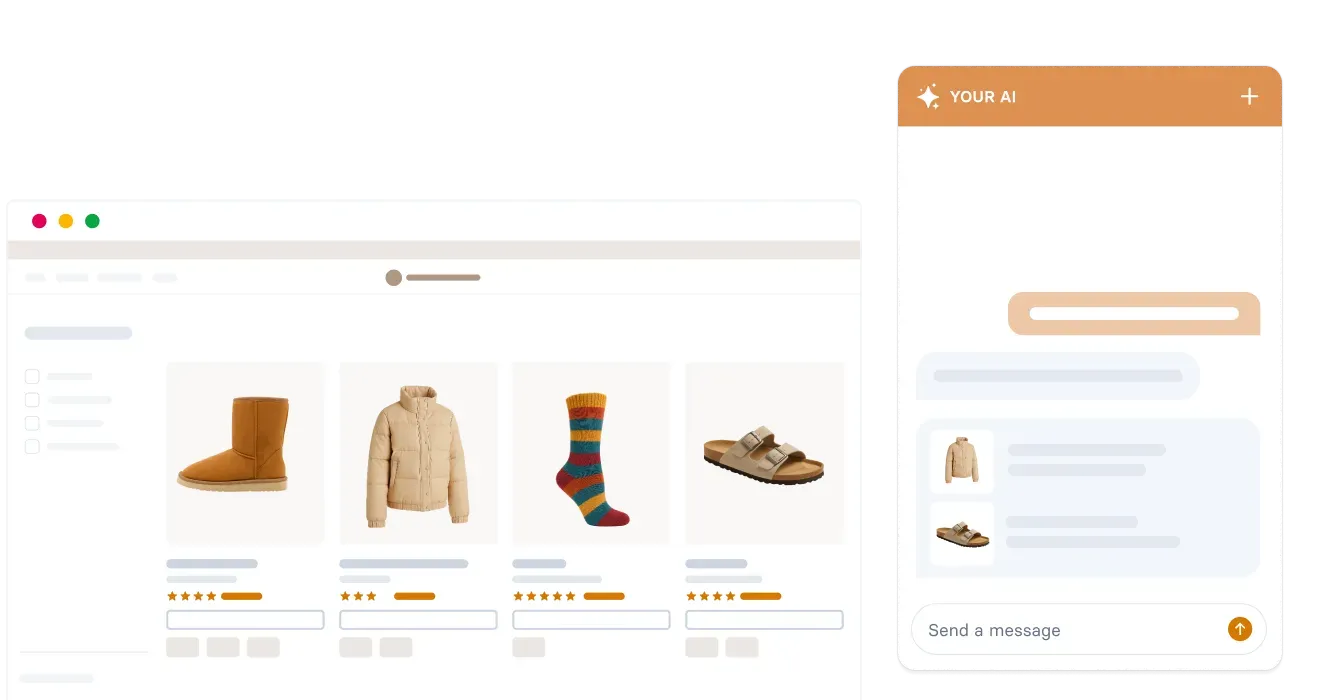
Among the various types of AI available today, AI agents occupy a different category. They combine autonomy (the ability to act without step-by-step instructions), reasoning (the capacity to process input, make decisions, and break complex tasks into subtasks), and tool use (the power to query databases, call APIs, and execute transactions). Instead of handling repetitive, rule-based queries, these AI tools solve open-ended problems. In ecommerce, AI agents handle everything from product discovery and personalized recommendations to order tracking, returns, and checkout across channels, web chat, email, Instagram DMs, WhatsApp, and voice.
What gives AI agents their capabilities is the underlying AI stack. AI agents draw on generative AI, machine learning pipelines, API integrations, and recommendation systems to make decisions in real time. This technology stack AI teams build around allows each autonomous AI agent to interpret context, interact with external services, and complete tasks end-to-end, from understanding a shopper's intent to executing a checkout. The decision-making process is continuous: AI agents perceive signals, evaluate options, and take action without waiting for human approval at every step.
The Rise of Agentic AI in 2026
Agentic artificial intelligence has moved from concept to enterprise reality faster than almost any prior technology wave. According to Gartner, 40% of enterprise applications will include task-specific AI agents by end of 2026, up from less than 5% in 2025. The global AI agents market reached roughly $7.8 billion in 2025 and is projected to exceed $10.9 billion this year.
McKinsey's State of AI 2025 report found that 62% of organizations are actively working with AI agents, 23% scaling agentic AI systems, 39% experimenting. Meanwhile, 88% of organizations regularly use AI in at least one business function, and 72% use generative AI. The capability to deploy autonomous agents across multiple use cases is now a competitive differentiator, not a novelty.
Three factors converged to make 2026 the inflection point. Protocol standardization arrived; Google and Shopify co-developed the Universal Commerce Protocol (UCP), while Anthropic's Model Context Protocol (MCP) created shared standards for how intelligent agents communicate. Payment infrastructure caught up; Visa, Mastercard, and PayPal all launched AI agent payment rails in 2025, enabling AI agents to interact with financial APIs and complete transactions autonomously. And consumer readiness crossed a threshold; 39% of consumers already use AI for product discovery, with AI-driven traffic to retail sites surging up to 6,900% year-over-year.
Real-World Impact: Ecommerce Leads the Way
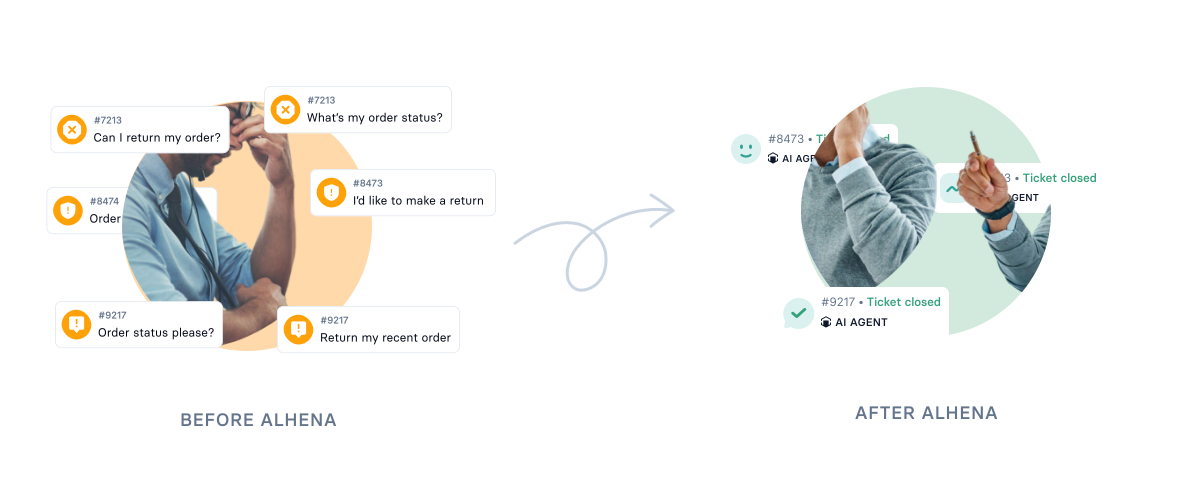
E-commerce has become the proving ground for AI agents. Salesforce data shows AI-powered agents drove roughly 20% of retail sales during the 2025 holiday season. McKinsey estimates agentic commerce could redirect $3 to $5 trillion in global retail spend by 2030. Shoppers who interact with an AI agent convert at nearly 4x the rate of those who do not, and stores report 7 to 25% revenue increases with up to 30% lower support costs.
Beyond e-commerce, AI agents are delivering results across industries. In customer service, healthcare, and financial services, organizations use AI to optimize operations and reduce costs. Healthcare providers report a 42% reduction in documentation time. In financial services, 70% of executives believe AI agents will directly contribute to revenue growth. Every dollar invested in enterprise AI agents returns up to $6.00 in short-term measurable benefits and $8 to $12 in long-term value through improved decision-making and intelligent automation.
The real-world capabilities of these AI systems extend to tasks that once required entire teams: triaging support tickets, managing inventory, personalizing marketing campaigns, and coordinating multi-step workflows across platforms. The best AI agents solve problems by breaking each task into subtasks, delegating where necessary, and adapting when conditions change. Whether the task is answering a pre-sale question or processing a return, the AI stack AI teams invest in determines how effectively agents perform. These capabilities make AI agents a powerful AI tool for any business looking to automate routine tasks while still handling complex, high-value interactions.
The governance challenge is real. Deloitte reports that over 40% of agentic AI projects may be cancelled by 2027 due to escalating costs or inadequate risk controls. Leading organizations succeed by implementing bounded autonomy, clear operational limits, escalation paths to humans, and comprehensive audit trails that automate workflows while keeping AI systems accountable.
How Alhena AI Brings Agentic Intelligence to Ecommerce
Most AI agent platforms were built for general-purpose support. They handle ticket deflection as their primary use case, but were never designed to sell. Alhena AI was purpose-built as an intelligent e-commerce assistant from day one, with two specialized agents working in tandem:
- Product Expert Agent - Understands your entire catalog, answers product questions, makes personalized recommendations, and guides shoppers through selection. Every response is grounded in verified product data, eliminating hallucinations that plague generic AI systems.
- Order Management Agent - Handles post-purchase workflows autonomously: order tracking, returns, exchanges, and subscription management. It connects directly to Shopify, WooCommerce, Magento, or Salesforce Commerce Cloud and your helpdesk via API, enabling seamless interaction across every touchpoint.
What sets this apart from tools like Zendesk AI or Intercom Fin is the sales DNA. Alhena's agents populate carts, pre-fill checkout, and drive revenue across every channel. Brands using Alhena AI's Shopping Assistant see measurable results: Tatcha achieved a 3x conversion rate with a 38% AOV uplift and 11.4% of total site revenue from AI. Victoria Beckham drove a 20% AOV increase. Puffy reached 63% automated resolution with 90% CSAT. The platform deploys in under 48 hours with no dev resources required, and built-in revenue attribution analytics tie every dollar back to AI agent interactions. See what that looks like for your online store with the Alhena ROI Calculator.
Ready to bring agentic AI to your ecommerce store? Book a demo with Alhena AI to see how purpose-built AI agents drive revenue, not just deflect tickets. Or get started for free with 25 conversations.

Frequently Asked Questions
What are AI agents and how do they differ from chatbots?
AI agents are autonomous software systems that reason, plan, and execute multi-step tasks with minimal human input. Unlike traditional chatbots that follow scripted decision trees, AI agents combine large language models with real time data access and tool usage to act independently, handling everything from product recommendations to order processing across multiple channels.
How does agentic AI work in ecommerce?
Agentic AI in ecommerce uses specialized agents that connect directly to your product catalog, order management system, and helpdesk. A Product Expert Agent handles pre-sale questions and guided selling, while an Order Management Agent manages post-purchase workflows like tracking, returns, and exchanges. Together, they automate the full customer journey and can populate carts, pre-fill checkout, and drive conversions.
How does Alhena AI compare to Zendesk AI or Intercom Fin for ecommerce?
Zendesk AI and Intercom Fin are support-first tools designed for ticket deflection. Alhena AI is purpose-built for ecommerce sales and support. It features agentic checkout (cart population, checkout pre-fill), hallucination-free responses grounded in verified product data, and built-in revenue attribution analytics. Tatcha achieved a 3x conversion rate and 38% AOV uplift using Alhena.
How quickly can ecommerce brands deploy AI agents?
Deployment timelines vary significantly by platform. Purpose-built ecommerce AI agents like Alhena AI deploy in under 48 hours with no developer resources required. They connect directly to Shopify, WooCommerce, Magento, Salesforce Commerce Cloud, and major helpdesks like Zendesk, Freshdesk, Gorgias, and Kustomer. Brands start seeing results within the first month.