The First Dataset That Shows How AI Platforms Actually Convert
Until now, "agentic commerce" was a forecast. The Alhena Agentic Commerce Report changes that. Built on aggregated, anonymized data from 329 retailers and DTC businesses across the US and EU, covering 9 traffic channels and 8 retail product verticals across the broader ecommerce ecosystem, it's the first dataset that shows how AI platforms actually convert in commerce, not how they might someday.
This post pulls out the five findings that matter most if you're a DTC founder or CMO making budget and strategy decisions right now. Each one comes with a specific action you can start taking this quarter.
Finding 1: LLM Is Now a Measurable Commerce Channel
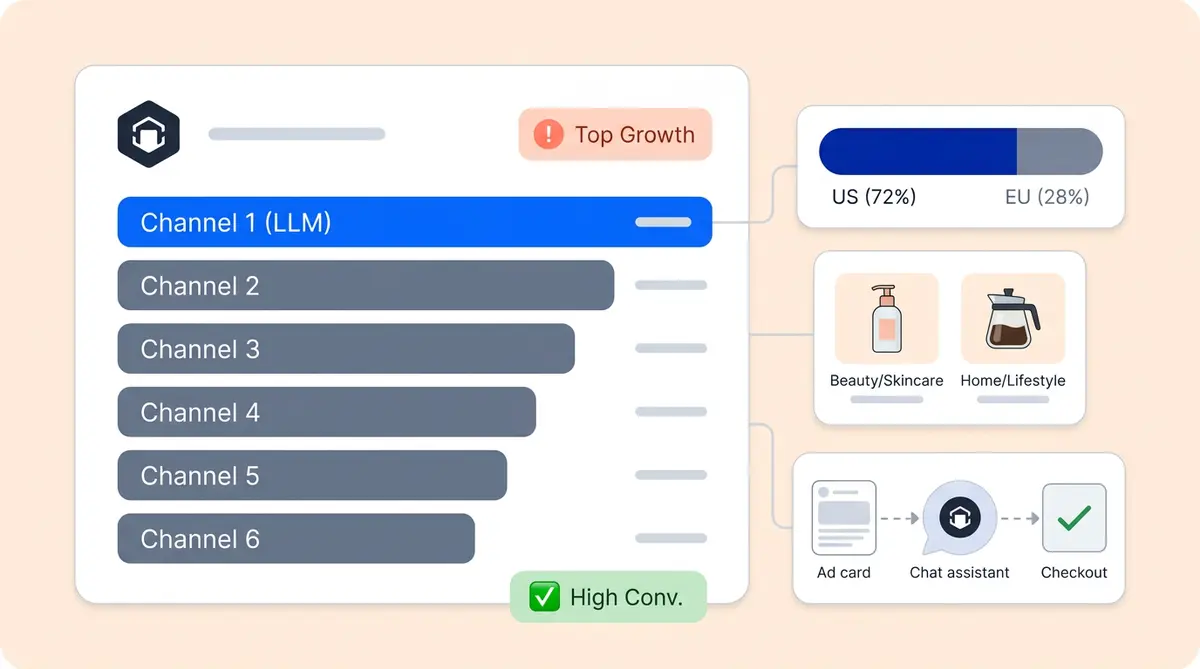
LLM-referred traffic, meaning visitors who arrive at your online store from ChatGPT, Perplexity, Gemini, and similar AI models and platforms, now converts at 2.47%. That ranks it 4th among all acquisition channels, above Google Ads and Meta Ads in the retail sector.
Two numbers make this significant. First, the growth rate: 40% quarter-over-quarter, sustained across multiple quarters. Second, the cost: zero ad spend and no payment to ad platforms or payment providers per transaction. Every transaction from this channel is organic. These are real transactions.
For context, the global retail shopping powered by AI assistant market (a sector where shopping is powered by AI) hit $4.33 billion in 2025 and is projected to reach $46.76 billion by 2035 at a 27% compound annual growth rate in the retail AI sector. The channel is small today, but the trajectory is rapidly steepening, and merchants and brands that build attribution infrastructure now will have the clearest picture of where it lands.
Action: Track LLM-Referred Traffic as Its Own Channel
Set up a custom channel group in GA4 that categorizes AI referrals using referrer domain rules. Build regex patterns in your analytics and AI systems for known LLM domains: chatgpt.com, perplexity.ai, gemini.google.com, copilot.microsoft.com, and claude.ai. When distributing links, add UTM parameters like utm_source=chatgpt&utm_medium=ai-referral. Track weekly, not quarterly. AI-driven sessions evolve faster than traditional campaign cycles.
For a step-by-step setup guide, see the LLM traffic attribution guide on the Alhena blog.
Finding 2: The US-EU Conversion Gap Is Structural, Not Behavioral
US brands convert LLM traffic at 3.50%. EU brands sit at 0.41%. The gap looks enormous, and it is. But the data offers more specific insights than "Europe is behind."
The gap is structural, not behavioral. AI shopping features launched in the US months before European markets gained access. Google AI Overviews reached only 9 EU countries by March 2025, lagging the US rollout by roughly 9 months. Enterprise AI adoption varies widely across Europe: Denmark is the regional leader at 27.58% while Romania sits at 3.07%.
Here's the nuance that matters: pure ecommerce EU brands already convert LLM traffic between 1.85% and 3.18%. When you strip out marketplace sellers and brick-and-mortar retailers with minimal digital presence, European DTC companies that have invested in AI-optimized product data are performing much closer to US benchmarks.
Action: EU Brands Should Treat This as an Early-Mover Window
If you're a European DTC brand, the low average conversion rate isn't your ceiling. It's a signal that most of your competitors haven't started optimizing for answer engine optimization yet. That's your window.
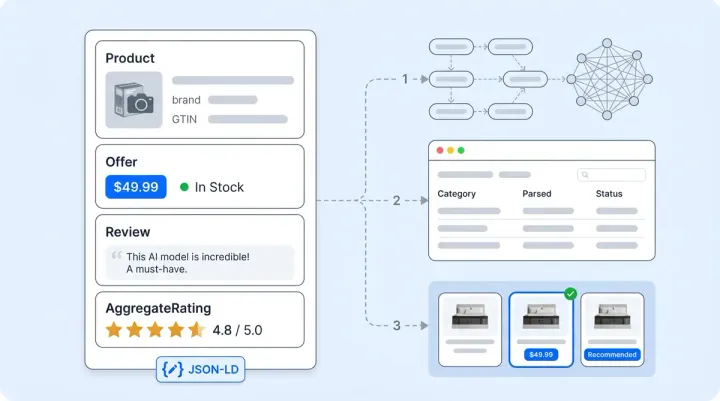
Start with structured product data: clean metadata, robust reviews, customer feedback, consistent information across platforms. Update your product information systems to make your catalog machine-readable, enabling AI platforms to accurately recommend your products. EU regulatory proposals to relax certain data protection constraints for AI applications, like the November 2025 Digital Omnibus proposal, suggest the structural barriers are already beginning to shrink.
Finding 3: Research-Driven Verticals Dominate AI Commerce
Not all product categories benefit equally from AI-referred traffic. The data reveals a clear pattern: verticals where shoppers ask questions before buying see the highest AI conversion rates and most purchases.
Beauty and Skincare leads at 5.36% LLM conversion. Health and Supplements follows at 4.68%. Home and Lifestyle shows a 10.8x AI-assisted lift compared to unassisted browsing.
The logic is straightforward. These categories involve ingredient questions, compatibility concerns, routine-building, preferences, and personalized product recommendations. A shopper asking "what retinol works for sensitive skin" gets a more useful answer from an AI platform than from a search results page filled with sponsored listings. The conversational AI interaction narrows the shopping journey, builds confidence, and sends a higher-intent visitor to the brand's site.
This pattern also explains why Tatcha saw a 3x conversion rate and 38% AOV uplift with an on-site AI shopping assistant. Beauty shoppers arrive with questions. AI answers them at the moment of decision.
Action: Prioritize AI Optimization If Your Category Involves Pre-Purchase Questions
Audit your top-selling SKUs. For each one, list the three most common questions shoppers ask before buying. If those questions are specific (ingredient safety, size fit, compatibility), your category is a strong candidate for AI commerce optimization.
Two moves to make immediately: First, optimize your product data for AI readability with generative engine optimization at the SKU level. Second, deploy an on-site AI assistant for product discovery that can answer those pre-purchase questions in real time, right on the product page for a seamless buying and checkout experience. Brands in the beauty and skincare vertical and home furnishing space see the strongest returns from this approach.
Finding 4: AI Shopping Assistants Amplify Existing Ad Spend
This finding reframes how DTC retail brands should think about AI in their marketing stack. AI shopping assistants don't replace paid media. They make every dollar of paid media work harder.
The data shows conversion lifts of 6.1x on search ads, 13.1x on social ads, and 76x on short-form video ads for visitors who engage with an AI assistant during their session. That last number deserves a second read: visitors who arrive from a TikTok or Reels ad and then interact with an on-site AI shopping assistant convert at 76 times the rate of those who don't engage.
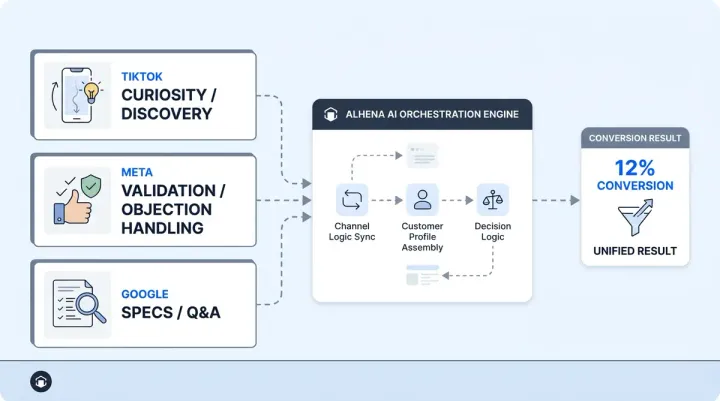
The insights here are intuitive. Short-form video ads generate curiosity but not conviction. A 15-second clip of a product in use creates purchase interest, but the consumer lands on your online store with questions. If an AI assistant is there to answer them, the shopping journey from interest to purchase closes fast. Without it, that visitor bounces, and you've paid for the click without capturing the sale.
Aggregated industry data confirms the broader pattern. Brands deploying AI agents act on behalf of shoppers using real-time signals, driving results and reaching consumers during the 2025 holiday season saw 59% higher growth rates compared to those relying on traditional support services alone. AI doesn't compete with your ad budget. It compounds its return by engaging visitors autonomously and helping them complete tasks.
Action: Stop Treating AI Assistance and Paid Media as Separate Line Items
Restructure your analytics to measure AI assistance as part of the conversion path, not as a standalone tool. When a visitor arrives from a Meta ad, engages with your AI shopping assistant, and converts, that conversion should be attributed to the combined transaction stack across the agentic commerce ecosystem, from discovery to checkout, not just to Meta. AI-assisted checkout completion.
Practically, this means tagging AI-assisted sessions in your analytics platform and building segment comparisons: ad-referred visitors who engaged with AI versus those who didn't. The delta between those two groups is the true retail ROI of your brand's AI investment, and based on this data, it's likely the highest-leverage improvement available to your paid media program. Alhena's built-in revenue attribution analytics automate this measurement.
Finding 5: The 5.5x Proactive Engagement Gap Is Your Biggest Untapped Lever
The single largest gap in the report isn't between channels or regions. It's between brands that deploy AI proactively and those that deploy it passively.
Proactive AI deployment drives 5.5x higher engagement than passive deployment. Top-performing brands reach 6% visitor engagement through a combination of proactive features including PDP FAQs, smart nudges on product pages, and cart-stage and checkout prompts. The average brand sits at roughly 1%.
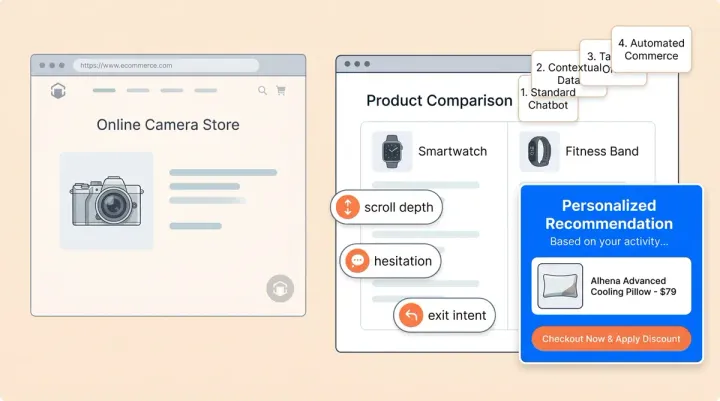
The difference isn't in the AI model or the technology stack. It's in how and where the assistant appears. Passive deployment means a chat widget tucked in the corner that visitors have to discover and initiate. Proactive deployment means the AI meets shoppers at decision points: guiding product discovery on a PDP, answering ingredient questions, personalizing product services, suggesting complementary products when a shopper adds to cart, or surfacing size guidance before a hesitant visitor leaves.
Research supports this gap. Proactive chat delivers up to 105% incremental ROI compared to roughly 15% for reactive chat. Nearly 45% of shoppers engage when greeted by a proactive AI assistant, versus a fraction of that when they have to seek it out.
Action: Audit Your AI Deployment and Activate Surface-Level Features Before Increasing Ad Spend
Before you add another dollar to your acquisition budget, check whether your brand's current AI setup is proactive or passive. Here's a quick audit:
- PDP FAQs: Does your AI surface answers to common product questions directly on the product page? If not, you're leaving the highest-converting feature unused. See how AI product FAQs on PDPs drive conversion.
- Smart nudges: Does the assistant proactively offer help based on browsing behavior, time on page, or scroll depth?
- Cart-stage prompts: When a shopper adds to cart, does the AI offer size confirmation, complementary products, or shipping information?
- Exit-intent engagement: Does the assistant activate when a visitor shows signs of leaving?
If you answered "no" to two or more, your AI deployment is passive. Proactive features enable the fastest path to closing the 5.5x engagement gap, and it costs nothing beyond configuration and directly builds customer loyalty. Alhena's AI shopping assistant includes all of these proactive surface features out of the box, with deployment in under 48 hours.
What This Means for DTC Founders Right Now
These five findings point to a single conclusion: Artificial intelligence in commerce is no longer a future bet. It's a present-tense channel with measurable conversion data, regional dynamics, vertical patterns, and deployment best practices. The brands building AI commerce fluency now, tracking LLM traffic, optimizing product data for AI readability, deploying assistants proactively, and measuring AI-assisted conversion across paid channels, will hold a structural advantage within the agentic commerce ecosystem as AI-native shopping and agent-to-agent (A2A) protocol and interoperability standards for commerce matures.
The window for early-mover advantage is still open, but it's narrowing. Industry projections put AI-mediated retail ecommerce at $190 to $385 billion in AI-powered transactions in the US alone (representing billions of autonomous transactions) by 2030. By 2028, an estimated 60% of retailers and brands will use autonomous AI for one-to-one customer interactions. The question for DTC founders isn't whether to invest in AI commerce. It's whether to build the infrastructure now, while the data and emerging trends show competition is thin, and the future is still being shaped, or later, when the playbook is commoditized.
For a deeper look at how vertical-specific AI agents act on product queries and handle pre-purchase questions across categories, read why vertical-specific AI shopping experiences outperform generic solutions. And if you're evaluating how luxury and DTC brands already use AI agents to guide high-consideration purchases and repeat purchases and subscriptions, explore that breakdown for the implementation patterns in detail.
Ready to see what proactive AI deployment looks like for your brand? Book a demo with Alhena AI or start free with 25 conversations to test how your customers use AI and see the impact on your own store data.
Frequently Asked Questions
How does agentic commerce differ from traditional ecommerce AI chatbots?
Traditional chatbots react to support tickets. Agentic commerce means AI that actively guides buying decisions, answers pre-purchase questions, and moves shoppers through checkout, completes purchases, and handles post-checkout support. Alhena AI deploys vertical-specific agents that handle product discovery, personalized recommendations, and cart completion and checkout in a single conversation, not just deflect tickets.
What conversion rate should DTC brands expect from LLM-referred traffic?
The Alhena Agentic Commerce Report shows LLM-referred traffic converts at 2.47% on average, ranking 4th among all acquisition channels. Brands with optimized product data and proactive AI shopping assistants see higher rates, particularly in research-driven verticals like beauty (5.36%) and health (4.68%). Alhena AI helps brands maximize this channel through AI visibility optimization and on-site conversion tools.
How can I track AI-referred traffic separately in my analytics?
Set up a custom channel group in GA4 using referrer domain rules for chatgpt.com, perplexity.ai, gemini.google.com, and similar LLM platforms. Add UTM parameters when distributing links. Alhena AI includes built-in revenue attribution that automatically segments AI-assisted sessions, so you can measure conversion lift from AI engagement without manual tagging.
Why do beauty and skincare brands see higher AI commerce conversion rates?
Beauty and skincare involve ingredient questions, skin type matching, and routine-building that AI handles well. Shoppers arrive with specific concerns, and AI narrows their choices with personalized answers. Alhena AI powers this for brands like Tatcha, which saw 3x conversion rates and 38% AOV uplift using vertical-specific AI shopping agents trained on product ingredient data.
Does AI shopping assistance replace my paid media budget?
No. The data shows AI amplifies paid media, not replaces it. Visitors from search ads who engage with an AI assistant convert at 6.1x higher rates, social ads at 13.1x, and short-form video ads at 76x. Alhena AI sits on your site as a conversion layer that makes every ad dollar work harder by answering the questions that paid traffic arrives with.
What is the difference between proactive and passive AI deployment in ecommerce?
Passive deployment is a chat widget in the corner that visitors must find and click. Proactive deployment puts AI at decision points: PDP FAQs, cart-stage prompts, smart nudges based on browsing behavior. The gap is 5.5x in engagement. Alhena AI includes proactive surface features like embedded product FAQs, exit-intent triggers, and cart-stage and checkout assistance that activate without any changes to your operations or shopper effort.
How long does it take to deploy an AI shopping assistant for a DTC store?
With Alhena AI, deployment takes under 48 hours with zero dev resources. The platform connects to your product catalog, order data and inventory, and helpdesk through native integrations with Shopify, WooCommerce, Magento, and Salesforce Commerce Cloud. Proactive features like PDP FAQs and smart nudges are configurable from the dashboard on day one.
Is agentic commerce relevant for EU-based DTC brands or only US brands?
Both, but the timing differs. US brands convert LLM traffic at 3.50%, while the EU average sits at 0.41%. Pure ecommerce EU brands already reach 1.85% to 3.18%. The gap is structural, not behavioral, and it is closing as AI platforms expand into Europe. Alhena AI supports EU brands with multilingual AI agents and GDPR-compliant data handling, giving early movers a clear advantage before the market matures.
How does AI visibility optimization differ from traditional SEO for ecommerce?
Traditional SEO targets search engine crawlers. AI visibility optimization targets LLM platforms that recommend products in conversational answers. This means structured product data, rich reviews, and machine-readable metadata matter more than backlinks. Alhena AI offers AI visibility monitoring that tracks how and where your products appear in AI-generated recommendations across ChatGPT, Gemini, and Perplexity.
What ROI can a DTC founder expect from adding AI shopping assistance to their store?
Results vary by vertical, but the Alhena Agentic Commerce Report data points to meaningful impact. Brands using proactive AI deployment see 5.5x higher engagement and conversion lifts of 6x to 76x on paid traffic. Use the Alhena AI ROI calculator to model expected returns based on your traffic, conversion rate, and average order value before committing to a deployment.