Ecommerce marketing teams now need three search disciplines running at the same time: SEO for Google rankings, AEO for AI direct answers, and GEO for influencing AI outputs across every surface. Most businesses are still doing only one. That's a problem, because AI-referred ecommerce traffic grew 4,700% year over year in 2025, and shoppers who arrive through AI engines convert at rates 31% higher than traditional organic search. Leading search strategists now define SEO, AEO, and GEO as three distinct marketing disciplines, each requiring its own optimization approach. Here's what separates AEO, GEO, and SEO from each other, why all three matter for search optimization for ecommerce businesses in 2026, and how to measure the full picture.
SEO: Still the Foundation, But No Longer Enough
Traditional SEO optimizes for Google's ranking algorithm to earn organic clicks. For ecommerce businesses, that means keyword-optimized product detail pages, backlink authority, site speed, and mobile experience. Marketing teams pour resources into keywords and content calendars around these ranking factors. Organic search still drives 43% of all ecommerce traffic and nearly a quarter of online orders. SEO delivers an 8x return compared to 4x for PPC. The foundation isn't crumbling. Voice search adds another layer: 71% of customers now use voice assistants for product queries, and those queries flow through the same AI-powered systems.
But it is shrinking. Over 60% of all searches now end without a click. When Google's AI Overviews appear on a query, organic click-through rates drop 61%, and the page sitting in position one loses 34.5% of its clicks. AI Overviews for commercial queries doubled from 8% to 18% in 2025 alone.
Here's where the gap between SEO and AEO becomes clear: your hiking boot ranks #1 on Google for "best waterproof hiking boot under $200." A shopper asks ChatGPT the same question. Your product isn't mentioned, because ChatGPT doesn't use Google rankings to decide what to recommend. LLMs like ChatGPT pull from structured product data, editorial reviews, and multi-source validation. AI-powered search solutions don't care about your PageRank. Ranking first on Google and being invisible to AI can happen at the same time. It's a blind spot that matters more every quarter, and it's only going to widen in the future. That's why SEO alone no longer covers the full search optimization landscape for ecommerce.
AEO: Optimizing for the Direct Answer
Answer Engine Optimization (AEO) is the practice of structuring your content so AI engines select your product as the direct answer to a shopper's query. Where SEO earns you a spot among ten blue links, AEO targets the single recommendation slot: being THE answer. The shift from SEO to AEO and GEO is not a replacement but an expansion of your digital marketing strategy for the future of search.
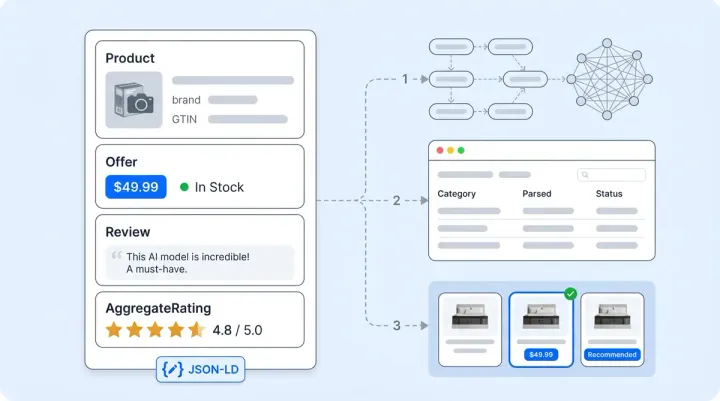
For ecommerce brands, AEO means three things. First, structured data. Product schema, FAQPage schema, and Review schema give AI engines parseable signals about what you sell, what it costs, and what customers think. Pages with FAQPage schema achieve a 41% citation rate in AI-generated answers, compared to 15% without. Second, complete product specs in plain, extractable text. AI can't recommend your moisturizer for rosacea if the ingredient list is locked inside an image or buried in a PDF. Third, Q&A content that matches how shoppers actually ask AI. "Is this moisturizer good for rosacea?" with specific ingredient details is exactly the format AI engines pull from when generating recommendations.
For a detailed breakdown of which schema types and fields matter most, see our guide to schema markup for AI search in ecommerce.
A skincare brand that adds FAQPage schema with targeted condition-specific questions and detailed ingredient breakdowns starts showing up as the top recommendation in ChatGPT for those queries. Only 12.4% of websites currently use structured data, so businesses that improve their product pages with schema markup now have a genuine first-mover advantage with customers searching through AI.
GEO: Influencing AI Across Every Surface
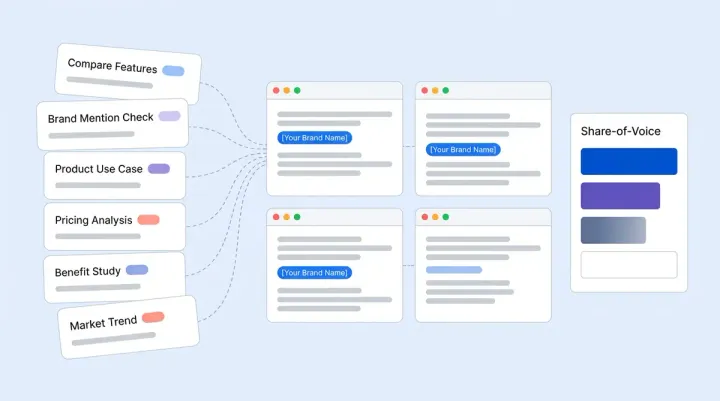
Generative Engine Optimization (GEO) is the broader discipline of shaping how AI engines perceive your brand across all the sources they pull from: your site, Reddit, YouTube, editorial reviews, affiliate content, and forums. While AEO makes your own pages machine-readable for LLMs, GEO builds the citation network and trust signals that make AI confident enough to recommend you.
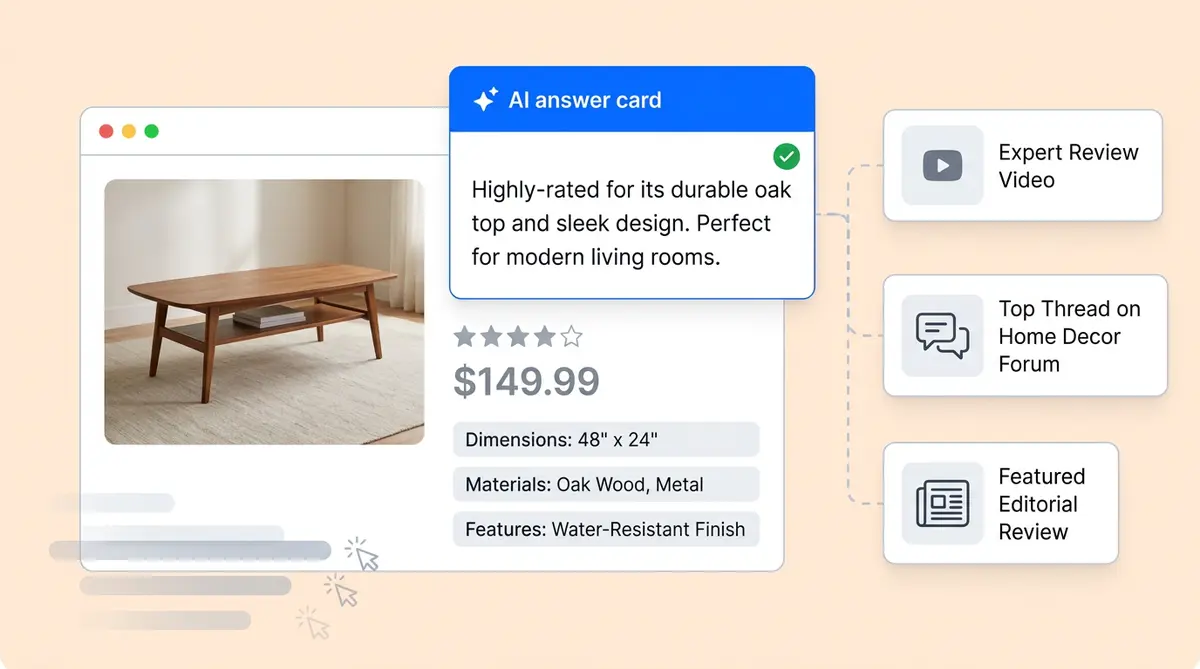
AI engines validate product recommendations through multi-source consensus. Industry research shows that third-party media coverage makes a brand 5x more likely to be cited by AI. YouTube has overtaken Reddit as the top social citation source in AI responses, appearing in 16% of LLM outputs compared to 10% for Reddit. The seven primary citation sources AI relies on include niche editorial reviews, Reddit threads, YouTube reviews, expert roundups, comparison sites, Q&A platforms, and industry knowledge bases.
Consider a supplement brand that earns mentions in three Reddit threads, two YouTube reviews, and a niche editorial roundup. Perplexity starts recommending it because it has that multi-source validation, even though the business's on-site SEO is average. That's GEO at work, and it's where marketing teams often have the biggest blind spot. You can explore the full off-site citation strategy for AI recommendations in our dedicated guide, or see how GEO applies specifically to product brands across ChatGPT, Gemini, and Perplexity.
How the Three Work Together for Ecommerce
Each discipline in the SEO, AEO, and GEO trifecta covers a different part of the discovery funnel. SEO drives direct organic traffic from shoppers who search Google. AEO captures the AI direct-answer recommendations when shoppers ask ChatGPT or Perplexity a specific product question. GEO builds the broader AI trust layer that influences which brands AI engines feel confident recommending across all surfaces.
Businesses doing all three create a compounding marketing advantage that's hard for competitors to replicate. Your SEO-optimized product pages give AI crawlers clean content to index. Your AEO-structured data makes that content extractable for direct answers. Your GEO citation network validates the recommendation with external proof. When AI-powered agents cite your products, customers arrive with higher purchase intent. Industry frameworks show that businesses executing GEO, AEO, and SEO together get discovered up to 10x faster by generative engines compared to those relying on organic SEO alone.
Here's the summary:
- SEO optimizes for ranking. Key metric: organic traffic.
- AEO optimizes for the direct answer. Key metric: AI citation rate.
- GEO optimizes for AI trust signals. Key metric: cross-source visibility.
The missing piece for most brands is measurement. Alhena AI Visibility serves as the measurement layer that tracks all three. Rendering Analysis shows how AI engines read and present your product pages, covering the AEO side. External Source Monitoring tracks your off-site citation network across review sites, forums, and editorial publishers, covering GEO. SKU-level multi-engine tracking across ChatGPT, Gemini, and Perplexity measures which specific products actually get recommended, and how often.
What closes the loop is first-party shopping data. Alhena's AI Shopping Assistant captures real shopper conversations on your site, revealing which product attributes drive purchase decisions and which AI-referred visitors actually convert. That helps connect AI visibility to revenue within your existing marketing stack, not just impressions. If you're still measuring only SEO and AEO performance in silos, you're missing how they compound. Learn more about the full picture with Alhena. Brands like Tatcha have seen a 3x conversion rate with AI-assisted shopping, and 11.4% of total site revenue attributed to AI interactions.
Ready to see how your products appear across AI engines? Book a demo with Alhena AI or start for free with 25 conversations to test it yourself.
Frequently Asked Questions
What is the difference between AEO and GEO for ecommerce brands?
AEO (Answer Engine Optimization) focuses on structuring your on-site product data so AI engines extract it as a direct answer. GEO (Generative Engine Optimization) focuses on building off-site citation signals like editorial reviews, Reddit mentions, and YouTube content that make AI engines trust your brand enough to recommend it. Alhena AI tracks both dimensions: Rendering Analysis covers AEO by showing how AI reads your product pages, while External Source Monitoring covers GEO by tracking your off-site citation network.
How does AEO vs GEO vs SEO affect product discovery in AI search?
SEO gets your products into Google search results. AEO gets your products selected as the direct answer when shoppers ask ChatGPT or Perplexity a specific question. GEO builds the multi-source trust that makes AI engines confident recommending you over competitors. Alhena AI Visibility tracks all three through SKU-level monitoring across ChatGPT, Gemini, and Perplexity, so you can see exactly which products get recommended and which don't.
What structured data do I need for answer engine optimization on product pages?
Product schema, FAQPage schema, and Review schema are the three essentials. Pages with FAQPage schema achieve a 41% AI citation rate compared to 15% without. Alhena AI's Rendering Analysis shows you exactly how AI engines parse your product pages and flags gaps in your structured data that cost you recommendations.
Can I measure whether my GEO strategy is working?
Yes. Alhena AI Visibility provides External Source Monitoring that tracks mentions of your products across review sites, forums, YouTube, and editorial publishers. It maps which third-party sources AI engines cite when recommending products in your category, so you can see within minutes where your citation network is strong and where it has gaps. It matters because AI engines update their source preferences constantly.
How do I connect AI search visibility to actual ecommerce revenue?
Most visibility tools stop at tracking mentions. Alhena AI closes the loop with first-party shopping data from its AI Shopping Assistant, which captures real shopper conversations on your site. This connects which AI-referred visitors arrive, what questions they ask, and whether they convert, giving you direct revenue attribution from AI search channels.