The Shade-Matching Problem Costing Beauty Ecommerce Billions
Up to 60% of foundation returns happen because the customer picked the wrong shade. Each return costs between $20 and $33 to process. For beauty brands running an online store, that's not just a logistics headache, it's a profit drain hiding in plain sight.
The root cause? Traditional ecommerce filters can't capture the nuance of "warm undertone with a dewy finish" or "something lighter than my current SPF moisturizer." Shoppers describe their skin the way they'd talk to a friend, not the way a product database is structured. That gap between natural language and how products are cataloged is exactly where AI voice technology steps in.
This post breaks down how beauty brands are using voice AI to guide shade matching, build skincare routines, recover abandon cart sessions, and automate customer service, plus how Alhena AI's Voice AI agent is purpose-built to turn those conversations into confident purchases.
Why AI Voice Fits Beauty Better Than Any Other Category
Beauty shopping is personal. A customer looking for foundation doesn't just need a color. She needs to explain her skin type, undertone, coverage preference, and whether she wants matte or satin finish. That's a conversation, not a search query, and it's a use case that static tools can't handle.
Voice AI handles this naturally. Instead of forcing shoppers through dropdown menus and swatch grids, it lets them describe what they want in their own words. "I have oily skin and I want something that won't cake by 3 PM" is a perfectly valid input for a voice-enabled AI shopping assistant. The AI agent instantly parses the caller's intent, asks follow-up questions, and maps the response to specific products in real time.

Shade Matching: Where Voice AI Solves a $20B Problem
Finding the right foundation match online is the single biggest friction point in beauty ecommerce. 35% of consumers cite finding the perfect foundation shade as their top challenge, and 60% of shoppers won't buy foundation online without some kind of shade-matching tool.
Here's the problem with most virtual shade finders: they rely on static inputs. Scan your face, answer three questions, get a recommendation. There's no room for back-and-forth. No way to say, "That looks too pink, can you try something warmer?" A basic bot or quiz builder simply can't handle this level of nuance.
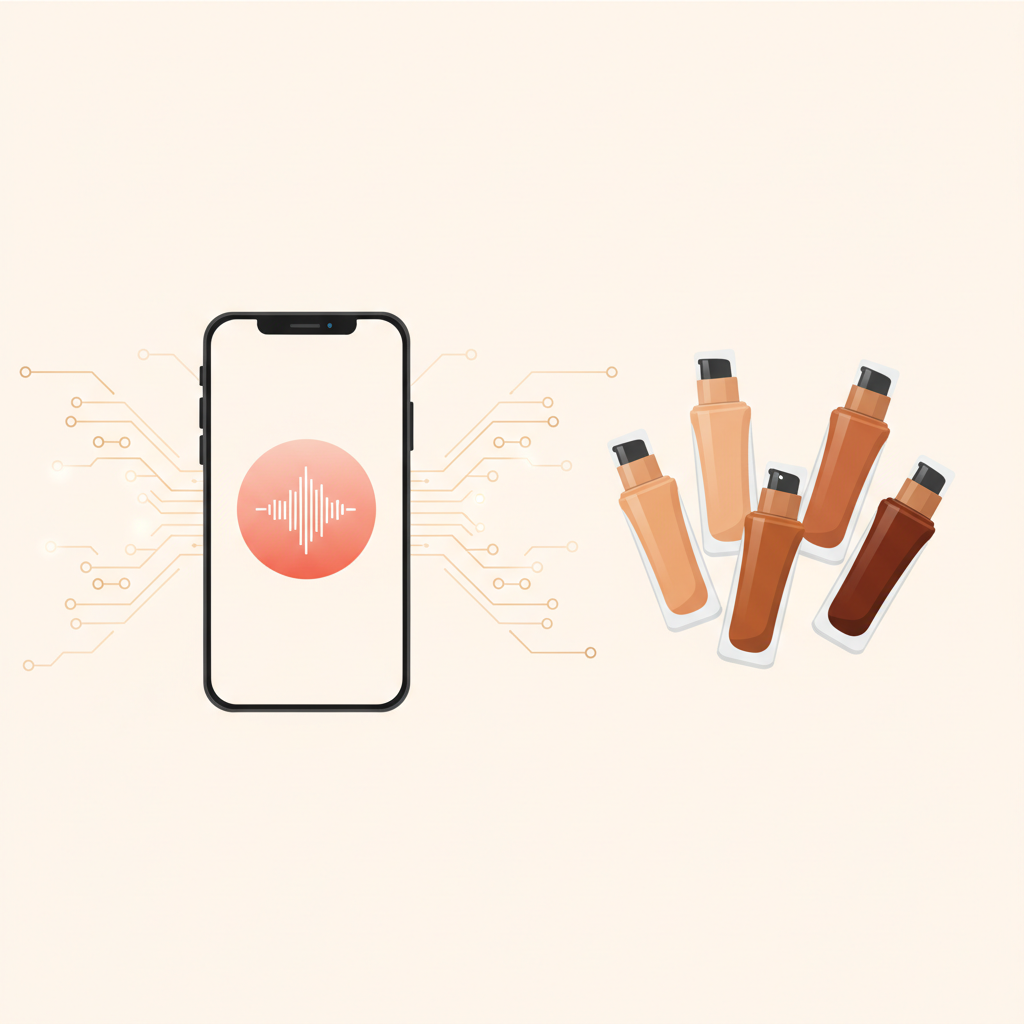
Voice AI changes that dynamic completely. A voice-enabled shade matcher powered by an agentic AI architecture can:
- Ask about lighting conditions ("Are you in natural light right now?")
- Clarify undertone preferences using plain language the caller naturally uses
- Cross-reference current products the shopper uses ("What foundation do you wear now?")
- Suggest alternatives when the exact match isn't available
- Walk the customer through a comparison of two close shades in real time
The result? Fewer wrong-shade purchases, fewer returns, higher customer satisfaction, and greater confidence at checkout. Brands that have implemented AI-powered shade tools report up to a 40% drop in returns. For any beauty brand struggling with return-driven margin erosion, this is the ai best practice worth prioritizing first.
Abandon Cart Recovery Through Conversational AI Voice
Nearly 70% of online beauty shoppers abandon cart before completing a purchase, according to industry data. Traditional recovery methods — email sequences and retargeting ads, have declining effectiveness. Voice AI introduces a fundamentally different approach to abandon cart recovery by re-engaging shoppers through outbound calls and proactive in-session nudges.
When a shopper adds a foundation and serum to their cart but hesitates, the AI agent can step in with a conversational prompt: "I noticed you were looking at the hydrating serum. Would you like help choosing the right shade of foundation to pair with it?" This isn't a generic popup, it's contextual, data-driven engagement that addresses the shopper's specific intent.
For brands that configure outbound call capabilities, Alhena's voice AI can also follow up on abandoned sessions via phone, delivering personalized recommendations to the caller without requiring them to navigate back to the site. Every inbound and outbound interaction automatically feeds into revenue attribution analytics, so you can track exactly how much revenue voice-driven abandon cart recovery generates.
This automation replaces what would otherwise require a human agent making manual follow-up calls, a process that doesn't scale and introduces inconsistent CX. With voice AI, the brand can call customers who left high-value carts, recover the sale, and do it with consistent brand voice across every touchpoint.
Skincare Routines: From Guesswork to Guided Conversations
Skincare is even more complex than shade matching. A routine depends on skin type, climate, age, sensitivity, active ingredients already in use, and personal goals like anti-aging, hydration, or acne control. No static quiz captures all of that. But a five-minute voice conversation can.
Over 70% of beauty consumers want AI-powered personalization, and 83% of Gen Z shoppers expect personalized recommendations. The demand exists. What's been missing is a delivery format that feels natural, not a chatbot reading FAQ answers, but a genuine consultation.
What a voice-guided skincare consultation looks like
A customer visits a skincare brand's online store and taps the voice assistant icon. She says, "My skin gets really dry in winter but I break out if I use anything too heavy." The AI voice agent responds with a follow-up: "Do you currently use a hydrating serum or just a moisturizer?" Based on her answers, it builds a morning and evening routine from the brand's catalog, explains why each product fits, and adds the bundle to her cart, automatically.
That's a personalized consultation that would take a human agent 15 minutes, delivered in under two. The AI agent handles the full conversation from discovery through agentic checkout, populating the cart and even pre-filling checkout fields. For brands selling multi-step routines (cleanser, toner, serum, moisturizer, SPF), average order value jumps when the AI recommends the full set instead of a single product.
Alhena customers like Tatcha saw 3x conversion rates and 38% AOV uplift after deploying this kind of guided, conversation-first commerce experience. Victoria Beckham achieved a 20% increase in average order value using the same approach.
How Alhena AI Powers Voice-Driven Beauty Experiences
Alhena AI's Voice AI is built for exactly this kind of guided product discovery. Unlike generic voice assistants or simple bot platforms like Voiceflow, Alhena is purpose-built for ecommerce, meaning it doesn't just answer questions. It sells.
Agentic architecture with specialized AI agents
Under the hood, Alhena uses an agentic architecture where different specialist AI agents work in concert. A shade-matching agent activates when a customer asks about foundation colors. A Product Expert Agent handles skincare routine building. A support agent manages order tracking, returns, and subscription management inquiries. From the shopper's perspective, this complexity is invisible, they experience one seamless, on-brand voice. But each agent is purpose-trained for its specific domain, delivering the ai best results across every use case.
Shade matching with zero hallucinations
Alhena grounds every recommendation in your actual product catalog. When a customer asks, "What's the closest match to MAC NC35 in your line?", Alhena cross-references your shade database, not a general knowledge base. There are no hallucinated product names, no recommendations for items you don't carry. This ensures every answer maps to a real SKU and delivers trustworthy results.
This matters in beauty more than any other category. A wrong shade recommendation doesn't just cause a return. It breaks trust with a customer who may never come back.
Skincare routine building that drives AOV
Alhena's Shopping Assistant can guide a shopper through a complete skincare routine, explain ingredient compatibility, and populate the cart with a multi-product bundle. Brands like Victoria Beckham saw a 20% increase in average order value using Alhena's AI-powered recommendations.
The Product Expert Agent understands product relationships (which serum pairs with which moisturizer, which actives conflict with each other) and communicates that knowledge conversationally. Instead of "Add to cart," the interaction feels like "Here's your full routine, and here's why each step matters."
Omnichannel voice across every touchpoint
Beauty shoppers don't stay in one channel. They discover on Instagram, research on the website, and ask questions over WhatsApp. Alhena's voice AI works across web chat, email, Instagram DMs, WhatsApp, phone lines, and connected devices, with a unified memory layer that remembers context across channels. If a customer starts a shade conversation on Instagram and continues on the website, Alhena picks up where it left off.
Configure voice personality and brand voice
Alhena's voice AI lets you configure every aspect of the brand voice experience. You can select from multiple voice profiles, adjust speaking speed, and set distinct personality and tone settings that are independent from your text-based AI chat channels. This means your voice agent can sound warm and consultative for beauty advice while your email automation stays polished and professional.
You can also set voice-specific answering guidelines, for example, instructing the agent to give concise answers first and offer details only when asked, or to confirm an order number before sharing order tracking information. These guidelines are fully configurable from the dashboard without any developer resources.
Multilingual support across 90+ languages
Beauty is a global market, and customer service inquiries come in multiple languages. Alhena Voice AI supports 90+ languages including English, Spanish, French, German, Portuguese, Italian, Hindi, Arabic, Japanese, and Korean. This multilingual capability means beauty brands can serve international customers without staffing separate support teams for each market, a major CX advantage for enterprise brands expanding globally.
Phone and SIP line integration for inbound and outbound
Alhena doesn't limit voice AI to the chat widget. You can connect a dedicated phone number directly from the dashboard, or configure SIP domain integration to route inbound calls from your existing telephony provider (like Twilio Elastic SIP Trunking) directly into Alhena's voice AI agent.
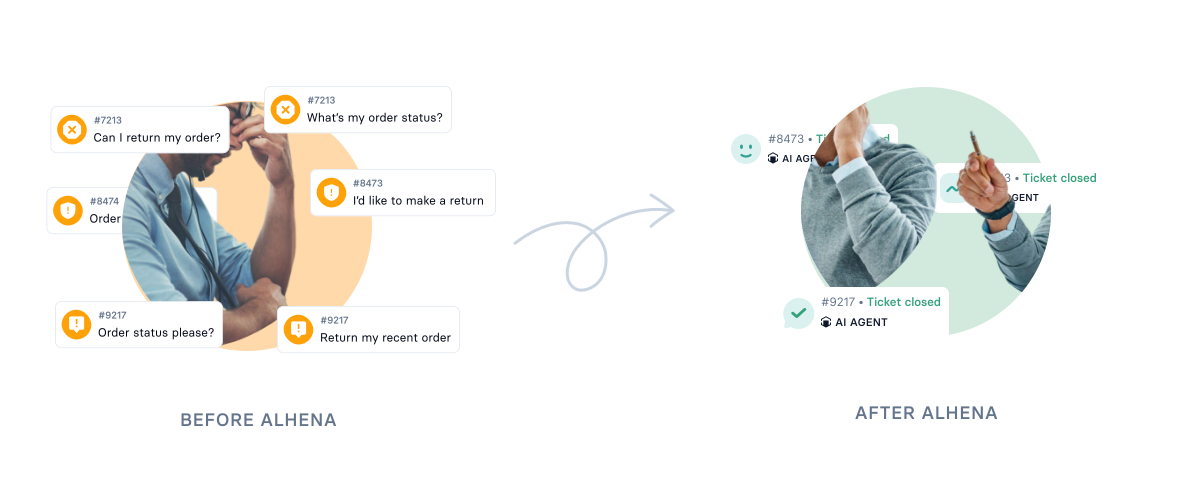
This means every caller, whether they're phoning about a missed call follow-up, an order tracking inquiry, or a shade-matching question, gets an instant, intelligent response. No hold music, no IVR phone trees, no missed calls. If the AI encounters a complex inquiry that requires escalation, it transfers the call to a human agent with full conversation context so the customer never has to repeat themselves.
For beauty brands handling high volumes of service calls, especially around product launches and seasonal promotions, this automation dramatically reduces response time while maintaining consistent CX. You can also configure human transfer guidelines so the AI knows exactly when to escalate: billing disputes, identity verification failures, or anytime the caller says "representative" or "agent."
Live in days, not months
Alhena deploys in under 48 hours with no dev resources required. It integrates with Shopify, WooCommerce, Magento, and Salesforce Commerce Cloud, plus helpdesk platforms like Zendesk, Gorgias, and Intercom. For beauty brands already running on these platforms, adding voice AI doesn't require a replatform or a six-month integration project.
The Business Case: Voice AI as a Revenue Channel
Most beauty brands still think of AI as a support tool, something to deflect tickets and reduce headcount. That's a narrow view. Voice AI is a sales channel.
With Alhena, the revenue impact is trackable. Built-in revenue attribution analytics show exactly which conversations led to purchases, what the average order value was, and how much revenue the AI generated. Tatcha saw 3x conversion rates and 38% AOV uplift after implementing Alhena, with 11.4% of total site revenue attributed directly to AI conversations.
For beauty brands spending heavily on customer acquisition, voice AI offers something rare: a channel that both acquires and converts at a lower cost per interaction than live agents or paid ads. To see how top ecommerce brands are already putting AI shopping assistants to work, explore our top AI shopping assistant use cases for 2025.
What to Look for in a Voice AI Solution for Beauty
Not every AI chatbot can handle the nuance of beauty. Here's what separates voice AI built for beauty ecommerce from generic solutions:
- Catalog-grounded responses: The AI must pull from your actual product data, not general internet knowledge. Hallucinated shade names or discontinued products destroy trust.
- Subjective language handling: Can it interpret "I want something glowy but not greasy" and map that to the right product attributes?
- Multi-turn conversations: Shade matching and routine building require follow-up questions. One-shot Q&A bots can't do this.
- Cart actions: The AI should populate the cart, apply bundles, and initiate checkout. Recommending a product without a path to purchase is a dead end.
- Revenue tracking: If you can't attribute sales to AI interactions, you can't justify the investment. Look for built-in analytics, not third-party workarounds.
- Support for diverse skin tones: AI training data must represent the full spectrum of human skin tones. Ask vendors about their training datasets and accuracy across demographics.
Alhena checks every one of these boxes. Its beauty and skincare solution includes a Shade Matcher, Skin Analyzer, Regimen Builder, and Smart Bundle Engine, all grounded in your product catalog and all capable of driving checkout.
Ready to give your beauty customers a voice-guided shopping experience that matches shades, builds routines, and drives revenue? Book a demo with Alhena AI or start free with 25 conversations.
Frequently Asked Questions
How does voice AI help with shade matching in beauty ecommerce?
AI voice lets shoppers describe their skin tone, undertone, and preferences using natural language instead of static filters. The AI agent asks multi-turn follow-up questions, cross-references the brand's product catalog in real time, and suggests the closest shade match. Unlike a basic bot or quiz builder, the voice AI handles subjective intent, phrases like "a bit warmer than what I wear now", and maps them to specific product attributes. This conversational approach captures nuances that dropdown menus miss, reducing wrong-shade purchases and returns by up to 40%. The automation works across the chat widget, phone lines, and SIP-connected inbound calls, so every caller gets the same quality of shade guidance.
How long does it take to deploy voice AI for a beauty brand?
With Alhena AI, deployment takes under 48 hours and requires no developer resources. The platform integrates with Shopify, WooCommerce, Magento, and Salesforce Commerce Cloud, plus helpdesk tools like Zendesk, Gorgias, and Intercom. You can start with shade matching or skincare routine guidance and expand from there.
Does voice AI work across multiple channels for beauty brands?
Alhena's voice AI works across web chat, email, Instagram DMs, WhatsApp, and phone lines. A unified memory layer maintains conversation context across all channels, so if a customer starts a shade consultation on Instagram and continues on the website, the AI remembers the full history.
Does voice AI support multiple languages for global beauty brands?
Alhena Voice AI supports multilingual interactions in 90+ languages, including English, Spanish, French, German, Portuguese, Italian, Hindi, Arabic, Japanese, and Korean. This multiple language capability is built into the core platform, you don't need separate deployments or additional configuration for each market. For beauty brands selling internationally, this means a single AI voice agent can serve customers worldwide with consistent brand voice, accurate product recommendations, and real-time shade matching, regardless of the language the caller speaks.