The Pop-up Debate Every Ecommerce Team Has
Your marketing team wants more e-commerce engagement. Your UX team hates intrusive, interruptive digital experiences. Both are right, because the problem isn't the concept of proactive messaging in e-commerce. It's the execution.
Static popups fire the same fixed digital copy, the same countdown timer, and the same generic discount to every digital visitor, whether they arrived 2 seconds ago or have been reading product details for 3 minutes. AI powered smart nudges work differently. They generate dynamic, real-time copy per product page, time themselves to user behavior, and stay contextually relevant in real-time to the visitor’s preferences and what they are actually doing. That distinction in nudging approach is why proactive, behavior-based nudges produce 3x to 5x higher engagement among users than generic popups with lower dismissal rates and higher satisfaction on proactive messages.
But the real question isn't "nudges versus pop-ups." It's how you configure, calibrate, and measure nudges so they drive conversions without annoying shoppers. This 2026 practical personalization guide walks through the three-surface engagement model, granular tuning controls, and the nudge-to-purchase measurement funnel that turn proactive AI chat conversion from marketing theory into revenue.
The Three-Surface Engagement Model
Most ecommerce businesses and retailers treat nudges, product page FAQs, and the chat widget as three separate tools. They're not. They're a coordinated proactive engagement system, and understanding how these tools work together is the first strategic step to hitting 6%+ AI engagement rates instead of the typical 1% customer engagement rate.
How Each Surface Catches a Different Intent Signal
Product page FAQs catch shoppers who are actively reading product details. These visitors are already engaged with the product. They want to know about ingredients, materials, shipping times, or compatibility. Smart FAQ Recommendations, auto-generated from real shopper questions, answer those queries without requiring the visitor to open chat.
Nudges catch users showing behavioral hesitation, creating conversion opportunities. The visitor isn't asking a question yet. They're lingering, scrolling back and forth, or stalling on the price section. A contextual nudge meets them at that moment of doubt with a relevant message tied to what they're doing on the page.
The chat widget catches buyers with complex or multi-product queries and questions. These are the self-selecting visitors who actively seek help, typically 1% to 2% of total traffic.
Together, nudges and FAQs drive the majority of AI conversations, far more than the chat widget alone. They intercept shoppers at the moment of hesitation rather than waiting for the shopper to seek help. That's the mechanism behind the gap between brands running passive chat (around 1% engagement) and brands running proactive AI across all three surfaces (6%+ engagement).
AI Smart Nudges in Action: Three Scenarios
Abstract descriptions don't show the real value. Here's what well-tuned nudges look like on a live e-commerce website:
- Jacket page, 45 seconds, no scroll: A shopper lands on a wool jacket PDP and stalls. They haven't scrolled past the hero image. After 45 seconds of dwell time, a nudge appears: "Not sure about the fit? Customers say this runs slim." The nudge references the specific product and addresses the most common hesitation point for that category.
- Moisturizer comparison, tab bouncing: A shopper toggles between two moisturizer product pages three times in 90 seconds. The behavior signals decision paralysis. A nudge appears: "Want help choosing between these? I can compare them in 10 seconds." One click opens a side-by-side comparison with product recommendations inside the AI shopping assistant and personalization.
- Size guide clicked twice, no add-to-cart: A shopper opens the size guide on a dress page, closes it, scrolls down, then opens it again. The repeated interaction signals unresolved sizing doubt. A nudge appears: "Need sizing help? Tell me your usual size and I'll recommend." The AI powered response pulls from product recommendations and brand's fit data, customer reviews, and sizing suggestions.
In each case, the personalization and relevance matches the hesitation signal. That's what separates a helpful, non-intrusive experience from an intrusive interruption.
Smart Tuning Controls That Make Nudges Smarter
The difference between a 3% engagement rate and a 6% engagement rate often comes down to tuning. Here are the controls that matter.
Timing Controls
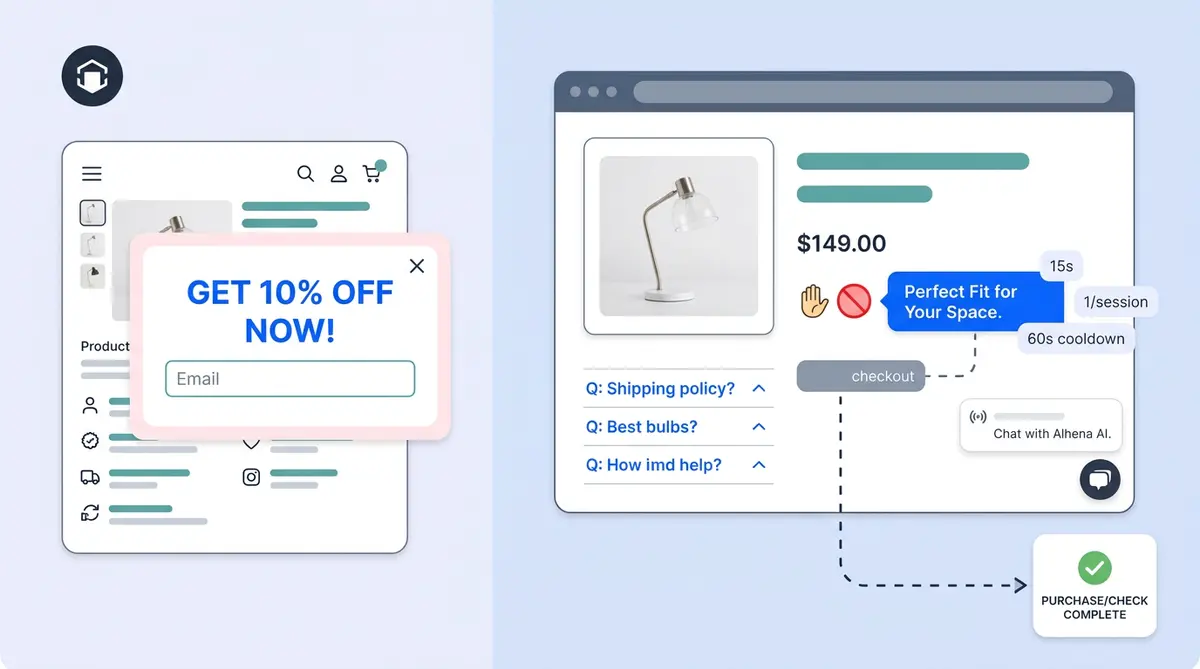
How long before a nudge appears depends on the page type. Product detail pages (PDPs) get shorter delays, typically 15 to 30 seconds, because the user has already shown intent by clicking into a specific product. Category pages and collection pages get longer delays, 30 to 45 seconds, because users are still browsing the category. Triggering a nudge in the first 10 seconds of any page visit increases bounce rates. The optimal window for most ecommerce sites across the industry is 30 to 120 seconds.
Frequency Controls
Frequency limits on proactive messaging prevent fatigue and protect loyalty. The key settings include once per session versus once per page, PDP-only versus site-wide, and a maximum nudges-per-visit cap. Data shows that 1 to 2 nudges per session hits the engagement sweet spot. Three nudges per session still produces positive results but with diminishing returns. Four or more nudges per session crosses into negative territory with measurable bounce rate increases and higher cart abandonment. A minimum 60-second cooldown between nudges prevents stacking.
Behavior Triggers
Each trigger should map to a specific nudge type so the message matches the signal:
- Size guide clicks (2+ times): Sizing assistance nudge
- Image scroll cycling: Product detail or review summary nudge
- Price section dwell (15+ seconds): Value proposition or payment options nudge
- Exit intent: Last-chance product highlight or shipping info nudge
- Return visit to same product (within 7 days): Welcome-back prompt with stock or price updates
The key principle: every trigger maps to a message that addresses the specific shopper preferences and hesitation the behavior reveals. Generic "Can I help you?" nudges fired on every trigger type waste the behavioral signal you just captured.
The Nudge-to-Purchase Measurement Funnel
Engagement metrics alone don't tell you if nudges are working. You need a full funnel from first impression to completed purchase, tracked with source attribution.
The five stages:
- Nudge impression: How many visitors saw a nudge (proactive AI can reach up to 45% of site visitors versus 5% for passive chat)
- Nudge interaction: How many clicked, tapped, or responded to the nudge
- AI conversation initiated: How many interactions turned into a multi-turn conversation with the AI
- Product added to cart: How many conversations led to an adding to cart event and reduce cart abandonment (AI-engaged shoppers show a 15% to 35% boost in adding to cart lift, proving that personalized nudges directly influence adding to cart decisions)
- Checkout completed and purchase confirmed: Final conversion, where AI-engaged shoppers convert at 12.3% versus 3.1% for unassisted visitors
This funnel must be tracked end-to-end with source attribution, analyzing each conversion path, so teams gain insights into which nudge types, which proactive behavior triggers, and which page placements produce the highest revenue per impression, tracking revenue by surface, not just the highest click rate. By analyzing and refining nudge performance across these stages. A nudge with a 20% click rate but low downstream conversion is less valuable than one with a 10% click rate that consistently drives purchase completions.
Won't Nudges Annoy My Customers?
This is the most common objection, and the data answers it clearly. Properly tuned proactive nudges with behavior-based triggers, frequency limits, and personalized, relevant, contextual copy produce proactive engagement rates 3x to 5x higher than generic pop-ups, with 70% lower negative sentiment. Shoppers perceive them as helpful rather than intrusive or interruptive because the message arrives in a timely way with timely, relevant messaging about the right product.
Brands like Tatcha have seen 3x boost in conversion rates and 38% higher average order value (AOV) from AI-engaged users, with 11.4% of total site revenue and stronger customer loyalty attributed to AI conversations with high customer satisfaction, trust, and loyalty. Those insights don't come from annoying users. They come from helping the right visitors at the right time.
How Alhena AI Powers All Three Surfaces
Alhena AI gives ecommerce businesses built-in controls across all three proactive engagement surfaces:
- Intelligent Conversion Nudges: Configure timing delays, frequency caps, and behavior triggers directly from the dashboard. Set PDP-specific or site-wide rules, define trigger-to-message mappings, and refine cooldown periods without developer resources.
- Smart FAQs: Auto-generated per product page from real shopper suggestions and shopper questions. FAQs update as new questions emerge, keeping the content fresh, relevant, and useful to what users and buyers actually ask.
- Revenue Analytics by Source: Performance is split by engagement source for performance analysis, so you can see exactly how much strategic revenue nudges, FAQs, and the chat widget each generate. Real-time funnel attribution tracks from first impression through checkout to final purchase, reducing cart abandonment at every stage, giving you actionable insights to optimize each surface independently.
The platform deploys in under 48 hours with no dev resources and integrates with leading e-commerce platforms including Shopify, WooCommerce, Magento, and Salesforce Commerce Cloud. Book a demo or use the ROI calculator to estimate the revenue impact before you start.
The Takeaway
The brands reaching 6% AI engagement rates are not the ones with the most aggressive pop-ups. They're the ones with the most smart, precisely tuned proactive nudge systems, where every AI prompt is timely and contextual and relevant, every trigger is behavioral, and every interaction is measured through to revenue. The three-surface model, combined with granular tuning controls and full-funnel attribution, turns proactive AI from a "nice to have" into a measurable revenue, conversions, and loyalty and retention channel revenue and sales growth channel.
Ready to see how tuned nudges perform on your store? Book a demo with Alhena AI or start free with 25 conversations.
Frequently Asked Questions
How do AI smart nudges differ from regular pop-ups?
Regular pop-ups fire based on a timer or page load with static copy that every visitor sees. AI smart nudges use user behavior signals like dwell time, supporting loyalty and, size guide clicks, and scroll patterns to trigger personalized, relevant, contextual messages tied to the specific product the shopper is viewing. Alhena AI generates nudge copy dynamically per product page, which is why behavior-based nudges achieve 3x to 5x higher engagement with lower dismissal rates.
Do AI nudges annoy customers?
Properly tuned nudges with behavior triggers, frequency caps, and contextual messaging produce 70% lower negative sentiment than generic pop-ups. The key is limiting nudges to 1 to 2 per session, setting minimum 60-second cooldowns, and matching the relevant message to the hesitation signal. Alhena AI lets you configure all of these controls from a single dashboard, so you can optimize and refine and fine-tune without developer resources.
What percentage of AI engagement comes from nudges versus the chat widget?
Proactive surfaces like nudges and smart FAQs reach up to 45% of site visitors, while passive chatbot widgets reach only about 5%. Brands using all three surfaces through Alhena AI typically see engagement rates of 6% or higher, compared to roughly 1% for brands relying on the chat widget alone. The gap comes from intercepting users at the moment of hesitation rather than waiting for them to seek help.
What behavior triggers work best for ecommerce nudges?
The highest-performing triggers include return visits to the same product (40% to 90% conversion improvement), size guide clicks (strong sizing doubt signal), and extended dwell time on product pages (30 to 120 seconds). Cart page inactivity and exit intent triggers also perform well. Alhena AI lets you map each trigger to a specific nudge type so the message always matches the hesitation signal.
How do I measure whether my nudges are actually driving revenue?
Track the full nudge-to-purchase funnel: impression, interaction, AI conversation, add to cart, and purchase. Each stage needs source attribution so you can compare revenue per impression across nudge types, behavior triggers, and page placements. Alhena AI splits revenue analytics by engagement source, showing exactly how much revenue nudges, FAQs, and the chat widget each generate with end-to-end funnel attribution.