Running an international ecommerce brand means running parallel operations. Your dot-com website serves the U.S. with USD pricing and FedEx shipping. Your dot-co-uk storefront has GBP pricing, Royal Mail delivery, and a 30-day return window instead of 14. Your dot-eu store covers the continent with EUR pricing, DHL delivery and fulfillment, and GDPR-compliant data handling. Each storefront has its own Shopify instance, its own product catalog with region-specific SKUs, and sometimes its own helpdesk.
For retailers running a multi-store ecommerce operation across multiple ecommerce platforms, this complexity is manageable when every touchpoint is human-operated. But the moment you add AI to the mix, a new question appears: how do you deploy a consistent, brand-aligned AI shopping and support experience across all of these storefronts without spinning up and managing separate AI systems for each one?
This guide covers the best multi-profile architecture, operating models, and customer journey considerations, rollout playbook, and operational model that lets international brands run one multi-storefront AI platform across stores in every region.
The Multi-Profile Architecture
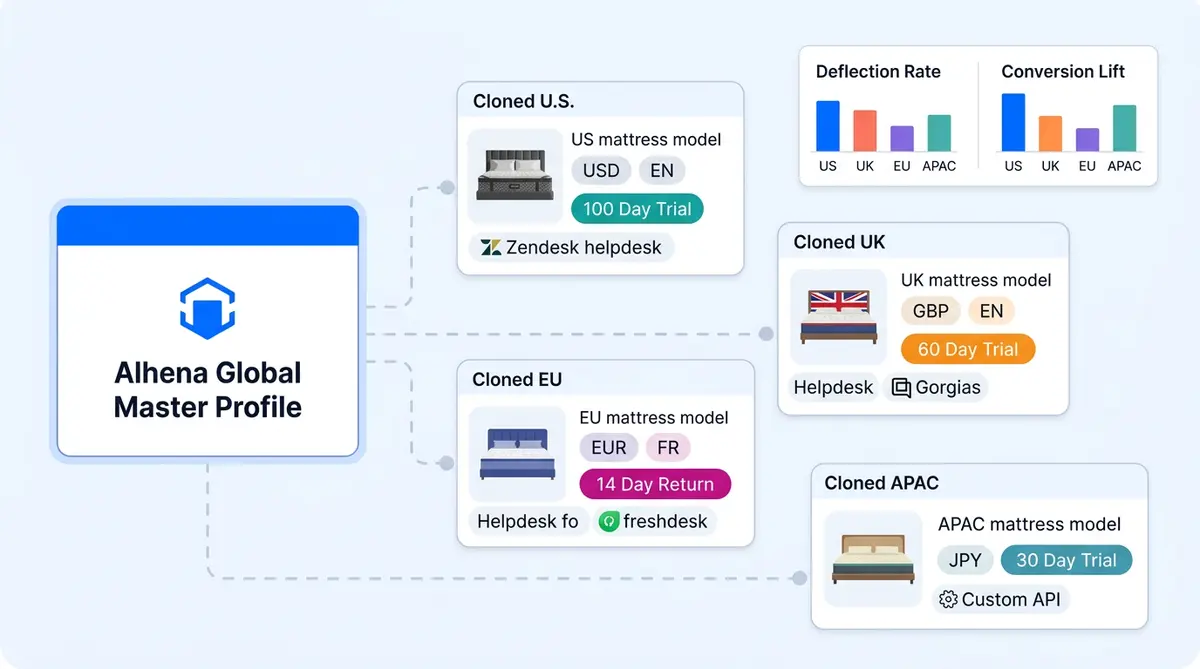
The core concept is simple: one Alhena AI platform account with separate profiles for each storefront. Each profile connects to its own commerce platform instance, whether that's Shopify, WooCommerce, or Salesforce Commerce Cloud. Each profile is trained on its own regional catalog, configured with its own policies, currencies, language preferences, catalogs, and integrations. This gives international storefronts the autonomy they need.
Your U.S. profile pulls product data from your American Shopify store and answers in USD. Your UK profile connects to a separate Shopify instance with GBP pricing and UK-specific return policies. Your EU profile handles EUR, references EU shipping carriers, and responds in the customer's preferred language.
Billing stays unified. All profiles share a single credit pool under one vendor relationship, so finance manages one contract and one invoice regardless of how many markets you operate in.
Profile Cloning for Brand Consistency
When you expand into a new market, you don't start from scratch. You clone an existing profile. The clone inherits everything that defines your brand: tone of voice, personality, behavior rules, compliance guardrails, and escalation logic. Then you customize what's region-specific: product catalog, pricing, return windows, shipping carriers, support hours, language, and local promotions.
This creates a clean separation between two types of rules:
- Brand-level guidelines apply globally across all profiles. How your brand name is formatted, what tone the AI uses, which topics trigger escalation to a human agent, and what compliance guardrails are in place. These stay consistent whether a customer is chatting on your U.S. store or your Japanese storefront.
- Regional rules are profile-specific. A 30-day return window in the UK versus 14 days in Germany. Royal Mail tracking in one market, DHL in another. EUR currency display in France, SEK in Sweden. Support hours aligned to local business hours.
The result is an AI that sounds like the same brand everywhere but knows exactly which policies, products, and logistics apply to the customer it's talking to. Brands that maintain this consistency see measurable results: Tatcha achieved a 3x conversion rate and 38% higher average order value when their AI conversations stayed brand-aligned and contextually accurate.
Different Tools per Region, No Forced Standardization
International brands often use different tech stacks in every market. Your North American team might run Gorgias for support while your European team uses Zendesk. One region handles returns through Narvar, another through ShipStation. Forcing every market onto the same helpdesk or returns platform just to get AI working is a non-starter for most operations teams.
Each Alhena AI profile connects to whatever tools that region already uses. Your U.S. profile integrates with Gorgias and ShipStation. Your UK profile connects to Zendesk and Narvar. Your APAC profile ties into Freshdesk and a local fulfillment system. No requirement to standardize. No migration projects. This flexibility means your AI setup stays as flexible as your existing operations. The AI adapts to your existing regional infrastructure, not the other way around.
Analytics Across Every Market
Managing AI across regions without cross-market visibility is flying blind. Alhena AI provides an aggregate performance view across all profiles from a single dashboard, plus the ability to drill down into any specific market.
From the aggregate dashboard view, international operations teams can compare AI engagement rates, conversion lift, deflection rates, and revenue attribution side by side across every storefront. When your German store shows a 72% deflection rate while your French store sits at 54%, you know where to focus optimization. When conversion rates from AI-assisted shopping show 3x conversion lift in one market and 1.5x in another, you can investigate what's different about the catalog, policies, or conversation flows.
This per-profile analytics view is what turns AI from a regional experiment into a globally managed channel. Crocus reached an 86% deflection rate and 84% CSAT by using profile-level data to continuously refine their AI's performance.
The Market-by-Market Rollout Playbook
International brands that try to launch AI across all markets simultaneously run into compounding problems: catalog errors in one region go unnoticed while you're fixing policy mismatches in another. The brands that scale AI successfully follow a disciplined market-by-market approach.
Phase 1: Prove value in one market (4 to 8 weeks). Pick your highest-volume storefront. Connect the AI to that store's catalog, helpdesk, and order management system. Measure deflection rate, CSAT, conversion lift, and revenue attribution. Manawa used this approach to cut support workload by 43% and drop response times from 40 minutes to under 1 minute.
Phase 2: Build the business case. Use documented results from Phase 1 to secure buy-in for expansion. Real numbers from your own store carry more weight than vendor promises.
Phase 3: Clone and customize. Clone the proven profile for the next region. Swap in the local catalog, adjust policies and language, connect regional integrations. Because the brand foundation is already tested, each new market launches in days, not months.
Phase 4: Repeat. Each subsequent region follows the same pattern. Weekly auto-training per profile keeps each regional AI current with its local catalog as products, prices, and policies change, with no manual intervention required.
Why This Approach Scales
Linear scaling kills international AI programs. The solution is scalable architecture with centralized control. If every new market requires building a new AI system from scratch, configuring it independently, and managing it as a separate vendor relationship, the operational overhead grows with every region you add. The multi-storefront, multi-profile architecture breaks that pattern.
New markets inherit proven brand guidelines and behavior rules. Regional customization happens at the profile level, not the platform level. Unified billing means one vendor relationship regardless of market count. Cross-market analytics give operations teams the visibility to manage performance globally without logging into separate systems per region.
Alhena AI is purpose-built for this model and built to scale: one platform managing multiple storefronts across regions, integrating with Shopify, WooCommerce, Salesforce Commerce Cloud, Gorgias, Zendesk, Freshdesk, Kustomer, Narvar, ShipStation, and more, without forcing tech stack standardization or creating overhead that scales with each new market.
International brands expanding AI market by market will outperform those trying to deploy everywhere at once. The multi-profile architecture means each new region launches in days because the brand foundation is already proven.
Ready to run one AI platform across every regional storefront? Book a demo with Alhena AI or start for free with 25 conversations.
Frequently Asked Questions
Do I need a separate Alhena AI account for each region?
No. Alhena AI uses a multi-profile architecture under one account. Each regional storefront gets its own profile with its own catalog, policies, and integrations, but everything is managed from a single platform with unified billing and shared credits.
Can different regions use different helpdesks with Alhena AI?
Yes. Each profile connects to whatever helpdesk that region already uses. Your U.S. team can run Gorgias while your European team uses Zendesk and your APAC team uses Freshdesk. Alhena AI adapts to your existing regional tech stack without requiring standardization.
How does Alhena AI maintain brand consistency across multiple storefronts?
Profile cloning carries forward your brand-level guidelines, including tone, personality, compliance guardrails, and escalation rules, to every new region. Regional rules like return policies, currencies, and shipping carriers are customized per profile. The AI sounds like the same brand everywhere while applying the right local policies.
How does billing work across multiple profiles?
All profiles share a single credit pool under one account. Finance manages one vendor relationship, one contract, and one invoice regardless of how many regional storefronts you operate. Credits are consumed across profiles from the shared pool.
Should I launch AI across all storefronts at the same time?
No. Alhena AI recommends a market-by-market rollout. Start with your highest-volume storefront, prove value over four to eight weeks with measurable results, then clone that proven profile for the next region. Each new market launches in days because the brand foundation is already tested.