Shopify stores lose roughly 70% of filled carts before checkout, according to Baymard Institute's analysis of 50 studies. That translates to $260 billion in recoverable revenue across the US and EU alone. Most Shopify merchants rely on abandoned cart emails to win those sales back, but Klaviyo's own data shows the average recovery rate sits at just 10.7%. AI is changing that number fast. Shoppers who engage with an AI assistant during their session convert at 12.3%, compared to 3.1% for those who don't, a 4x improvement. This guide breaks down why Shopify cart abandonment happens in 2026, where email recovery falls short, and how AI-powered tools recover revenue that traditional tactics leave on the table.
What Shopify Cart Abandonment Actually Costs You
The 70.22% average cart abandonment rate isn't a Shopify-specific problem, and it affects every ecommerce business regardless of size. Red Stag Fulfillment's research confirms that Shopify stores see virtually identical rates to the broader ecommerce benchmark. But the pain hits harder depending on your vertical. Fashion and apparel stores face 75-80% abandonment. Beauty brands sit at 68-72%. Electronics falls between 65-70%.
Mobile makes it worse, especially for businesses selling on the go. Shopping cart abandonment on mobile devices climbs to 78%, compared to 66% on desktop. With over 70% of Shopify traffic coming from phones, that gap represents serious revenue loss for stores that haven't optimized their mobile checkout experience.
The reasons shoppers walk away are well-documented. Baymard's checkout research breaks it down:
- 48% leave because of extra costs (shipping, taxes, fees added at checkout)
- 26% abandon when forced to create an account
- 25% don't trust the site with payment info
- 23% find delivery too slow
- 22% hit a checkout process that's too long or complicated
Here's what matters for your recovery strategy: most of these objections are answerable in real time. A shopper worried about shipping costs needs a quick answer, not an email three hours later. That's the core argument for AI intervention over traditional recovery. For a deeper look at what drives shoppers away, see our breakdown of the 10 biggest reasons behind cart abandonment.
Why Email Recovery Hits a Ceiling
Abandoned cart emails still work. It's a channel that still delivers, and nobody's arguing otherwise. Klaviyo's benchmark data shows a 50.5% open rate, 6.25% click rate, and 3.33% conversion rate for abandoned cart flows. Three-email sequences produced $24.9 million in revenue, compared to $3.8 million from single-email sends. That's a 6.5x difference.
But those numbers have a ceiling. The average Shopify store recovers 10.7% of abandoned carts and abandoned checkouts through email. Top performers hit 15-20%, however the remaining 80%+ never convert. Those abandoned carts are gone for good.
Three structural problems limit email recovery:
Timing. By the time your first email lands (typically 1-4 hours after abandonment), the shopper has moved on. They've found the product elsewhere, lost the impulse, or simply forgotten why they wanted it. The moment of highest purchase intent is when they're still on your site, not hours later. Shoppers often don't come back.
Context blindness. A standard Shopify abandoned cart email captures the items left in the cart and shows the product image, price, and a "complete your purchase" button. It doesn't know why the shopper left. Was it the shipping cost? A sizing question? Payment concerns? Without that context, it's not possible for the email to address the real objection. The shopper didn't get an answer when they needed one.
Channel fatigue. Shoppers receive dozens of marketing emails daily. Open rates for abandoned cart emails remain strong relative to other email types, but the channel itself is increasingly crowded. SMS performs better (98% open rate, 4.5-8% conversion), but consent requirements limit its reach.
Email remains part of any good recovery stack. But treating it as the primary strategy means accepting that 80-90% of abandoned carts are simply lost.
How AI Changes the Cart Recovery Equation
The biggest shift AI brings to Shopify cart abandonment isn't better emails. It's intervening before the shopper leaves. Industry data from Envive AI shows that AI-powered chat recovers 35% of abandoned carts, compared to 3-5% for email alone. That gap exists because AI addresses the root cause of abandonment in the moment it happens.
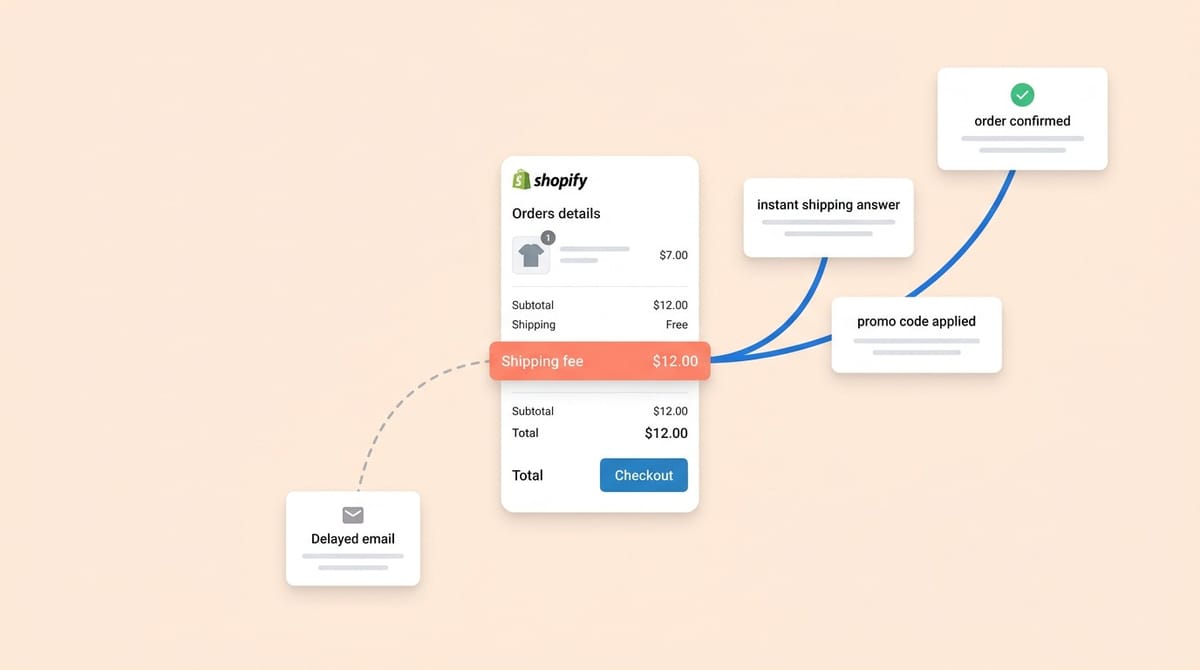
Think about the most common abandonment trigger: unexpected costs at 48%. When a shopper sees a shipping fee they didn't expect, they have a question: "Is there free shipping over a certain amount?" or "How much would shipping cost to my area?" An AI shopping assistant answers that instantly. No waiting. No digging through FAQ pages. The shopper gets clarity and either completes the purchase or makes an informed decision to leave.
The same logic applies to every major abandonment reason. Sizing uncertainty? The AI pulls product specs and recommends the right fit. Return policy concerns? Instant, accurate answers pulled from your store's actual policies. Payment options? The AI confirms whether you accept Apple Pay, Shop Pay, or offer buy-now-pay-later, right in the conversation.
Real-time intervention works because it matches the speed of the shopper's decision-making. McKinsey's research found that personalized, real-time engagement can boost conversion rates by up to 40%. That aligns with what brands are seeing on the ground: shoppers who engage in two-way conversations during their session complete their purchase nearly 50% of the time. For more on the conversion impact, see how AI shopping assistants increase ecommerce conversion rates.
Six AI Strategies That Recover Abandoned Shopify Carts
1. Exit-Intent Detection and Proactive Engagement
AI models analyze behavioral signals like mouse movements toward the browser's close button, scroll velocity changes, and tab-switching patterns to predict abandonment 2-4 seconds before it happens. That window is enough to trigger a targeted message: a free shipping reminder, a limited-time offer, or a simple "Can I help you find what you need?"
This is 2-3x more effective than rule-based exit-intent popups because the AI learns which triggers work for different shopper segments. For example, a first-time visitor is likely to respond to a discount. A returning customer might just need reassurance about delivery timing.
2. Conversational Objection Handling
Instead of a static popup, an AI shopping assistant opens a conversation. It asks what's holding the shopper back and responds with specific, accurate information pulled from your Shopify product catalog, shipping policies, and return terms. This turns a one-way interruption into a two-way exchange, and 69% of consumers actually prefer chatbots for quick brand communication, according to Salesforce.
3. Personalized Incentive Optimization
Blanket discounts eat your margins. AI determines who actually needs an incentive and what type works best. The data is compelling:
- Free shipping offers lift recovery by 28%
- Percentage discounts (5-15%) lift recovery by 18-25%
- Reminder-only messages (no discount) still recover 40-60% of carts
AI-optimized incentive targeting cuts margin loss from 8-12% (blanket discounts) down to 2-4%, while keeping recovery rates the same or better. That's the difference between a profitable recovery program and one that gives away revenue you would have earned anyway.
4. Smart Multi-Channel Recovery
When a shopper does leave, AI doesn't just send an email. It selects the best channel and timing for each individual across multiple touchpoints based on their behavior history. Email handles 50-60% of post-abandonment recovery. Retargeting ads contribute 25-35%. SMS, when consent exists, converts 2-4x higher than email.
AI-driven send-time optimization alone lifts open rates by 10-15% by matching delivery to individual browsing patterns. Combined with channel selection, this approach squeezes significantly more conversions from the same abandoned cart pool.
5. Agentic Checkout Assistance
This goes beyond answering questions. An AI agent can actively help shoppers complete their purchase by populating carts, applying discount codes, and pre-filling checkout fields. For Shopify stores, this means the AI doesn't just suggest products. It removes friction from the actual buying process.
When a shopper says "I want the blue one in medium," the AI adds it to cart. When they ask about a promo code, the AI applies it. This kind of hands-on assistance is what separates conversational AI from a basic FAQ chatbot.
6. Post-Purchase Intelligence That Prevents Future Abandonment
Every abandoned cart contains data about what went wrong. AI aggregates these patterns across thousands of sessions to identify systemic issues: a product page with confusing sizing info, a shipping threshold that's too high, a checkout step where most drop-offs happen. This feedback loop means your abandonment rate improves over time, not just your recovery rate. We cover more of these tactics in our guide to how AI recovers abandoned carts.
How Alhena AI Tackles Shopify Cart Abandonment
Alhena AI connects directly to your Shopify store and syncs your product catalog, inventory, pricing, and policies in real time. That's the foundation for everything else: every answer the AI gives is grounded in your actual data, not generic responses.
Where Alhena differs from most Shopify cart abandonment apps is its focus on selling, not just support. The platform runs two specialized agents: a Product Expert Agent that handles product discovery, comparisons, and recommendations, and an Order Management Agent that deals with post-purchase questions like order tracking, returns, and exchanges.
For cart abandonment specifically, Alhena's Product Expert Agent engages shoppers who show hesitation. It answers sizing questions using your actual product data. It compares items side by side when a shopper is deciding between two options. It recommends alternatives when something is out of stock. Every interaction helps move the shopper closer to checkout, not just deflect a support ticket.
The results back this up. Tatcha, a luxury skincare brand on Shopify, saw a 3x conversion rate increase and 38% average order value uplift after deploying Alhena, with the AI contributing to 11.4% of total site revenue. Read the full Tatcha case study here. Puffy achieved 63% automated inquiry resolution with 90% customer satisfaction, and Victoria Beckham reported a 20% increase in average order value. See all customer results.
Alhena also works across channels. The same AI that engages shoppers on your Shopify storefront also handles Instagram DMs, WhatsApp messages, and email. If a customer abandons a cart on mobile and later asks a question on Instagram, the AI has the full context of their browsing session. No repeated questions, no lost context.
If you're exploring what an AI agent can do on Shopify beyond cart recovery, our guide to setting up an AI agent for Shopify covers the full picture. Setup takes under 48 hours with no developer resources needed. Alhena syncs with Shopify natively and integrates with helpdesks like Zendesk, Gorgias, and Intercom, so it fits into your existing support stack without replacing anything.
What to Look for in a Shopify Cart Abandonment AI Solution
Not every AI tool labeled "cart recovery" actually reduces abandonment. Many don't go beyond glorified email automation with an AI label. Here's how to choose a real AI cart recovery solution, and which features matter most:
Real-time catalog sync. The AI needs live access to your Shopify product data, including inventory levels, pricing, variants, and shipping options. If it's working from a static export, it will give wrong answers and erode trust.
Conversational, not just reactive. A chatbot that only responds when clicked isn't reducing cart abandonment. Look for proactive engagement triggered by behavioral signals, like exit intent, prolonged inactivity on the cart page, or repeated visits without purchase.
Revenue attribution. You need to know exactly how much revenue the AI is generating. Alhena includes built-in revenue attribution analytics that track which conversations led to completed purchases and the associated revenue. Without this, you're guessing at ROI.
Hallucination-free responses. Generic AI chatbots can fabricate product details, invent shipping policies, or quote incorrect prices. For a Shopify store, one wrong answer about a return policy or delivery date can cost you the sale and the customer's trust. Your AI must be grounded in verified product data with zero hallucination.
Omnichannel coverage. Cart abandonment doesn't happen only on your website. Shoppers browse on Instagram, ask questions on WhatsApp, and compare products across tabs. An effective AI solution works across all these touchpoints with shared conversation context.
Easy setup, no dev dependency. If deploying the AI requires custom development or weeks of integration work, most Shopify merchants won't see ROI fast enough to justify the investment. The best solutions connect to Shopify in minutes and start working within days.
Ready to stop losing 70% of your Shopify carts to abandonment? Book a demo with Alhena AI to see how real-time AI engagement recovers the revenue email can't reach, or start free with 25 conversations and test it on your store today. Use the ROI calculator to estimate what you could recover.

Frequently Asked Questions
What is the average cart abandonment rate for Shopify stores?
Shopify stores see a cart abandonment rate of approximately 70%, matching the global ecommerce average tracked by Baymard Institute across 50 studies. Mobile abandonment is higher at 78%, which matters since over 70% of Shopify traffic comes from mobile devices.
How does AI reduce cart abandonment on Shopify?
AI reduces Shopify cart abandonment by intervening in real time while the shopper is still on your site. It detects exit intent, answers product and policy questions instantly, recommends alternatives, and can even populate carts or apply discount codes. AI chat recovers up to 35% of abandoned carts, compared to 10.7% for email alone.
What are the top reasons shoppers abandon carts on Shopify?
The top reasons are unexpected extra costs like shipping and taxes (48%), required account creation (26%), lack of trust in payment security (25%), slow delivery (23%), and a checkout process that is too long or complicated (22%), according to Baymard Institute.
Is AI better than abandoned cart emails for recovery?
AI and email work best together, but AI significantly outperforms email alone. Email recovers an average of 10.7% of abandoned Shopify carts. AI-powered real-time chat recovers up to 35%, because it addresses objections while the shopper still has purchase intent, not hours later.
How does Alhena AI help with Shopify cart abandonment?
Alhena AI connects to your Shopify store and syncs your product catalog, pricing, and policies in real time. Its Product Expert Agent engages hesitant shoppers with accurate product answers, comparisons, and recommendations. Brands like Tatcha saw a 3x conversion rate increase and 38% AOV uplift using Alhena.
How long does it take to set up Alhena AI on Shopify?
Alhena AI deploys on Shopify in under 48 hours with no developer resources needed. It syncs with your Shopify catalog automatically and integrates with helpdesks like Zendesk, Gorgias, and Intercom.
Can AI prevent cart abandonment before it happens?
Yes. AI models analyze behavioral signals like mouse movements, scroll patterns, and page dwell time to predict abandonment 2-4 seconds before it happens. This allows the AI to trigger a proactive message, such as answering a shipping question or offering free shipping, before the shopper leaves.
What is the ROI of using AI for Shopify cart recovery?
The ROI is significant. Recovering a 75 dollar abandoned cart costs approximately 0.50 dollars in AI expenses, a 150x return. AI also protects margins by targeting incentives only to shoppers who need them, cutting margin loss from 8-12% with blanket discounts to just 2-4%.