Shopify President Harley Finkelstein dropped a stat during the company's Q4 2025 earnings call that deserves more attention: orders coming to Shopify stores from AI-powered search engines grew 15x since January 2025. The growth started from a small base, but the trajectory is hard to ignore. AI search discovery is becoming a real commerce and chat-driven channel, and most commerce and e-commerce merchants aren't doing anything to show up in it. Every Shopify merchant should take steps now to prepare.
This post breaks down what the 15x number means for search discovery, why shoppers are shifting to AI-powered and agentic product discovery and assistance, and what you can do right now to make sure your Shopify storefront gets cited.
What the 15x Number Actually Tells Us
Finkelstein was specific: these are orders, not sessions or impressions. Shoppers who used AI to buy products through ChatGPT, Google AI Overviews, Google Gemini, Perplexity, voice assistant platforms, and similar AI tools completed checkout on Shopify stores at 15 times the rate they did a year earlier.
Two things matter here. First, the base was small. AI search traffic to e-commerce stores is still a fraction of what organic Google search or paid ads deliver. Second, the growth patterns are accelerating. Shopify reported 11x growth in Q3 2025, then 15x by Q4. That's not flattening out.
For merchants, the signal is clear: AI search is a Shopify sales channel now. It's small but growing fast, and the merchants who show up early will have an outsized advantage as the volume scales and customer experience moves toward AI.
Why Shoppers Are Moving to AI Search for Product Discovery
Traditional search engines work with keywords. You type "lightweight hiking boots waterproof", scan ten blue links in your browser, open four tabs to browse, compare specs and apply filters. AI search, powered by semantic search, collapses that process. A user asks, "What's a good waterproof hiking boot under $150 that works for wide feet?" and gets a generative AI answer with specific products.
This changes what it means to be "found". In classic search engine SEO, you win by matching keywords and earning backlinks. In AI search, you win by having the structured markup, reviews, and product details that let an AI engine confidently cite your product in its answer.
The shift is especially strong for considered purchases, where customers want comparison, context, and detail. Site categories like beauty, home furnishings, and outdoor gear are seeing faster adoption of AI-assisted product discovery because the questions are nuanced and traditional search results don't answer them well.
Five Things Shopify Merchants Should Do Now
You don't need a new tech stack to start showing up in AI search results. But you do need to treat your product catalog as the foundation of AI discoverability.
1. Fill every product attribute field
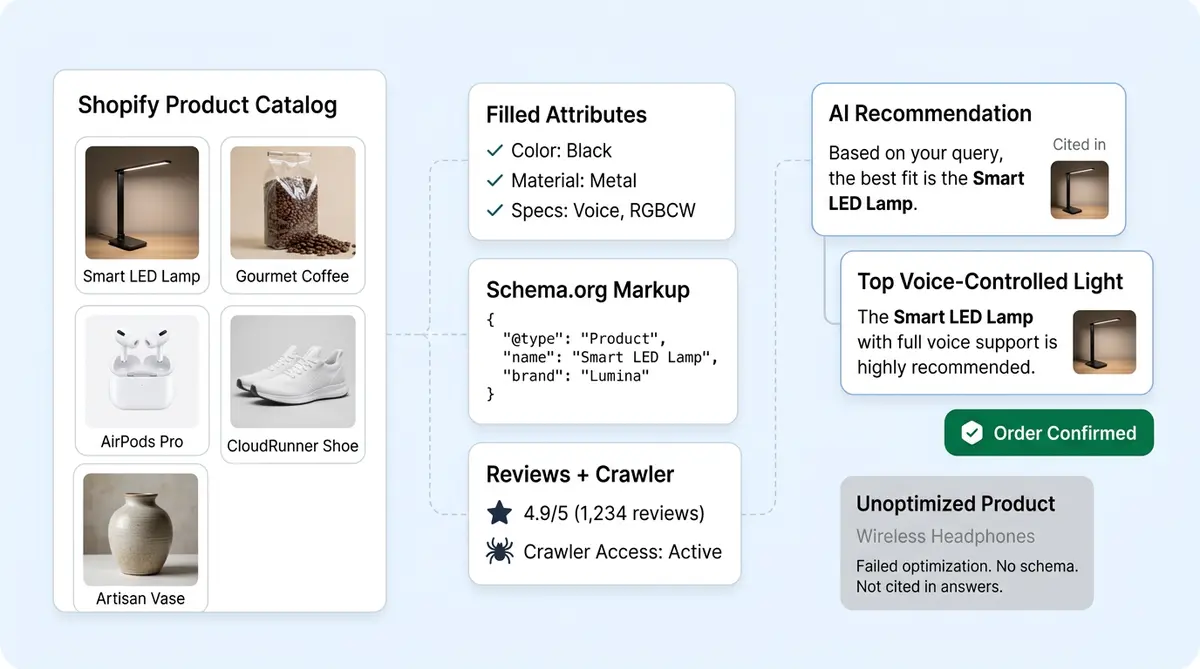
AI search engines cite products; they can confidently discover new products, recommend them, and describe them. If your PDP is missing product attributes like materials, dimensions, compatibility notes, use cases, or tags, the AI has less to work with and is less likely to cite you or include you in a recommendation. Think of each empty field as a missed citation opportunity.
2. Add structured markup to your PDPs
Schema.org markup (Product, Offer, AggregateRating) and Google Merchant Center feeds give AI search engines machine-readable product data. Your structured markup feeds both Google Shopping and AI surfaces, so a single improvement helps improve visibility and pulls double duty.
3. Allow AI crawlers access
Check your Shopify admin robots.txt and meta tags for blocks on GPTBot, PerplexityBot, OAI-SearchBot, and Google-Extended. If these bots can't crawl your website due to privacy or access settings, your store's products won't appear in their answers. Some Shopify theme settings, plugins, or apps block them by default. Check your Shopify admin settings.
4. Build review volume and third-party mentions
AI search engines synthesize information from multiple sources. Google store ratings are already functioning as AI citation signals. A product with 200 reviews and coverage on a niche blog will consistently outperform a store with a product shoppers might prefer for specs alone but that has zero external validation.
5. Answer buyer questions on your product pages
AI search queries are conversational prompts and natural language queries, not keywords. Customize each product page and landing page with FAQ content that addresses the actual questions shoppers ask: "Is this safe for sensitive skin?" or "Will this fit a king-size bed?" These questions and answers on each page are exactly the format AI search engines match to user intent and pull from when building responses.
Measuring What You Can't See in Google Analytics
Here's the challenge: most analytics platforms don't break out AI search as a referral source. ChatGPT and ChatGPT-style browser traffic might show up as direct or get lumped into organic. You can't improve what you can't measure.
This is where smart, purpose-built tracking becomes essential. You need SKU-level visibility data across individual AI search engines, not just aggregate traffic numbers. Which products are getting cited? In which engines? Is the AI showing your price, your reviews, your product image, or just your brand name mentioned in passing?
Alhena's AI Visibility product was built to answer exactly these questions. It tracks how individual SKUs appear across ChatGPT, Gemini, Perplexity, and other AI platforms. The rendering analysis shows whether your products display with pricing, ratings, and imagery or just get a passing brand mention. And the revenue attribution layer connects every step of the customer journey from AI discovery and chat interactions to actual conversions, so you know the actual search engines and AI prompts delivering sales, not just traffic.
If you want a deeper look at how this works, the AI Visibility product overview covers the full architecture, from source monitoring to content-gap and product recommendations. It goes beyond customer support, offering AI recommendations and tracking how your store appears in AI.
The Window Is Open, but It Won't Stay Open
The 15x growth stat is compelling because it represents an early-mover advantage. AI search volume is growing fast, but most retailers haven't started treating it as a channel. The ones who clean up their product catalog, add structured markup, and start measuring AI discovery and visibility now will have a head start that's hard to close once the channel matures.
Traditional SEO took years to become competitive. AI search optimization is in its first inning. The playbook is simpler, the competition is thinner right now, and the cost of entry for commerce and e-commerce brands is low. If your Shopify store has strong product data and catalog data, up-to-date inventory, stock levels, and a way to measure citations, you're already ahead of most small business Shopify store owners in your category.
Ready to see how your products appear in AI search results? Book a demo with Alhena AI or start for free.
Frequently Asked Questions
What does Shopify's 15x AI search order growth mean for merchants?
It means AI platforms like ChatGPT, Gemini, and Perplexity are sending real customers to Shopify stores, not just traffic. Orders from these sources grew 15x in 2025 according to Shopify President Harley Finkelstein. While still a small share of total orders, the growth rate is accelerating each quarter.
How do I get my Shopify products to show up in AI search results?
Start with complete product data: fill every attribute field, add Schema.org structured markup, and make sure AI crawlers like GPTBot and PerplexityBot can access your website. Products with rich details, reviews, and third-party mentions get cited more often than those with thin descriptions.
What is AEO and how is it different from SEO?
AEO stands for Answer Engine Optimization. While SEO focuses on ranking in traditional search results, AEO focuses on getting your products cited in AI-generated answers. The key difference is that AI search engines don't rank pages. They cite products they can confidently describe based on structured data and reviews.
Can I track how my products appear in AI search?
Standard analytics tools don't break out AI search as a referral source. Purpose-built tracking like Alhena's AI Visibility monitors SKU-level appearance across ChatGPT, Gemini, Perplexity, and other AI platforms, including whether your price, reviews, and images are shown.
Which product categories benefit most from AI search optimization?
Categories with considered purchases see the highest AI search adoption: beauty, home furnishing, outdoor gear, and fashion. Shoppers in these categories ask nuanced questions that traditional search engines don't answer well, making AI-powered product discovery a natural fit.
Is AI search optimization expensive for small Shopify stores?
No. The core actions, completing product attributes, adding Schema.org markup, unblocking AI crawlers, and building review volume, are free or low-cost. The competitive landscape is thin right now, so small business stores can establish AI visibility before larger brands catch up.