Searchers make up roughly 24% of ecommerce visitors but drive 44% of total site revenue. They convert at 2.5x the rate of browsers. Yet on most ecommerce sites, the group that controls search results and the group that controls product merchandising sit in separate rooms, use separate tools, and chase separate KPIs. The result is a gap where searchandising ai ecommerce strategies should be: search returns "relevant" products that ignore margin goals, while merchandising pushes promotions that ignore what the shopper actually typed. This post breaks down what searchandising is, why the search-merchandising silo costs real money, and how AI closes that gap with product search optimization ai that works in real time.
What Is Searchandising?
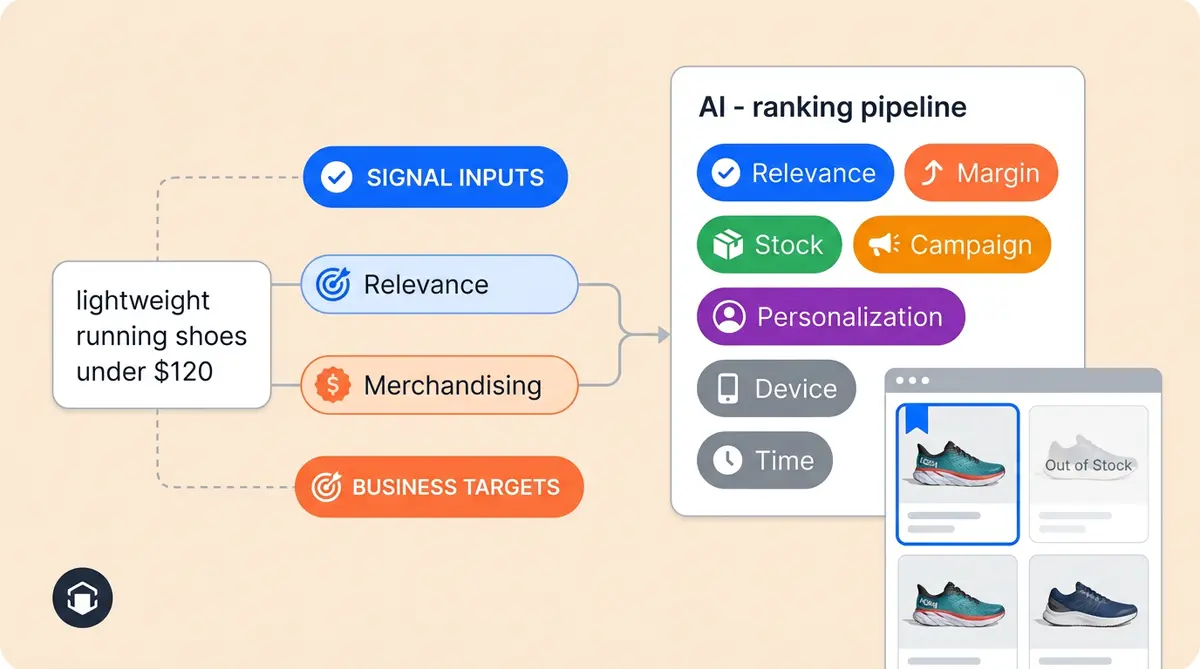
Searchandising is the practice of combining site search and merchandising into a single, coordinated function. Instead of treating search as a retrieval problem and merchandising as a promotional one, searchandising layers business intent on top of relevance for merchants and their teams. Every time a shopper searches "lightweight running shoes under $120," a searchandising system doesn't just match keywords. It ranks results using relevance, margin targets, inventory levels, seasonal campaigns, and that shopper's behavioral history, all at once.
The term has been around for years, but the technology to do it well hasn't. Traditional search engines handled keyword matching. Merchandisers manually set boost/bury search rules in a separate interface. The two systems didn't talk to each other. AI changed that equation entirely.
The Revenue Leak: Why Separate Search and Merchandising Costs You
Google Cloud and Harris Poll research puts the cost of search abandonment at $234 to $300 billion annually across U.S. retail. That number reflects what happens when 94% of consumers have abandoned a session because search results felt irrelevant.
The root cause isn't bad search technology alone. It's the organizational split. Search teams optimize for zero-result rates and relevance scores. Merchandising teams optimize for campaign exposure and margin mix. Neither team owns the full picture or the potential to promote products effectively: showing the right product, at the right rank, for the right business reason, to the right shopper.
Baymard Institute's 2024 benchmark found that 41% of ecommerce sites fail to support key search query types. Meanwhile, only 15% of companies dedicate resources to search optimization. This is the most underleveraged search discovery channel in ecommerce, and the silo is the reason.
How AI Unifies Search and Merchandising
AI-powered searchandising collapses the search-merchandising divide into a single ranking pipeline, using natural language processing and machine learning to handle both jobs at once. Here's how each layer works for practitioners thinking about search merchandising ecommerce improvements.
Query Intent Understanding
Modern AI search classifies every query before returning results. A lookup query ("Nike Air Max 90 white size 11") needs exact matching and speed. An exploratory query ("gifts for runners") needs diversity and discovery. A constraint-heavy query ("wireless earbuds under $50 with noise canceling") needs hard filters applied before any business logic kicks in. This intent classification shapes everything from autocomplete suggestions to the search results page, and it happens in milliseconds and determines which ranking signals get the most weight. Combined with synonym handling and improved search functionality, this information can help the system serve radically different result pages for queries that share identical keywords.
Smart Ranking with 200+ Signals
AI searchandising replaces static boost/bury rules with learning-to-rank models that ingest behavioral data (clicks, add-to-carts, purchases), catalog attributes (margin, stock levels, newness), contextual signals (device, location, time of day), and personalization layers, catalog depth, and applied filters. A European electronics retailer using Nosto's ai searchandising tools saw a 260% increase in targeted brand sales by layering margin optimization into relevance ranking, without hurting visibility for competing products.
Dynamic Merchandising Rules That Adapt in Real Time
Static merchandising rules break fast. A "boost winter coats" rule set in October still runs in March on plenty of sites. AI-powered smart systems adapt automatically: they detect trending queries, shift ranking weights as inventory changes, and adjust campaign exposure based on real-time conversion analytics data. The merchandiser still sets strategic guardrails (pin a hero product, enforce a minimum margin threshold, suppress out-of-stock items), but the AI handles the constant tuning that no human team can keep up with.
What This Looks Like in Practice
Consider a beauty brand running a spring skincare campaign. A shopper searches "hydrating serum for dry skin." Without searchandising, the search engine returns the top-selling serums by keyword match. The merchandising team's campaign banner sits on the homepage but never touches search results.
With search and merchandising combined through AI, the system returns serums ranked by relevance to the query, boosted by the active campaign's featured products, filtered by stock availability, and personalized based on the shopper's past browsing. The campaign and the search work together across the customer journey instead of running in parallel.
This is exactly the kind of discovery gap that AI search, chat, and recommendations fix when they operate as a unified system rather than disconnected tools. Platforms like Alhena AI's Shopping Assistant take this further by adding conversational discovery on top of search, so shoppers who can't articulate the right query still find what they need through guided product conversations.
Getting Started: Practical Steps for Your Team
You don't need to rip out your entire search stack on day one. Start here:
- Audit your search-merchandising overlap. Pull your top 50 search queries from your ecommerce store and compare results against your current merchandising priorities. Where do they conflict? That's your revenue leak. For more on finding these gaps, see what AI conversation data reveals about merchandising gaps.
- Unify the KPIs. Search and merchandising teams should share revenue-per-search-session as a north star metric, not just relevance scores or campaign impressions separately.
- Layer business rules into your ranking model. If your search platform supports it, start with simple rules: boost in-stock items, suppress low-margin SKUs below a threshold, and weight campaign products within relevant queries.
- Measure before and after. Track revenue per search session, conversion rate for searchers vs. browsers, and zero-result rate. These three performance metrics tell you whether your product search optimization ai investment is working.
Why Searchandising Matters More Now
Traffic from generative AI sources grew 1,200% year-over-year through late 2025, per Adobe data. Shoppers arriving from AI answers convert 16% higher than other traffic. As more product discovery starts outside your site (in ChatGPT, Perplexity, Google AI Overviews), the searches that do land on your site carry even higher intent. Making the most of every one of those high-intent sessions with ai searchandising isn't optional. It's where the margin is. Your highest-value customers are already telling you what they want through their search behavior.
For brands already using AI-powered site search, the next step is connecting that search intelligence to your merchandising strategy. Alhena AI helps ecommerce teams bridge that gap with AI that understands both what shoppers want and what your business needs them to find.

Frequently Asked Questions
What is searchandising in ecommerce?
Searchandising is the practice of unifying site search and product merchandising into a single function. Instead of running search for relevance and merchandising for promotions separately, searchandising layers business goals (margin, inventory, campaigns) directly into search ranking. The result is product results drawn from your full product catalog that are both relevant to the shopper who chose to search instead of browse and aligned with your revenue strategy, improving the shopping experience for customers across your online store.
How does AI improve searchandising compared to manual rules?
Manual boost/bury rules are static and break quickly as inventory, seasons, and shopper behavior change. AI-powered searchandising uses learning-to-rank models that ingest 200+ signals (clicks, conversions, stock levels, margin, device type, location) and adjust rankings in real time. One retailer saw a 260% lift in targeted brand sales after switching from manual rules to AI-driven ranking.
What metrics should I track to measure searchandising performance?
Focus on three core metrics: revenue per search session (your north star), conversion rate for searchers vs. non-searchers (benchmark is 2.5x higher for searchers), and zero-result rate (industry average is 10-15%). If your zero-result rate is above 10% or your searcher conversion premium is below 2x, your searchandising setup needs work.
Can Alhena AI help with searchandising for my ecommerce store?
Yes. Alhena AI combines conversational product discovery with AI-powered search to help shoppers find the right products, even when they can't articulate the perfect search query. The platform connects search intelligence with merchandising strategy, supports Shopify, WooCommerce, Magento, and Salesforce Commerce Cloud, and deploys in under 48 hours. You can try it free with 25 conversations at alhena.ai/sign-up.