The 5.5x Gap Is Real, and It's Growing
Brands that deploy AI proactively see 5.5x higher engagement than those running passive chatbots. That's not a rounding error. It's the difference between AI that sits in a corner waiting to be asked a question and AI that reads buyer behavior, intercepts intent, and guides shoppers toward a purchase.
The data backs this up from every angle. Proactive AI engagement reaches 45% of site visitors, while passive chat barely touches 5%. Forrester pegs the ROI gap at 105% for proactive setups versus 15% for reactive ones. And during the 2025 holiday season, brands running AI agents grew revenue 59% faster than those that didn't.
This post breaks down why that gap exists, gives you a four-stage maturity model to assess where your brand falls, and maps out the specific moves that shift AI from a cost center into a revenue engine.
Proactive vs. Passive AI Deployment: What's Actually Different
Passive AI deployment is the default for most ecommerce brands. You install a chatbot widget, load it with FAQ answers, and wait. The bot responds when a customer types a question. It handles order status lookups and return policy queries. It deflects tickets. That's it.
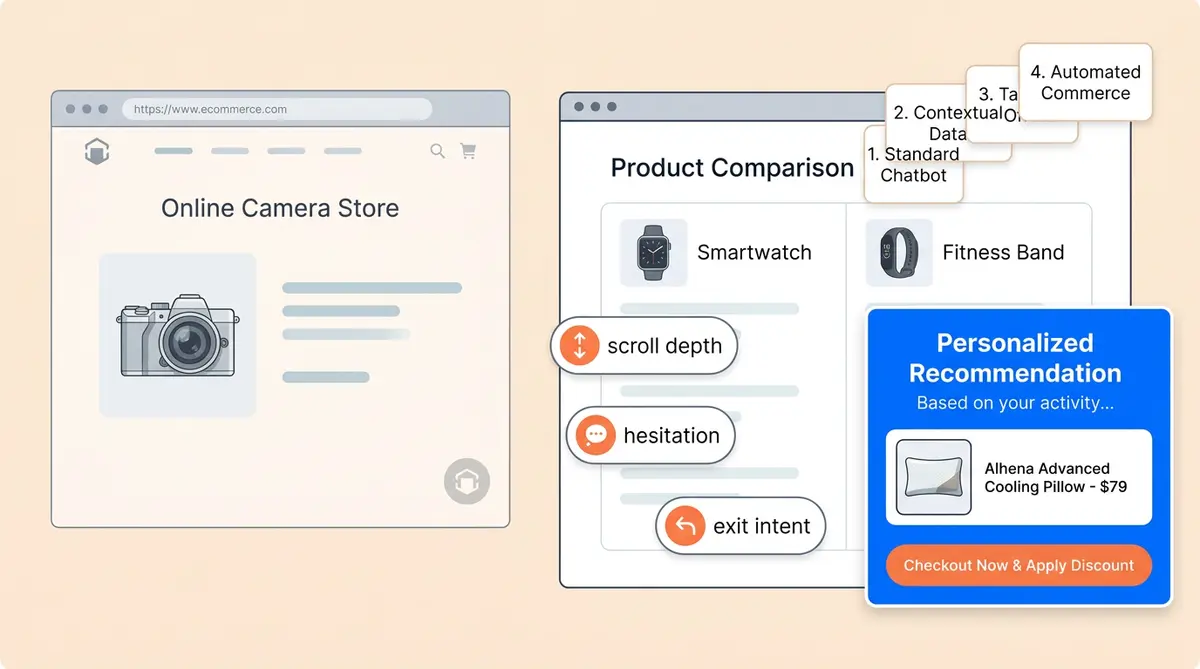
Proactive AI deployment flips the model. Instead of waiting for queries, the AI watches behavioral signals in real time: scroll depth, time on page, hesitation patterns, exit intent, product comparison behavior. It uses those signals to intervene at the right moment with the right message.
Here's what proactive AI deployment actually looks like in practice:
- Conversational search: A shopper types "something warm for a ski trip" and the AI returns curated product sets, not keyword matches. It asks follow-up questions about budget, style, and sizing to narrow results.
- Guided product discovery: When a visitor browses three similar products without adding to cart, the AI shopping assistant steps in with a comparison or recommendation based on their browsing pattern.
- Contextual nudges: A returning customer who bought running shoes last month gets a proactive suggestion for complementary gear, not a generic popup.
- Cart-stage intervention: When a shopper stalls at checkout, the AI addresses the likely objection (shipping cost, sizing uncertainty, return policy) before they abandon.
The AI engagement gap between these two approaches isn't subtle. Industry data shows that AI-engaged shoppers convert at 4x the rate of unassisted browsers, with conversion rates hitting 12.3% versus 3.1% for those who never interact with AI.
Why the AI Engagement Gap Exists
Proactive AI Intercepts Intent at the Right Moment
Timing is everything in ecommerce. A shopper comparing four similar jackets is at peak purchase intent, but they're also at peak confusion. Passive chatbots miss this moment entirely because no one thinks to type "help me pick a jacket" into a chat widget.
Proactive AI detects that hesitation through behavioral signals and intervenes. It might surface a quick comparison, highlight the bestseller, or ask what matters most: warmth, weight, or price. That single interaction can collapse a 10-minute browsing session into a 2-minute purchase.
An IBM and NRF study of 18,000 consumers across 23 countries found that 45% already use AI during their buying journeys. They're using it to research products, interpret reviews, and find deals. Brands that don't meet shoppers with proactive AI at those decision points are invisible when it matters most.
It Reduces Decision Fatigue
More options don't mean more sales. Research with 1.6 million consumers found that 64% of purchase probability decline comes from choice overload. Conversion rates peak at four to six options per page. After seven to nine product comparisons, cognitive fatigue sets in and abandonment spikes.
This is where AI shopping assistants earn their keep. Instead of showing 200 products and hoping the customer filters their way to the right one, proactive AI curates a short list based on stated and inferred preferences. It turns a catalog into a concierge experience.
The classic jam study proved this decades ago: 6 options converted 30% of browsers while 24 options converted just 3%. Proactive AI applies that principle at scale, across every product category, for every visitor.
Real-Time Personalization Drives Higher Conversion
Ecommerce platforms using real-time AI personalization report a 37% increase in average order value and a 42% reduction in cart abandonment. Product recommendations alone drive up to 31% of total site revenue.
But personalization only works when it's proactive. A recommendation engine buried at the bottom of a product page that nobody scrolls to isn't personalization. It's decoration. Proactive AI surfaces the right recommendation at the right time: in the chat window, during search, at checkout, or through social commerce channels like Instagram DMs and WhatsApp.
Brands like Tatcha have seen this play out directly. By deploying Alhena AI's proactive shopping assistant, they achieved a 3x conversion rate and 38% AOV uplift, with 11.4% of total site revenue flowing through AI-assisted interactions.
The Proactive AI Deployment Maturity Model for Ecommerce
Not every brand can jump straight to fully autonomous AI. The shift from passive to proactive happens in stages, and knowing where you stand is the first step to closing the AI engagement gap in ecommerce. Here's a four-stage maturity model built from industry adoption data and real deployment patterns.
Stage 1: Reactive Support
Your AI is a glorified FAQ page. It waits for customers to initiate conversation, responds with scripted answers, and handles basic queries like order status and return policies. There's no personalization, no behavioral awareness, and no revenue attribution.
Typical metrics: Under 1% of visitors engage with chat. ROI sits around 15%. AI is purely a cost-reduction play.
Who's here: Brands that installed a chatbot and checked the box. Industry data shows nearly half of ecommerce businesses remain in experimental AI phases.
Stage 2: Basic Automation
You've moved beyond scripted FAQ responses. Your AI handles ticket routing, automates simple workflows, and manages higher volumes of support conversations. You might have basic segmentation for email or on-site messaging, but your chat AI still doesn't initiate contact or respond to behavioral signals.
Typical metrics: AI handles 6x more conversations than human-only teams. Deflection rates improve. But there's still no measurable revenue contribution from AI.
How to move up: Start tracking which support interactions correlate with purchases. Implement basic behavioral triggers like exit intent and time-on-page thresholds. Add AI support concierge capabilities that blend support and sales.
Stage 3: Intent-Driven Engagement
This is where the 5.5x engagement gap materializes. Your AI watches behavioral signals, detects purchase intent, and intervenes with contextual recommendations, proactive nudges, and guided discovery. It doesn't just answer questions. It starts conversations.
Typical metrics: 45% visitor engagement rate. 4x to 5x conversion lift on AI-assisted sessions. 35% cart recovery rate. 37% AOV increase. AI has measurable, attributed revenue impact.
How to move up: Deploy conversational search that understands natural language queries. Add cross-channel proactive engagement through icebreaker messages and social commerce. Build unified customer memory so the AI remembers past interactions across every touchpoint.
Stage 4: Autonomous AI-Led Commerce
The AI runs the full shopping journey from discovery through checkout. It understands context, remembers every prior interaction, takes independent action (populating carts, pre-filling checkout, applying relevant promotions), and orchestrates the experience across web, email, social, and voice channels.
Typical metrics: 59% higher revenue growth versus non-deployers (2025 holiday data). AI-assisted sessions drive 10% or more of total site revenue. Customer lifetime value increases as AI builds ongoing relationships.
Who's here: Only about 7% of organizations have reached fully scaled AI deployment. McKinsey projects this level of agentic commerce will mediate $3 to $5 trillion in global consumer spending by 2030.
Moving Up the Maturity Curve: Actionable Steps
From Stage 1 to Stage 2 (Weeks 1 to 4)
- Audit your current chatbot performance. Pull engagement rate, deflection rate, and resolution rate. If engagement is below 2%, you're confirming Stage 1.
- Automate your top 5 ticket categories. Order tracking, return initiation, shipping questions, product availability, and sizing help cover 60% to 80% of inbound volume for most brands.
- Connect your AI to your ecommerce platform. Your chatbot needs real-time access to order data, inventory, and customer history. Without this, it can't do anything beyond reading FAQ articles.
- Measurable outcome: 50% to 60% automated inquiry resolution, 30% reduction in first-response time.
From Stage 2 to Stage 3 (Weeks 4 to 8)
- Implement behavioral triggers. Set up proactive messages based on exit intent, cart value thresholds, time on product pages, and repeat visit patterns.
- Deploy conversational product search. Replace keyword-only search with AI that understands intent ("something for a summer wedding under $200") and returns curated results.
- Add revenue attribution tracking. Tag every AI-assisted interaction and track it through to purchase. You need to know which conversations drive revenue, not just which ones deflect tickets. The Alhena AI ROI calculator can help you model the expected impact.
- Enable proactive cart recovery. When a shopper adds items but stalls, the AI should address the likely objection (sizing, shipping cost, return policy) before the session ends.
- Measurable outcome: 3x to 5x engagement rate increase, 20% to 38% AOV uplift, first measurable AI revenue attribution.
From Stage 3 to Stage 4 (Months 2 to 6)
- Unify customer memory across channels. Your AI should recognize a customer whether they come through web chat, email, Instagram DMs, WhatsApp, or voice. Every interaction builds on the last.
- Enable agentic checkout. Let the AI populate carts, pre-fill checkout fields, and apply relevant promotions without the customer navigating away from the conversation.
- Expand to social and voice channels. AI agents that sell across social commerce and voice channels capture demand where customers already spend their time.
- Build feedback loops. Use AI analytics to identify which proactive interventions drive the most revenue and double down on them. Cut the ones that annoy more than they convert.
- Measurable outcome: AI-attributed revenue exceeds 10% of total site sales. Cart abandonment drops 30% to 42%. Customer retention improves as AI-driven personalization compounds over time.
Passive AI Is a Cost Center. Proactive AI Is a Revenue Engine.
The framing matters. When AI only deflects support tickets, it shows up on the balance sheet as a cost reduction line item. It saves money, but it doesn't make money. And cost-center tools get their budgets cut when times get tight.
Proactive AI flips that equation. When your AI drives measurable conversions, increases average order value, recovers abandoned carts, and generates attributed revenue, it becomes a growth investment. A Gartner study found that 51% of service and support leaders now prioritize increasing sales revenue, and 91% face executive pressure to deploy AI not just for efficiency but for direct revenue impact.
The 2025 holiday season made this concrete. Brands running AI agents grew 59% faster than those without. AI-driven revenue per visit jumped 254% year over year. AI and agents powered 20% of all retail transactions during the season, fueling $262 billion in revenue.
The gap between proactive deployers and passive ones isn't closing. It's accelerating. Every quarter a brand spends stuck at Stage 1 or Stage 2 is a quarter where competitors at Stage 3 and 4 are compounding their advantage through better data, smarter personalization, and deeper customer relationships.
How Alhena AI Powers Proactive Engagement
Alhena AI is built for this shift. It's not a support chatbot with a few sales features bolted on. It's a purpose-built ecommerce AI with two specialized agents: a Product Expert Agent that handles guided discovery, conversational search, and personalized recommendations, and an Order Management Agent that resolves post-purchase queries autonomously.
The proactive engagement layer is where Alhena separates from generic tools. Alhena detects behavioral signals, initiates conversations at high-intent moments, and guides shoppers through the full purchase journey. It works across web chat, email, Instagram DMs, WhatsApp, and voice, with unified memory that carries context across every channel.
Results from live deployments show what Stage 3 and Stage 4 look like in practice. Victoria Beckham Beauty saw a 20% AOV increase. Puffy achieved 63% automated inquiry resolution with 90% CSAT. Crocus hit an 86% deflection rate while maintaining 84% CSAT. And Alhena deploys in under 48 hours with no dev resources required, so the path from Stage 1 to Stage 3 doesn't take months of engineering work.
The hallucination-free architecture matters here too. Proactive AI only works when customers trust the recommendations. Alhena grounds every response in verified product data, so the AI never fabricates specs, invents availability, or recommends products that don't exist.
Key Takeaways
- The 5.5x engagement gap between proactive and passive AI deployment is supported by converging data across conversion, engagement, ROI, and revenue metrics.
- Passive chatbots are stuck at under 5% engagement. Proactive AI reaches 45% of visitors and converts them at 4x to 5x higher rates.
- Decision fatigue kills conversion. AI-guided discovery cuts through choice overload by curating options based on real buyer intent.
- The four-stage maturity model gives you a clear diagnostic: reactive support, basic automation, intent-driven engagement, and autonomous AI-led commerce.
- Most brands are stuck at Stage 1 or 2. Only 7% have reached fully scaled AI deployment. The window to gain a competitive edge is open now, but closing fast.
- Proactive AI is a revenue engine, not a cost center. Brands deploying AI agents grew 59% faster during the 2025 holiday season.
Ready to close the engagement gap? Book a demo with Alhena AI to see how proactive AI deployment works for your store, or start free with 25 conversations and test the difference yourself.
Frequently Asked Questions
How do I measure the AI engagement gap on my ecommerce site?
Track three metrics: chat engagement rate (percentage of visitors who interact with AI), AI-assisted conversion rate versus unassisted, and AI-attributed revenue as a share of total sales. Alhena AI includes built-in revenue attribution analytics that tie every conversation to a purchase, giving you a clear read on whether your AI is a cost center or a revenue driver.
What's the fastest way to move from a passive chatbot to proactive AI deployment?
Start with behavioral triggers: exit intent, time-on-page thresholds, and cart value milestones. These alone can shift your engagement rate from under 2% to double digits within weeks. Alhena AI deploys in under 48 hours and comes with proactive nudges, conversational search, and guided discovery out of the box, so you skip months of custom development.
Does proactive AI annoy customers or feel intrusive?
Not when it's done right. Industry data shows 89% of customers contacted proactively report a positive experience, and 44% of online shoppers welcome a chat invitation while browsing. The key is behavioral targeting over time-based popups. Alhena AI uses intent signals like scroll depth, product comparison patterns, and hesitation to trigger conversations only when they're helpful.
How does proactive AI reduce cart abandonment compared to email recovery flows?
Email recovery reaches shoppers hours after they've left. Proactive AI addresses objections in real time, before the abandonment happens. Platforms using real-time AI intervention report a 42% drop in cart abandonment rates. Alhena AI detects checkout hesitation and surfaces answers about shipping, sizing, or returns right in the conversation, recovering sales that email never could.
What ROI should I expect from proactive AI deployment in the first 90 days?
Brands typically see a 3x to 5x lift in chat engagement, 20% to 38% AOV increase, and measurable AI-attributed revenue within the first quarter. Alhena AI customers like Tatcha generated 11.4% of total site revenue through AI-assisted sessions, with a 3x conversion rate. Use the Alhena ROI calculator to model the numbers for your store's traffic and average order size.
Can proactive AI work for niche or vertical-specific ecommerce brands?
Yes, and it often works better for niche brands because the product catalog is more focused and the AI can learn domain expertise faster. Alhena AI's Product Expert Agent is trained on your specific catalog, including specs, fit guides, ingredients, and use cases. Brands across beauty, fashion, home furnishing, and outdoor gear all use proactive AI to guide high-consideration purchases.
How is proactive AI different from basic product recommendation widgets?
Recommendation widgets are static and placement-dependent. Proactive AI is conversational and context-aware. It asks questions, narrows options, handles objections, and guides shoppers to the right product through dialogue. Alhena AI combines recommendations with conversational search and agentic checkout, so the AI can populate carts and pre-fill checkout without the shopper ever leaving the conversation.
What ecommerce platforms does Alhena AI integrate with for proactive deployment?
Alhena AI integrates with Shopify, WooCommerce, Magento, and Salesforce Commerce Cloud on the storefront side, plus helpdesks like Zendesk, Freshdesk, Gorgias, and Intercom. It also supports omnichannel proactive engagement across web chat, email, Instagram DMs, WhatsApp, and voice, all connected through a unified customer memory layer.
How does proactive AI improve customer lifetime value beyond the first purchase?
Proactive AI builds a relationship, not just a transaction. Unified memory means Alhena AI remembers past purchases, preferences, and browsing history across every channel. Returning customers who engage with AI chat spend 25% more on average. Over time, the AI gets smarter about each customer's needs, driving repeat purchases and higher retention without additional marketing spend.
Is proactive AI deployment worth it for stores under $10M in annual revenue?
Absolutely. The engagement gap affects brands at every scale, and smaller stores often see faster ROI because each recovered sale has a bigger impact on the bottom line. Alhena AI offers a free tier with 25 conversations so you can test proactive engagement before committing. For a store doing $5M annually, even a 5% conversion lift on AI-assisted sessions can mean six figures in new revenue.