The Checkout-to-Delivery Dead Zone
Sixty-six percent of online customers feel anxious after clicking "buy," according to Narvar's 2025 State of Post-Purchase Report. Not about their purchase decision, but because the business that just spent ten minutes guiding them through product selection suddenly goes silent.
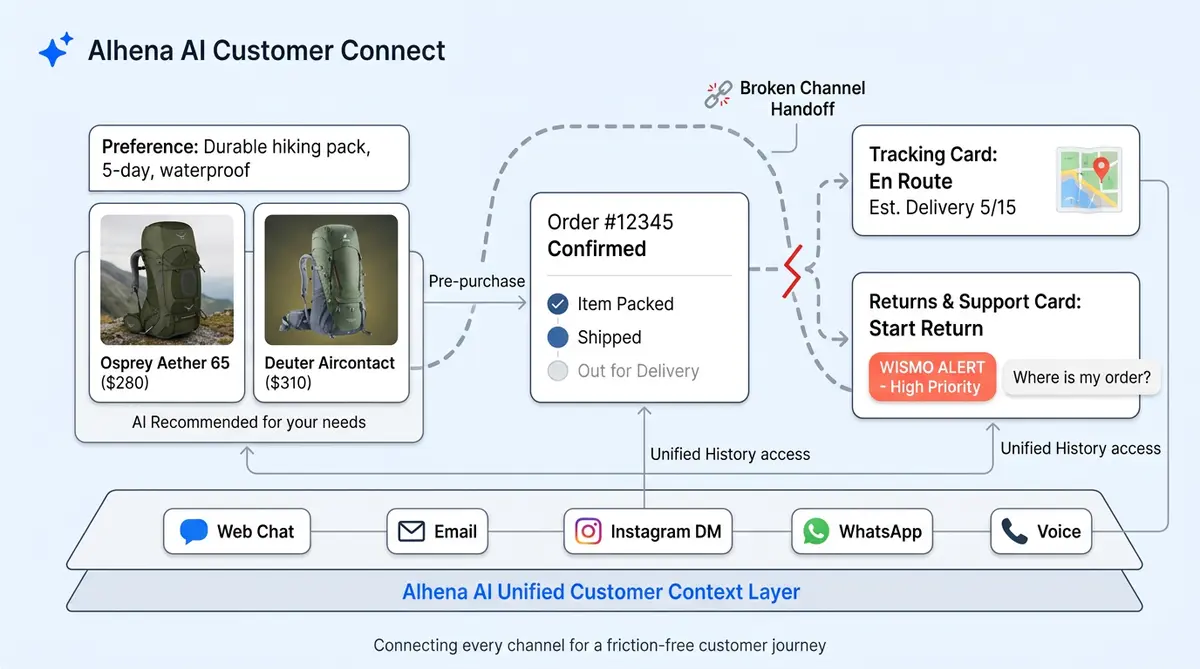
This silence is the handoff: the moment a customer stops being a "prospect" your pre purchase AI nurtures and becomes an "order number" your post purchase system barely recognizes. Most ecommerce businesses have invested in both systems separately. Both work. The gap between them, where purchasing behavior context evaporates and 67% of first-time buyers quietly decide never to come back, is the problem nobody budgets for.
This post is part of our AI customer journey orchestration series. It covers the specific ways the pre purchase to post purchase handoff breaks, and what closing it looks like in practice.
Three Ways the Handoff Breaks
1. The silent window
Between checkout confirmation and the first delivery update, most businesses go dark for three to seven days. Customers check tracking pages 3.2 times per order on average (Ecommerce Fastlane), looking for reassurance they aren't getting. Radial found 90% of consumers say shipping represents at least half of their total experience quality. When your AI goes quiet during this window, every minor delay becomes a trust-breaking interaction instead of a manageable touchpoint.
2. Contradictory messages
When pre-purchase and post-purchase AI run on separate data, they make contradictory promises. A customer asks your shopping assistant about delivery timing. It responds "ships within 2 business days." Three days later, the support bot says, "estimated delivery: 5 to 7 business days." Same retailer, two different answers. Stibo Systems found 59% of retailers manage marketing, ecommerce, and service through entirely separate systems, each pulling from different data sources. No offer or discount code fixes that credibility gap.
3. Context disappears at handoff
Before checkout, your AI learns the customer has sensitive skin, is buying a birthday gift, and chose expedited shipping because the event is Saturday. All of that context vanishes when the order management system takes over. IDC research found ecommerce businesses lose 20 to 30% of potential revenue from this kind of data fragmentation. The customer calls about a delay and has to explain the gift context all over again. Returns ignore why the product was bought. Upsells contradict stated preferences. Every customer interaction feels impersonal despite the personalized shopping experience that promised otherwise.
What Continuity Looks Like
Closing the handoff doesn't mean buying more tools. It means connecting your existing stack through a single memory layer that carries pre-purchase context into every post-purchase interaction.
Alhena AI runs two specialized agents sharing one unified per-customer memory. The Product Expert Agent handles discovery and conversion. The Order Management Agent handles tracking, returns, and delivery. The handoff between them is invisible: the Order Management Agent already knows what the customer bought, why they bought it, and which channel they prefer.
Instead of a generic "your order shipped" notification, a connected system sends: "Your gift order (the moisturizer set for your mother's birthday) shipped today, on track for Friday, one day before the event." That single message, referencing pre-purchase context, does more for trust than any branded tracking page redesign.
This works across web chat, email, Instagram, WhatsApp, and voice because Alhena integrates directly with Shopify, Salesforce Commerce Cloud, and shipping platforms like Narvar and ShipStation, pulling real-time order data into the same conversation thread that started pre-purchase.
The Measurable Impact
Radial's research shows 79% of consumers won't buy again after a poor post-purchase experience, yet 83% of consumers think post-purchase could improve while only 18% of retail leaders agree. That 65-point perception gap means most retailers don't even know their handoff is broken.
Businesses using Alhena's unified approach see the opposite pattern. Tatcha hit 3x conversion rates and 38% AOV uplift. Manawa cut support workload by 43% and dropped response times from 40 minutes to 1 minute. Puffy maintains 90% CSAT with 63% automated resolution across the full journey. The growth came not from better pre-purchase or post-purchase AI in isolation, but from connecting them.
Returning customers spend 61% more than new ones and drive 40% of ecommerce revenue (Retainful). Post-purchase upsells convert at 12 to 18% when they reference actual customer preferences. Estimate your revenue recovery from closing the gap.
For related strategies, see how AI lifecycle marketing matches campaigns to each customer stage and how AI drives retention with 8 proven strategies.
Ready to close the handoff gap? Book a demo with Alhena AI or start free with 25 conversations.
Frequently Asked Questions
What happens to customer context when pre purchase AI hands off to post purchase AI?
In most ecommerce setups, pre purchase conversation data (product preferences, sizing questions, gift intent) stays locked in the shopping assistant's database. The order management system has no access to it. Customers who spent 15 minutes discussing their needs get a generic "your order shipped" message with no reference to what they bought or why.
Why does my ecommerce AI give different shipping estimates before and after purchase?
Pre purchase AI pulls shipping data from product catalog pages while post purchase AI pulls from the OMS or carrier APIs. These sources often disagree. The product page says "ships in 2 days" based on averages; the OMS shows "3 to 5 business days" based on real-time warehouse capacity. Fixing this requires a single AI layer with access to live data at every stage.
How does the checkout-to-delivery dead zone affect first-time buyer retention?
Sixty-seven percent of first-time buyers decide whether to return during the window between checkout and delivery. Most brands send only an order confirmation and a shipping notification during this period, leaving days of silence. Customers check tracking 3.2 times per order. Brands that fill this gap with context-aware updates see 23 to 31% higher repeat purchase rates.
How does Alhena AI's dual-agent architecture prevent context loss at handoff?
Alhena runs a Product Expert Agent and an Order Management Agent sharing one unified memory per customer. The Product Expert handles discovery and conversion; the Order Management Agent handles tracking, returns, and delivery. Because both agents share the same memory, the handoff is invisible and customers never repeat themselves.
What is the measurable cost of losing customer context between sale and delivery?
IDC research shows ecommerce companies lose 20 to 30% of potential revenue from data silos across AI systems. Seventy-nine percent of consumers won't buy again after a poor post purchase experience (Radial), and returning customers spend 61% more than new ones. The handoff gap costs both immediate support dollars and long-term lifetime value.
What does a context-aware post purchase message look like versus a generic one?
Generic: "Your order #12345 has shipped. Track it here." Context-aware: "Your gift order, the moisturizer set for your mother's birthday, shipped today and is on track for Friday delivery, one day before the event." The second message references pre purchase context and addresses the customer's specific concern, driving higher engagement and fewer WISMO tickets.