The Multi-Storefront Challenge No One Warns You About
Cross-border ecommerce is projected to hit $2 trillion by 2034, growing 28.3% faster than domestic online sales, according to Precedence Research. For brands running multiple storefronts across regions, that growth creates a specific operational headache: how do you keep AI-powered customer experiences consistent, accurate, and locally relevant across every store, enhancing the customer experience at each touchpoint?
Most brands start by copying their AI setup from one storefront to the next. That approach breaks fast. Customer engagement varies by region. Different product catalogs, shipping rules, currencies, return policies, and languages turn a "just duplicate it" strategy into a mess of disconnected bots giving wrong answers in the wrong tone. For any multi-store ecommerce operation, you need an ecommerce solution that treats localization as a core feature, not an add-on.
This guide covers the best practices, real-world use cases, and domain expertise needed to manage multi-storefront AI ecommerce at scale, and how to avoid the most common mistakes.
Why "Translate and Deploy" Doesn't Work
The biggest misconception about running a multi-region or global ecommerce chatbot is that localization equals translation. It doesn't. Research from Lokalise shows that 76% of online shoppers prefer buying in their native language, and 40% flat-out refuse to purchase from sites that don't offer it. But swapping English for French doesn't fix region-specific return windows, local shipping carriers, or currency formatting.
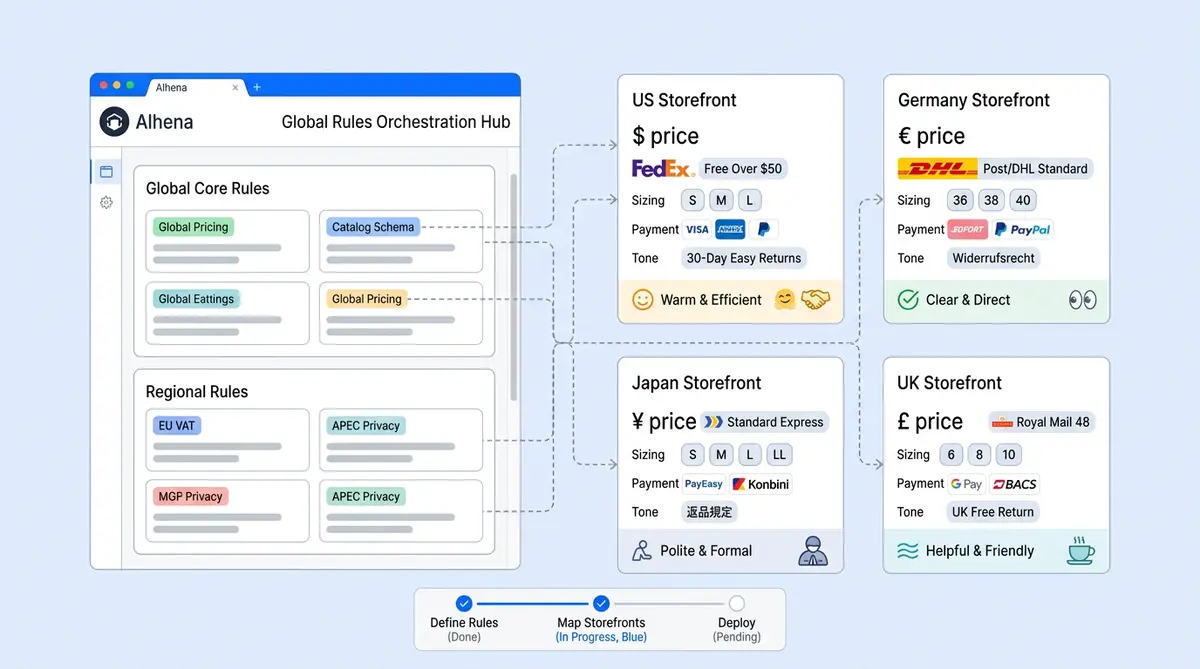
A customer in Germany asking about delivery timelines needs answers based on EU warehouse stock and DHL availability, not your U.S. fulfillment center's FedEx rates. A shopper in Japan expects different product sizing, payment methods, and even communication formality than someone browsing your UK store.
True multi-storefront AI ecommerce requires deep integration with your ecommerce platforms and enterprise tools. Each AI agent needs to understand:
- Region-specific product catalogs and catalogs with local pricing, availability, and descriptions
- Local fulfillment and shipping rules per storefront
- Regional return and refund policies that may differ by country or even by state
- Cultural tone and communication style beyond word-for-word translation
- Data privacy regulations like GDPR, CCPA, or LGPD that vary by jurisdiction
One AI Brain, Many Storefronts
The temptation is to spin up a separate AI agent for each storefront. That creates exactly the kind of siloed, expensive support structure you're trying to avoid. As Delight AI's engineering team puts it, building separate agents per region leads to "a costly, siloed support structure" that's nearly impossible to maintain.
The better approach is a single AI layer with a multi-locale framework. Your AI agent uses one core knowledge base with content labeled as either global (brand voice, product specs, company policies) or region-specific (local shipping, regional promotions, language preferences). When a customer connects, the system detects their locale and dynamically surfaces the right answers.
This is how Alhena AI's Shopping Assistant works. It connects through deep integration with your product catalog, order management system, and helpdesk across every storefront, pulling region-specific data in real time. Whether a customer chats on your Shopify Plus expansion store in France or your main WooCommerce site using existing tools in the U.S., the AI draws from the right catalog with the right policies, delivering personalized engagement that makes shoppers feel like they're talking to a local team. For brands already using multilingual AI support, adding storefronts becomes configuration rather than rebuilding.
Brand Voice Across Borders
Consistent brand presentation drives 23 to 33% higher revenue, according to research compiled by Atom Writer. But keeping that voice consistent across a multi-region ecommerce chatbot is harder than it sounds. What feels friendly and casual in the U.S. can read as unprofessional in Germany or overly informal in Japan.
The fix isn't to water down your brand voice into something generic. It's to build tone parameters into your AI's configuration per locale. Alhena AI lets you set brand tone guidelines at the storefront level, so your AI stays on-brand while adapting its communication style to local expectations, driving stronger engagement. The core personality stays the same across stores. The delivery adjusts per locale. Global teams get a localized experience that still sounds like one brand.
Brands like Tatcha have seen the payoff of getting this right: a 3x conversion rate and 38% higher average order value when AI conversations feel natural and brand-aligned rather than robotic.
The Phased Rollout That Actually Works
Launching AI across all storefronts at once is a recipe for compounding errors that overwhelm teams. A bad product recommendation in one region goes unnoticed while you're firefighting a policy mismatch in another. Yuma AI's implementation research confirms that phased deployments consistently outperform big-bang launches.
Here's the rollout that works for multi-storefront AI ecommerce:
- Start with your highest-traffic storefront. Get the AI tuned, test edge cases, and measure performance against your KPIs (resolution rate, CSAT, conversion lift).
- Expand to one additional region that shares a language but has different policies. This forces you to build the locale-switching framework without adding translation complexity.
- Add multilingual storefronts one at a time. Test each language with native speakers before going live. Automated translation quality checks catch about 80% of issues, but the remaining 20% can be brand-damaging.
- Connect your helpdesk and order management. Alhena AI offers native integration with Zendesk, Gorgias, Freshdesk, and other platforms so your AI has real-time access to order data across every storefront. This means a customer asking "where's my order?" gets an accurate, personalized answer regardless of which store they bought from.
Brands like Manawa followed this approach and cut their support workload by 43% while dropping response times from 40 minutes to under 1 minute, with 80% of inquiries fully automated.
What to Look for in a Multi-Region AI Platform
Not every AI tool or set of tools is built for multi-storefront and enterprise complexity. When evaluating platforms, look for these non-negotiables:
- Catalog-aware AI: The platform should pull live product data per storefront, not rely on a single static knowledge base. Alhena's Product Expert Agent connects directly to your commerce platform, whether that's Shopify, WooCommerce, Magento, or Salesforce Commerce Cloud, and other leading ecommerce platforms.
- Per-storefront policy configuration: Return windows, shipping options, and promotions should be configurable by region without duplicating the entire AI setup.
- Omnichannel per region: Your French customers might prefer WhatsApp while your U.S. audience uses web chat. The AI should work across social commerce channels, email, chat, and voice for each storefront.
- Revenue attribution across stores: You need to know which storefront's AI is driving sales, not just deflecting tickets. Alhena's built-in analytics track revenue attribution per conversation, so you can measure ROI by region from a single dashboard from a single dashboard across all your catalogs.
- Hallucination-free responses: Wrong answers are bad enough in one market. Across multiple regions with different regulations, a hallucinating chatbot becomes a liability. Unlike generic chatbots, Alhena grounds every response in verified product data to eliminate this risk.
The Bottom Line
Managing AI across multiple storefronts and regions isn't about cloning a chatbot and translating it. It's about building a single, intelligent AI layer that adapts to each market's catalog, policies, language, and cultural expectations while keeping your brand voice intact and enhancing every interaction. For e-commerce brands, ensuring consistency across every touchpoint is what separates the leaders from the rest.
The brands getting this right are seeing agentic storefronts drive real revenue, not just handle support tickets. With 91% of customer service leaders under pressure to implement AI in 2026, the question isn't whether to deploy AI across your storefronts. It's whether you'll do it in a way that actually scales.
Ready to run one AI across every storefront? Book a demo with Alhena AI or start for free with 25 conversations.
Frequently Asked Questions
What is multi-storefront AI ecommerce?
Multi-storefront AI ecommerce refers to deploying a single AI system that serves customers across multiple online stores, each with its own product catalog, pricing, policies, and language. Rather than building separate chatbots per store, the AI uses a shared knowledge base with region-specific layers to deliver accurate, localized responses.
How does a multi-region ecommerce chatbot handle different languages?
A well-built multi-region ecommerce chatbot detects the customer's locale automatically and responds in the correct language with culturally appropriate tone. It goes beyond translation by adjusting for regional product availability, local shipping options, and country-specific policies. Alhena AI supports multilingual conversations natively across web chat, email, WhatsApp, and Instagram.
Can I use one AI agent for all my storefronts?
Yes, and that's the recommended approach. Running a single AI agent with per-storefront configuration is more efficient than maintaining separate bots for each region. Alhena AI connects to multiple commerce platforms simultaneously, pulling the right catalog and policy data based on which storefront the customer is browsing.
How long does it take to deploy AI across multiple storefronts?
With Alhena AI, a single storefront can go live in under 48 hours. Adding each additional storefront typically takes a few days for configuration and testing. A phased rollout, starting with your highest-traffic store and expanding one region at a time, delivers the best results.
Does multi-storefront AI work with Shopify Plus expansion stores?
Yes. Shopify Plus supports up to 10 expansion stores, and Alhena AI integrates with each one. The AI pulls product data, pricing, and inventory from each expansion store independently, so customers always see accurate, store-specific information.
How do I measure AI performance across different regions?
Look for a platform with per-storefront analytics that tracks resolution rate, CSAT, conversion rate, and revenue attribution by region. Alhena AI's built-in dashboard breaks down these metrics per storefront, so you can compare performance across markets and identify which regions need optimization.
What about data privacy when running AI across multiple countries?
Multi-region AI deployments must comply with local data privacy laws like GDPR in Europe, CCPA in California, and LGPD in Brazil. Alhena AI uses a multi-region architecture that processes and stores data in compliance with regional regulations, keeping customer information within required jurisdictions.