The CRM Nobody Uses
Most ecommerce brands have a CRM system. Few use it well. Customer relationship management platforms hold promise, but most ecommerce businesses treat them as glorified address books. Personalization at scale requires understanding customer needs, not just storing contact details. The ecommerce brands that get this right use their CRM as a personalization engine that powers better customer experiences, not a data warehouse. According to Validity's 2025 report, 76% of CRM users say less than half of their data is accurate and complete. The typical ecommerce CRM holds thousands of contacts with a name, email, and maybe a purchase date. No skin type. No size preference. No style DNA. No price sensitivity signal. No gifting intent.
The CRM can't power personalization because it doesn't contain anything personal. Manual enrichment is impossible at scale. AI-powered CRM tools are the best solution for ecommerce businesses that want to turn analysis of customer conversations into actionable profiles. The result is a database that costs money to maintain but generates no insight that changes how you sell. It’s one of the biggest challenges facing ecommerce CRMs today.
That's starting to change. Ecommerce businesses connecting conversational AI to their CRM are building customer profiles that get richer with every interaction, and turning that data into measurable revenue. This post breaks down the ecommerce CRM strategy framework that makes it work: the AI-CRM flywheel.
The AI-CRM Flywheel: From Data Storage to Revenue Engine
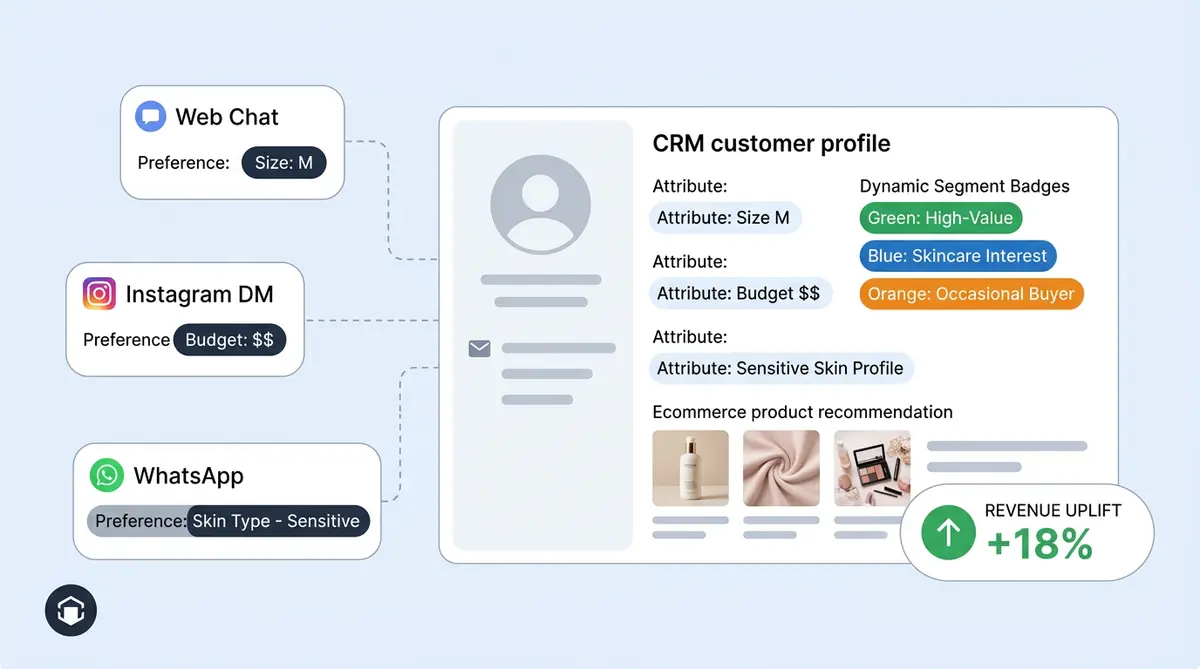
AI shopping assistants capture preference data from every conversation: skin type, size, budget, gifting intent, product concerns, pricing sensitivity, and inventory preferences. That ecommerce conversation data flows into the CRM, enriching the contact profile. The enriched profile feeds back into the AI so the next conversation starts from context, not zero.
The AI skips questions it already knows the answer to, makes more relevant recommendations, and captures even deeper preference signals and behavioral signals. Every interaction makes the CRM richer and the AI smarter. This loop doesn't exist with static CRM data entry or form-based capture. Natural language processing, machine learning algorithms, and generative AI features analyze each conversation to identify patterns, run ai algorithms on conversation data, and extract structured attributes automatically.
McKinsey found that companies leading in personalization generate 40% more revenue from those efforts than average players. Better customer experiences through personalization is how you get there: AI creates the data, the CRM stores and structures it, and AI consumes it to sell better. Over time, this loop powers predictive analytics and lead scoring: the AI model can forecast what a returning customer is likely to buy based on stated preferences and past behavior. Predictive analytics tools built on this enriched data outperform any ai model trained on transactional data alone. The forecasting gets sharper with every conversation.
CRM Properties That Actually Drive Revenue
Most ecommerce CRM systems are still configured for transactional data: name, email, order count, total spend. For ecommerce businesses evaluating ai powered CRM systems, the gap between what their crm systems store and what ai tools need is the core problem. That tells you what someone bought. It's not the best foundation for personalization. It doesn't tell you why, or what they'll buy next.
The best ai tools for ecommerce platforms go beyond basic CRM fields. An ai powered ecommerce CRM strategy built on generative ai needs preference features and properties:
- Skin type and skin concerns (beauty brands)
- Body measurements and fit preference (fashion brands)
- Style DNA and aesthetic preferences
- Price sensitivity tier (budget, mid-range, premium)
- Gift buyer vs. self-buyer flag
- Dietary restrictions and allergen alerts (food and beverage brands)
- Real-time inventory interest signals Preferred communication channel
- Product category affinity
These properties enable lead scoring, predictive analytics, and optimizing customer engagement based on actual intent signals. Matching CRM properties to your business needs is the first step. The ai model assigns scores using preference data rather than demographic guesses, making lead scoring far more accurate for ecommerce platforms and transform a CRM from a transaction log into a personalization engine. Map which properties matter best for your vertical. Beauty brands need skin and ingredient properties. AI solutions can also match these preferences against product descriptions using natural language processing, powering content creation for targeted email marketing campaigns.
Generative ai tools analyze product descriptions alongside stated preferences to build segments that no manual process could create. Fashion brands need size and style properties. Food brands need dietary and allergen properties. When AI captures these through natural shopping conversations, as outlined in our first-party data guide, your CRM finally contains the data that drives repeat purchases and the best possible customer experiences across every touchpoint.
For a deeper look at how CDPs power AI shopping experiences, see our guide on customer data platforms for ecommerce.
Segmentation That Sells
Traditional CRM segmentation groups contacts by demographics (age, location, gender) or transactional behavior (purchase frequency, AOV tier). AI-enriched CRM segmentation groups contacts by stated preferences, behavioral patterns, and purchase intent. This level of personalization helps marketers streamline campaign targeting while optimizing for conversion rather than open rates. Marketing strategies built on natural language data from real conversations outperform guesswork every time. Ecommerce brands can streamline their entire segmentation workflow by letting ai solutions and ecommerce ai tools handle the data collection captured from conversations.
"Repeat buyers with oily skin who prefer fragrance-free products under $50" is a segment that drives a 10x more relevant email marketing campaigns than "women 25 to 34 who bought skincare." Research shows AI-driven segmentation delivers 20 to 30% better conversion than demographic methods, with accuracy above 80% compared to roughly 60% for traditional approaches.
The difference is that conversational AI gave you the data to build the precise segment. Without it, you're grouping customers by browsing history and the only data you have, which usually amounts to "bought something in the last 90 days." That's not a segment. That's a list.
Measuring the CRM Revenue Lift
Three metrics prove the flywheel is working:
- Revenue per enriched contact. AI tools also surface dynamic pricing opportunities, customer satisfaction signals, and automation triggers from conversation data. Dynamic pricing decisions improve when the ai model understands each customer’s price sensitivity. Marketing campaigns powered by this data see higher open rates and conversions. Compare contacts with three or more AI-captured attributes against un-enriched contacts. Brands using AI-powered personalization see shoppers convert at 12.3% vs. 3.1% for unassisted visitors.
- Repeat purchase rate for AI-engaged customers. Personalized post-purchase communications boost second-purchase rates by 45%, according to Opensend research. The richer the CRM profile, the more relevant every follow-up touchpoint becomes. Customer service and customer engagement interactions also feed the data platform, capturing customer needs that inform future marketing strategies and personalization.
- LTV uplift from preference-powered experiences. 56% of shoppers become repeat buyers after personalized experiences, building loyalty and customer relationships that compound over time. Personalized customer experiences drive repeat ecommerce revenue. It’s the best approach to long-term CRM ecommerce success. Use forecasting models to track LTV differences between customers whose profiles were enriched through AI conversations and those with email-only records.
Tatcha, for example, attributes 11.4% of total site revenue to AI-assisted customer experiences, with a 3x conversion rate lift for this ecommerce brand and 38% higher average order value. That revenue traces directly back to the preference data the AI captured and the CRM stored.
How Alhena AI Activates Your CRM
Alhena AI is purpose-built for this flywheel. As an ai powered platform designed for ecommerce platforms, it helps ecommerce businesses and ecommerce brands streamline their entire CRM strategy. The platform automatically extracts configured attributes from shopping conversations and pushes them to HubSpot, Klaviyo, and other marketing automation services connected to your ecommerce platforms, Klaviyo, and Salesforce without manual data entry tasks or tech overhead. Every product inquiry, support workflow,, recommendation interaction, cart action, and objection signal becomes a structured CRM event with metadata like product IDs, categories, and price points.
Unified memory maintains a continuous customer profile across web chat, email, Instagram DMs, and WhatsApp, feeding every interaction's insights back into both the AI and the CRM simultaneously. Whether through customer service or shopping, a shopper who tells the Instagram DM bot they have sensitive skin gets fragrance-free recommendations the next time they view the website. No form. No manual tag. AI agents streamline this entire process, optimizing every customer interaction automatically. The AI remembered, and the CRM recorded it.
Alhena’s ai solutions, including vertical AI agents like the Skin Analyzer, Fit Analyzer, and Outfit Builder generate the richest preference data because they ask domain-specific questions about your product catalog that generic chatbots and basic ai tools never capture. These aren’t simple chatbots. They’re ai agents trained on your entire product catalog and customer relationship management data. And revenue analytics connect CRM-enriched interactions to purchases, so you can measure the dollar value of every attribute through detailed analysis the AI captures.
A CRM With AI Is a Revenue Engine
An ai-powered CRM is the best system for ecommerce companies that want to turn customer data into revenue. Without AI, a CRM is just a database. With AI-driven enrichment, it becomes a revenue engine.
The brands that connect conversational AI to their CRM will build customer profiles that get richer with every interaction, power personalized ecommerce experiences that get more relevant with every visit. Ecommerce brands that adopt this approach build a lasting competitive advantage in marketing strategies, customer engagement, personalized ecommerce customer experiences, customer engagement, and ecommerce growth, and compound a personalized ecommerce data advantage. These ai solutions create customer engagement and upselling loops that no manual CRM workflow can match and build stronger customer relationships that competitors relying on manual entry and form-based capture can never match.
Ready to turn your CRM from a data graveyard into a revenue engine? Book a demo with Alhena AI or start for free with 25 conversations to see the flywheel in action.
Frequently Asked Questions
How does AI transform a CRM from data storage to a revenue engine?
AI shopping assistants like Alhena AI capture preference data (skin type, size, budget, gifting intent) from every conversation and push it directly into your CRM. This creates the AI-CRM flywheel: enriched profiles power better AI recommendations, predictive analytics, lead scoring, and workflow automation. The ai model improves with every conversation, making forecasting, natural language understanding, and personalization more accurate. Customer experiences across ecommerce platforms improve as the CRM grows richer, which capture even deeper signals, compounding the value of every customer record over time. The result is personalized customer engagement that improves with every ecommerce interaction.
What CRM properties should ecommerce brands capture through AI conversations?
Go beyond transactional fields like name and email. Alhena AI captures preference properties including skin type, fit preference, style DNA, price sensitivity tier and pricing preferences, gift buyer vs. self-buyer flag, dietary restrictions, preferred communication channel, and product category affinity. Which properties matter most depends on your vertical. Ecommerce brands should prioritize properties that their marketing automation and personalization strategies actually consume.
Can AI replace manual CRM data entry entirely?
For preference and intent data, yes. Alhena AI extracts customer attributes from natural shopping conversations and syncs them to your CRM automatically. Research shows 79% of opportunity data gathered by sales reps is never manually entered into a CRM. AI captures this data in real time without relying on human input. Unlike basic chatbots, Alhena AI uses natural language processing and generative ai to understand nuanced customer needs and customer service requests and extract structured CRM data automatically.
How does the AI-CRM flywheel improve personalization over time?
Each conversation adds new preference data to the CRM profile. Alhena AI's unified memory reads that enriched profile before the next interaction, skipping questions it already knows the answer to and making more targeted recommendations. The result is personalization that compounds: every visit is more relevant than the last. The ai model also improves lead scoring and predictive analytics accuracy, helping marketers build smarter personalized campaigns for ecommerce brands over time. Customer engagement data feeds back into every ai solutions touchpoint.
How do you measure the ROI of connecting conversational AI to your CRM?
Track three metrics: revenue per enriched contact (contacts with 3+ AI-captured attributes vs. un-enriched), repeat purchase rate for AI-engaged customers vs. non-engaged, and LTV uplift from personalized experiences. Alhena AI's revenue analytics attribute purchases to AI-assisted interactions so you can calculate exact dollar value per CRM attribute. Track how marketing campaigns in Klaviyo or your marketing automation platform perform for enriched vs. un-enriched segments to prove the automation ROI.
Can one AI platform feed both HubSpot and Klaviyo simultaneously?
Yes. Alhena AI integrates with HubSpot, Klaviyo, Salesforce, and other marketing automation platforms. Klaviyo users benefit from, real-time event sync, pushing conversational data to whichever marketing automation platforms your team uses. Each product inquiry, cart action, and objection signal becomes a structured event with metadata, so your marketing automation, ecommerce data platform, and sales CRM all benefit from the same AI-captured data. This streamlines your marketing strategies across every channel.