Your e-commerce site search is probably losing you revenue right now.
A shopper types "lightweight rain jacket for hiking" into the search bar. The site search algorithm returns 200 results, including fashion blazers and patio umbrellas. The shopper scrolls, gives up, and leaves for a marketplace where the AI-powered search assistant understood the query. That's the customer experience gap every modern retail brand must close.
Traditional site search was built for a world where users navigated category filters and autocomplete suggestions. But shoppers in 2026 describe what they want in natural language, the way they'd ask a knowledgeable store associate. Conversational search closes this gap using natural language processing, generative AI, and large language models to understand intent, handle follow-up questions, and guide product discovery through intelligent conversation.

How Traditional Search Fails Shoppers
Most ecommerce sites run keyword-based site searches, native search engines in Shopify or Magento, or tools like Algolia or Bloomreach. These search tools match the text input a user types against product catalog metadata.
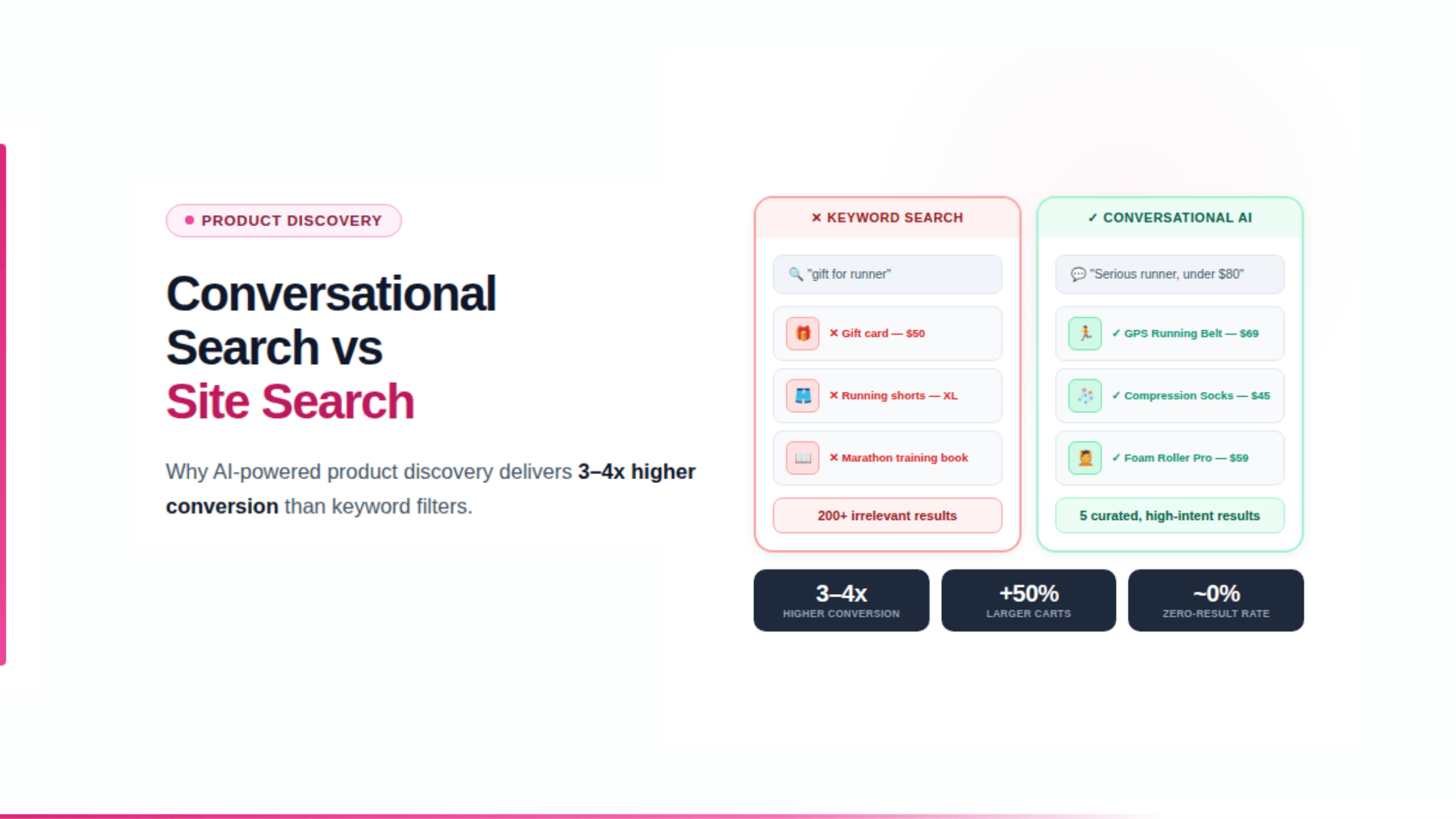
The problem: site search algorithms are literal. When a searcher types "gift for dad who has everything", the algorithm treats each keyword independently, ignoring intent entirely. Even misspellings produce zero results, despite you stocking what the user searched for.
This creates three failure modes. Zero-result search queries happen when user search terms don't match any product name, roughly 10-15% of e-commerce site search queries. Irrelevant search results damage user experience. And filter fatigue kills mobile conversion when shoppers navigate manual dropdown filters.
Traditional site search converts at 2-3%. No amount of merchandise ranking or algorithm tuning fixes the fundamental issue: keyword site search doesn't understand what people want. It's a complex problem demanding a different AI system.
What Conversational AI Search Does Differently
Conversational search is an AI-powered approach to product discovery built on natural language processing (NLP), natural language understanding, and retrieval-augmented generation. Three capabilities separate it from any traditional site search tool.
Semantic understanding. Conversational AI search interprets meaning, not just text. "Something cozy for movie night" is understood as loungewear, not a literal keyword retrieval for "cozy." The semantic search layer uses vector search and machine learning to rank results by true relevance to the searcher's intent, handling complex queries that would break any site search bar.
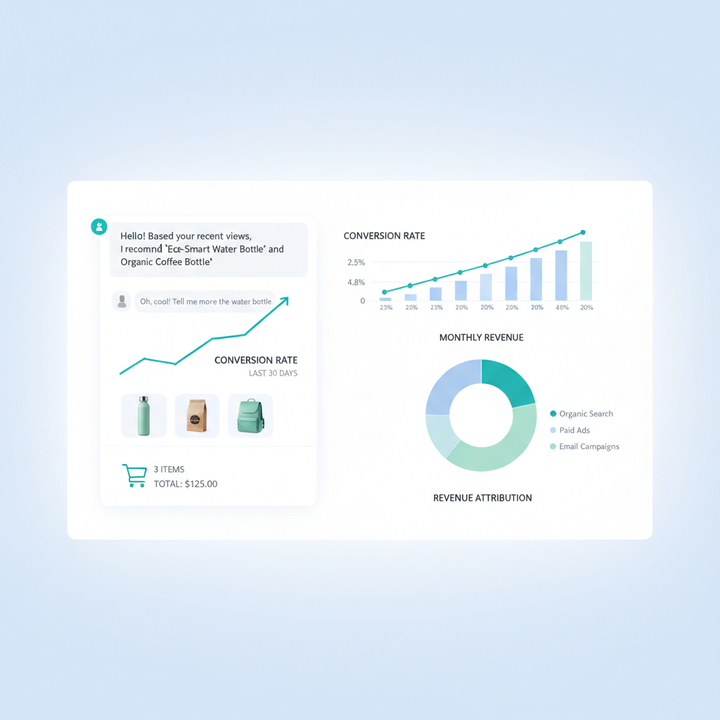
Multi-turn conversation with context. Unlike site search, where each search query is independent, conversational search maintains context across a dialogue. A user can search "running shoes for flat feet" and then refine with a follow-up question: "under $120 in blue". The AI assistant remembers the original intent. This dynamic, multi-turn interaction mirrors how a retail store agent guides discovery, and it's where traditional chatbots evolve into intelligent search assistants that help shoppers find exactly what they need. With generative AI powering the conversation, the AI-generated response adapts to each query naturally, delivering each result fast and accurately.
Guided discovery. When a query is ambiguous, conversational AI asks clarifying questions instead of dumping results. "I need a gift" prompts, "What's the occasion and budget?" This helps shoppers find products across any product category — even items they didn't know existed, with AI-generated suggestions that are data-driven and personalized to each shopper's behavior and preference.
The ROI: Conversion, Revenue, and Customer Experience
AI-powered conversational search outperforms traditional site search on every metric.
Conversion rates jump 3-4x. Brands implementing AI search see 8-12% conversion versus 2-3% typical of keyword site search, where chatbots and outdated search tools simply can't help shoppers find what they actually want. Average order value rises 25-50% through context-aware recommendation and dynamic cross-sell, powered by real-time analytics on what each shopper is looking for, not static "related products" content. Zero-result queries drop to near zero.
Every interaction enriches the AI-powered system's understanding of your customer base, making content and recommendations more relevant over time. This is a data-driven competitive moat for modern retail brands competing against marketplaces and AI-powered product searches from Google.

How Alhena AI Delivers Conversational Search
Alhena AI's AI-powered Shopping Assistant brings conversational search to any e-commerce site with deep catalog integration across every channel.
Hallucination-free discovery. Alhena AI trains on your knowledge base, product catalog content, policies, and brand voice, so it never fabricates listings. This data-driven accuracy powers product discovery that shoppers and B2B buyers trust.
Intelligent search with semantic relevance. The AI understands your product categories and attributes, ranking and optimizing search results by true relevance to user intent, outperforming standard search engines, Google Shopping, and Algolia implementations.
Omnichannel voice search and text. Works across your e-commerce website, mobile, WhatsApp, and voice assistants, the same NLP powering every touchpoint.
Vertical AI agents and personalization. For specialized merchandise categories, the Fit Analyzer guides purchase decisions (reducing returns 10-15%) and the Skin Analyzer recommends by skin type. This personalization goes beyond any site search bar or OpenAI-based chatbot, an agentic AI system for retail commerce and B2B e-commerce alike.
Brands prove the ROI: Tatcha saw 38% higher AOV with 11.4% revenue attribution. Victoria Beckham achieved a 20% AOV increase through AI-powered product discovery.
You don't need to rebuild your storefront. Alhena AI connects via API, syncs your full catalog, and can go live on any e-commerce website in 48 hours. When a shopper finds what they need through a single conversational query instead of clicking through filters, the entire purchase journey accelerates.
Ready to transform how shoppers discover products? Book a demo with Alhena AI or start for free.

Frequently asked questions
Does conversational AI search increase e-commerce conversion and revenue?
Yes. Brands deploying AI-powered conversational search see 3-4x higher conversion compared to keyword site search, plus 25-50% higher AOV from context-aware recommendation and personalized product discovery. Search result relevance improves because AI search interprets intent rather than matching keywords; zero-result queries drop to near zero, keeping shoppers on your e-commerce site.
How do I implement AI search on my e-commerce website without replacing my existing search tool?
Alhena AI integrates via API with Shopify, WooCommerce, and Salesforce Commerce Cloud, syncing your full product catalog. Deploy alongside your existing search bar and autocomplete; no need to replace. The AI Shopping Assistant handles natural language queries, voice search input, and guided product discovery. Most retail brands go live within 48 hours with measurable improvements in search query conversion and revenue.
Can conversational search handle voice search across multiple channels on an e-commerce site?
Absolutely. Alhena AI supports text and voice search across your e-commerce website, mobile app, WhatsApp, and voice assistants. The same conversational AI intelligence powers every channel, understanding natural language, maintaining conversation context, and delivering personalized search results whether the user types or speaks.
What is the difference between traditional site search and conversational search on an ecommerce site?
Traditional site search relies on keyword matching; the search algorithm compares the exact text a searcher types into the search bar against product name metadata, tags, and descriptions. If a search query doesn't match a product name in your catalog, the e-commerce site returns zero results, even when you stock exactly what the shopper wants. Conversational search takes a fundamentally different approach. It uses natural language processing and NLP to understand the meaning behind each search query, interpret user search intent, and deliver personalized search results ranked by true relevance, not just keyword overlap. On any modern e-commerce website, this means shoppers find what they need faster, misspellings no longer break the experience, and the search bar becomes the most powerful merchandise touchpoint on your e-commerce site.
How does Alhena AI handle misspellings, slang, and vague search queries that break traditional site search?
Traditional site search algorithms fail when a search query doesn't match product name text exactly; misspellings, slang, and vague descriptions all produce zero or irrelevant search results. Alhena AI solves this with NLP-powered intelligent search that interprets the meaning behind any search query, regardless of how it's phrased. A search for "comfy kicks" is understood as casual sneakers. "Gift for runner under 80" surfaces curated search results without needing exact keywords. The search engine also handles autocomplete intelligently, suggesting relevant product categories as the user search input evolves. This makes the search bar on your e-commerce site dramatically more effective, helping every searcher find what they need, even when they can't articulate it precisely. For modern retail brands, this eliminates one of the biggest revenue leaks in e-commerce: failed search queries that send shoppers to a competitor.
How does conversational search optimize search results compared to tools like Algolia or Bloomreach?
Traditional search tools like Algolia and Bloomreach use algorithms to rank search results based on keywords, synonyms, and manual merchandise rules. They can handle autocomplete and basic personalization, but they struggle with ambiguous or complex search queries; a searcher typing "something cozy for movie night" gets irrelevant results because the search engine can't interpret intent. Conversational search replaces this static approach with dynamic, machine-learning-powered intelligent search. It can optimize search on an e-commerce site by understanding what the shopper actually means, asking clarifying questions, and returning search results that reflect true intent, not just product name matches. Alhena AI's personalize layer goes further by adapting recommendations and search result rankings based on each shopper's behavior and preferences, delivering a level of personalization that rule-based search tools cannot match.