What Is Conversational AI for Customer Service?
Conversational AI for customer service is a category of artificial intelligence that lets businesses hold natural, human-like conversations with customers across chat, email, voice, and social channels. It combines natural language processing (NLP), natural language understanding (NLU), machine learning, and dialogue management to interpret what a customer means, not just what they type.
Unlike rule-based chatbots that follow rigid scripts and break down the moment a question falls outside their decision tree, conversational AI handles slang, typos, follow-up questions, and context shifts. It learns from every interaction and gets better over time. Think of the difference between a vending machine and a personal shopper. One gives you what you pressed the button for. The other listens, asks follow-ups, and adapts.
For ecommerce brands specifically, this means an AI shopping assistant that can guide shoppers through product selection, answer sizing questions, check order status, process returns, and even populate carts, all in a single conversation thread.
Conversational AI vs. Traditional Chatbots: What's the Difference?
The terms "chatbot" and "conversational AI" get used interchangeably, but they're not the same thing. A traditional chatbot is a rule-based tool. You build a decision tree, map out expected questions, and write canned responses. When a customer asks something outside that tree, the bot fails. It sends them to a generic "I don't understand" message or drops the conversation entirely.
Conversational AI works differently. It uses NLP to break down sentence structure, NLU to detect intent and pull out key details (like an order number or product name), and natural language generation (NLG) to craft responses that sound human. It maintains context across a multi-turn conversation, helping provide a better customer experience, so a customer can say "what about in blue?" without re-explaining what product they were asking about.
Here's a practical example. A customer types: "I ordered those running shoes last week but they're too tight. Can I swap for a half size up?" A rule-based chatbot might match "ordered" and show a generic order tracking page. A conversational AI agent understands the customer wants an exchange, identifies the product, pulls up the order, and starts the return process. That's the gap between a frustrating experience and a resolved ticket.
If you're evaluating options, our guide on how to select an AI chatbot for customer service breaks down the key criteria to consider.
How Conversational AI Works Under the Hood
Every conversational AI interaction follows a four-step pipeline. Understanding this helps you evaluate platform capabilities and set realistic expectations for what the technology can do.
Step 1: Input Processing (NLP)
The system receives the customer's message and breaks it down. It handles spelling errors, shorthand ("u" instead of "you"), emojis, and multilingual inputs. Modern systems support 30+ languages natively.
Step 2: Intent Detection (NLU)
The AI figures out what the customer actually wants. "Where's my stuff?" and "Can you track order #4521?" both map to the same intent: order tracking. The system also extracts entities (the order number, a product name, a date) to take action.
Step 3: Dialogue Management
This is where conversational AI separates itself from basic bots. The dialogue manager tracks the full conversation history, remembers what was said three messages ago, and decides the best next step. Should it ask a clarifying question? Pull data from the CRM? Escalate to a human agent? This layer makes multi-turn conversations possible.
Step 4: Response Generation (NLG)
The system generates a natural, context-aware reply. With generative AI models, responses aren't pulled from a fixed template. They're composed in real time, matching your brand's tone and voice. The best platforms ground these responses in your verified product data and knowledge base to prevent hallucinations.
Benefits of Conversational AI for Customer Service
The business case for conversational AI in customer service isn't theoretical anymore. Companies are seeing measurable results across cost, speed, satisfaction, and operational efficiency.
Dramatic Cost Reduction
AI interactions cost roughly $0.18 per conversation compared to $4.32 for human-handled service, according to All About AI's 2025 analysis. That's a 95.8% reduction, and it's one of the clearest ROI stories in customer service. Gartner projects that conversational AI deployments will cut contact center labor costs by $80 billion by 2026. Companies that deploy AI-powered customer service see an average return of $3.50 for every $1 invested, with top performers hitting 8x ROI.
Faster Response and Resolution Times
First response time drops from an average of 8.2 minutes to 2.1 minutes with conversational AI, a 74% improvement. Average handle time falls from 6.5 minutes to 2.9 minutes. For ecommerce brands like Manawa, that meant going from 40-minute response times to under 1 minute while automating 80% of customer inquiries.
Higher Customer Satisfaction
The data pushes back against the assumption that customers hate talking to AI. Measured deployments show CSAT scores climbing from 78% to 97%. Net Promoter Scores jumped from 23 to 63 in organizations using conversational AI. Brands like Puffy maintain a 90% CSAT while resolving 63% of inquiries automatically.
24/7 Availability Across Channels
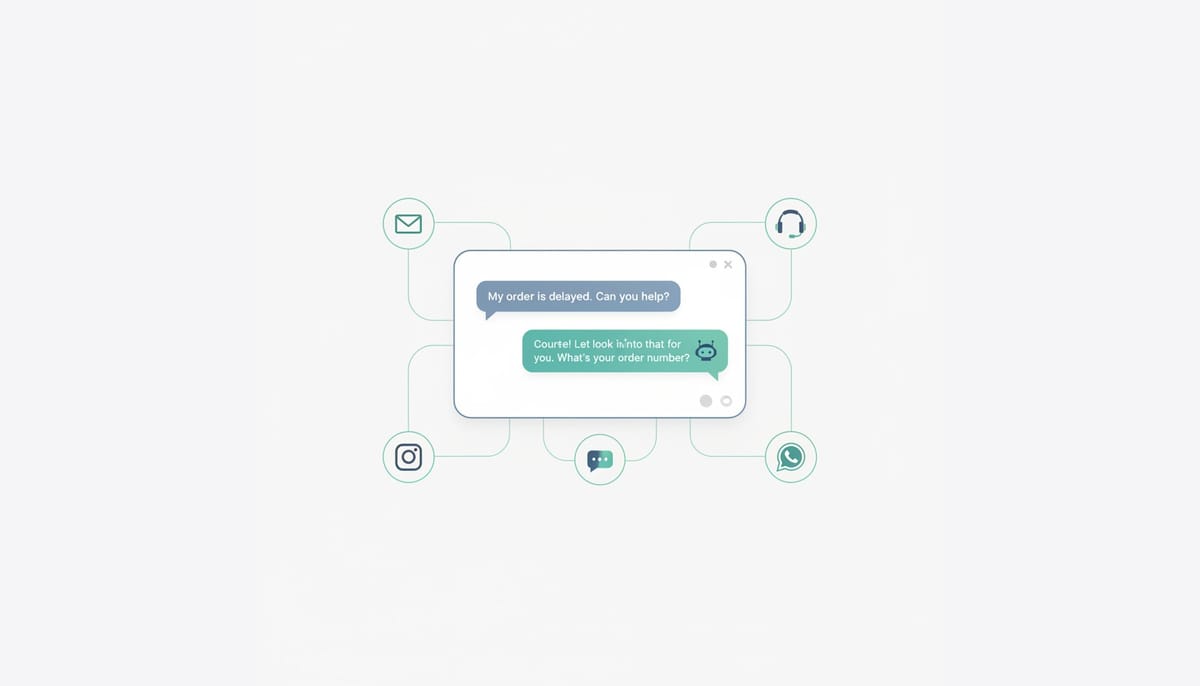
Customers don't wait for business hours. Conversational AI handles inquiries around the clock across web chat, email, Instagram DMs, WhatsApp, and voice. That omnichannel presence lets you deliver consistent experiences, so a customer who starts a conversation on your website can pick it up on WhatsApp without repeating themselves.
Better Agent Experiences
When AI handles the repetitive "where's my order?" and "what's your return policy?" questions, human support teams focus on complex problems that actually need their expertise. Agent ticket capacity increases by 200%, from 26 to 78 tickets per day. Employee turnover drops 43% because agents aren't burned out by monotonous work.
Top Use Cases for Ecommerce Brands
Conversational AI isn't just for answering FAQs. The most impactful implementations go well beyond basic question-and-answer flows.
Product Discovery and Guided Selling
A customer asks, "I need a moisturizer for oily skin under $30." An AI shopping assistant filters your catalog in real time, asks clarifying questions about preferences (fragrance-free? SPF?), and recommends the best personalized matches. Tatcha saw a 3x conversion rate and a 38% increase in average order value with this approach, generating 11.4% of total site revenue from AI-assisted conversations.
Order Management
Tracking packages, modifying orders, processing returns, and handling exchanges are high-volume, repetitive tasks. An AI support concierge pulls order data directly from your ecommerce platform and takes action without routing the customer to a human. Crocus achieved an 86% deflection rate with this model while maintaining 84% CSAT.
Social Commerce
With AI-powered social commerce, brands respond to product questions in Instagram DMs, Facebook comments, and WhatsApp messages automatically. Instead of losing a potential buyer who asked "does this come in red?" at 11 PM, the AI answers instantly and links them to the product page.
Proactive Engagement and Cart Recovery
Conversational AI doesn't just react. It initiates. Proactive AI greetings yield 45% engagement rates, and AI-driven cart abandonment interventions recover 35% of abandoned carts. When a shopper hesitates on a product page, the AI can offer a size guide, highlight a current promotion, or answer an unasked question based on behavior patterns.
Voice-Based Support
Phone support isn't going away, but voice AI is changing how it works. Instead of rigid IVR menus ("Press 1 for billing, press 2 for..."), conversational voice AI lets customers describe their issue naturally. The global voice commerce market is projected to reach $62 billion by 2025, growing toward $250 billion by 2033.
How to Get Started with Conversational AI
Implementing conversational AI for customer service doesn't require a year-long project or a dedicated engineering team. Here's a practical roadmap.
1. Audit Your Support Tickets
Start by categorizing your last 1,000 support tickets. What percentage are repetitive? Order tracking, return requests, sizing questions, and shipping inquiries typically account for 60-80% of total volume. These are your automation targets.
2. Pick the Right Platform
Not all conversational AI software is built the same, and not all solutions deliver the same results. General-purpose tools like Zendesk AI and Intercom Fin handle ticket deflection well, but they weren't designed to drive revenue. For ecommerce, you need a platform that connects to your product catalog, understands purchase intent, and can take transactional actions like populating carts or processing refunds. Our breakdown of the best AI customer service chatbots for ecommerce compares the leading options.
3. Connect Your Data Sources
The AI is only as good as the data it draws from. Connect your ecommerce platform (Shopify, WooCommerce, or Magento), your helpdesk (Zendesk, Freshdesk, Gorgias), and your knowledge base. This gives the AI real-time access to order data, product information, and your support policies.
4. Set Escalation Rules
Define clear handoff triggers. When should the AI transfer a conversation to a human? Common escalation criteria include negative sentiment, VIP customers, complex complaints, and refund requests above a certain dollar amount. The best implementations make this transition invisible to the customer, passing full conversation context to the agent to maintain service quality.
5. Launch, Measure, and Iterate
Start with a pilot covering 25% of your traffic. Track containment rate (what percentage of conversations the AI resolves without human help), CSAT, first-contact resolution, and cost per interaction. Most users see measurable results within 60 days. Then expand coverage and refine based on the data.
How Alhena AI Powers Conversational Customer Service
Alhena AI is purpose-built for ecommerce, combining customer support and sales in a single conversational AI platform. While most tools treat service and selling as separate functions, Alhena handles both through two specialized agents.
The Product Expert Agent acts as a virtual shopping assistant, guiding customers through product discovery with natural conversation. With no manual training required, it learns from your full product catalog, learns your brand voice, and answers questions with zero hallucinations because every response is grounded in your verified data.
The Order Management Agent handles the post-purchase side: order tracking, returns, exchanges, cancellations, and refund processing. It connects directly to your ecommerce platform and takes action autonomously, not just answering questions but resolving them.
What makes this different from tools like Zendesk AI or Intercom Fin? Alhena's agentic checkout capability. The AI doesn't just recommend products. It populates the customer's cart, pre-fills checkout fields, and drives the purchase forward. Victoria Beckham saw a 20% increase in average order value with this approach.
Alhena deploys in under 48 hours with no dev resources needed. It works across web chat, email, Instagram DMs, WhatsApp, and voice. And it integrates with the tools ecommerce brands already use: Shopify, Salesforce Commerce Cloud, Zendesk, Gorgias, Intercom, and more.
Built-in revenue attribution analytics give you insights into exactly how much revenue AI-assisted conversations generate. You don't have to guess whether conversational AI is working. You can see the dollar impact. Explore the ROI calculator to estimate your potential return.
Key Takeaways
- Conversational AI is not a chatbot. It uses NLP, NLU, and machine learning to understand intent, maintain context, and generate natural responses across multiple turns.
- The ROI is proven. AI interactions cost $0.18 vs. $4.32 for human support, with companies averaging 3.5x returns on investment.
- Start with your highest-volume tickets. Order tracking, returns, and product questions are ideal automation targets and typically account for 60-80% of support volume.
- Ecommerce needs a sales-capable AI. Generic support tools handle ticket deflection but miss the revenue opportunity. Purpose-built platforms like Alhena combine support and selling.
- The hybrid model wins. AI handles routine inquiries; humans handle complex, emotional, or high-value situations. Companies that get this balance right see CSAT scores above 90%.
- Implementation is faster than you think. Modern platforms deploy in days, not months, and show measurable results within 60 days.
Ready to see how conversational AI can transform your customer service and drive revenue? Book a demo with Alhena AI or start for free with 25 conversations.

Frequently Asked Questions
What is conversational AI for customer service?
Conversational AI for customer service uses natural language processing, machine learning, and dialogue management to hold human-like conversations with customers across chat, email, voice, and social channels. Unlike rule-based chatbots, it understands intent, maintains context across multi-turn conversations, and improves over time.
How is conversational AI different from a chatbot?
Traditional chatbots follow scripted decision trees and fail when questions fall outside their programming. Conversational AI uses NLP and NLU to understand varied phrasing, detect intent, and maintain context. It can handle follow-up questions, slang, and typos, while chatbots can only respond to pre-mapped inputs.
How much does conversational AI reduce customer service costs?
AI interactions cost roughly $0.18 compared to $4.32 for human-handled service, a 95.8% reduction. Gartner projects conversational AI will cut contact center labor costs by $80 billion by 2026. Companies see an average ROI of $3.50 for every $1 invested, with top performers reaching 8x returns.
Can conversational AI handle multiple channels at once?
Yes. Modern conversational AI platforms operate across web chat, email, Instagram DMs, WhatsApp, voice, and more. The best platforms maintain a unified conversation history so customers can switch channels without repeating themselves. Alhena AI supports all of these channels from a single platform.
Will conversational AI replace human customer service agents?
No. The most successful implementations use a hybrid model where AI handles routine inquiries (order tracking, FAQs, returns) and humans handle complex, emotional, or high-value situations. 75% of customers still prefer humans for complex issues. AI actually improves agent experience, reducing burnout, improving operations, and cutting turnover by 43%.
How long does it take to set up conversational AI for customer service?
Deployment timelines vary by platform. General-purpose tools can take weeks or months of custom development. Purpose-built ecommerce platforms like Alhena AI deploy in under 48 hours with no engineering resources needed, connecting to your existing product catalog and helpdesk automatically.
What's the best conversational AI platform for ecommerce?
For ecommerce, you need a platform that connects to your product catalog, understands purchase intent, and takes transactional actions like populating carts. Alhena AI is purpose-built for this, combining support and sales with agentic checkout. Tatcha saw 3x conversion rates and 38% AOV uplift using Alhena.
How do you measure conversational AI ROI?
Track five key metrics: containment rate (percentage resolved without human help), CSAT score, first-contact resolution rate, cost per interaction, and revenue attributed to AI conversations. Platforms like Alhena AI include built-in revenue attribution analytics so you can see the exact dollar impact.