You invested in AI for your e-commerce store. The results are strong. Conversations are up. Resolution rates are high. Customer satisfaction scores look great. Then the board asks: "What's the ROI?"
Your team pulls up deflection rates and CSAT improvements. The room goes quiet. Not because the numbers are bad, but because they don't speak the language the board uses to make funding decisions. Boards don't fund CSAT improvements. They fund revenue growth, margin expansion, and competitive digital positioning.
This is where most CMOs lose their AI budget. Not because the technology failed, but because they framed it as a support tool instead of a revenue channel. The marketing leader who presents AI in ecommerce as a growth engine gets more budget. The one who presents it as a cost line gets cut in the next review cycle.
This guide gives you two things: a board reporting framework that translates AI performance into the three numbers that actually move the conversation, and a strategic investment case for AI search that positions it as a channel allocation decision your marketing board can act on today.
The Board Reporting Framework: Three Numbers That Matter
Strip away every dashboard metric your AI marketing platform generates. For a marketing board presentation, you need exactly three numbers. Each one maps directly to how your board already evaluates digital growth investments.
Number One: AI-Attributed Revenue
This is your headline number. Not conversations handled. Not tickets deflected. Total dollar value of purchases where AI helped drive the buying decision, traced through attribution modeling and attribution model frameworks from AI interactions to completed conversions and orders.
Leading ecommerce and retail brands on the Alhena AI platform attribute 10 to 11% of total retail site revenue to AI powered, generative AI-assisted, generative AI-driven conversational commerce sessions. Tatcha saw a 3x conversion rate and 38% average order value uplift from conversational AI-engaged sessions, with 11.4% of site revenue flowing through the AI shopping assistant (also called an AI assistant).
Present this number the same way you present revenue from paid search, email, social, and affiliate. Place it in a channel revenue table alongside those sources. When the board sees AI generating $400,000 per month sitting next to email at $350,000 and affiliate at $200,000, the conversation shifts from "is AI working?" to "how do we scale this channel?"
That reframing is everything. AI-attributed revenue ecommerce brands track today proves that AI in ecommerce proves the channel belongs in the same conversation as every other revenue source on your P&L.
Number Two: ROAS Equivalent for AI
Calculate AI-attributed revenue divided by total AI platform cost. This gives you a return-on-ad-spend equivalent that your board already knows how to evaluate.
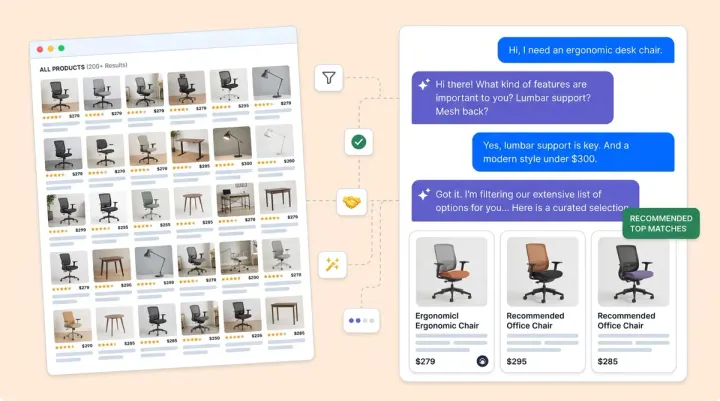
Here's why the number looks different from paid media. With Google Ads or Meta, a ROAS of 4:1 to 6:1 is considered strong. AI shopping assistants routinely deliver 10:1 to 30:1 because the "media cost" is the platform fee, and the "traffic" is consumers and shoppers and visitors you already acquired through other channels. AI captures purchase intent and buyer intent at every stage of the customer journey. Map the full customer journey, turning browsing behavior and shopping behavior and purchase behavior into buying decisions. AI doesn't compete with your ad budget. It exists to drive sales, boost conversions and boost conversion rates across the entire conversion funnel, and drive sales outcomes from every session across the full funnel. It’s not competing for budget. It multiplies the return on every dollar you already spend acquiring visitors.
The channel amplification data makes this concrete. According to Alhena's 329-brand AI Commerce Report from 2025, Google Ads visitors convert 6.1x higher, Meta Ads visitors convert 13.1x higher, and TikTok Ads visitors convert 76x higher when they engage with on-site AI. Brands using AI this way, using AI to convert at scale compared to shoppers from those same channels who don't engage. Your existing paid media spend becomes dramatically more productive when AI delivers personalized on-site experiences.
For the board, this means AI is not a separate budget line competing for resources. It's an amplifier that improves the return on resources you've already committed.
Number Three: Cost Avoidance Plus Margin Impact
Support automation savings are real, but don't present them as headcount reduction. Present them as margin improvement per order. Consider also the impact on abandoned carts: AI-powered cart recovery and guided checkout reduce abandoned cart rates.
Combine three components: ticket deflection savings (brands on Alhena see 70 to 86% deflection rates), reduced return rates from better product matching during the online shopping experience. Every online shopping interaction, and margin gains from dynamic pricing strategies. Dynamic pricing alone where AI tools adjust pricing based on competitor price signals and demand forecasting, adjust pricing logic, demand forecasting signals, and inventory management, overstock prevention, overstock reduction, inventory management optimization, and replenishment and auto-replenishment signals, and increased average order value from cross selling, upsell recommendations, and guided selling. Crocus achieves an 86% deflection rate with 84% CSAT. Puffy resolves 63% of inquiries automatically while maintaining 90% customer satisfaction, stronger customer retention, and better personalization and AI personalization across the shopper experience. Retention improves.
Express the combined figure as margin improvement per order. If AI saves $3.50 in support costs, prevents $1.20 in return processing, and adds $8 in AOV through cross selling and upsell recommendations, that's $12.70 in margin improvement per AI-engaged order. Multiply by monthly AI-engaged order volume and the board sees a profitability story, not a cost-cutting story.
The AI Search Investment Case: A Five-Minute Board Briefing
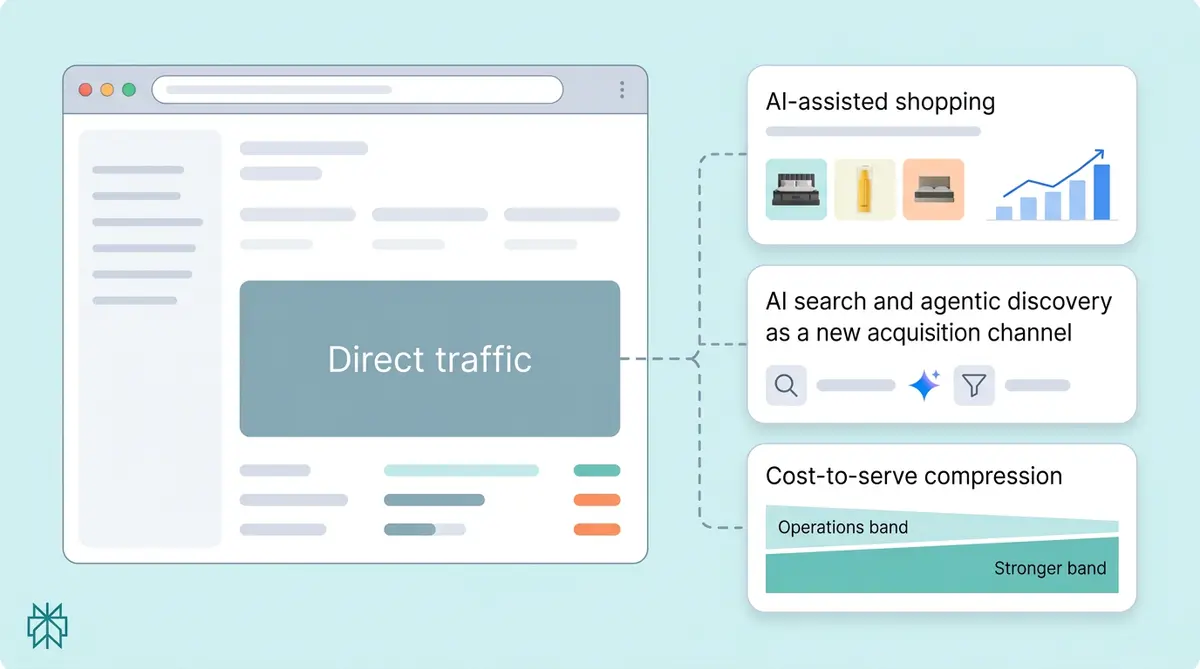
The second half of your board presentation addresses where AI-driven revenue is going next. AI search is the fastest-growing zero-cost agentic AI acquisition channel. The agentic commerce shift in ecommerce, and your CMO AI search strategy today determines whether your brand captures or misses this shift.
The Channel Reality
Traffic referred by large language models (ChatGPT, Perplexity, Gemini, and similar platforms) now converts at 2.47%, according to Alhena's cross-brand benchmark data. That places it as the 4th highest converting commerce channel, above Google Ads at 1.82% and Meta Ads at 0.52%, with zero ad spend, completely free.
Revenue from this channel now grew 130% while visitor volume grew 40%. Each new AI-referred visitor is becoming more valuable over time. When AI-referred visitors engage with an on-site AI shopping assistant, their conversion rate jumps to 9.84%, a 4x lift on an already high-converting channel.
The Cost of Inaction
Brands not optimizing for AI search are invisible at the point of purchase. When a shopper asks ChatGPT for a product recommendation and your brand doesn't appear, that sale goes to whichever competitor the AI does recommend.
This is different from traditional search in one critical way: you can't buy your way to AI visibility with ads. There is no paid placement. Platforms like Bloomreach and similar platforms focus on site search, but Bloomreach-style product discovery, but AI search visibility requires a different approach, no free trial workaround in ChatGPT's product discovery and recommendations. AI recommendations are earned through product data quality, competitor price monitoring, inventory accuracy, review signals, and structured content. Brands that delay building AI share of voice can't write a check later to catch up.
The Budget Allocation Recommendation
AI search optimization, smart search, and the right ai tools require investment in product data completeness and product discovery optimization, structured markup, review strategy, and AI visibility monitoring. This is not a six-figure infrastructure project. It's a reallocation of existing content and SEO resources toward the channel that now converts at 2.47% versus channels where the same investment produces diminishing returns.
Recommend that your ecommerce brand allocate 10 to 15% of SEO and content marketing budget toward AI search optimization and visibility optimization in 2026, increasing to 20 to 25% in 2027 as the channel scales. Frame it as rebalancing toward the highest-ROI channel, not as new spending.
How to Present AI to a Skeptical Board: Three Reframes
Most board resistance to AI investment comes from how AI gets described, not from the results themselves. Here are three reframes that change the conversation.
Reframe "we deployed a chatbot" as "we launched a new revenue channel that attributes $X per month in incremental sales." The word "chatbot" triggers a mental model of basic FAQ automation. "Revenue channel" triggers the same evaluation framework your board uses for email, paid search, and affiliate.
Reframe "our AI deflects 80% of tickets" as "we reduced cost-per-order by $Y while improving customer satisfaction." Deflection is an operational metric that sounds like you're avoiding customers. Cost-per-order improvement is a profitability metric that sounds like you're running a tighter business.
Reframe "we're optimizing for AI search" as "we're securing product visibility in the fastest-growing zero-cost acquisition channel before competitors do." Optimization sounds like a technical project. Securing competitive position sounds like a strategic investment with a window of opportunity.
Why Alhena AI Makes Board Reporting Easy
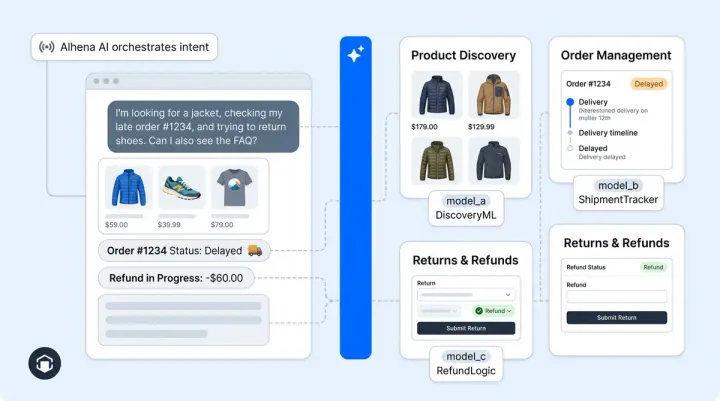
Most AI platforms force CMOs to cobble together revenue data from multiple systems. Alhena AI was built with board-level reporting as a core feature, not an afterthought.
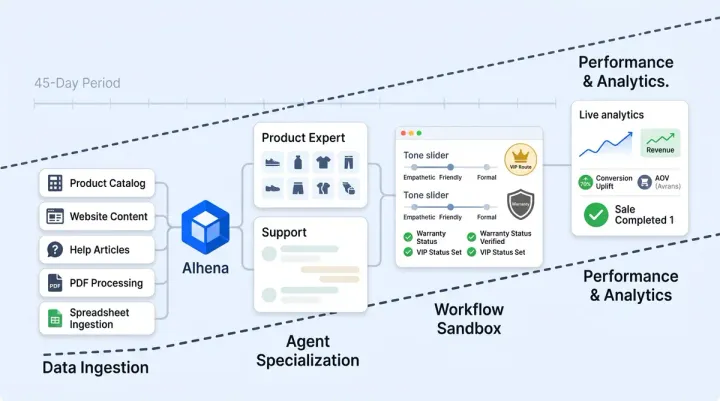
AI powered, built-in revenue attribution provides full attribution, tracing every AI conversation to completed purchases and conversions with real-time source-level attribution. You see exactly which interactions drove revenue, broken down by chat, FAQ engagement, and proactive nudges. No custom ai tools or analytics setup required. Alhena's revenue analytics give you the AI-attributed revenue number directly.
Channel-level performance data shows how AI multiplies returns on every traffic source. See the 6.1x, 13.1x, and 76x channel amplification numbers broken down by your actual traffic mix, so you can calculate your specific ROAS equivalent without spreadsheet gymnastics.
AI Visibility and smart search tracking monitors and tracks how your products appear across ChatGPT, Perplexity, Gemini, and Google AI Overviews, connected to revenue attribution and conversion attribution data so you can see which AI search appearances convert to purchases. This powers the AI search investment case with your own data insights, not industry averages.
Executive dashboards present the three board numbers (AI-attributed revenue, ROAS equivalent, margin impact) in a format ready for your next board deck. No custom report building. No analyst time. The CMO AI search strategy becomes trackable from the same platform driving the revenue.
Alhena deploys in under 48 hours across Shopify, WooCommerce, Magento, and Salesforce Commerce Cloud. On Shopify alone, ecommerce platforms and stores using Alhena, connecting to your existing helpdesk through pre-built integrations. Manawa cut response times from 40 minutes to 1 minute while automating 80% of inquiries. Victoria Beckham saw a 20% AOV increase.
The Bottom Line
The CMOs who keep their AI budgets and expand them won't be the ones with the best technology. They'll be the ones who communicate AI's impact in the language their board already speaks: revenue growth, margin expansion, and competitive positioning.
The data exists. The measurement framework exists. The only question is whether you present AI as a cost line or a growth engine. Boards fund growth engines.
Ready to give your board the AI revenue story they've been waiting for? Book a demo with Alhena AI to see board-ready revenue attribution in action, or start free with 25 conversations and build your own numbers. Use the ROI Calculator to estimate your AI-attributed revenue before your next board meeting.

Frequently Asked Questions
How should a CMO calculate AI-attributed revenue for a board presentation?
Divide total purchases where AI influenced the buying decision by total site revenue to get AI's channel contribution percentage. Alhena AI tracks this automatically, tracing every AI conversation to completed purchases with source-level attribution across chat, FAQ engagement, and proactive nudges. Leading brands on Alhena attribute 10 to 11% of total site revenue to AI-assisted sessions.
What is the ROAS equivalent for an AI shopping assistant and how does it compare to paid media?
AI ROAS equals AI-attributed revenue divided by total platform cost. Because AI converts visitors you already acquired through other channels, the ratio typically lands at 10:1 to 30:1, far above the 4:1 to 6:1 considered strong for paid media. Alhena AI's channel-level dashboards calculate this automatically, showing exactly how AI amplifies returns on Google Ads (6.1x lift), Meta Ads (13.1x lift), and TikTok Ads (76x lift).
Why is AI search a strategic channel investment for ecommerce brands in 2026?
LLM-referred traffic converts at 2.47%, ranking 4th among all commerce channels above Google Ads and Meta Ads, with zero ad spend. Revenue from this channel grew 130% while visitor volume grew 40%, meaning each AI-referred visitor becomes more valuable over time. Alhena AI provides AI Visibility tracking across ChatGPT, Perplexity, and Gemini connected to revenue data, helping brands secure competitive position in this fast-growing channel.
How do you present AI performance to a board that only cares about revenue and margins?
Use three numbers: AI-attributed revenue (total dollars traced from AI interactions to purchases), ROAS equivalent (AI-attributed revenue divided by platform cost), and margin impact per order (support savings plus reduced returns plus AOV uplift from guided selling). Alhena AI's executive dashboards present all three metrics in board-ready format with actionable insights without requiring custom report builds or analyst time.
How does Alhena AI track revenue attribution differently from general chatbot and chatbots platforms?
Alhena AI was built for ecommerce revenue attribution from the ground up. Every conversation is traced to completed purchases with breakdowns by interaction type (chat, FAQ, nudge) and traffic source. The platform shows channel amplification data proving how AI multiplies returns on each paid channel, and connects AI Visibility monitoring to actual purchase data so CMOs can tie AI search appearances to revenue.