Why Ecommerce Brands Are Looking Beyond Gorgias
Gorgias built its reputation as the go-to helpdesk for Shopify stores, and that makes it the default for many DTC brands. Deep order management, unlimited agent seats, and solid macro automation made it the default choice for DTC brands. But as ecommerce teams scale, a pattern keeps repeating: the ticket-based pricing model that seemed affordable at 300 tickets a month starts bleeding budget at 5,000.
Gartner predicts that agentic AI will resolve 80% of common customer service issues without human help by 2029. The helpdesk market is shifting fast, and sticking with a tool that charges more every time your customers reach out isn't a growth strategy.
This guide breaks down the best gorgias alternatives for customer support for ecommerce brands in 2026, with honest pricing comparisons, feature analysis, and a clear look at which tool fits your stage and goals.
8 Best Gorgias Alternatives for Ecommerce Brands
Each alternative below solves a different piece of the puzzle. Some offer better pricing models. Others bring AI capabilities that Gorgias can't match. A few do both.
1. Alhena AI: Best for AI-Driven Sales and Support
Alhena AI isn't a traditional helpdesk. It's an AI-native platform built specifically for ecommerce that treats every customer conversation as a revenue opportunity, not just a ticket to close.
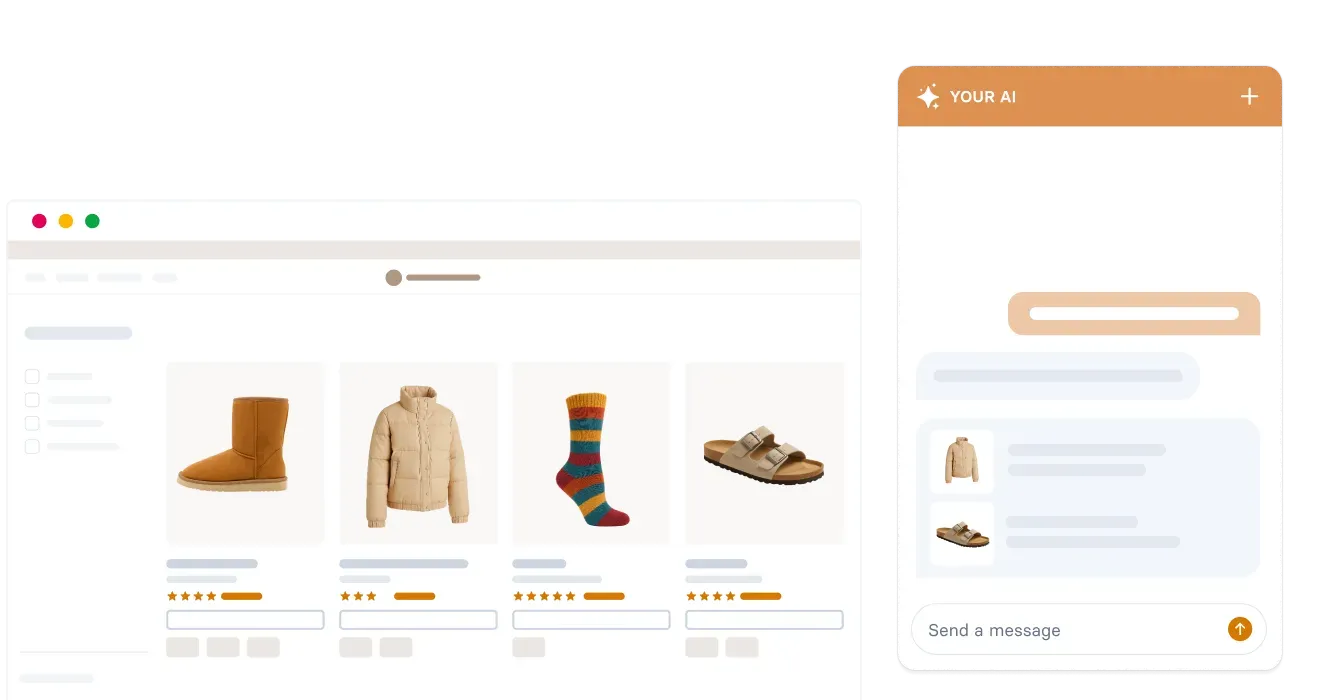
Where Gorgias automates support deflection, Alhena's AI Shopping Assistant actively guides shoppers through product discovery, answers detailed product questions with zero hallucinations, and drives them to checkout with "Add to Bag" CTAs and personalized upsell nudges. Two specialized agents power the experience: a Product Expert Agent that knows your entire catalog and a Order Management Agent that handles returns, cancellations, and order edits autonomously.
The results speak for themselves. Tatcha saw a 3x conversion rate, 38% AOV uplift, and 11.4% of total site revenue driven by Alhena AI. Puffy hit 63% automated inquiry resolution with 90% CSAT. Victoria Beckham reported a 20% AOV increase.
Alhena deploys in under 48 hours with no dev resources, works across web chat, email, Instagram DMs, WhatsApp, and voice, and integrates with Shopify, WooCommerce, Magento, and Salesforce Commerce Cloud. It also layers on top of existing helpdesks including Gorgias, Zendesk, and Freshdesk, so you don't have to rip and replace your entire stack.
Pricing: Free plan with 50 conversations per month. Paid plans start at $1.10 per conversation. G2 rating: 4.9/5.
Best for: Ecommerce brands that want AI to drive revenue, not just deflect tickets.
2. Zendesk: Best for Enterprise Scale
Zendesk is the 800-pound gorilla of helpdesks. With 1,500+ integrations, advanced SLA management, and deep reporting, it's built for companies that need enterprise-grade infrastructure.
The trade-off? Zendesk isn't purpose-built for ecommerce. Viewing Shopify orders requires third-party apps. The per-agent pricing (Suite Professional at $115 per agent per month, plus a $50 AI add-on) adds up fast for larger teams. And the learning curve is steep enough that most brands need weeks of onboarding.
That said, if you're running a complex multi-department operation with 50+ agents, Zendesk's customizable workflow engine and advanced reporting are hard to beat. For ecommerce-specific AI, many Zendesk users add Alhena AI as an intelligent layer on top.
Pricing: $19 to $169 per agent per month. AI add-on: $50 per agent per month. G2 rating: 4.3/5.
Best for: Enterprise brands with large support teams and complex workflows across multiple departments.
3. Freshdesk: Best Budget-Friendly Option
Freshdesk offers the rare combination of a free tier and genuinely useful AI (Freddy AI) baked into the platform. For ecommerce brands watching every dollar, it's one of the most cost-effective gorgias alternatives available.
The Pro plan at $49 per agent per month includes automation rules, SLA management, and pre-built Shopify and Stripe integrations. Freddy AI provides real-time agent suggestions and can auto-resolve straightforward queries. The ecommerce integrations aren't as deep as Gorgias's native Shopify connection, but they cover the essentials.
Brands running Freshdesk who want deeper AI product recommendations and sales-through-support capabilities often pair it with Alhena AI.
Pricing: Free plan available. Paid plans from $15 to $79 per agent per month. G2 rating: 4.4/5.
Best for: Budget-conscious small and mid-size ecommerce brands that need solid helpdesk fundamentals without enterprise pricing.
4. Intercom: Best for Conversational Engagement
Intercom's Fin AI agent is one of the more capable AI resolution tools on the market. It handles multi-step conversations, pulls from your knowledge base, and resolves issues end-to-end rather than just routing tickets.
The platform also excels at proactive engagement: behavior-triggered messages, product tours, and onboarding flows that most helpdesks don't offer. For DTC brands that want to meet shoppers before they open a support ticket, that's a real advantage.
The downside is cost. Fin charges $0.99 per resolution. WhatsApp, SMS, and email all carry usage fees on top of seat pricing ($29 to $132 per seat per month). For high-volume ecommerce, those per-resolution charges stack up quickly. If you're evaluating Intercom's AI specifically, our Alhena AI vs Intercom Fin breakdown covers the key differences for ecommerce.
Pricing: $29 to $132 per seat per month. Fin AI: $0.99 per resolution. G2 rating: 4.5/5.
Best for: DTC and SaaS brands that prioritize proactive customer engagement and conversational UX.
5. Gladly: Best for Premium Customer-Centric Brands
Gladly takes a fundamentally different approach: it organizes support around people, not tickets. Every customer gets a single, lifelong conversation thread across all channels, so agents never ask "can you repeat your issue?"
Major ecommerce brands like Crate and Barrel and Ulta Beauty use Gladly for this unified experience. The platform delivers true omnichannel support with voice, chat, SMS, email, and social from one view, with strong AI routing and 45+ language support.
The catch is price. Plans start at $180 per agent per month with a 10-agent minimum, putting the floor at $1,800 per month. That's enterprise territory. For Shopify brands already on Gladly, adding Alhena AI brings the revenue-driving shopping assistant layer that Gladly's support-focused AI doesn't cover.
Pricing: From $180 per agent per month (10-agent minimum). G2 rating: 4.7/5.
Best for: Enterprise ecommerce brands ($50M+ revenue) that want a people-first support experience.
6. Kustomer: Best for CRM-Powered Support
Kustomer merges helpdesk functionality with CRM-level customer intelligence. Every interaction, order, loyalty status, and browsing session appears on a unified timeline, giving agents complete context before they type a single word.
The AI capabilities are robust, with intelligent routing, VIP prioritization, and automated resolution. Kustomer pulls data from Shopify, Klaviyo, marketing platforms, and loyalty programs into one view, which helps agents personalize every response.
The minimum commitment is 8 seats at $89 per seat per month ($712 per month floor), so it's not built for small teams. But for mid-market brands that want deep customer intelligence alongside their support workflows, Kustomer paired with AI-powered guided selling can be a strong combination.
Pricing: $89 to $139 per seat per month (8-seat minimum). G2 rating: 4.4/5.
Best for: Mid-market ecommerce brands that want CRM-level customer data integrated into support.
7. Re:amaze: Best with Predictable Pricing
Re:amaze is the closest direct alternative to Gorgias in terms of positioning. It's built specifically for ecommerce, with native Shopify, WooCommerce, and BigCommerce connections, and an intuitive shared inbox that handles email, chat, social, and SMS.
The key difference? Per-user pricing instead of per-ticket. At $29 to $69 per user per month, your bill stays flat whether you handle 500 or 5,000 conversations. For brands burned by Gorgias's volume-based billing, that predictability alone can justify the switch.
Re:amaze also supports multi-brand management from a single account, which is useful for portfolio brands running several stores. The AI capabilities are more basic than Alhena or Intercom, but the fundamentals are covered.
Pricing: $29 to $69 per user per month. G2 rating: 4.2/5.
Best for: Multi-brand ecommerce businesses that want Gorgias-style ecommerce focus with predictable, per-user billing.
8. Tidio: Best for Small Stores on a Budget
Tidio combines live chat, chatbot automation, and its Lyro AI agent in a package that small ecommerce stores can actually afford. The free plan covers basic live chat, and the Lyro AI can resolve up to 64% of routine questions autonomously.
The Shopify integration is straightforward, and the drag-and-drop chatbot builder lets non-technical teams create custom flows without code. For a store doing $500K in annual revenue that needs "good enough" automation, Tidio gets the job done.
The limits show at scale. Advanced features get expensive (the Plus plan hits $749 per month), the reporting isn't deep enough for data-driven teams, and the AI lacks the product recommendation and guided selling capabilities that revenue-focused brands need.
Pricing: Free plan available. Paid plans from $29 per month. G2 rating: 4.7/5.
Best for: Small ecommerce stores and startups that need affordable chatbot automation with a free entry point.
How to Choose the Right Tool
With so many options available, picking the right tool depends on three things: your budget, your team size, and what you actually need AI to do.
If cost predictability is your top priority, look at Re:amaze or Freshdesk. Both use per-user pricing that won't spike during a product launch. Tidio works if you're just starting out and need a free or low-cost entry point.
If you want AI that drives revenue, not just deflects tickets, Alhena AI is the clear pick. No other tool on this list combines product expertise, guided selling, agentic checkout, and built-in revenue attribution analytics in one platform. It's the difference between an AI that says "here's your tracking number" and one that says "based on your skin type, here are three serums you'll love" while adding them to the cart.
If you need enterprise infrastructure, Zendesk or Gladly give you the workflow engine and compliance tools that mid-market platforms lack. Kustomer is the right call if CRM-level customer data matters more than raw helpdesk features.
If conversational engagement is your priority, Intercom's proactive messaging and Fin AI make it strong for brands that want to engage shoppers before problems arise.
What Sets AI-First Platforms Apart from Traditional Helpdesks
The biggest gap in the gorgias alternatives market isn't between helpdesk A and helpdesk B. It's between tools that treat support as a cost center and tools that treat every conversation as a chance to sell.
Traditional helpdesks (Gorgias, Zendesk, Freshdesk) were built to manage tickets. They route, prioritize, and close. AI was bolted on later as an add-on to deflect routine questions. The metric they optimize for is deflection rate: how many tickets can we avoid sending to a human?
AI-first platforms like Alhena AI were designed from the ground up around a different question: how much revenue can every customer interaction generate through self-service and guided selling?
That difference shapes everything. Alhena's AI Shopping Assistant doesn't just answer "where's my order?" It recommends products based on browsing history, walks shoppers through product comparisons, runs interactive quizzes to match needs with SKUs, and pre-fills checkout to reduce friction.
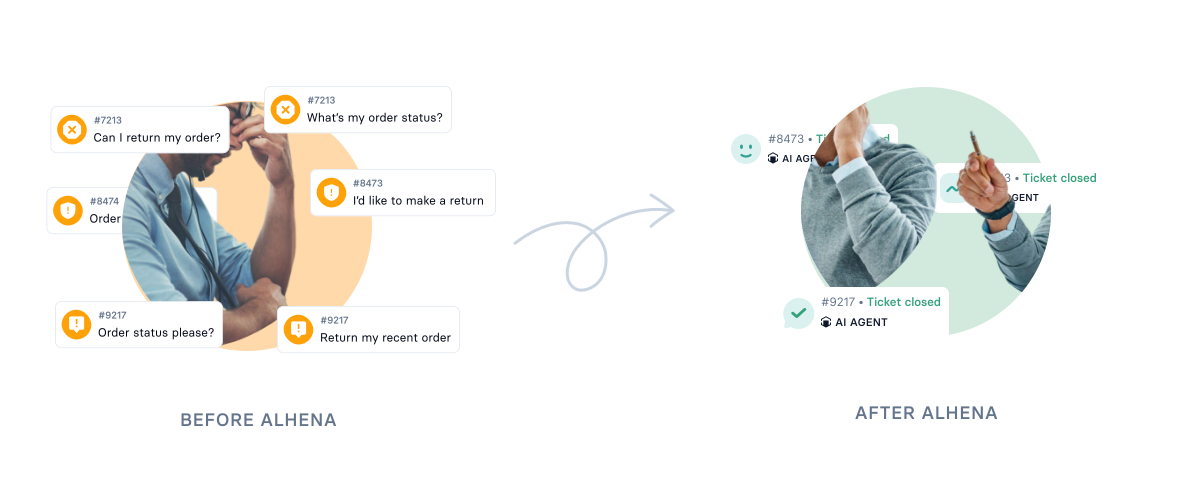
The Support Concierge handles the traditional ticket work in parallel, so you get both revenue and resolution from a single platform. The brands capturing that demand aren't running support chatbots. They're running shopping assistants.
Support as a Revenue Channel: Real Results
The shift from cost-center support to revenue-driving AI isn't theoretical. Ecommerce brands are already seeing measurable returns.
Tatcha, the Unilever-owned skincare brand, deployed Alhena AI and saw 11.4% of total site revenue come directly from AI-powered conversations. Those aren't ticket deflection metrics. That's new revenue from shoppers who got personalized product guidance through chat.
Manawa, a travel and experience marketplace, cut their support workload by 43% while reducing response times from 40 minutes to under 1 minute. They automated 80% of inquiries without sacrificing quality, freeing agents to focus on high-value bookings.
Crocus achieved an 86% deflection rate with 84% CSAT, proving that automation and customer satisfaction aren't mutually exclusive when the AI is grounded in accurate product data.
Making the Switch: What to Expect
Migrating from Gorgias to a new platform doesn't have to be a months-long project. Here's what the process typically starts from data export, integration setup, AI training, Parallel running and then Team training.
If you're not ready for a full migration, tools like Alhena AI can layer on top of your existing Gorgias setup, adding AI shopping assistant and agent assist capabilities without replacing your helpdesk. You get the revenue upside while keeping your current workflows intact.
Ready to see how AI can turn your support conversations into revenue? Book a demo with Alhena AI or start for free with 25 conversations to experience the difference between a helpdesk and an AI commerce platform.

Frequently Asked Questions
Can I use Alhena AI without replacing Gorgias?
Yes. Alhena AI integrates directly with Gorgias as an AI layer on top of your existing helpdesk. You keep your current Gorgias workflows for ticket management while Alhena adds AI-powered shopping assistance, guided selling, and autonomous order handling. Most brands go live with this setup in under 48 hours.
How does Alhena AI compare to Gorgias Automate?
Gorgias Automate focuses on deflecting support tickets, resolving up to 60% of Tier-1 queries. Alhena AI goes further by actively selling through conversations with product recommendations, interactive quizzes, and agentic checkout. Tatcha saw 11.4% of total site revenue come from Alhena AI conversations, a metric Gorgias Automate is not designed to deliver.
Does Alhena AI work with Shopify, WooCommerce, and Magento?
Yes. Alhena AI integrates natively with Shopify, WooCommerce, Magento, BigCommerce, and Salesforce Commerce Cloud. It also connects with helpdesks like Zendesk, Freshdesk, Gorgias, Intercom, and Kustomer. The platform pulls product catalog, order, and customer data from your ecommerce stack to power accurate, hallucination-free AI responses.
What is the best help desk software for Shopify stores that need omnichannel support?
For Shopify-native omnichannel support, Gorgias remains strong with its deep Shopify integration, but its ticket system pricing becomes a bottleneck at scale. Re:amaze is the closest direct alternative with native Shopify and BigCommerce connections and built-in live chat, email, social, and SMS support from a single dashboard. Gladly offers true omnichannel coverage including voice, chat, and WhatsApp from one unified customer view, though at a steep $180 per agent per month. If you want AI-driven omnichannel capabilities across web chat, email, Instagram DMs, and WhatsApp without replacing your current helpdesk, Alhena AI layers on top of your existing Shopify stack and connects across every channel.
How do chatbots and AI agents differ in ecommerce customer service?
Traditional chatbots follow scripted, rule-based flows. They can handle repetitive questions like "what's your return policy?" but break down when a shopper asks something outside the predefined decision tree. An AI agent, by contrast, understands intent, pulls from your product catalog in real time, and can execute multi-step actions like processing a return, recommending a replacement, and adding it to the cart in a single conversation. Gorgias offers basic bot automation that deflects Tier-1 support tickets. Platforms like Intercom (with Fin AI) and Alhena AI go further with fully autonomous AI agents that resolve complex queries end-to-end without human intervention, turning customer service into a self-service experience that also drives revenue.
What should ecommerce leaders look for in a customer service platform's automation capabilities?
Decision-makers evaluating automation should assess three layers. First, rule-based automation. Second, AI-powered self-service. Third, revenue automation. This is where AI-first platforms like Alhena AI separate from traditional helpdesk software. Track deflection rate, resolution time, CSAT, and revenue attribution to measure the true ROI of your automation investment.
How do I evaluate the real cost of a ticket system versus per-agent or per-conversation pricing?
The true cost of your helpdesk depends on your support volume and growth trajectory. Gorgias's ticket-based pricing seems affordable at lower volumes but scales linearly with every customer inquiry, meaning a successful product launch or viral moment can spike your bill overnight. Per-agent models like Zendesk, Freshdesk, and Kustomer keep costs stable regardless of ticket volume, but become expensive as you add seats. Per-conversation pricing, used by Alhena AI, aligns cost with actual AI-handled interactions rather than total ticket volume, so you only pay when the AI resolves something. Also consider the revenue side: if an AI agent is driving conversions through guided selling, the net cost may be negative.