The AI customer service market hit $12.06 billion in 2024 and is racing toward $47.82 billion by 2030. Ecommerce brands are driving much of that growth, and for good reason: AI slashes the average cost per interaction by 68% while keeping customers happy. But not every AI tool is built for ecommerce. Freshdesk's Freddy AI handles ticket deflection and agent productivity well for general support teams, yet it wasn't designed to drive revenue, recommend products, or close sales inside a chat window.
If you're running an online store and Freddy AI feels like it's capping your potential, you're not alone. This guide breaks down the seven best Freshdesk Freddy AI alternatives for ecommerce in 2026, comparing each on the features that actually matter for online retailers: commerce platform integrations, revenue attribution, pricing predictability, and time to value.
Why Ecommerce Brands Outgrow Freshdesk Freddy AI
Freshdesk is a strong general-purpose helpdesk within the Freshworks CRM ecosystem. It works for IT teams, SaaS companies, and service businesses. But ecommerce has unique requirements that Freddy AI simply wasn't built to handle.
The biggest gap is revenue. Freddy AI measures success in tickets deflected and agent hours saved. It doesn't track whether a chat interaction led to a purchase, an upsell, or a recovered cart. For ecommerce brands where 69% of retailers report revenue increases tied directly to AI, that blind spot is costly.
Then there's the integration depth. Most Freshdesk ecommerce integrations are read-only. Your agents can see order data, but they can't process refunds, cancel orders, or check live inventory from within the platform. Freddy AI also only replies to the first message in an email thread, a real limitation that causes issues when ecommerce support conversations often span multiple exchanges.
Pricing adds another layer of friction. Freddy AI Agent charges roughly $49 per 100 sessions across its paid plans, and the auto-recharge feature can trigger surprise bills during peak seasons like Black Friday or holiday sales. There's no sandbox to test Freddy AI against historical tickets before going live, so you're essentially guessing at ROI until you're already paying.
What to Look for in a AI tool
Before comparing tools, it helps to know which criteria will help you choose the right fit. These factors separate ecommerce-ready AI from generic helpdesk AI. Here's what matters most:
- Commerce platform integration depth: Can the AI execute actions like refunds, cancellations, and inventory checks? Or does it just display order data?
- Revenue attribution: Does the tool track conversions, average order value (AOV) uplift, and revenue generated through AI interactions?
- Product catalog intelligence: Can it recommend products based on real catalog data, customer history, and browsing behavior?
- Omnichannel coverage: Does it support chat, email, social DMs, WhatsApp, and voice from a single platform?
- Pricing predictability: Will costs spike during peak seasons, or is the pricing model transparent and scalable?
- Time to value: How quickly can you go from sign-up to live AI handling real customer conversations?
- Hallucination control: Does the AI ground responses in verified product data, or can it fabricate answers that mislead shoppers?
With these criteria in mind, let's look at the seven best alternatives.
Freshdesk Freddy AI vs Top Alternatives: At a Glance
| Freddy AI | Alhena AI | Gorgias AI | |
|---|---|---|---|
| Built for | General helpdesk | Ecommerce sales + support | Ecommerce support |
| Revenue Attribution | No | Yes, built-in | Partial |
| Agentic Checkout | No | Yes | No |
| Commerce Actions | Read-only | Full (refunds, orders, inventory) | Full (refunds, orders, returns) |
| Setup Time | Days to weeks | Under 48 hours | 1-3 weeks |
| Channels | Chat, email, phone | Chat, email, social, WhatsApp, voice | Chat, email, social, SMS |
| Pricing Model | Per agent + per session | Per conversation | Per ticket + per AI resolution |
| G2 Rating | 4.5/5 | 4.9/5 | 4.6/5 |
7 Best Freshdesk Freddy AI Alternatives for Ecommerce
1. Alhena AI: Best for Revenue-Driven Ecommerce Support
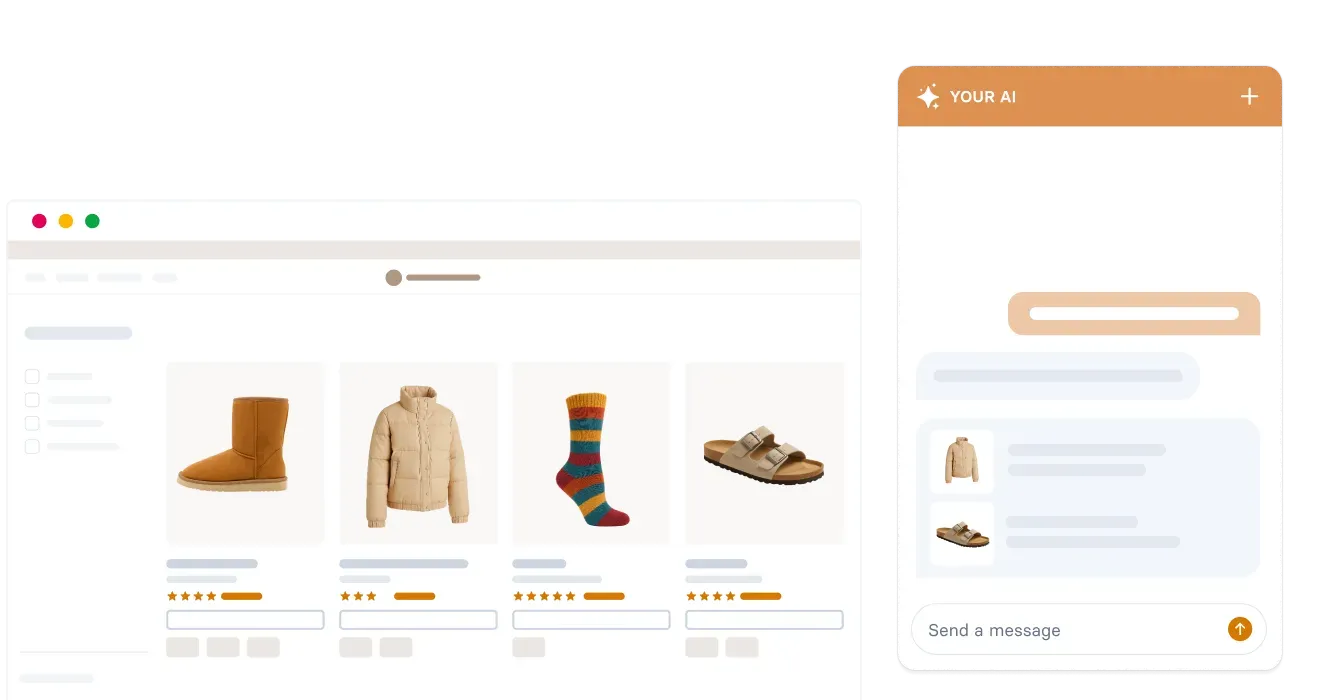
Alhena AI is purpose-built for ecommerce. Where Freddy AI stops at deflecting tickets, Alhena turns every customer interaction into a potential sale. It combines two specialized agents: a Support Concierge that automates L1 queries with hallucination-free answers, and a Product Expert Agent that recommends products, answers detailed product questions, and guides shoppers toward checkout.
The revenue numbers speak for themselves. Tatcha (Unilever) saw 3x conversion rates, a 38% AOV uplift, and 11.4% of total site revenue attributed to AI after deploying Alhena. Puffy hit 90% CSAT with 63% automated resolution, and Victoria Beckham achieved a 20% AOV increase.
Alhena's Agent Assist gives human agents real-time summaries, sentiment analysis, and suggested responses when conversations need a personal touch. The platform covers every channel: web chat, email, Instagram DMs, WhatsApp, and voice. It integrates natively with major platforms including Shopify, WooCommerce, Magento, Salesforce Commerce Cloud, and helpdesks like Freshdesk, Zendesk, and Gorgias.
Setup takes under 48 hours with no dev resources. Alhena uses an agentic checkout system that populates carts and pre-fills checkout for shoppers, a feature no other tool on this list offers. The built-in revenue attribution analytics dashboard lets you measure exactly how much AI-driven revenue flows through your store.
Pricing: Usage-based per conversation. Free tier with 25 conversations. View pricing details.
G2 Rating: 4.9/5 (36 reviews)
Best for: Ecommerce brands that want AI to drive sales, not just cut support costs.
2. Gorgias AI: Best for Shopify-Native Helpdesk
Gorgias is the most ecommerce-native helpdesk on the market, used by over 15,000 online stores. Its AI Agent 2.0 includes a Shopping Assistant for pre-sale engagement and a Support Agent for post-purchase automation. The platform can process refunds, cancel orders, and initiate returns directly within conversations.
Gorgias recently added intent-based discounting, where its AI offers timely coupons based on shopper behavior. That's a meaningful step toward revenue generation. The ticket-based pricing model (starting at $10/month for 50 tickets) means unlimited agents, which is appealing for growing teams.
The trade-off: AI Agent adds $0.90 per resolved conversation on top of your helpdesk fee. Some users report a three-week setup period before AI works properly, and phone/SMS support costs extra.
Pricing: $10 to $900/month (ticket-based) + $0.90/AI resolution
G2 Rating: 4.6/5 (800+ reviews)
Best for: Shopify brands wanting a combined helpdesk and AI agent with deep commerce integrations.
3. Zendesk AI: Best for Enterprise-Scale Support
Zendesk needs no introduction. With over two decades in customer service, it offers a mature omnichannel workspace and 1,500+ integrations. Its Advanced AI add-on includes AI-powered ticket routing, an AI Agent for automated responses, and Agent Copilot for drafting replies.
For ecommerce, the limitations are familiar. Zendesk's AI was trained on billions of general support interactions, not ecommerce-specific ones. The Shopify integration shows basic order info but can't take actions like starting a return. Each conversation is treated as standalone, with no memory across interactions.
Cost is the other consideration. Suite Professional runs $115/agent/month, and Advanced AI adds $50/agent/month on top of that. Automated resolutions cost $1.50 to $2.00 each. For a mid-size ecommerce team, you're looking at $200+ per agent monthly before AI resolution fees.
Pricing: $115+/agent/month + $50 AI add-on + per-resolution fees
G2 Rating: 4.3/5
Best for: Large enterprises that need a proven, full-featured support platform and can absorb the cost.
4. Intercom Fin AI: Best for Proactive Messaging
Intercom's Fin AI agent has resolved over 40 million conversations with a reported 67% resolution rate. It draws from connected knowledge bases and handles chat, email, social, and WhatsApp. Intercom also excels at proactive messaging, letting you trigger in-app messages, product tours, and onboarding flows.
The ecommerce fit is partial. Fin operates like a fast librarian: it's great at finding information, but it can't guide customers toward purchase decisions the way a sales-trained AI can. It counts "assumed resolutions" when customers simply stop responding, which inflates success metrics. At $0.99 per resolution plus base seat costs ($29 to $132/seat/month), costs balloon during high-traffic periods.
Pricing: $29 to $132/seat/month + $0.99/resolution
G2 Rating: 4.5/5 (3,500+ reviews)
Best for: SaaS and ecommerce brands that value proactive customer engagement and product-led onboarding.
5. Tidio AI (Lyro): Best for Small Ecommerce Stores
Tidio's Lyro AI automates up to 67% of customer queries and integrates smoothly with Shopify. It handles product recommendations using store data, supports live chat with AI-to-human handoff, and covers Facebook Messenger, Instagram, and WhatsApp. For small stores handling fewer than 100 conversations per month, Tidio offers solid value at an accessible price point.
The catch: Lyro AI and Tidio's rule-based Flows are completely disconnected. A customer interacting with a Flow can't be handed to the AI agent mid-conversation. Lyro also can't learn from past agent conversations, only from knowledge base articles. And the pricing gets confusing, since Lyro and Flows are billed separately, often doubling your total cost.
Pricing: $29/month (50 conversations), Lyro AI from $39/month (100 conversations)
G2 Rating: 4.6/5 (600+ reviews)
Best for: Small to mid-size Shopify stores looking for affordable AI chat automation.
6. Ada AI: Best for Enterprise Automation Volume
Ada targets large enterprises with its "Reasoning Engine" combining NLP and large language models. It automates 70% to 83% of conversations across chat, email, voice, and social messaging. Custom Playbooks let you build complex multi-step workflows, and the platform integrates with Zendesk, Salesforce, and Shopify.
Ada can process refunds, track orders, and recommend products, solid ecommerce capabilities. But the pricing is strictly enterprise. No public pricing exists, and reported costs exceed $300,000 per year for roughly 150,000 monthly tickets. The Playbooks require significant time and expertise to build, and some users report chatbot loops and inconsistent responses. Ada's Trustpilot score (1.9/5) contrasts sharply with its G2 rating (4.6/5), which is worth investigating before committing.
Pricing: Custom enterprise quotes only (reported $300K+/year)
G2 Rating: 4.6/5 | Trustpilot: 1.9/5
Best for: Large retailers processing 100K+ tickets/month who need high automation rates.
7. Help Scout AI: Best for Human-First Small Teams
Help Scout takes a human-centric approach to customer support. Its AI Answers feature deflects common questions through the Beacon widget, AI Drafts helps agents write faster responses, and AI Summarize provides ticket context at a glance. The recent shift to contact-based pricing (not per-agent) means unlimited users on every plan.
For ecommerce, Help Scout is limited. AI Answers only learns from knowledge base articles, not from past support tickets. There's no native WhatsApp or voice support, no chatbot builder for custom flows, and no ecommerce-specific reporting. It's a clean, simple tool, but if you need AI that sells, recommends products, or tracks revenue, you'll hit a ceiling quickly.
Pricing: Free to $75/month (contact-based) + $0.75/AI resolution
G2 Rating: 4.4/5 (400+ reviews)
Best for: Small teams that prioritize personal, human-feeling support over heavy automation.
How These Alternatives Compare on Ecommerce Features
Different stores have different needs. The right choice depends on your store's size, budget, and whether you want AI that reduces costs, generates revenue, or both. Here's how the seven alternatives stack up on the features that matter most for ecommerce:
- Revenue attribution: Only Alhena AI offers built-in revenue tracking that ties AI conversations to actual sales. Gorgias is moving in this direction with its Shopping Assistant, but the analytics aren't as granular.
- Agentic checkout: Alhena AI is the only tool that populates carts and pre-fills checkout directly from the chat. No other alternative on this list does this.
- Commerce action depth: Alhena and Gorgias lead here, with the ability to process refunds, modify orders, and check live inventory. Zendesk and Intercom show order data but can't take action. Tidio, Ada, and Help Scout fall somewhere in between.
- Omnichannel coverage: Alhena, Zendesk, and Intercom cover the most channels. Gorgias and Tidio have solid but narrower channel support. Help Scout lacks WhatsApp and voice entirely.
- Pricing predictability: Alhena's per-conversation model and Gorgias' ticket-based pricing are the most transparent. Intercom's per-resolution model and Zendesk's layered add-ons create the most unpredictable bills.
For ecommerce brands that care about turning support into a revenue channel, Alhena AI and Gorgias are the clear frontrunners. The difference: Alhena was built for ecommerce sales from day one, while Gorgias added sales features on top of a helpdesk foundation.
Key Takeaways
- Freshdesk Freddy AI is a capable general-purpose AI, but it lacks ecommerce-specific features like revenue attribution, agentic checkout, and deep commerce platform actions.
- Alhena AI is the strongest alternative for ecommerce brands that want AI to drive sales, with proven results (3x conversions at Tatcha, 90% CSAT at Puffy) and a 48-hour deployment timeline.
- Gorgias is the best pick if you want a Shopify-native helpdesk with growing AI sales features.
- Zendesk and Intercom suit enterprises that prioritize scale and omnichannel reach over ecommerce specialization.
- Tidio and Help Scout work well for smaller stores with simpler needs and tighter budgets.
- The most important question isn't "which tool deflects the most tickets?" It's "which tool makes me the most money?"
Ready to see how AI can turn your ecommerce support into a revenue channel? Book a demo with Alhena AI or start free with 25 conversations.

Frequently Asked Questions
Can I use Alhena AI on top of Freshdesk without replacing the entire helpdesk?
Yes. Several Freddy AI alternatives work as an automation layer that plugs directly into your existing Freshdesk ecosystem. Alhena AI, Tidio, and Ada all integrate with Freshdesk as the underlying ticket system while replacing Freddy as the AI agent handling customer-facing conversations. This setup lets you keep your current helpdesk workflows, knowledge base, triage rules, and agent workspace intact while upgrading the AI that powers chat, email, and self-service automation. Alhena AI even syncs resolution data back to Freshdesk tickets so your reporting stays unified across the service platform.
How does Freshdesk Freddy AI pricing compare to Alhena's usage-based during peak ecommerce seasons?
Freddy AI Agent uses a session-based price model where Freshworks charges roughly $100 per 1,000 sessions on Pro and Enterprise plans. The auto-recharge feature means your bill can spike without warning during Black Friday or holiday surges. Usage-based alternatives like Alhena AI charge per conversation with no surprise auto-recharge, making costs predictable even when ticket volume doubles. For a mid-size ecommerce brand processing 5,000 to 10,000 monthly interactions, the total cost difference between Freddy's session model and a flat per-conversation model can reach 30 to 50 percent during high-traffic months.
What's the difference between an AI agent that deflects tickets and one that drives ecommerce revenue?
A deflection-focused AI tool like Freddy AI or Help Scout AI measures success by how many tickets it resolves without a human agent touching them. It answers FAQs, routes queries, and reduces support workload. A revenue-focused AI agent goes further by recommending products, guiding shoppers through purchase decisions, populating carts through agentic checkout, and tracking exactly how much revenue each AI interaction generates. Alhena AI is the only tool on this list with built-in revenue attribution that ties chat conversations to actual sales, AOV uplift, and conversion rate changes. The difference matters because 69 percent of retailers already report revenue increases from AI, yet most helpdesk AI tools can't measure or drive that impact.