AI chatbots deliver two distinct categories of benefit: they remove customer service cost, and they add revenue. On live ecommerce deployments, the support side shows up as 80–86% of routine inquiries resolved without an agent, and replies arriving in seconds rather than tens of minutes. The revenue side shows up as higher conversion and larger baskets — up to 3x conversion and 38% higher average order value. Most published "benefits of chatbots" articles only count the first category.
Every number here comes from a named deployment
No industry averages, no vendor surveys.
| Brand | What was measured | Result |
|---|---|---|
| Tatcha | Conversion rate vs. site average | 3x |
| Tatcha | Average order value | +38% |
| Tatcha | Share of site revenue influenced | 11.4% |
| Tatcha | Deflection / CSAT | 82% / 81% |
| Crocus | Deflection / customer satisfaction | 86% / 84% |
| Crocus | Reopen rate | 3.7% |
| Victoria Beckham | Average order value | +20% |
| Victoria Beckham | Online sales revenue | +10% |
| Manawa | Average reply time | 40 min → 1 min |
| Manawa | Inquiries automated | 80% |
Sources: Tatcha, Crocus and Victoria Beckham case studies.
What an AI chatbot is
An AI chatbot is software that interprets a customer's question in natural language and answers it without a script. Unlike rule-based bots, which match keywords to pre-written replies, an AI chatbot reads intent and generates an answer. The commercially useful ones are connected to live systems — product catalog, order management, help desk — so answers reflect real inventory and real order state rather than a static knowledge base.
Two pieces of artificial intelligence do the work. Natural language processing turns messy human phrasing into structured intent, so "my parcel never showed up" and "where is my order" land in the same place. Machine learning then sharpens that match over time, treating resolved interactions as training signal. You will see the same AI technology sold as an AI bot, a virtual assistant, a conversational AI platform or an AI agent. The labels move around. The test does not: does it read intent, and can it act on what it reads?
That second half is the whole difference. A bot grounded in nothing is a search box with worse manners — fluent, confident, and no more useful than the site search it replaced.
Support-side benefits
1. Routine volume stops reaching your agents
Deflection is the share of customer inquiries an AI resolves with no human agent involved. Published ecommerce deployments land between 80% and 86%. Crocus reached 86% self-service resolution while holding 84% customer satisfaction and a 3.7% reopen rate — the last number matters most, because deflection without a low reopen rate just means customers gave up.
Order status, return windows, shipping timelines and password resets are structurally identical every time they are asked. Handing those queries to software is not a downgrade in service. For that kind of interaction it is an upgrade, because the response arrives in seconds instead of hours, and the customer never has to wait for someone to become available.
The trap is measuring deflection alone. A bot that closes interactions aggressively posts a beautiful deflection number and a terrible reopen rate. Ask any vendor for both, plus the transfer rate to a person, before you believe the headline.
2. Response time collapses
Manawa, a travel and activities marketplace, cut average response time from 40 minutes to 1 minute while automating 80% of inquiries — without adding headcount.
Speed is the benefit customers actually feel. Nobody has ever praised a brand for its deflection rate, but plenty of people will forgive a policy they dislike if someone responds to them straight away.
3. Coverage does not depend on staffing
An AI assistant answers at 2am on a Sunday exactly as it does at 10am on a Tuesday, across multiple languages, at any concurrent volume, on every channel you run.
This matters most in two situations: international customers in timezones you do not staff, and demand spikes during promotions or seasonal peaks, when queue times normally blow out. Both are periods when a slow answer costs a sale rather than just annoying someone. It also means the customer experience stays identical whether someone reaches you through the website, WhatsApp or voice.
4. Agents get their difficult work back
When routine tickets stop arriving, your agents get their time back for the cases that need judgment — angry customers, edge-case policy calls, anything with a real decision in it.
Agent Assist streamlines the middle ground: the AI drafts a reply, the agent edits it, and the system treats that edit as feedback and improves. The human agent stays accountable for the answer and stops retyping the same paragraph forty times a week.
Revenue-side benefits
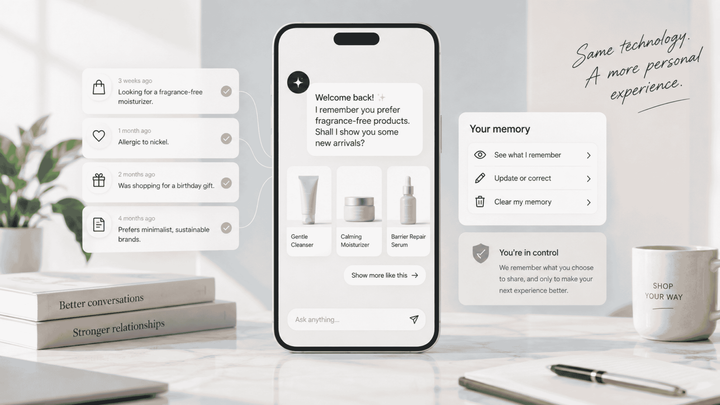
This is the half most "benefits of chatbots" articles skip, because most chatbots cannot do it. Shoppers who engage with an AI mid-session behave differently from shoppers browsing alone, and personalized answers are what changes the behaviour.
5. Shoppers who ask questions convert better
Tatcha recorded a 3x conversion rate on AI-assisted conversations versus their site average, with 11.4% of total site revenue attributed to those conversations.
A shopper asking "will this work on sensitive skin" is showing purchase intent. Engagement at that moment, with a genuinely relevant product, is closer to sales than to customer support.
6. Baskets get bigger
Tatcha saw a 38% increase in average order value from personalized recommendations. Victoria Beckham saw 20%, alongside a 10% lift in online sales revenue.
The mechanism is guided discovery, not upselling. When the AI understands what the shopper is solving for, personalization stops being a rail of vaguely related items and becomes a relevant answer to the question they actually asked. That is why personalized suggestions inside a conversation outperform the same products shown on a product page.
7. The AI can complete the action, not just describe it
The gap between an AI that explains your return policy and one that generates the return label is the gap between deflecting a ticket and resolving a customer's problem.
Action-taking covers adding to cart, pre-filling checkout, tracking an order, processing a return, pausing a subscription, changing a delivery address. Each requires live system access, identity verification and a policy check — which is why most chatbots stop at describing.
8. You find out what your customers actually ask
Every interaction is a record of a question your site failed to answer. In aggregate, that is the highest-quality product and customer experience insight most brands never collect.
Recurring queries about fit, ingredients or compatibility are gaps in your product pages. Recurring queries about shipping are a gap in your policy page. Support volume is a map of how customers interact with you and where that breaks down, and the insight is effectively free, because you are already paying to collect it.
What AI chatbots don't do well
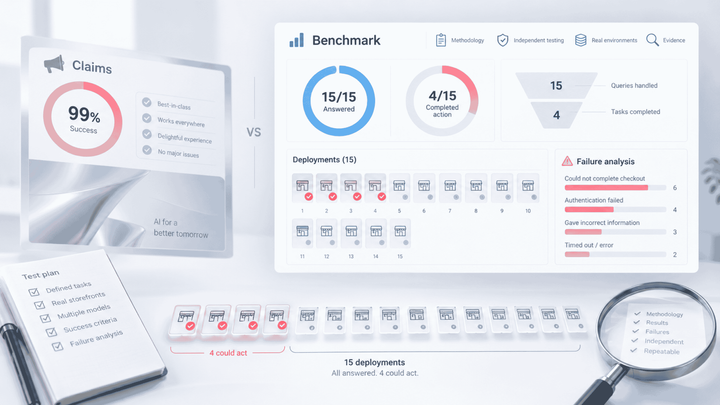
In 2026 Alhena ran a stress test of 15 live AI agents — one continuous conversation each, memory tested at three tiers, eight dimensions, nothing inferred from marketing material. Two failure modes were common enough to be structural.
One continuous interaction per agent, memory tested at three tiers, eight dimensions. Read the full methodology.
Catalogue dumping (5 of 15 agents)
Asked for a recommendation with a constraint, the agent returned bestsellers. It is retrieval plus ranking rather than reasoning, so the shopper's actual constraint has nowhere to go. Nothing about the output is intelligent, however fluent the sentences around it are.
The handoff cliff (4 of 15 agents)
The agent escalated to a human agent without passing context, so the customer repeated themselves from the top. Escalating is a strength. Escalating with amnesia is worse than having no AI at all, because the customer ends up with a worse user experience than plain human interaction would have given them.
Hallucination is a real risk on any ungrounded system
A fluent, confident, wrong answer about an ingredient, a refund status or an order can cost more than the ticket it saved. The mitigation is architectural — grounding every response in verified catalog and policy data, and refusing rather than guessing — not a better prompt.
Emotional and complex cases still need a person
A customer whose order matters for a specific date, or who is already angry, is not a deflection opportunity. Complex judgment calls are exactly the work you freed your agents up to do.
What is not a benefit of an AI chatbot
Three things get claimed as benefits and are not.
- Replacing your support team. Headcount reduction is a possible consequence of automation, not a benefit of the technology. Teams that redeploy agents to complex work and retention outperform teams that cut.
- Deflection as an end in itself. Self-service with a high reopen rate means customers abandoned the channel, not that they were helped. An automated bad response just reaches the customer faster.
- Instant results with no setup. An AI chatbot is only as good as the catalog, policies and help desk history it is connected to. Bad knowledge in, confident nonsense out.
What to measure
Instrument these before you launch, not after.
- Deflection rate and reopen rate — always together, never alone
- Transfer rate, and whether context survives the handover to a person
- Customer satisfaction on AI-handled interactions specifically, split out from your overall CSAT
- Average reply time, first response and full resolution
- Conversion rate and AOV on AI-assisted sessions versus site average
- Revenue attributed to AI interactions — if the platform cannot report this, you are measuring half the value
Conversion lift and attributed revenue are where the case for the investment usually gets made, and they are the two things most customer service tools cannot produce. Run your own numbers here.
Which benefits apply to your business
Ecommerce and DTC
Both halves apply, and the revenue half usually dominates. Pre-purchase questions, sizing and fit, order tracking, returns, subscription changes. If you are at the vendor-comparison stage, this breakdown of 16 ecommerce AI agents covers the field.
SaaS and B2B
The support half dominates. Onboarding questions, documentation retrieval, escalation with context intact. Tier-one troubleshooting is the clearest win, because it streamlines the repetitive half of the queue without touching the cases your engineers actually need to see.
Internal HR and IT helpdesks
The same technology works on employee-facing queries, and the economics are often better because HR and IT teams are smaller relative to the volume they absorb. Policy lookups, leave balances, onboarding paperwork and password resets are the highest-volume interactions in most internal helpdesks.
High-volume, low-complexity support
Deflection is the headline benefit and the ROI case is straightforward. The only real question is how much of that volume you can safely automate before accuracy starts to slip.
Low-volume, high-complexity support
The case is weakest here. If most of your tickets need judgment, agent assist is a better fit than customer-facing automation.
Frequently asked questions
Two categories. On support: 80–86% of routine inquiries resolved with no human agent, replies measured in seconds, and coverage across timezones and languages without extra staffing. On revenue: higher conversion on assisted sessions (3x for Tatcha) and larger orders (+38% Tatcha, +20% Victoria Beckham). Which category matters more depends on whether your volume is mostly pre-purchase or post-purchase.
Rule-based bots match keywords to scripts, so anything phrased unexpectedly fails. An AI bot built on natural language processing reads intent and generates an answer, which means it handles the long tail of real customer phrasing. The practical difference shows up in containment: rule-based bots deflect the questions you anticipated, AI deflects the ones you did not.
Live chat routes a question to a person and inherits that person's queue, hours and capacity. An AI chatbot responds immediately, at any volume, in any supported language, and escalates the cases that need judgment. The two are not alternatives — the strong setup is AI first, with a clean handoff into live chat.
Eliminating your team, deflection treated as a standalone metric, and instant value with no knowledge base setup. Automation without accurate grounding just produces wrong answers more quickly. See the section above for why each one fails.
Natural language processing, usually shortened to NLP, converts free-text phrasing into structured intent, so wording that has nothing in common lands on the same request. Machine learning refines that mapping using resolved interactions and agent feedback. Grounding then constrains the answer to your verified catalog and policies, which is what separates a useful assistant from a fluent guesser.
Ecommerce is the one category where the revenue side is measurable. A shopper asking a product question is inside a buying session, so conversion and AOV on assisted sessions can be compared directly against site average. In most other categories you can only measure cost avoided.
Deployment is the short part — Alhena connects to an existing catalog and help desk history in under 48 hours. The measurable part depends on your volume: high-traffic stores see a readable deflection number within two weeks, and a readable conversion signal within a full purchase cycle.
It depends which half of the value you can capture. Support-only deployments justify themselves on tickets deflected against cost per ticket. Ecommerce deployments have a second line — Tatcha attributes 11.4% of total site revenue to AI conversations, which changes the arithmetic entirely. Model both before you compare vendors on price per resolution.
Yes, and it is one of the clearer benefits for anyone selling internationally. A single knowledge base serves every market, so answers stay consistent across languages and policy updates propagate everywhere at once, without hiring per timezone.
The useful ones do, and they share context across them. Web chat, email, Instagram DMs, WhatsApp, voice. A customer who starts in a DM and follows up by email three days later should not have to start over, and that continuity is a large part of the user experience benefit.
Run one continuous interaction rather than a series of isolated questions, give it a constraint and see whether it respects it, then force an escalation and check whether context survives. Those two tests alone caught failures in 9 of the 15 agents we stress-tested.
Which benefits can this product actually produce
The benefits of AI chatbots are real and measurable, but they split unevenly. Support benefits are near-universal. Revenue benefits require an AI connected to a live catalog with the ability to act — which most are not.
If you are evaluating, the useful question is not "what are the benefits of AI chatbots." It is "which of these benefits can this specific product actually produce on my catalog, and how would I know?" Ask for the deflection and satisfaction numbers together, ask what happens on the handoff, and ask what insight you get back about the questions your customers keep asking.
See it answer questions on your own catalog
Connected to your products, policies and order data — not a scripted demo environment.
Book a demo Read the 15-agent stress test