U.S. consumers returned products worth $890 billion in 2024, according to the National Retail Federation. That's roughly one in five online purchases sent back. But here's what most return-reduction guides miss: returns don't start at the shipping label. They start at the product page, the moment a shopper can't quite picture how something will look, fit, or work in their life.
That gap between a flat product photo and reality is what retail strategists call the "imagination gap." AR tools can help close it for certain categories, but most ecommerce brands don't need full spatial computing to fix the problem. They need a smarter way to answer questions, show products in context, and guide shoppers to the right item before checkout. This post breaks down where AR fits, where conversational visual AI is enough, and how to reduce returns without overhauling your tech stack.
The Imagination Gap Is a Pre-Purchase Problem
When a customer stares at a 2D image of a sofa and tries to guess whether it'll fit their living room, they're doing mental math with bad inputs. Humans are poor at estimating dimensions, colors on screens rarely match reality, and product descriptions can only do so much. The result: over half of all returns trace back to appearance mismatches (22%) and fit or size issues (35%+), according to a Forrester Consulting study for UPS.
These aren't fulfillment failures or shipping damage. They're confidence failures. The shopper didn't have enough information to buy with certainty, so they bought with hope, and hope doesn't survive unboxing.
The fix isn't just better photos (though those help). It's giving customers a way to ask questions, see products styled for their context, and get honest answers about fit, materials, and compatibility before they click "Add to Cart."
What "Visual AI" Actually Means (and How It Differs from AR)
AR and visual AI get lumped together, but they solve different problems in different ways. Clarity here matters, because the right solution depends on your product category.
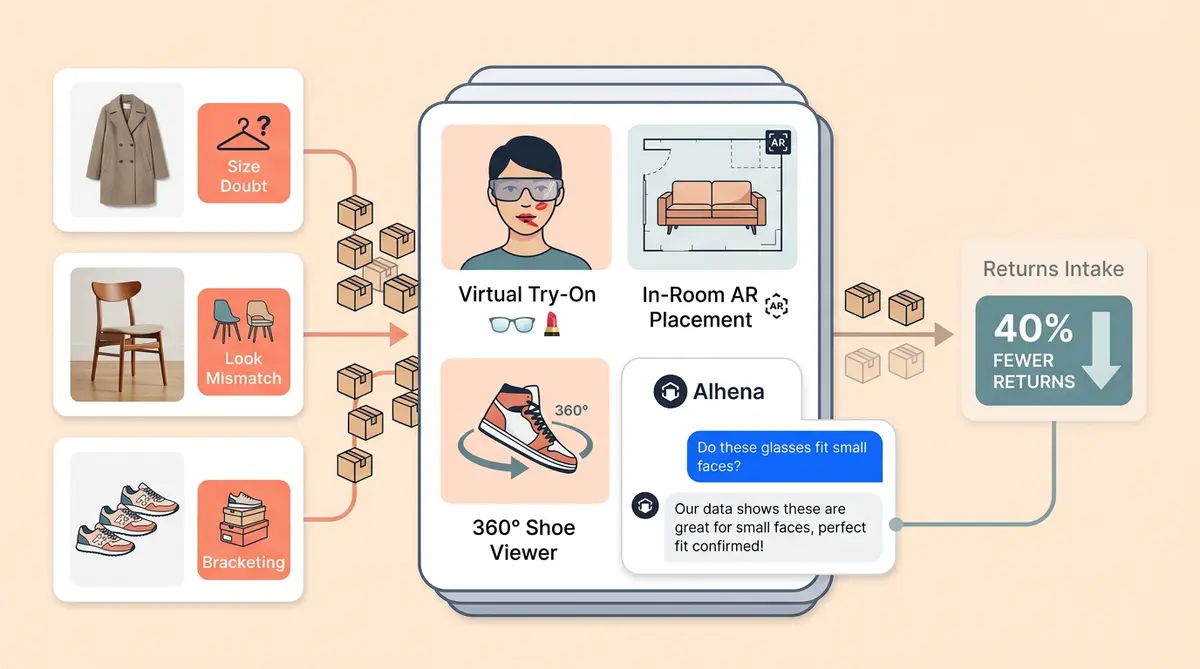
Augmented reality uses a phone's camera to overlay 3D models into a shopper's physical space. Think IKEA Place letting you "put" a bookshelf in your living room. For furniture, large home goods, and spatial products, AR is genuinely powerful. Industry analyses suggest that products with 3D and AR interactions see up to a 40% decrease in returns.
Conversational visual AI takes a different approach. Instead of camera overlays, it works through chat: generating try-on images, building outfit combinations from a product catalog, surfacing image-rich product recommendations, and answering detailed questions about specs, sizing, and materials. It doesn't need a camera or 3D models. It needs a product catalog and a smart agent.
For most e-commerce categories, especially apparel, beauty, electronics, and home accessories, the imagination gap isn't about spatial placement. It's about unanswered questions: "Will this shade match my skin tone?" "Is this fabric see-through?" "Will these headphones fit over glasses?" A conversational assistant that handles those questions with images and verified data closes the gap without requiring a 3D modeling pipeline.
How Pre-Purchase Q&A Reduces Buyer's Regret
Consider the return reasons again. "Product looks different than expected" and "wrong size or fit" account for over half of all returns. Both are information problems, not product problems. The item was fine. The shopper just didn't know enough before buying.
A conversational AI shopping assistant attacks this directly. When a shopper asks "Will this moisturizer work for sensitive, oily skin?" or "What's the inseam on these in a size 32?", they get a grounded, specific answer pulled from verified product data, not a generic FAQ page buried three clicks deep.
This matters for lifetime value, too. Shoppers who get the right product on the first try are more likely to come back. A return isn't just a logistics cost; it's a trust cost. Every wrong item erodes confidence in your business. Every right-first-time purchase builds it.
Tatcha saw a 3x conversion rate and 38% average order value uplift after deploying Alhena AI's Product Expert Agent. That lift didn't come from AR. It came from answering product questions in real time with accurate, catalog-grounded responses, so shoppers bought with confidence instead of uncertainty.
Where AR Wins and Where Conversational Visual AI Is Enough
Not every category needs the same tools. Here's an honest breakdown:
AR is best for spatial products. Furniture, large home goods, and anything where "Will it fit my space?" is the primary question. In-room visualization genuinely prevents the most expensive returns in ecommerce, because shipping a couch back costs $50-$150. If you sell big-ticket spatial products, invest in 3D/AR for your top SKUs.
Conversational visual AI is best for fit, style, and spec questions. Fashion and apparel, beauty and skincare, electronics, and accessories all have high return rates driven by unanswered questions, not spatial uncertainty. A shopper doesn't need to "place" a lipstick in their bathroom. They need to know if the shade works for their complexion.
Most brands need both approaches, but can start with one. Conversational AI solutions deploy in days and cover the broadest set of return causes. AR requires 3D asset creation and works best for specific high-return categories. Start where the data points: check your return reasons by category and invest accordingly.
How Alhena AI Helps Ecommerce Brands Reduce Returns
Alhena AI is purpose-built for ecommerce, not general support. Its agents work together to close the imagination gap at every stage of the shopper journey.
The Product Expert Agent is trained on your full product catalog: specifications, sizing data, materials, compatibility notes, and customer reviews. When a shopper asks a question, it gives a hallucination-free answer grounded in verified data. No guessing, no generic responses. This is the single biggest lever for preventing "looked different than expected" returns, because the shopper gets specifics before buying.
Alhena's AI Shopping Assistant goes beyond Q&A. It asks clarifying questions to understand what the shopper actually needs, then recommends products that match, complete with image-rich product cards in the chat. Instead of browsing 200 products and guessing, the shopper sees 3-5 curated options with the context to choose correctly.
After the sale, Alhena's Order Management Agent handles order lookups, tracking, exchange requests, and return processing. Fast, accurate post-purchase support can turn a potential return into an exchange or store credit, protecting revenue while keeping the customer happy. Puffy achieved 63% automated inquiry resolution and 90% CSAT with this approach.
The assistant also supports agentic checkout: it populates carts, pre-fills checkout fields, and confirms product details before the shopper completes the purchase. That last confirmation step catches mismatches (wrong color, wrong size) before they become returns.
Implementing Without Dev Resources
One reason return-reduction projects stall is complexity. AR implementations can take 2-3 months and require 3D asset pipelines. Conversational AI doesn't have that barrier.
Alhena's chat widget installs via a script tag, the Shopify app, or native integrations with WooCommerce, Salesforce Commerce Cloud, and Magento. Deployment takes under 48 hours with no developer resources. The Product Expert Agent activates automatically once your ecommerce platform is connected, pulling catalog data, product specs, and inventory in real time.
Tuning happens through the Alhena dashboard: set guidelines for tone and brand voice, add FAQs, boost specific products, and review conversation analytics. No code, no custom front-end builds.
For brands that want to layer in AR later, the roadmap is straightforward. Start with conversational AI to cover the broadest return causes (fit, specs, compatibility). Then introduce 3D/AR for your highest-return spatial categories using your return data to prioritize which SKUs get 3D treatment first.
Measuring the Impact
You can't improve what you don't measure. Alhena's built-in Revenue Impact analytics attribute assisted purchases directly, showing which conversations led to conversions and how much revenue the AI influenced.
Victoria Beckham saw a 20% AOV increase through AI-assisted shopping. Crocus achieved an 86% deflection rate with 84% CSAT, meaning fewer tickets and happier customers. These metrics tie directly to return prevention: when shoppers get better guidance, they buy better products.
Return-rate impact specifically requires merchant-side measurement. Track return rates by product category before and after deploying conversational AI. Use Alhena's ROI calculator to model the revenue impact. For context, processing a single return costs retailers 20-65% of the item's price. Even a modest reduction in return rate translates to significant margin recovery.
Key Takeaways
- Ecommerce returns cost U.S. retailers $890 billion in 2024, with the online return rate near 20%.
- Over half of returns stem from appearance mismatches and fit/size issues, both information problems that can be solved before checkout.
- Industry data suggests AR interactions reduce returns by up to 40%, but AR is most effective for spatial products like furniture.
- For most ecommerce categories, conversational visual AI that answers product questions and shows image-rich recommendations is the faster, broader solution.
- Alhena AI's Product Expert Agent gives shoppers hallucination-free, catalog-grounded answers that build purchase confidence and reduce buyer's regret.
- Deployment takes under 48 hours with no dev resources. Start with conversational AI, then layer in AR for high-return spatial categories.
Ready to close the imagination gap and reduce returns? Book a demo with Alhena AI or start for free with 25 conversations.
Frequently Asked Questions
What is the imagination gap in ecommerce?
The imagination gap is the disconnect between a 2D product image on screen and how that item actually looks, fits, or functions in a shopper's life. Humans are poor at estimating dimensions and colors from photos alone. Over 57% of returns trace back to appearance mismatches and fit issues caused by this gap. Visual AI and conversational shopping assistants help close it by giving shoppers better information before purchase.
How much can AR reduce ecommerce return rates?
Industry data suggests products with 3D and AR interactions see up to a 40% decrease in returns, according to analyses cited by Linnworks and attributed to Shopify. This stat applies primarily to spatial products like furniture and home goods where in-room visualization helps shoppers confirm fit. Results vary by category and implementation.
Can AI shopping assistants reduce returns without AR?
Yes. Most returns stem from unanswered questions about fit, materials, compatibility, and appearance. An AI shopping assistant like Alhena AI answers those questions in real time using verified catalog data, guides shoppers to the right product, and builds purchase confidence. This addresses the root cause of returns for categories where AR isn't practical, like beauty, fashion, apparel accessories, and electronics.
How does Alhena AI help reduce ecommerce returns?
Alhena AI's Product Expert Agent answers detailed product questions (sizing, materials, compatibility) using verified catalog data, so shoppers buy the right item the first time. The AI Shopping Assistant asks clarifying questions and recommends matching products with image-rich cards. After purchase, the Order Management Agent handles exchanges and returns efficiently. Tatcha saw a 3x conversion rate and 38% AOV uplift with this approach.
How long does it take to deploy Alhena AI?
Alhena AI deploys in under 48 hours with no developer resources. The chat widget installs via a script tag, the Shopify app, or native integrations with WooCommerce, Salesforce Commerce Cloud, and Magento. The Product Expert Agent activates automatically once your ecommerce platform is connected.
What is the difference between AR and conversational visual AI?
AR uses a phone's camera to overlay 3D product models into a shopper's physical space. It's best for furniture and large home goods. Conversational visual AI works through chat: answering product questions, showing image-rich recommendations, and guiding shoppers to the right item. Most ecommerce categories benefit more from conversational visual AI because their return problems are information gaps, not spatial gaps.
What does it cost to process an ecommerce return?
Processing a single return costs retailers 20-65% of the item's price, covering reverse logistics, restocking, and labor. For a store with 1M dollars in annual sales and a 20% return rate, even a 20% reduction in returns saves 40,000 to 130,000 dollars per year. Use Alhena's ROI calculator to model your specific numbers.