Picking between Alhena AI and Tidio comes down to a simple question: do you need a live chat tool that happens to have AI, or an e-commerce AI agent that drives revenue and handles customer support? Both platforms serve online stores, but they come at the problem from opposite directions. Tidio started as a live chat widget and layered customer support AI on top. Alhena AI was built from day one as an AI powered shopping assistant that turns conversations into sales.
With 91% of customer service leaders facing executive pressure to adopt AI in 2026, according to Gartner, choosing the right chatbot platform matters more than ever. Whether you're a small business exploring your first chatbot or an enterprise team looking to automate ticket volume and streamline workflows, the right choice depends on your customer needs. Tidio is often compared to competitors like ManyChat and Intercom, while Alhena AI goes head-to-head with helpdesk-native tools like Zendesk and Freshdesk.
If you're looking for a Tidio alternative, this guide compares Alhena AI and Tidio across pricing, features, integrations, and ideal use cases so you can make the right call for your store. If you want a broader checklist, our guide on how to choose the best AI agent covers the key criteria.
Alhena AI vs Tidio: At a Glance
Before we get into the details, here's a quick snapshot of how these two platforms compare across the categories that matter most to e-commerce teams. Whether your business needs center on customer support, multichannel communication, or AI powered sales automation, this comparison will help you decide. We'll cover everything from chatbot capabilities and omnichannel interaction support to analytics, scalability, ease of use, and real-world pricing, including the add ons and hidden costs that can catch teams off guard. By the end, you'll know which chatbot fits your ticket system, self service goals, and overall customer service strategy.
Alhena AI vs Tidio: At a Glance
| Alhena AI | Tidio | |
|---|---|---|
| Core Focus | E-commerce sales + support | Live chat + support automation |
| AI Agent | Product Expert + Order Management agents | Lyro AI (FAQ-based) |
| Agentic Checkout | Yes, populates carts and pre-fills checkout | No |
| Revenue Attribution | Built-in, conversation-level tracking | No native tracking |
| Channels | Web, email, Instagram, WhatsApp, voice | Web, email, Instagram, Messenger, WhatsApp |
| Helpdesk Integration | Layers on Zendesk, Gorgias, Freshdesk, etc. | Replaces your helpdesk |
| Best For | Mid-market to enterprise e-commerce | Small businesses, startups |
| G2 Rating | 4.9/5 | 4.7/5 |
What Tidio Offers E-Commerce Brands
Tidio is one of the most popular live chat platforms on the market, used by over 300,000 businesses worldwide. It started as a simple chat widget and has grown into a customer communication platform with AI chatbot capabilities through its Lyro agent. If you're evaluating multiple options, including competitors like ManyChat and Intercom, our guide on the best AI customer service chatbots for e-commerce covers the wider landscape.
Tidio's Core Features
Tidio's strength is its live chat experience. The widget is easy to install, the interface supports multiple languages, and it includes visitor tracking so your team can see who's browsing in real time. The shared inbox pulls in conversations from web chat, email, Instagram, Facebook Messenger, and WhatsApp into one view, with basic ticket routing and assignment.
Lyro AI is Tidio's AI agent, powered by Anthropic's Claude model. It answers customer questions by pulling from your knowledge base (FAQ pages, help articles, and up to 60 pages of website content). Tidio claims Lyro resolves up to 67% of conversations automatically.
Tidio also includes a Flows builder, a drag-and-drop tool with 40+ templates for automations like abandoned cart recovery and proactive visitor engagement. One catch worth knowing: Flows and Lyro AI can't run in the same conversation. You get one or the other, not both working together.
Tidio's Integrations
Tidio connects with several e-commerce platforms including Shopify, WooCommerce, WordPress, and BigCommerce. On the marketing and CRM side, it integrates with HubSpot, Mailchimp, and Klaviyo for messaging and lead capture. Through Zapier, you can connect to 1,000+ additional apps. What Tidio doesn't do is layer on top of existing helpdesks like Zendesk or Gorgias. It's designed to replace your helpdesk, not extend it.
What Alhena AI Offers E-Commerce Brands
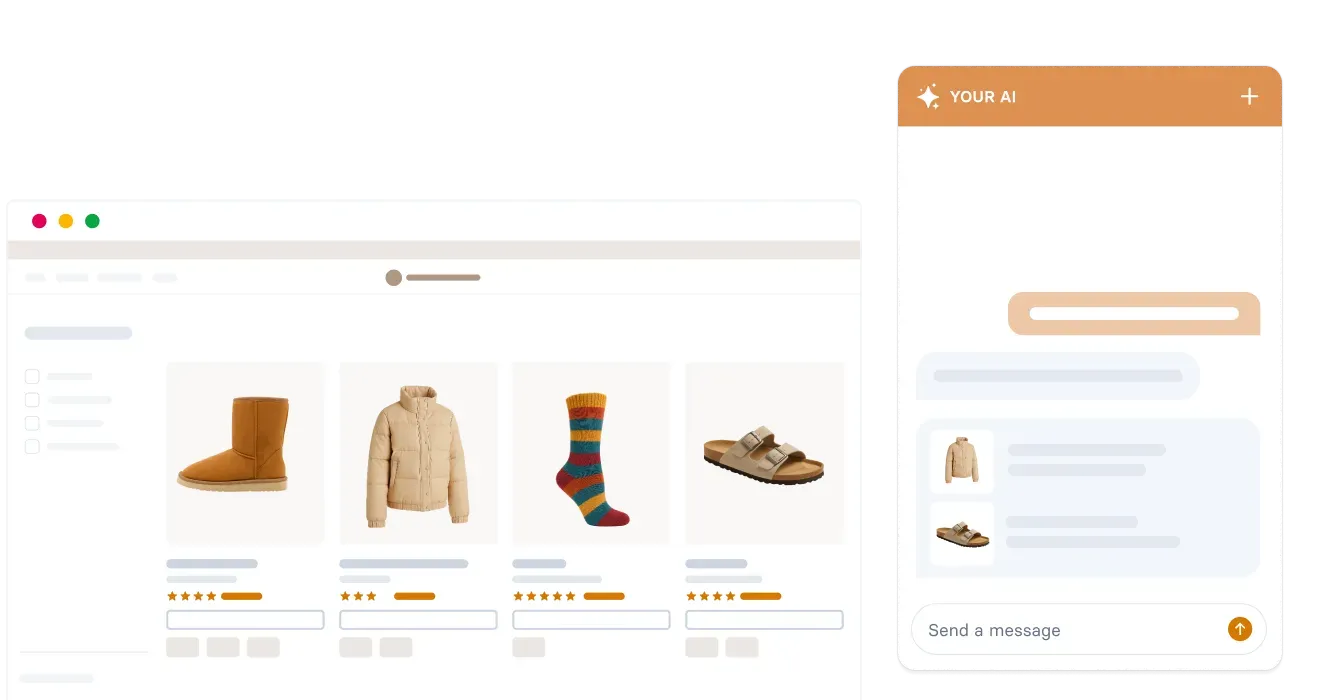
Alhena AI takes a different approach. Instead of starting with live chat and adding AI later, Alhena was purpose-built as an e-commerce AI platform that handles both sales and support from the ground up.
Two Specialized AI Agents
Where Tidio has a single AI agent (Lyro), Alhena runs two purpose-built agents that work together:
- Product Expert Agent: Handles conversational product discovery, guided recommendations, and conversational search. A shopper can type "I need a moisturizer for oily skin under $30" and get relevant product matches instantly, complete with ingredient details and reviews.
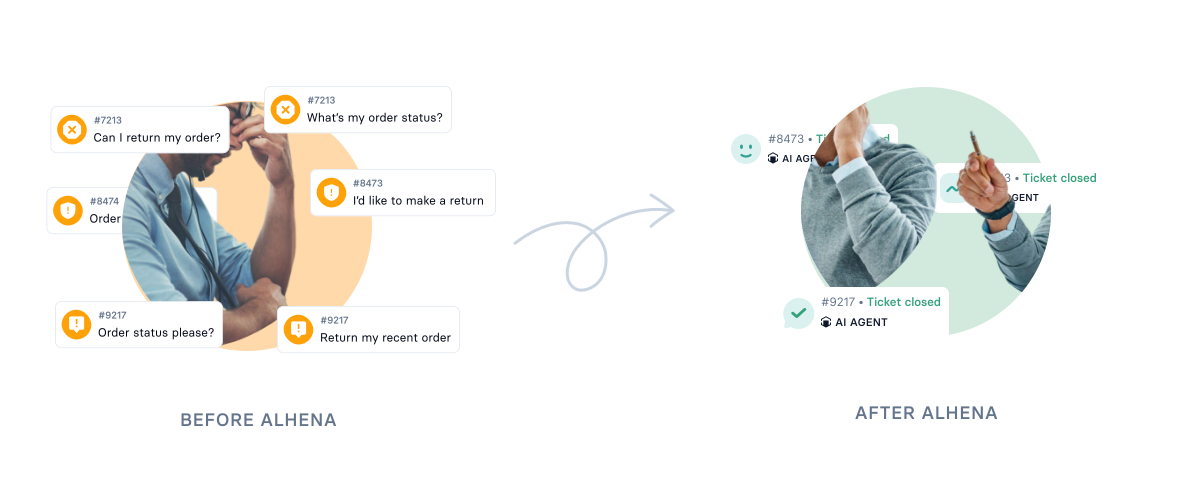
- Order Management Agent: Processes returns, tracks orders, handles cancellations, and manages address changes. This goes beyond answering questions about order status; it actually takes action.
Agentic Checkout
This is one of Alhena's biggest differentiators. The AI can populate a shopper's cart and pre-fill checkout fields directly within the chat window. It calls your commerce platform's APIs (Shopify Storefront API, WooCommerce REST API, or Magento GraphQL) in real time to check inventory, apply discounts, and push items to cart. No other AI chatbot in Tidio's category does this. For a deeper look at how this works under the hood, see our post on how shopping AI agents fix the missing revenue layer in most e-commerce AI tools.
Revenue Attribution Analytics
Every conversation Alhena handles is tracked through to conversion. The built-in revenue attribution dashboard shows exactly which AI interactions led to purchases, the average order value of AI-assisted sales, and the total revenue your AI agent generated, along with performance metrics for every conversation. Tidio has no equivalent feature. If you can't measure it, you can't prove ROI to your leadership team.
Alhena's Integrations
Alhena connects with Shopify, WooCommerce, Magento, and Salesforce Commerce Cloud on the e-commerce side. On the helpdesk side, it integrates with Zendesk, Freshdesk, Gorgias, Intercom, and Kustomer. The key difference: Alhena layers on top of your existing helpdesk rather than replacing it. If your team already lives in Zendesk, you don't have to rip that out.
Pricing: Alhena AI vs Tidio
Tidio's pricing looks attractive at first glance, but the real cost often surprises teams once they factor in AI add-ons and conversation limits.
Tidio Pricing (2026)
- Free: $0/month, 50 conversations, basic live chat
- Starter: $29/month, 100 conversations
- Growth: $59 to $349/month, 250 to 2,000 conversations
- Plus: $749/month, custom volume
- Premium: From $2,999/month, unlimited conversations
The catch? Lyro AI costs extra. You'll pay $39 to $700/month on top of your base plan depending on AI conversation volume. Tidio's Flows automation is also a separate add-on at $29 to $299/month. According to Featurebase's analysis, real-world Tidio costs run 2 to 3x higher than the base price once you add AI and automation.
Alhena AI Pricing
Alhena offers a free tier available to any store, with 25 conversations to test the platform. Pro and Enterprise plans are conversation-based, and Alhena publishes an ROI calculator showing a cost-per-conversation of $1.00 to $1.50 compared to the industry average of $2.86. Full pricing details require a demo, but the packaging is simpler: AI, analytics, and all channels are included in every paid plan. No separate add-ons for the AI agent.
For growing brands, this matters. With Tidio, a mid-size store doing 1,000 AI conversations per month could easily spend $500+ between the base plan and Lyro add-on. With Alhena, you get the full platform (AI agents, revenue tracking, omnichannel support) in one package.
What Alhena AI Does That Tidio Cannot
Both platforms answer customers’ questions. The gap appears when you look at what happens beyond basic Q&A.
Selling, Not Just Supporting
Tidio's Lyro AI is a support tool. It deflects FAQ-style questions and escalates complex ones to human agents. Alhena's Product Expert Agent takes a more advanced approach: it runs conversational search, asks clarifying questions ("What's your skin type?"), compares products side by side, and guides shoppers to checkout. Brands like Tatcha saw a 3x conversion rate and 38% average order value uplift after deploying Alhena's shopping assistant. Read the full case study here.
Voice AI
Tidio doesn't offer phone support. Alhena's Voice AI handles inbound calls with natural conversation, no IVR menus, no "press 1 for billing." For brands with older demographics or high-value orders where phone is the preferred channel, this fills a real gap.
Hallucination-Free Responses
Every AI chatbot risks making things up. Alhena grounds all responses in verified product data, order records, and your knowledge base, then flags anything it can't confirm rather than guessing. This is especially important for beauty and health brands where wrong ingredient information could cause real problems.
Works With Your Existing Helpdesk
If you're already running Zendesk, Gorgias, or Freshdesk, Tidio asks you to switch. Alhena plugs into your current setup through its Agent Assist product, giving your human agents AI-powered suggestions without changing their existing workflows. Manawa cut response time from 40 minutes to 1 minute and automated 80% of inquiries using Alhena alongside their existing tools. See the results.
When to Choose Tidio
Tidio is a solid choice if you check these boxes:
- You're a small business or startup running a Shopify or WooCommerce store with fewer than 500 support conversations per month
- Budget is your top priority and you need a free or low-cost live chat widget to start engaging visitors
- You don't have a helpdesk yet and want an all-in-one chat, ticketing, and basic automation tool
- You need simple FAQ automation and don't require AI-driven product recommendations or checkout assistance
- Your team is non-technical and needs a no-code Flow builder for basic automations
For early-stage stores focused on support deflection rather than AI-driven sales, Tidio delivers real value at an accessible price point. If you're comparing other platforms too, our Alhena AI vs Intercom Fin AI breakdown and Alhena vs Gorgias Automate comparison may also help.
When to Choose Alhena AI
Alhena AI is the better fit when:
- You want AI that sells, not just supports, with conversational product discovery, guided recommendations, and agentic checkout that turns browsers into buyers and helps boost conversion rates
- You need to prove ROI with built-in revenue attribution that maps every conversation to a purchase
- You already use a helpdesk like Zendesk, Gorgias, or Freshdesk and don't want to replace it
- You're scaling and need enterprise-grade security (SOC 2, PCI-DSS, ISO 27001, HIPAA compliance)
- You need voice support alongside chat, email, and social channels
- You sell in high-consideration categories like fashion, beauty, or home furnishing where guided selling directly impacts conversion
E-commerce brands like Victoria Beckham (20% AOV increase), Puffy (63% automated resolution, 90% CSAT), and Crocus (86% deflection, 84% CSAT) chose Alhena for exactly these reasons. You can explore more results on the customer success stories page.
Why E-Commerce Brands Are Switching to Alhena AI
Most chatbot platforms, Tidio, ManyChat, Intercom, started as live chat tools and bolted on AI automation later. Alhena AI was purpose-built as an AI powered chatbot for e-commerce, and the difference shows in every workflow, interaction, and customer support outcome. Where Tidio's chatbot handles basic ticket deflection, Alhena's AI chatbots automate the full journey: product discovery, guided selling, and agentic checkout from one seamless, multichannel interface with no steep learning curve.
Scalability is where competitors fall short. Tidio's add ons stack up, $39 to $700/month for the chatbot, plus separate automation fees. Alhena's free plan includes AI, analytics, omnichannel customer support, and real time revenue tracking in every tier. For a small business on Tidio's Growth plan or an enterprise team paying $2,999/month for Premium, Alhena delivers more value per interaction. The user friendly interface offers ease of use and deep customization for complex business needs, while self service capabilities and a verified knowledge base let AI powered agents automate routine tickets so human agents handle what matters.
Tidio replaces your helpdesk. Alhena layers seamlessly on top of Zendesk, Freshdesk, Intercom, and Gorgias, preserving your ticket system, CRM, and agent workflows. Its multiple channel customer service spans live chat, email, phone, Facebook Messenger, and social, with multichannel analytics that tie every chatbot interaction to revenue month for month. For brands ready to streamline customer support with a SaaS chatbot that sells, not just deflects customer needs, Alhena AI is the competitor to watch.
The Bottom Line
Tidio and Alhena AI serve different needs at different stages of growth. Tidio is an affordable, popular live chat tool that works well for small stores getting started with customer engagement and basic AI automation. Its 300,000+ users and 4.7 G2 rating speak to its reliability for that audience.
Alhena AI is built for e-commerce brands that have moved past basic support and want AI to actively drive revenue. The combination of AI shopping assistance, agentic checkout, revenue attribution, voice AI, and seamless helpdesk integration makes it the stronger choice for brands serious about turning customer interactions into measurable business outcomes.
Gartner predicts that agentic AI will autonomously resolve 80% of common customer service issues by 2029. The platforms investing in agentic capabilities today, not just FAQ deflection, are the ones that will lead the next wave of e-commerce AI.
Ready to see how Alhena AI can drive revenue for your store? Book a demo or start free with 25 conversations and see the difference for yourself.

Frequently Asked Questions
Is Alhena AI a good Tidio alternative for e-commerce?
Yes. Alhena AI is purpose-built for e-commerce sales and support, while Tidio is primarily a live chat tool with AI added on top. Alhena offers agentic checkout, revenue attribution analytics, and voice AI that Tidio lacks. Brands like Tatcha have seen 3x conversion rates and 38% AOV uplift after switching to Alhena.
How does Alhena AI pricing compare to Tidio?
Tidio starts free but AI features (Lyro) cost $39 to $700 per month extra on top of base plans ranging from $29 to $2,999 per month. Alhena includes AI, analytics, and all channels in every paid plan with no separate add-ons. For mid-size stores, Alhena's all-inclusive pricing often works out more predictable than Tidio's layered add-on model.
Can Alhena AI work with my existing helpdesk like Zendesk or Gorgias?
Yes. Alhena integrates on top of Zendesk, Freshdesk, Gorgias, Intercom, and Kustomer without replacing them. Tidio is designed as a standalone helpdesk replacement, so it doesn't layer onto existing tools.
What is agentic checkout and does Tidio offer it?
Agentic checkout means the AI can populate a shopper's cart and pre-fill checkout fields directly within the chat conversation. Alhena AI supports this by calling Shopify, WooCommerce, or Magento APIs in real time. Tidio does not offer agentic checkout.
Does Tidio have revenue attribution tracking?
No. Tidio does not offer native revenue attribution. Alhena AI includes built-in analytics that track every conversation through to purchase, showing exactly how much revenue your AI agent generates. This is critical for brands that need to prove AI ROI.
Which platform is better for small businesses?
For very small stores with under 500 monthly conversations and a tight budget, Tidio's free and Starter plans are a practical starting point. For growing brands that want AI to drive sales rather than just deflect support tickets, Alhena AI delivers better ROI even at smaller scale.
Does Alhena AI support voice calls like phone support?
Yes. Alhena Voice AI handles inbound phone calls with natural conversation, no IVR menus or hold music. Tidio does not offer any voice or phone channel support. This matters for brands where phone is a preferred purchase channel.