Kustomer AI starts at $89 per seat per month, requires an eight-seat minimum, and charges an extra $0.60 for every AI-handled conversation. Before a single customer message lands in your inbox, you could be looking at $1,300 or more per month just for AI features. It's a price tag that makes sense for large support operations with deep technical teams. But for e-commerce brands that need an AI virtual assistant selling products, not just handling self-service tickets, the math doesn't add up.
If you're researching Kustomer AI alternatives, you've probably noticed that most comparison articles pit Kustomer against helpdesk competitors. This review takes a different angle. We're comparing Kustomer's AI to Alhena AI, a platform built from the ground up for e-commerce sales and support. Below, you'll find a feature-by-feature breakdown, honest takes on pricing and where each platform shines, and guidance on which AI solutions fit your business and support needs.
Alhena AI vs Kustomer AI: At a Glance
Before getting into the details, here's a side-by-side review of how these two platforms compare across the features that matter most to ecommerce brands.
Alhena AI vs Kustomer AI: At a Glance
| Alhena AI | Kustomer AI | |
|---|---|---|
| Core Focus | Ecommerce sales + support | CRM-powered support automation |
| Guided Selling | Product Expert Agent with agentic checkout | Not available natively |
| Revenue Attribution | Built-in (tracks AI-driven sales, AOV, conversion) | Not included |
| Deployment Time | Under 48 hours, no dev needed | ~2 months with technical resources |
| Pricing Entry Point | Free tier (25 conversations), usage-based plans | $89/seat/mo (8-seat min) + $0.60/AI conversation |
| Social Commerce | Instagram DMs, WhatsApp with selling capability | Social channels for support only |
| Voice AI | Native AI voice channel | AI Voice included (telephony costs extra) |
| Ecommerce Platforms | Shopify, WooCommerce, Magento, SFCC | Shopify, Adobe Commerce, BigCommerce |
How Kustomer AI Works
Kustomer positions itself as an "AI-native customer service platform." It started as a CRM and service platform for support teams and has layered AI capabilities on top over time. The platform now offers three core AI features: AI for Customers (autonomous AI bots), AI for Reps (agent copilot), and AI Agent Studio (a no-code chatbot builder for custom agent API workflows).
On the ecommerce side, Kustomer connects to Shopify with a full two-way integration sync. Agents can view orders, process refunds, and take actions like canceling orders directly from the customer timeline. It also integrates with Adobe Commerce and BigCommerce, along with subscription and returns tools. The unified customer timeline pulls interaction history, order data, loyalty data, and customer information into one view.
Kustomer supports email, live chat, SMS, WhatsApp, voice, and social media. The live chat features include real-time messaging with AI suggestions across Facebook and Instagram. Its autonomous AI agents can resolve order status checks, refund requests, reservation changes, and common policy inquiries and auto-replies to common queries. Pre-built replies. Kustomer reports that some brands reach automated resolution of roughly 40% of chat interactions through its AI, though reaching that number requires significant configuration, escalation rules, and ongoing tuning.
The platform's biggest strengths are its deep CRM foundation, customer intelligence, and workflow customization. If your team has the technical resources and API expertise to configure complex agent workflows, Kustomer gives you granular control. The tradeoff: implementation typically takes two months, it's a steep learning curve, and you'll need dedicated resources to train, improve, and maintain the AI.
How Alhena AI Works
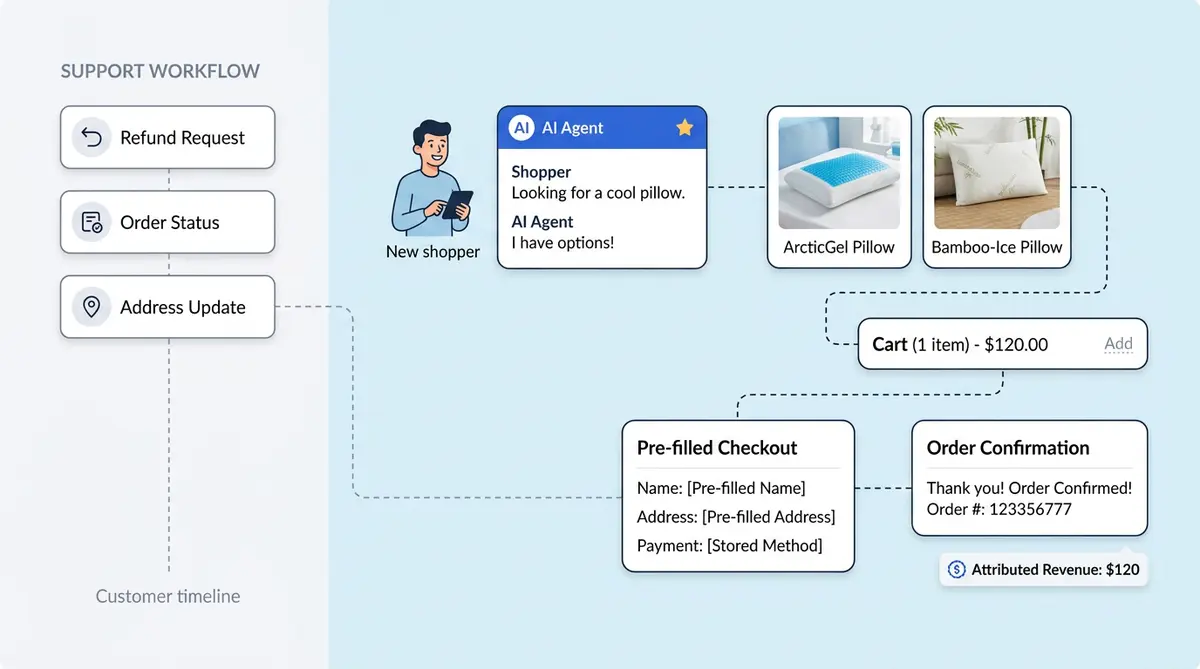
Alhena AI was purpose-built for ecommerce from day one. Where Kustomer started as a support CRM and added AI later, Alhena was designed as a generative AI platform with two specialized agents: a Product Expert Agent that handles guided selling and product discovery, and an Order Management Agent that covers post-purchase support like tracking, returns, and cancellations.
The Product Expert Agent does something Kustomer's AI doesn't: it actively sells. It understands natural language product queries, natural conversational flow,, asks follow-up questions to narrow preferences, recommends the right products, and can populate carts and pre-fill checkout. Alhena calls this "agentic checkout," and it's a meaningful difference. It's the kind of feature. Instead of just deflecting tickets, Alhena converts browsers into buyers.
Alhena connects to Shopify, WooCommerce, Magento, and Salesforce Commerce Cloud on the commerce side, and to Zendesk, Freshdesk, Gorgias, Kustomer, Intercom, and Zoho Desk on the helpdesk side (and other leading helpdesks). Alhena works with the most popular helpdesks. It's worth noting: you don't have to choose between Alhena and Kustomer. Many brands run Alhena alongside Kustomer to add sales capabilities that their helpdesk can't provide on its own.
Deployment takes under 48 hours with no developer resources needed. Alhena ingests your product catalog, knowledge sources, and knowledge base content, and helpdesk history to go live quickly. The platform is hallucination-free: it responds only with verified product and customer data, never fabricating answers.
Under the Hood: How Alhena Connects to Your Ecommerce Store
One of the biggest differences between Alhena and Kustomer shows up at the integration layer. Kustomer offers a Shopify connector and basic Adobe Commerce support, but the AI doesn't deeply index your catalog or fetch live order data on its own. Alhena's integrations go much deeper. Here's how the Magento (Adobe Commerce) integration works as an example of what happens behind the scenes for every supported platform.
Connecting Your Store in Minutes
A merchant connects their Magento 2 store by entering five fields in Alhena's dashboard: the store URL, a consumer key, consumer secret, access token, and access token secret. These come from a standard Magento Integration that the merchant creates in their admin panel (System, Extensions, Integrations), which uses OAuth 1.0a (HMAC-SHA256) authentication.
Alhena validates the credentials instantly by calling Magento's REST API, auto-derives the store name from the domain, and provisions two AI agents automatically: a Product Expert Agent for catalog questions and an Order Management Agent for post-purchase inquiries. No chatbot builder expertise needed, no API coding, no weeks of configuration. It's easy to set up.
Full Catalog Ingestion with Variants, Images, and Custom Attributes
Once connected, Alhena's training pipeline crawls the entire Magento catalog through the REST API. It pages through all simple and configurable products, filters by visibility and stock status, and for each configurable product, fetches every child variant (sizes, colors, SKUs) automatically.
The crawler ingests product titles, descriptions, pricing (including sale prices and MSRP), images, and any custom attributes the merchant chooses to include (think: material, SPF value, concentration, fabric type). It even auto-detects the store's URL suffix configuration (.html vs. clean URLs) so that every product link Alhena generates matches the real storefront.
The result: Alhena's AI chatbot has a complete, structured representation of your catalog in its knowledge base. When a shopper asks "do you have this in size M?" or "show me moisturizers under $40," the Product Expert Agent searches real product data, not hallucinated guesses. Multi-website Magento stores are also supported, with filtering by website ID so each storefront only surfaces its own products.
Live Order Lookups at Runtime
When a customer asks "where's my order?", Alhena's Order Management Agent doesn't rely on cached data. It calls Magento's order API in real time, matching on the customer's email and order number. For each order, Alhena fetches shipment details, builds tracking URLs for carriers like UPS, FedEx, and USPS, and maps Magento's internal status codes to plain-language updates: "Order Processing," "Order Shipped," "Order Cancelled."
That live data goes straight into the AI's response, so the customer gets an accurate, up-to-the-minute answer without waiting for a human agent to look it up. Manawa saw response times drop from 40 minutes to 1 minute and automated 80% of inquiries using this kind of real-time order integration.
Same Depth Across Every Platform
Alhena's Magento integration is one example, but the same pattern applies to Shopify, WooCommerce, and Salesforce Commerce Cloud. Each integration ingests the full catalog, syncs variants and pricing, and enables live order lookups. Kustomer's ecommerce integrations show order data in the agent timeline, but they don't power an AI that can sell products or fetch real-time shipping updates autonomously.
Where Alhena AI Pulls Ahead
Revenue Attribution, Not Just Ticket Metrics
Kustomer tracks CX metrics: ticket volume, resolution time, CSAT scores, and automation rates. These numbers matter, but they don't tell you how much money your AI is making. Alhena includes built-in revenue attribution analytics that track exactly which conversations led to purchases, the average order value of AI-assisted sales, and the percentage of total site revenue driven by the AI, giving you actionable insight into what's working.
Tatcha attributes 11.4% of total site revenue to Alhena AI. Victoria Beckham reported a 20% increase in AOV. These aren't support metrics. They're sales outcomes that show direct ROI, something Kustomer's analytics dashboard isn't designed to measure.
Guided Selling and Agentic Checkout
Kustomer's AI agents handle CX queries: "Where's my order?" "Can I get a refund?" "What's your return policy?" They do this well. But ask Kustomer's AI to recommend a moisturizer for dry skin, compare two products, or suggest a gift under $50, and it doesn't have the product knowledge to help.
Alhena's Product Expert Agent handles all of that across every channel. It processes layered product queries ("I need a waterproof jacket for hiking in the Pacific Northwest, under $200"), returns personalized, data-grounded recommendations from your real catalog, and nudges hesitant shoppers with personalized, contextual prompts. Brands using Alhena report over 300% increases in conversion rates and over 50% lifts in average order value.
48-Hour Deployment vs. Two-Month Implementation
Kustomer's implementation timeline averages two months. You'll need to configure the AI Agent Studio, train custom agents, set up workflow automations, and dedicate technical staff to ongoing tuning. The 8-seat minimum means you're committing to a significant monthly cost before your team sees results.
Alhena deploys in under 48 hours. It ingests your existing product catalog and knowledge base automatically, as the Magento integration walkthrough above shows. No dev resources required. You can start free with 25 conversations to test and improve performance before scaling. A/B testing and iterative testing of AI responses are built into the workflow.
Omnichannel Social Commerce and Voice
Both platforms cover the basics: email, chat, SMS, WhatsApp, and social channels. But Alhena extends into two areas where Kustomer's AI presence is limited. Alhena's Social Commerce agent handles Instagram DMs and WhatsApp with the same product expertise as live chat, turning digital social engagement into sales. Alhena Voice AI provides an AI-powered voice channel for brands that need digital phone support without staffing a call center with human agents.
Kustomer supports these channels for messaging and ticket routing, but its AI doesn't carry product knowledge or selling ability into social DMs or voice calls the way Alhena does.
Transparent, Predictable Pricing
Kustomer's pricing structure layers costs: $89 to $139 per seat, an 8-seat minimum ($712 to $1,112 per month before AI), plus $0.60 per AI conversation and $40 per user per month for agent assist. A 10-person team using both AI products can expect $1,300 or more in monthly AI costs alone. That monthly spend adds up.
Alhena offers a free tier with 25 conversations to test the platform, and paid plans scale based on usage with no seat minimums. You only pay for what you need. Run the ROI calculator to estimate your return before committing.
When Kustomer AI Makes Sense
Kustomer isn't a bad product. It's a strong choice in specific scenarios:
- Large support teams (20+ agents) that need granular CRM customization and workflow control across complex service operations
- Businesses with dedicated technical staff who can spend two months configuring and continuously tuning AI agent workflows
- Companies that already run Kustomer as their CRM and want native AI layered on top of their existing customer data and records
- Non-ecommerce brands in fintech, travel, or SaaS where the primary goal is AI customer service resolution, not product sales
If your support operation is your product (think: a marketplace or SaaS company where every ticket is high-stakes), Kustomer's deep CRM foundation and agent workflow tools justify the cost.
When to Choose Alhena AI
Alhena AI is the better choice when your priority extends beyond ticket deflection into driving revenue:
- Online stores on Shopify, WooCommerce, Magento, or Salesforce Commerce Cloud that want AI to recommend products and close sales, not just answer FAQs
- Brands that want fast time-to-value with under 48 hours to deployment and no dev team required
- Teams that need revenue attribution to prove AI ROI with hard sales numbers, not just deflection rates
- Growing companies with lean teams that can't justify an 8-seat minimum or $1,300 per month in AI add-ons
- Omnichannel sellers on Instagram and WhatsApp who need AI that sells in social DMs, not just supports
- Brands already using Kustomer who want to add AI selling capabilities on top of their existing helpdesk
Brands in beauty and skincare, fashion and apparel, home furnishing, and sports and fitness are a perfect fit for Alhena because product discovery and guided selling directly impact conversion rates in these verticals.
The Bottom Line
Kustomer AI is a capable support platform with strong CRM roots. If you're running a large team, have technical resources to spare, and care primarily about resolving tickets efficiently, it delivers. But Kustomer doesn't sell for you.
Alhena AI was built ai-native from day one. It combines support automation with guided selling, agentic checkout, and revenue attribution in a single platform that deploys in days, not months. Brands like Tatcha (3x conversions, 38% AOV uplift, 11.4% of site revenue from AI), Puffy (63% automated resolution, 90% CSAT), and Crocus (86% deflection rate, 84% CSAT) prove that you don't have to choose between great support and great sales. Alhena handles both.
The real question isn't which tool deflects more tickets. It's which one makes you more money. If you're evaluating AI chatbot or conversational AI platforms that also drive revenue, check out our best AI shopping assistants for Kustomer guide for a better and broader comparison. Better AI means better sales results.
Ready to see what AI-driven revenue looks like? Book a demo with Alhena AI or start for free with 25 conversations.
Frequently Asked Questions
How does Alhena AI compare to Kustomer AI for ecommerce?
Alhena AI is purpose-built for ecommerce sales and support, while Kustomer AI focuses on CRM-powered ticket resolution. Alhena includes guided selling, agentic checkout, and revenue attribution analytics that Kustomer doesn't offer. Brands like Tatcha have seen 3x conversion rates and 38% AOV uplift using Alhena's Product Expert Agent.
What are the best Kustomer AI alternatives for online stores?
For e-commerce brands, Alhena AI is the strongest Kustomer alternative because it combines customer support automation with personalized product recommendations and checkout assistance. Other options include Gorgias (ecommerce-focused support), Zendesk (general support), and Freshdesk (budget-friendly with a free plan for small teams). Alhena helps brands grow by tracking AI-driven revenue, not just ticket deflection.
Can I use Alhena AI alongside Kustomer?
Yes. Alhena integrates with Kustomer as a helpdesk connector, so you can keep using Kustomer for CRM and keep and ticketing while adding Alhena's AI shopping assistant and order management capabilities. Many Shopify brands run both platforms together to get the best of CRM-driven support and AI-powered selling.
How much does Kustomer AI cost compared to Alhena AI?
Kustomer starts at $89 per seat per month with an 8-seat minimum, plus $0.60 per AI conversation and $40 per user for agent assist. A 10-person team pays roughly $1,300 monthly in AI costs alone. Alhena offers a free tier with 25 conversations and usage-based paid plans with no seat minimums.
How long does it take to deploy Alhena AI vs Kustomer AI?
Alhena AI deploys in under 48 hours with no developer resources required. It automatically ingests your product catalog and knowledge base. Kustomer's implementation typically takes about two months and requires dedicated technical staff to configure AI agent workflows and ongoing optimization.
Does Alhena AI work with Shopify, WooCommerce, and Magento?
Yes. Alhena AI integrates natively with Shopify, WooCommerce, Magento 2 (Adobe Commerce), and Salesforce Commerce Cloud. On the helpdesk side, it connects to Zendesk, Freshdesk, Gorgias, Kustomer, Intercom, and Zoho Desk. Kustomer integrates with Shopify and Adobe Commerce but doesn't support WooCommerce or Salesforce Commerce Cloud.
What is revenue attribution in Alhena AI?
Revenue attribution tracks which AI conversations directly led to purchases, the average order value of AI-assisted sales, and the percentage of total site revenue driven by the AI. Tatcha attributes 11.4% of total site revenue to Alhena AI. Kustomer's analytics focus on support metrics like ticket volume and resolution time, not sales outcomes.
How does Alhena's Magento integration work?
Alhena connects to Magento 2 stores via OAuth 1.0a REST API. A merchant enters five credentials from their Magento admin panel, and Alhena validates them instantly. It then ingests the full product catalog (variants, images, custom attributes, pricing) and enables live order lookups for real-time WISMO responses. The entire setup is easy and takes minutes, not weeks.