Most skincare shoppers land on a single item page, add one item, and leave. The average beauty ecommerce cart contains one to two products when the ideal skincare regimen requires five to seven. That gap between what a customer buys and what their skin actually needs is where revenue disappears. Alhena AI's deployment data shows a 38% AOV uplift when AI-powered routine creation replaces single-item recommendations, converting the same traffic into multi-item carts by solving the discovery and confidence gaps that static product pages cannot.
This post breaks down the six mechanical layers inside an AI-powered skincare routine builder, the AOV math behind each layer, and why this capability is the highest-revenue technology in beauty ecommerce today.
The AOV Problem in Beauty Ecommerce
A shopper searching for a vitamin C serum finds one, adds it to cart at $45, and checks out. That's a simple completed transaction, but it's also a missed opportunity. The same shopper needs a cleanser, toner, moisturizer, eye cream, and SPF to build a complete routine. If the store only surfaces the serum, it captures 15% to 20% of the shopper's potential skin care spend.
Static catalog pages can't solve this. They show related items in a grid, but they don't explain why those items work together, whether the ingredients are compatible, or what order to apply them. The shopper has to do that research alone, and most won't. They buy the one product they came for and leave.
An AI-powered skincare routine builder changes this equation by guiding the shopper through a personalized regimen in a single conversation. Instead of browsing five separate product pages, the shopper receives a perfect, sequenced regimen matched to their personalized skin profile, with every product explained and ready to add to cart.
Layer One: Skin Profiling Through Conversation
The routine builder opens with targeted questions about skin type, skin age, primary concerns like fine lines and signs of aging, current regimen gaps, sensitivity, and lifestyle factors and pain points. Unlike a static 15-question quiz that follows a fixed decision tree, conversational skin analysis adapts each question based on previous answers.
If a shopper mentions acne-prone skin in the first response, the AI skips generic skin type questions and moves directly to facial acne-specific concerns: hormonal or stress-related, frequency of breakouts, current actives in use, and whether the skin is also dry or dehydrated (a common pairing the shopper might not mention on their own). This dynamic skin analysis builds a detailed skin profile in two to four exchanges, often under three minutes.
The AOV impact starts here. A static quiz might recommend one hero product per concern. Conversational profiling uncovers multiple concerns and regimen gaps, creating the foundation for a multi-product recommendation. A shopper who came for an acne serum now also learns they need a hydrating toner and a non-comedogenic SPF, tripling the potential cart.
Layer Two: Morning Versus Evening Routine Logic
Skincare routines are not one list. They are two distinct protocols with different product requirements. The AI must understand that vitamin C belongs in the morning before SPF because it provides antioxidant protection against UV and environmental damage. Retinol belongs in the evening after cleansing because it increases photosensitivity and breaks down in sunlight.
Certain actives should never appear in the same application step. AHA exfoliants and retinol in the same evening routine can cause irritation, so the AI needs to alternate them across different nights or separate them into different steps with appropriate wait times.
This layer doubles the item opportunity. A single-routine recommendation might include four products. A split morning and evening protocol can include seven to ten, because the shopper needs separate treatments, different moisturizer weights (lighter for morning under SPF, richer for evening recovery), and distinct active ingredients for each time of day. The math is straightforward: two routines mean roughly twice the cart value compared to one generic product list.
Layer Three: Ingredient Compatibility Engine
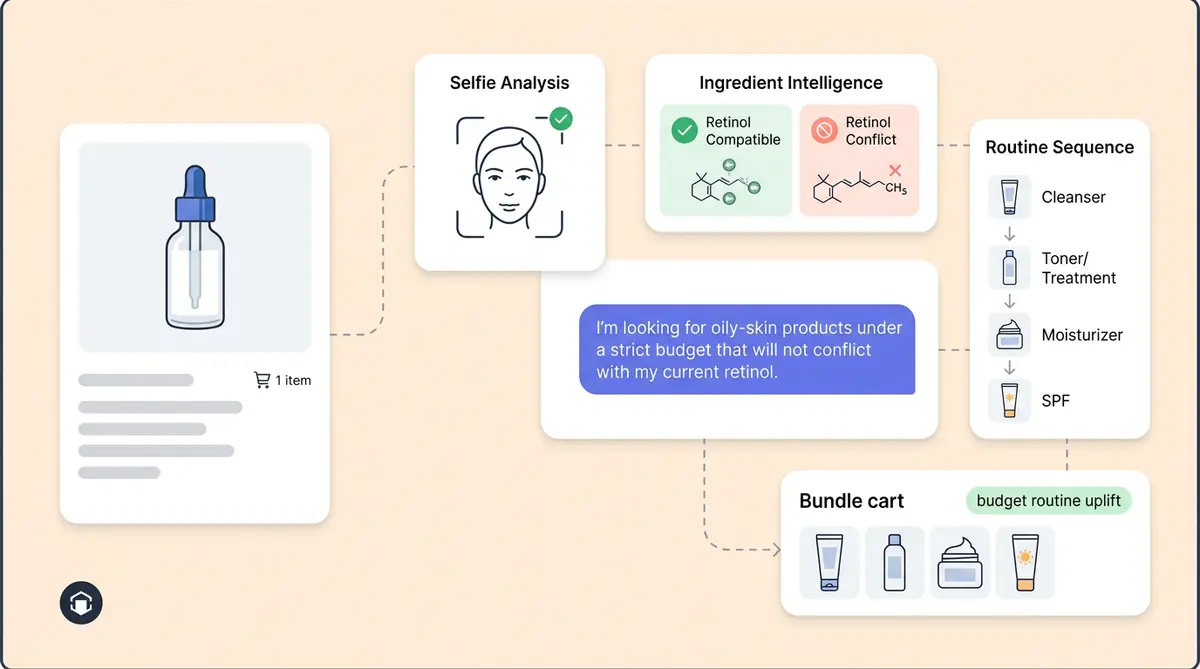
The AI must enforce ingredient conflict rules across the full routine. This is where basic recommendation widgets fail completely, because they match products to concerns without checking whether those products can coexist on the same skin.
Conflict rules the engine must enforce:
- Retinol with AHA/BHA in the same application layer causes excessive exfoliation and barrier damage
- Niacinamide with direct vitamin C at high concentrations can reduce the efficacy of both actives
- Benzoyl peroxide with retinoids causes degradation of the retinoid molecule on contact
- Glycolic acid with salicylic acid in the same layer doubles the exfoliation load and risks chemical burns on sensitive skin
Synergistic pairings the engine should prioritize:
- Hyaluronic acid with ceramides strengthens the moisture barrier while attracting and sealing hydration
- Peptides with antioxidants support collagen production while neutralizing free radical damage
- Niacinamide with zinc regulates sebum production for oily and acne-prone skin
The ingredient compatibility engine doesn't just prevent bad combinations. It actively builds stronger routines by pairing synergistic ingredients across steps. A routine built with compatibility logic feels like expert advice from a dermatologist, which is exactly why shoppers trust it enough to buy all products in the set.
Layer Four: Step Sequencing by Texture and Penetration
Skincare products must be layered in a specific order from thinnest to thickest consistency. Applying a heavy cream before a lightweight serum blocks the serum's active ingredients from penetrating the skin. The AI must sequence the routine correctly:
- Cleanser removes dirt, oil, and makeup to prepare a clean surface
- Toner balances pH and preps the skin to absorb actives
- Essence delivers lightweight hydration and first-layer actives
- Serum concentrates active ingredients for targeted treatment
- Eye cream addresses the thinner, more sensitive periorbital facial area
- Moisturizer seals in previous layers and strengthens the moisture barrier
- SPF (morning only) provides UV protection as the final daytime step
Shoppers who understand the logic behind the sequence are more likely to purchase the full routine. When the AI explains that skipping the toner step means the $65 serum won't absorb properly, the toner stops being an optional add-on and becomes a necessary investment. Each step in the sequence creates a logical reason to buy the next product, building the cart through education rather than pressure.
Layer Five: Regimen-Driven Upselling and the AOV Math
Here's where the revenue math gets specific. A shopper arrives for a single $45 serum. The AI builds a personalized five-step morning routine:
- Gentle cleanser: $32
- Hydrating toner: $28
- Vitamin C serum (the original product): $45
- Barrier repair moisturizer: $48
- Mineral SPF: $36
Total regimen value: $189, a 4.2x increase in cart size from the original $45.
Add an evening routine with a retinol treatment ($52), a richer night cream ($54), and an eye cream ($38), and the full AM/PM routine reaches $333. Even if the shopper only buys the morning routine, the AOV jumps from $45 to $189.
This is why regimen recommendations feel like expert advice rather than aggressive cross-selling. The products are presented as a cohesive system, not as add-ons. "You need SPF after vitamin C" is a skincare fact, not a sales pitch. The educational framing removes the friction that kills upsell conversion on static sites.
Alhena AI's documented results confirm the math: brands using the AI Shopping Assistant for regimen creation see a 38% AOV uplift and a 3x conversion rate from personalized routine conversations, with the AI influencing over 11% of total site revenue.
Layer Six: Agentic Checkout From Routine to Cart
The final mechanical layer is what separates a recommendation from a sale. The AI presents the complete routine as branded cards within the conversation, each showing the item image, price, and role in the routine. The shopper sees individual add-to-cart buttons with pricing for each product and a "Add Full Routine" option that populates the cart with all items in one click.
Alhena AI's agentic checkout then redirects to a pre-filled checkout page, compressing the path from regimen recommendation to purchase into seconds. On a static site, the same shopper would need to navigate to five separate category pages, add each item individually, and return to the conversation to remember what was recommended. That multi-page navigation kills conversion.
The single-click regimen-to-cart flow is critical because every additional step in the purchase path reduces completion rates. When the AI handles product selection, sequencing, conflict checking, and cart population within the same conversation, the shopper's only decision is whether to buy, not how to buy.
Why Static Quizzes and Recommendation Widgets Fail
Static quiz builders follow predetermined decision trees that cannot adapt to ingredient conflicts mid-conversation. They output a fixed item set based on initial inputs or a single selfie without checking whether those products are compatible across morning and evening protocols. They cannot sequence products by application logic, build distinct AM/PM routines from a single interaction, or present the complete routine in a shoppable format within the chat experience.
Basic recommendation widgets are worse. They pull "frequently bought together" or "customers also viewed" products based on aggregate purchase data, not individual skin profiles. Two shoppers with opposite skins see the same recommendations on the same product page.
Shade matching tools solve one purchase decision. A foundation match is a single-item sale. Routine creation solves five to seven decisions in a single conversation, making it the best and highest-AOV capability in beauty AI.
How Alhena AI Powers Routine Building for Beauty Brands
Alhena AI's Skin Analyzer and Regimen Builder combine all six mechanical layers into a single conversational experience. The AI runs conversational skin profiling, ingredient compatibility checks, morning and evening protocol logic, texture-based step sequencing, rich card presentation, and agentic checkout that converts full routines into populated carts.
Every recommendation is grounded in the brand's verified catalog. The AI will never recommend a product you don't carry, claim an ingredient benefit that isn't on the label, or suggest an application step that conflicts with another product in the set. This hallucination-free technology with accurate, verified data is why shoppers trust the routine enough to buy all five to seven products instead of just the one they searched for.
The system deploys in under 48 hours across Shopify, WooCommerce, Magento, and Salesforce Commerce Cloud without developer resources. It runs on web chat, email, Instagram DMs, and WhatsApp through Alhena's social commerce channels, and every routine conversation feeds into built-in revenue attribution so you can see the exact AOV lift and revenue saved from regimen creation versus single-product pages.
Key Takeaways
- Single-item recommendations leave 70% or more of potential beauty cart value unrealized because shoppers need five to seven products for a complete skincare routine.
- The six mechanical layers of AI regimen creation (skin profiling, AM/PM logic, ingredient compatibility, step sequencing, regimen upselling, and agentic checkout) each contribute directly to higher cart values.
- Routine recommendations convert at higher rates than single-item suggestions because the educational framing builds confidence and removes purchase friction.
- Brands deploying Alhena AI's routine builder see 38% higher AOV by solving every skincare decision in one conversation instead of one page at a time.
- Agentic checkout compresses the path from personalized routine to populated cart into a single click, eliminating the multi-page navigation that kills conversion on static sites.
Ready to convert single-item shoppers into full-routine buyers? Book a demo with Alhena AI to see the routine builder in action, or start free with 25 conversations and explore the AOV lift on your own catalog.
Frequently Asked Questions
How does an AI skincare routine builder use ingredient compatibility to prevent bad product combinations?
Alhena AI's ingredient compatibility engine enforces conflict rules across the full routine, preventing combinations like retinol with AHA/BHA in the same step or benzoyl peroxide with retinoids. It also prioritizes synergistic pairings like hyaluronic acid with ceramides, building routines that are safer and more effective than anything a static quiz can produce.
Why does AI routine building drive higher AOV than single-product skincare recommendations?
Single-product recommendations capture 15% to 20% of a shopper's potential skincare spend. Alhena AI's routine builder solves five to seven product decisions in one conversation, converting a $45 serum shopper into a $189 full-routine buyer. Brands using this approach see 38% higher AOV because the products are presented as a cohesive system, not add-ons.
How does conversational skin profiling differ from a static skincare quiz for ecommerce?
Static quizzes follow fixed decision trees regardless of answers. Alhena AI's conversational profiling adapts each question based on previous responses, building a dynamic skin profile in two to four exchanges. This uncovers multiple concerns and routine gaps that fixed quizzes miss, creating the foundation for higher-value multi-product recommendations.
What is agentic checkout in AI skincare routine building and how does it increase conversion?
Agentic checkout means the AI populates the cart with the full recommended routine and redirects to pre-filled checkout in a single click. Alhena AI compresses the path from routine recommendation to purchase into seconds, eliminating the multi-page navigation that kills conversion when shoppers have to add five to seven products individually on static sites.
Can an AI routine builder create separate morning and evening skincare protocols from one conversation?
Yes. Alhena AI builds distinct AM and PM routines from a single conversation, placing vitamin C and SPF in the morning protocol and retinol in the evening. This doubles the product opportunity compared to a single generic list, because each time of day requires different actives, textures, and treatment steps matched to the shopper's skin profile.