The Wrong-Product Problem Is a Matching Failure, Not a Service Failure
Seven in ten online apparel returns happen because of fit-related returns, sizing issues, and wrong-fit product returns. Up to 60% of beauty returns stem from wrong shade or regimen mismatches. These aren't customer service problems. They're product matching solutions waiting to happen. They're product matching failures that happen before the order is placed in the customer journey.
Static size charts and ingredient lists sit on every product page, yet ecommerce product returns keep climbing because passive information doesn't replace active guidance. powerful AI-powered product matching that asks questions, analyzes inputs, and makes personalized recommendations is the only the only scalable technology to close the gap between what a customer thinks they need and what will actually work for them.
This post breaks down how Alhena AI's Skin Analyzer and Fit Analyzer work together to deliver solutions for the wrong-product problem at the point of purchase in the shopping journey, with the return-reduction business case for both beauty and fashion brands.
How the AI Skin Analyzer Works for Beauty Brands
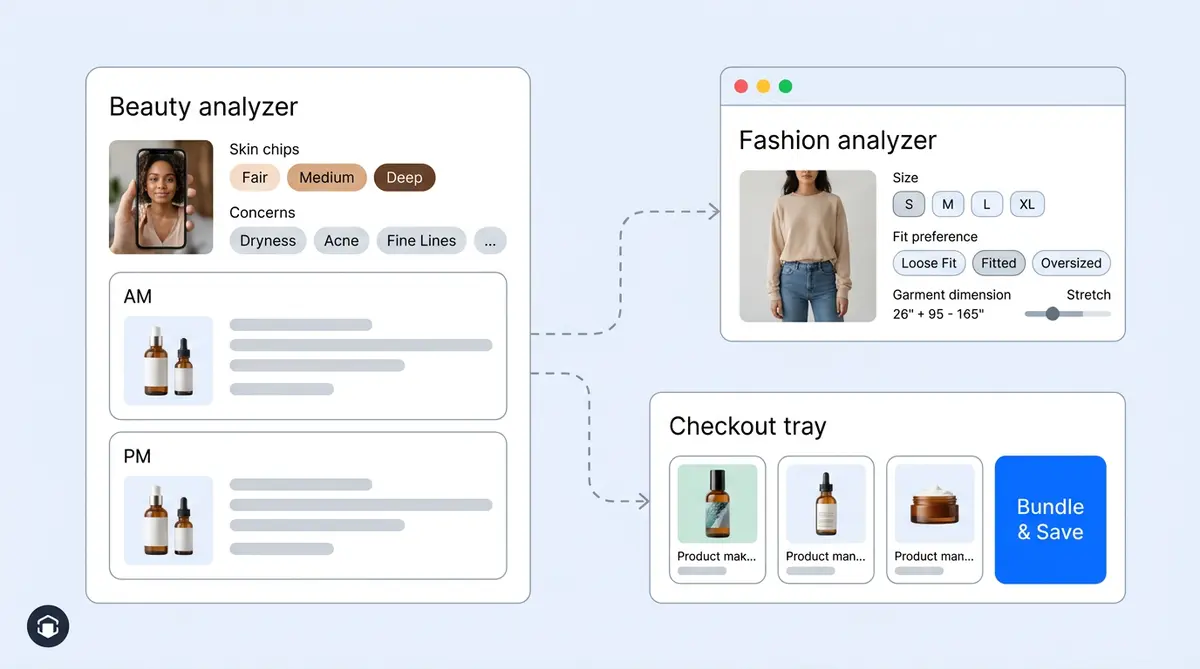
The Skin Analyzer evaluates skin type (oily, dry, combination), facial skin concerns like acne, aging, hyperpigmentation, and sensitivity, and tone through conversational questions or selfie-based facial analysis to deeply analyze facial skin with clinical accuracy. It cross-references the customer's profile against your verified product catalog and recommends specific products, plus full morning and evening regimens, that are tailored to work together and appropriate for their skin health and deep, personalized skincare needs based on real skincare expertise. The AI meets each customer's specific skin needs.
The Regimen Builder extends this by creating multi-product regimens that drive higher AOV while ensuring ingredient compatibility. A consumer searching for a retinol serum or face makeup won't get paired with an exfoliating acid that causes irritation. Every suggestion is grounded in your actual product data, science-backed formulation data, and trusted ingredient insights, not generated from general skincare knowledge. That focus on skin health matters because it's what prevents the "this doesn't work for me" return.
Brands like Tatcha have seen a 3x conversion rate and 38% AOV uplift after deploying Alhena's AI-powered skincare recommendations, proving that accurate matching drives conversions and revenue while reducing ecommerce returns. Those are the metrics that matter. Learn more about how conversions improve across the full shopper journey..
How the AI Fit Analyzer Works for Fashion Brands
The Fit Analyzer collects sizing data and fit preferences through natural conversational questions about fit behavior, body shape preferences, and past buying behavior, not invasive body scanning. This sizing technology improves the digital shopping experience, drives consumer engagement, and builds trust in digital commerce.. It cross-references the customer's inputs against detailed, granular SKU-level garment dimensions from your catalog, accounting for label-specific sizing variations and sizing inconsistencies across sizes and fabric stretch characteristics.
The result isn't just the right size and fit. It's tailored fit guidance (slim versus relaxed) for each garment. A "medium" in a structured blazer fits nothing like a "medium" in a relaxed sweatshirt from the same brand. The AI knows this because it trains on your catalog's actual clothing measurements, not generic sizes pulled from a chart. Different sizes stretch differently depending on fabric.. Personalized product recommendations give shoppers the confidence to buy the right size fit every time.
If most of your support tickets are about sizing, that's a signal your product pages aren't doing enough. The Fit Analyzer provides a better customer experience by intercepting those questions before they become tickets or, worse, returns.
The Return Reduction Math
AI size recommendations and fit recommendations reduce fashion returns by 25 to 50%. For a brand doing $10M in revenue with 30% return rates, that means $3M in returned merchandise annually. Every dollar returned costs roughly $0.85 in reverse shipping, restocking labor, product write-offs, lost resale value, and sustainability costs from landfill waste. For any business with similar numbers, reducing returns by a third saves $750K to $1.5M per year.
For beauty brands, accurate shade and regimen matching cuts returns 20 to 30% while simultaneously increasing AOV through multi-product regimen suggestions. A luxury skincare brand using Alhena saw 11.4% of total site revenue attributed directly to AI conversations directly.
The AI size recommendation market is projected to grow from $1 billion to nearly $3 billion by 2029. The ROI is proven and the margin impact is immediate. This innovation in AI-powered analysis technology, confirmed by 2025 business data and 2025 return rate studies, delivers actionable insights for treatments, skincare, and apparel. This technology means brands start seeing results within weeks., which is why beauty brands convert at 5.36% with AI-assisted shopping.
Complementary Solutions That Complete the Picture
Skin Analyzer and Fit Analyzer don't work in isolation. Alhena's Shopping Assistant includes several complementary tools:
- Shade Matcher for precise foundation and concealer color matching
- Color Analyzer for fashion palette and print recommendations
- Upload and Match (a lightweight virtual try-on alternative) that lets shoppers photograph an outfit they like and find similar products for faster product discovery
All of these work within the same conversation. A shopper can get skin analysis, shade matching, and a complete regimen recommendation in a single flow.
Deployment and Platform Integration
Both analyzers deploy within Alhena's standard 48-hour setup. Merchants start seeing improvements. They integrate across Shopify, WooCommerce, and Salesforce Commerce Cloud. No special hardware is required, and the user experience is simple: phone cameras handle visual photo-based analysis. Both agents deliver expert-level guidance trained on your latest catalog data so results reflect actual inventory, not generic or untrusted product knowledge.
Both analyzers connect to agentic checkout, which converts the recommendation into a populated cart immediately. The shopper goes from "what's my shade?" to "ready to buy" without leaving the chat, turning browsing into buying immediately.
Returns Are a Symptom, Not an Inevitability
Returns aren't an inevitable cost of online selling. They're a symptom of insufficient product matching at the point of purchase. Brands deploying AI analyzers that understand their shopper's body, skin, and preferences before the order is placed are turning their highest-return categories into their highest-margin categories.
Ready to minimize returns and protect your margins with smarter product matching? Book a demo with Alhena AI today to explore your return reduction potential. You can also book a demo to see the Skin Analyzer in action or start for free with 25 conversations, always available for customers who want to explore pricing and what AI-powered product matching can do for your return metrics..

Frequently Asked Questions
How does AI skin analysis work for online beauty shopping?
Alhena AI's Skin Analyzer evaluates skin type, concerns, and tone through conversational questions or photo-based analysis using your phone camera. It cross-references each shopper's profile against the brand's verified product catalog to recommend specific products and full routines. Because recommendations come from actual inventory data, shoppers get products that genuinely match their skin, helping reduce returns from wrong products by 20 to 30%.
Are AI sizing recommendations accurate enough to reduce fashion returns?
Yes. Alhena AI's Fit Analyzer trains on SKU-level garment dimensions, fabric stretch data, and brand-specific sizing variations from your catalog. It goes beyond generic size charts to recommend the right size and fit preference for each clothing item. AI size recommendations reduce fashion returns by 25 to 50% across brands that deploy them.
What is the financial impact of AI-powered return reduction for fashion brands?
For a fashion brand doing $10M in revenue with a 30% return rate, every dollar returned costs roughly $0.85 in processing. Reducing returns by a third with Alhena AI's Fit Analyzer saves $750K to $1.5M annually in reverse shipping, restocking, write-offs, and lost resale value. The margin impact is immediate.
Do AI skin and fit analyzers require special hardware or apps?
No. Alhena AI's Skin Analyzer and Fit Analyzer work within the web-based Shopping Assistant. Photo-based analysis uses standard phone cameras. No dedicated app downloads, special hardware, or body scanning equipment is needed. Both tools deploy on Shopify, WooCommerce, and Salesforce Commerce Cloud within 48 hours.
How quickly do brands see return rate improvements after deploying AI analyzers?
Most brands using Alhena AI see measurable return rate improvements within weeks of deployment. The AI trains on your catalog data from day one, so recommendations are accurate immediately. Brands typically report both lower return rates and higher AOV within the first full sales cycle.
Can AI skin analyzers and fit analyzers work together in one conversation?
Yes. Both Alhena AI analyzers operate within the same Shopping Assistant conversation. A shopper browsing a beauty and fashion brand can get skin analysis, shade matching, fit recommendations, and a populated cart in a single flow, all all building confidence through agentic checkout that converts recommendations into purchases immediately.
How does Alhena AI prevent wrong-shade returns for beauty brands?
Alhena AI combines the Skin Analyzer with the Shade Matcher to evaluate skin tone and match it against foundation and concealer shades in the brand's catalog. Because it references verified product data rather than general color theory, shade matches reflect what the brand actually sells. This accuracy cuts shade-related beauty returns by 20 to 30%.