The Gap Between Knowledge Base Chatbots and Revenue
Shoppers who engage with an AI shopping assistant during their online shopping session convert at 12.3 percent, nearly four times the 3.1 percent rate of those who do not, according to the 2026 E-commerce Conversion Benchmark Report. Yet most e-commerce teams still rely on knowledge base chatbots that were never architected to sell. These chatbot tools answer "Where is my order?" but go silent when a shopper asks "Which moisturizer works best for combination skin?", failing to engage customers at the exact moment they express a customer need.
The architectural difference matters. A knowledge base chatbot retrieves static FAQ documents through keyword matching, functioning as a self-service help center for repetitive support queries. An AI shopping assistant layers intent detection, real-time catalog retrieval, and conversational commerce APIs on top of that same knowledge base infrastructure to turn support interactions into revenue events. This is the generative AI application that bridges the gap between answering frequently asked questions and actually powering shop conversions through intelligent product discovery.
Technical Architecture: From Retrieval to Revenue
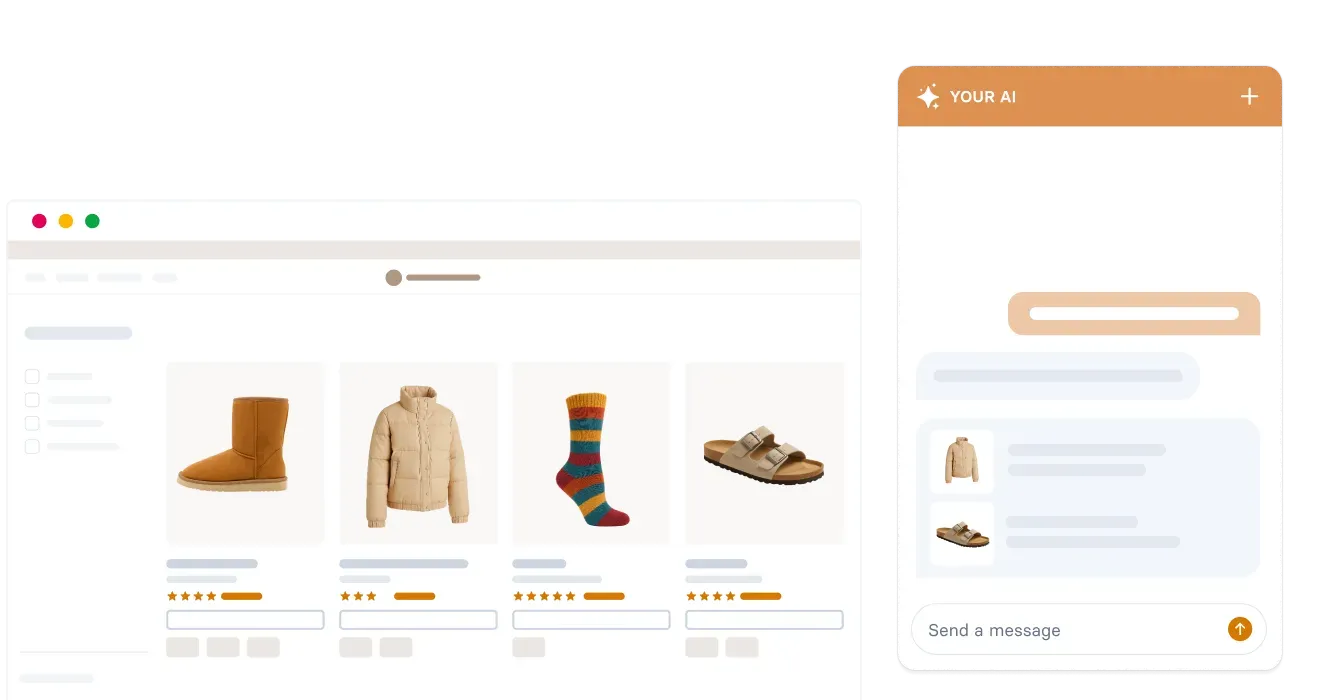
Transforming a knowledge base chatbot into a revenue engine requires adding three agentic layers to the existing stack. Each layer introduces new AI capabilities that enhance the chatbot's functionality beyond simple FAQ page retrieval:
Intent Classification Layer - A natural language processing classifier sits upstream of the knowledge base router. It uses NLP to distinguish support intents (order_status, return_request) from purchase intents (product_comparison, size_recommendation, restock_alert). When a purchase signal is detected, the query routes to the product expert pipeline instead of the FAQ retriever. This intent detection is the conversational AI capability that separates a basic bot from an AI-powered shopping agent.
RAG-Based Product Retrieval Layer - Product catalog data (titles, descriptions, attributes, reviews, inventory counts) is chunked and converted into vector embeddings stored in a vector database. At query time, the customer's natural language question is embedded and matched via cosine similarity against the product catalog index, producing a ranked shortlist of relevant SKUs grounded in real structured product data. This retrieval-augmented generation approach uses generative AI to deliver personalized recommendations that answer questions with actual products rather than generic FAQ responses.
Conversational Commerce Execution Layer - This agentic layer handles the transaction. It calls commerce platform API endpoints (Shopify Storefront API, WooCommerce REST API, Magento GraphQL endpoint) to check real-time inventory, apply discount logic, populate the cart, and pre-fill checkout fields, all within the chat session. The result is a seamless online shopping experience powered by AI that automates the path from product discovery to checkout.
Simplified Data Flow
Customer message
    |
    v
[Intent Classifier] --support--> [Knowledge Base RAG] --> FAQ answer
    |
    purchase signal
    |
    v
[Product Embedding Search] --> Top-K SKUs
    |
    v
[LLM Response Generator] + [Inventory API] + [Pricing API]
    |
    v
Personalized recommendation + Add-to-Cart action
This architecture preserves the existing knowledge base chatbot for support queries while adding a parallel revenue path for product discovery and personalization. There is no need to rip and replace. Alhena AI implements this exact pattern as a managed service, deploying both a Product Expert AI Agent and an Order Management AI Agent that share a unified memory layer across channels. These AI agents operate as agentic assistants, capable of reasoning through multi-step customer interactions, searching your catalog, and executing commerce actions autonomously.
Key Technical Components in Depth
NLP Purchase Intent Detection
Modern intent classifiers use fine-tuned transformer models trained on e-commerce conversation logs. This natural language processing capability is the backbone of any AI assistant designed for conversational commerce. Alhena's intent layer identifies over 30 purchase-signal categories, including comparison requests, feature queries, size and fit queries, and replenishment timing. When a knowledge base chatbot misroutes a purchase intent to an FAQ, you lose the conversion. Accurate classification is the single highest-leverage component in this architecture, it is the chatbot best practice that determines whether your AI agent sells or simply deflects.
Understanding customer needs through natural language is what separates chatbot best practices from outdated keyword-matching approaches. Each query carries a prompt of intent data that, when classified correctly, powers personalized shopping experiences that drive revenue.
Embedding-Based Product Matching
Traditional keyword search fails on queries like "breathable office chair for lower back pain." Embedding-based similarity search encodes both the query and every product description into the same vector space, enabling semantic matching. This AI-powered search tool handles synonyms, attribute combinations, and natural language that keyword search cannot parse, making product discovery feel like a conversation with a knowledgeable shop assistant rather than an interaction with a search bar.
This is a use case where generative AI delivers clear, measurable value: the AI application transforms how shoppers find relevant products by understanding the meaning behind their words rather than just matching keywords. Image data from product photos can further enhance retrieval accuracy by pairing visual context with text-based embeddings.
Real-Time Inventory and Pricing Integration
A recommendation is useless if the product is out of stock. The commerce execution layer makes synchronous API calls to verify inventory at the endpoint of each storefront at the moment of recommendation. Alhena AI connects directly to Shopify, WooCommerce, Magento, and Salesforce Commerce Cloud catalogs, ensuring every suggestion is backed by live availability data, eliminating the hallucination problem that plagues generic LLM chatbots. This real-time data collection from your commerce platform enables accurate, trustworthy responses that optimize conversion rates and build customer satisfaction.
The runtime integration ensures that every product surfaced by the AI agent reflects current pricing, stock status, and promotional offers across your storefront, data points that a static knowledge base bot simply cannot access.
Measuring Revenue Impact: Key KPIs
Once the AI shopping assistant layer is live, track these metrics to quantify its contribution through built-in analytics:
AI-Attributed Revenue - Total revenue from sessions where the AI assistant influenced a purchase. Tatcha achieved 11.4 percent of total site revenue through Alhena AI conversations. This metric captures how effectively your AI powers shop conversions.
Conversion Rate Lift - Compare assisted vs. unassisted session conversion. Tatcha saw a 3x conversion rate increase when shoppers interacted with the AI assistant instead of browsing unassisted. This sample of data demonstrates how conversational product discovery outperforms passive site navigation.
Average Order Value Uplift - Measure whether AI-powered recommendations drive cross-sells. Victoria Beckham reported a 20 percent AOV increase, proving that personalized product suggestions from an AI agent enhance basket size.
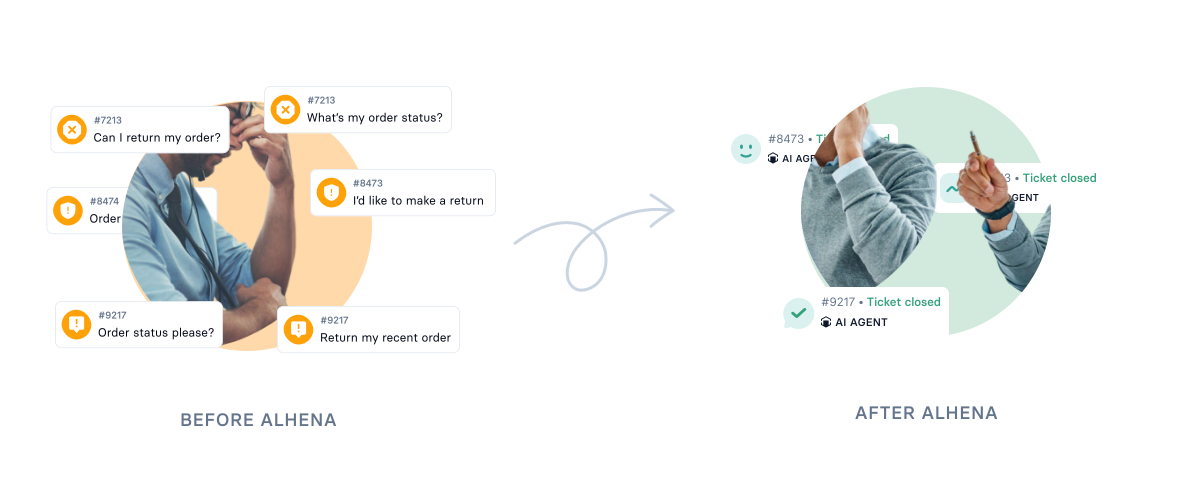
Deflection-to-Resolution Ratio - Track how many support queries the knowledge base handles autonomously through self-service. Puffy reached 63 percent automated inquiry resolution with 90 percent CSAT. High deflection rates free your human agent and support team resources for complex cases, enabling your customer service team to focus on interactions that require empathy and judgment.
Revenue per Conversation - Total AI-attributed revenue divided by total AI conversations, the dollar value of each chat interaction. This is the clearest measure of whether your chatbot is functioning as a customer experience tool or a cost center.
Alhena's built-in revenue attribution analytics surface these metrics automatically, so you do not need to build custom tracking pipelines. The platform collects relevant data across every conversation to give your support team and leadership instant visibility into AI performance.
From Knowledge Base Chatbot to Revenue Engine in Practice
The implementation path does not require a ground-up rebuild. If your knowledge base chatbot already handles self-service support well, accurately responding to repetitive questions, streamlining access to your help center, and providing instant responses in multiple languages, adding a revenue layer means deploying an intent router, connecting your product catalog as a vector index, and integrating commerce API endpoints for checkout actions.
For retailers, the path from support bot to revenue engine follows chatbot best practices: start with what works, then layer on AI capabilities that enable new use cases. A multilingual AI assistant can answer questions for your global customer base, while agentic product retrieval delivers personalized recommendations that no static FAQ page or knowledge base software can match.
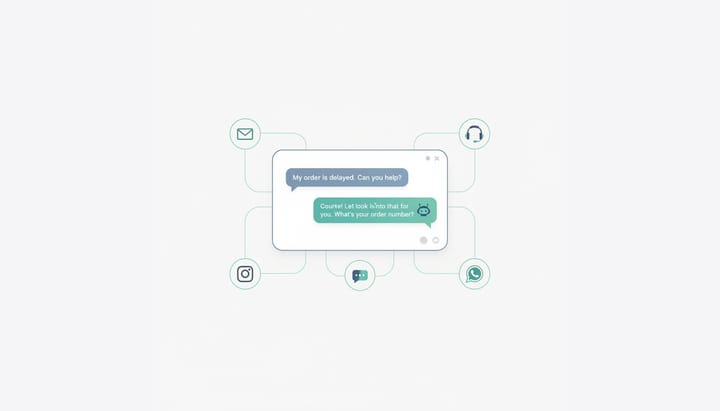
Alhena AI packages this entire AI-powered stack into a managed platform that deploys in under 48 hours with no developer resources required. It connects to your existing helpdesk (Zendesk, Freshdesk, Gorgias, Intercom, Kustomer) and commerce platform, then runs both the Product Expert AI Agent and Order Management AI Agent across web chat, email, Instagram DMs, WhatsApp, and voice channels. Retailers who adopt this approach see their chatbots evolve from support strategy tools into full-fledged AI-powered conversational commerce engines that personalize every shopper interaction.
The difference between a knowledge base chatbot and a revenue engine is not more content. It is a fundamentally different retrieval and execution architecture purpose-built for e-commerce sales, one that turns every conversation into an opportunity to engage customers, optimize the shopping experience, and power shop revenue.
Ready to turn your chatbot into a revenue channel? Book a demo with Alhena AI or start for free with 25 conversations.
Frequently Asked Questions
What is the difference between a knowledge base chatbot and an AI shopping assistant?
A knowledge base chatbot retrieves pre-written FAQ answers using keyword matching. An AI shopping assistant adds intent classification, RAG-based product retrieval from your live catalog, and conversational commerce APIs that can populate carts and drive checkout -- turning support conversations into revenue events.
How does RAG-based product retrieval work in ecommerce?
Retrieval-Augmented Generation (RAG) converts your product catalog into vector embeddings stored in a vector database. When a shopper asks a natural-language question, the system embeds the query and finds the most semantically similar products using cosine similarity, then feeds those results to an LLM to generate a grounded, hallucination-free recommendation.
Can I add an AI shopping assistant without replacing my existing chatbot?
Yes. The architecture adds an intent classification layer upstream of your current chatbot. Support queries continue flowing to your knowledge base as before, while purchase-intent queries route to a parallel product retrieval and commerce execution pipeline. Alhena AI deploys this pattern in under 48 hours alongside existing helpdesks like Zendesk, Freshdesk, and Gorgias.
What KPIs should I track after deploying an AI shopping assistant?
Focus on AI-attributed revenue, conversion rate lift (assisted vs. unassisted sessions), average order value uplift, deflection-to-resolution ratio, and revenue per conversation. Tatcha achieved 11.4 percent of total site revenue and a 3x conversion rate through Alhena AI.
How does an AI shopping assistant handle real-time inventory?
The commerce execution layer makes synchronous API calls to your ecommerce platform (Shopify, WooCommerce, Magento, or Salesforce Commerce Cloud) at the moment of recommendation. This ensures every product suggestion is backed by live stock data, eliminating out-of-stock recommendations that erode trust.
What is NLP purchase intent detection and why does it matter?
Purchase intent detection uses fine-tuned transformer models to classify whether a shopper's message signals buying interest (product comparison, size inquiry, restock question) versus a support need (order tracking, returns). Accurate intent routing is the highest-leverage component because misrouting a purchase signal to a generic FAQ costs you the conversion.