CSAT surveys capture roughly 5% of customer interactions, according to Gartner. The other 95% vanish into chat logs, email threads, and DM inboxes without anyone reading the customer feedback or how the customer actually felt. No ratings, no scores, nothing to learn from. AI sentiment analysis in e-commerce flips that ratio. It reads every text conversation in real time, tagging frustration, hesitation, delight, and purchase intent as they happen, not days later in a spreadsheet.
This post covers what a sentiment detection chatbot actually picks up, how those signals change AI behavior mid-conversation, and why aggregate sentiment data is the business intelligence layer most e-commerce brands and teams are missing. It's part of our Conversational Analytics for Ecommerce pillar series on the revenue signals hiding in your AI chat data.
Why Real-Time Sentiment Beats Post-Interaction Surveys
Static CSAT surveys have two problems. First, only a fraction of customers fill them out as feedback, and those who do skew toward extremes in their text responses: either very happy or very angry. Second, by the time you read a bad score, the customer has already churned, left a review, filed a chargeback, or damaged your brand reputation and brand perception.
Real-time sentiment e-commerce technology solves both. AI-driven sentiment technology, among the most impactful AI applications in ecommerce, processes every message across web chat, email, Instagram DMs, and WhatsApp, and classifies the customer sentiment as it shifts within a single conversation. Companies using real-time emotion monitoring are 2.4x more likely to exceed their customer satisfaction goals and customer satisfaction score benchmarks, according to Sprinklr research. Weber Shandwick found that real-time detection cuts crisis response time from 47 minutes to 11 minutes.
With AI-powered, AI-driven sentiment analysis, the shift is from reactive measurement to proactive customer experience intervention. You measure emotions as they happen, not after the damage is done. Instead of learning that 30% of customers were frustrated last month, you know a specific customer is frustrated right now, and your AI makes decisions to adjust its behavior in that same conversation.
The Four Sentiment Signals That Matter in Ecommerce Chat
Not all emotions carry the same weight in e-commerce. Four specific signals drive the decisions that affect revenue decisions, retention decisions, and operational cost.
Frustration: Wrong Product, Slow Response, Policy Confusion
Frustration detection AI chat technology identifies patterns most companies miss. A customer who writes, "I already explained this," isn't using the word "angry", but the signal is clear. For example, common frustration triggers in e-commerce include receiving the wrong item, waiting too long for a reply, and hitting confusing return or exchange policies.
Specific text cues include repeat-contact mentions ("this is my third message"), ALL CAPS, rapid-fire short messages, and sarcasm like "Oh great, another delay." AI sarcasm detection now reaches 84% accuracy, per MIT Sloan research. Machine learning and deep learning models trained on large datasets, like BERT, naive bayes classifiers, support vector machines, and other NLP classifiers in contextual AI platforms catch these at 85-95% accuracy, compared to 60-70% for basic keyword matching.
Hesitation: Price, Comparison, Sizing Doubt
Hesitation is the signal sitting between "interested" and "gone". Customers asking, "Is this worth the price?" or "How does this compare to a competitor like [competitor brand]?" or "Will this fit if I'm between sizes?" are all showing purchase consideration that could go either way.
This is different from the broader shopper hesitation patterns covered in our dedicated post. Here, we're focused on how AI-driven sentiment technology detects hesitation as an emotional state within chat, not the behavioral triggers behind it.
Delight: Perfect Match, Great Recommendation
Delight shows up as enthusiastic language, unprompted praise, and willingness to recommend. "This is exactly what I was looking for!" or "Your recommendation was perfect" are high-value signals. Happy customers spend up to 140% more than unhappy ones, according to a Crescendo AI study.
Purchase Intent: Ready to Buy, Asking About Shipping
Purchase intent AI catches the moment a consumer shifts from browsing to buying. Questions about stock availability, shipping timelines, gift wrapping, and discount codes are all high-intent signals. "Can I get this by Friday?" is a customer ready to convert, not someone looking for product information.
How Sentiment Changes AI Behavior in Real Time
Detecting sentiment is only half the equation. The value comes from what the AI does with that signal. A sentiment detection chatbot that reads emotions but doesn't adapt its responses is just a fancy analytics dashboard.
Frustrated customer detected: The AI softens its tone, acknowledges the problem explicitly ("I understand this has been frustrating"), and can surface a goodwill discount or expedited shipping offer. If frustration compounds, it triggers escalation to a human agent with full context. Alhena's Support Concierge handles this handoff without the customer repeating themselves.
Hesitant customer detected: The AI shifts to confidence-building: social proof ("This is our best-seller in your size range"), side-by-side comparisons, or size-guide walkthroughs. It doesn't push a sale. It removes doubt.
Delighted customer detected: The AI capitalizes on positive momentum with a cross-sell ("Customers who loved this also tried..."), a product review request, a customer reviews boost, or a ratings request, or a loyalty program mention. Victoria Beckham saw a 20% AOV increase using this kind of delight-triggered upselling.
High purchase intent detected: The AI simplifies the path to checkout. No extra questions, no "Did you know?" tangents. Alhena's Product Expert Agent can populate carts and pre-fill checkout directly in chat. Tatcha drove 11.4% of total site revenue through these AI-assisted, intent-driven conversations.
Sentiment-Driven Escalation: The Emotional Threshold Model
Most escalation systems use topic-based rules: if the customer mentions "refund" or "manager", transfer to a human. That's how AI ticket routing works at the keyword level, and our human escalation post covers the handoff mechanics in detail.
AI-driven sentiment escalation works differently. It tracks emotional accumulation across a conversation. A single frustrated message might score a 0.6 on a 0-1 scale. If the AI resolves the issue, that score drops. But if frustration compounds, moving from "this is wrong" to "I've been waiting 20 minutes" to "forget it, I want a refund," the cumulative score crosses a threshold that triggers immediate human intervention.
This emotional threshold model catches customers who never use explicit escalation words or language but are clearly on the verge of churning. Gainsight data shows that sentiment-driven interventions boost customer retention and reduce annual churn by 28%, with 39% of flagged at-risk accounts renewing within 30 days. Puffy maintains 90% CSAT using this approach at scale.
Aggregate Sentiment Trends as Business Insights, Predictive Intelligence, and Trend Analysis
Individual sentiment detection saves single conversations. Aggregate sentiment data saves your business. When you track sentiment across high-volume thousands of conversations daily, predictive sentiment patterns emerge that no survey, customer feedback form, or customer reviews feed can match.
Alhena applies this same sentiment intelligence to review responses. Learn more about Alhena AI's review management approach.
Product issue detection: If frustration scores spike for a specific SKU on Tuesday, predictive sentiment flags let businesses spot a quality issue, and your product team knows before the return requests flood in on Friday. Chick-fil-A detected a 923% rise in BBQ sauce mentions with 73% negative sentiment when they changed a recipe, according to Sprinklr. They relaunched the original, and sentiment reversed to 92% positive.
Category-level frustration mapping: Which product categories generate the most hesitation? Which ones drive delight? These actionable insights feed that goes directly into merchandising decisions, inventory planning, pricing strategy, brand perception tracking, and marketing spend allocation, connecting to the broader merchandising gap insights we've covered separately.
Seasonal and campaign sentiment: A holiday sale might drive high purchase intent but also spike frustration if shipping estimates are unclear. Weekly trend analysis dashboards show these patterns in time to optimize messaging, staffing, or policy language before they become costly problems. This feedback loop between sentiment data and business decisions is what separates reactive CX from proactive customer experience.
Bain & Company research shows companies and e-commerce companies that act on AI-driven sentiment and customer emotion data see 23% higher customer retention rates and $340 increased customer lifetime value per customer. The data is there in every conversation. The question is whether you're reading it. The feedback is already there in the text of every conversation.
How Alhena AI Turns Chat Into Emotional Intelligence
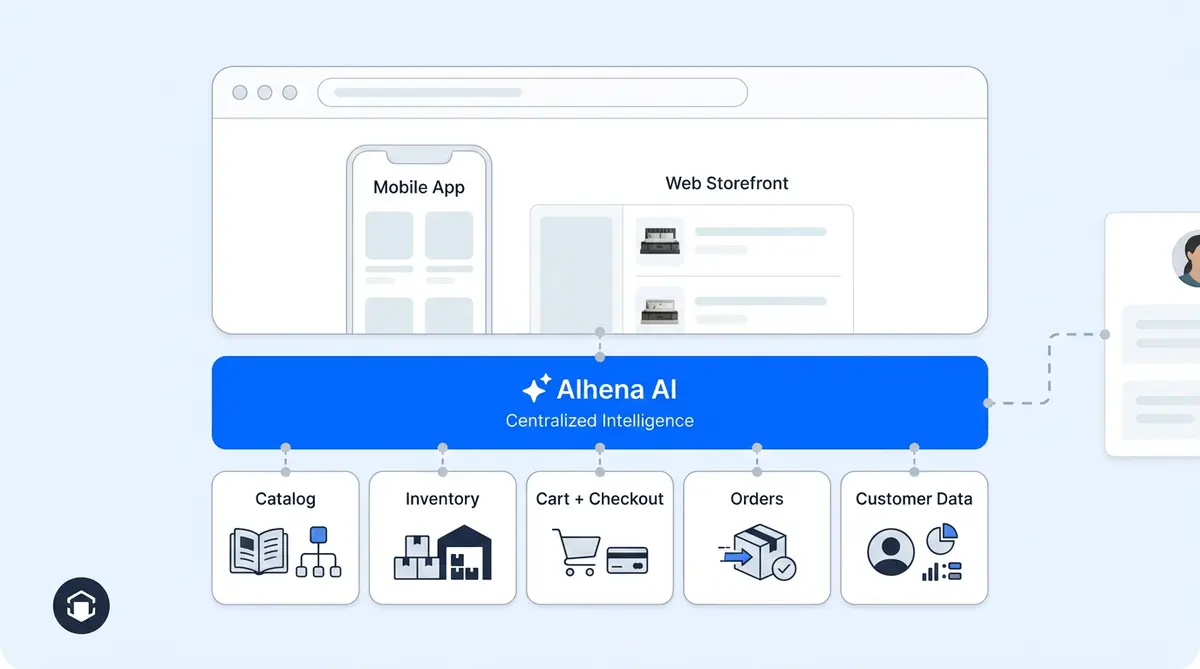
Alhena's sentiment layer sits across every channel, including web chat, email, social DMs, and voice, and feeds into two specialized agents. The Product Expert Agent uses delight and intent signals to drive conversions. The Support Concierge uses frustration and hesitation signals to resolve issues and protect customer satisfaction. Agent Assist surfaces sentiment context to human agents when escalation triggers, as covered in our Agent Assist deep dive.
All of this is grounded in verified product data, with no hallucinations. Alhena deploys in under 48 hours with no dev resources or technology overhead, integrating with Shopify, Salesforce Commerce Cloud for commerce, and helpdesks like Zendesk and Gorgias.
Ready to turn every chat into an emotional intelligence signal? Book a demo with Alhena AI or start free with 25 conversations. Use the ROI calculator to estimate the revenue impact of real-time emotion detection on your store.
Frequently Asked Questions
What is AI sentiment analysis in ecommerce?
AI sentiment analysis in ecommerce uses NLP (natural language processing) to detect customer emotions like frustration, hesitation, delight, and purchase intent in real-time chat conversations. Unlike static CSAT surveys and feedback forms that capture roughly 5% of interactions, real-time sentiment technology reads 100% of conversations across chat, email, and social channels with 85-95% accuracy.
How does real-time sentiment detection differ from CSAT surveys?
CSAT surveys are post-interaction and only a small fraction of customers complete them. Real-time emotion analysis reads every message and customer feedback data signal as it happens, detecting emotional shifts mid-conversation so the AI can adapt its behavior immediately. Companies using real-time sentiment tools are 2.4x more likely to exceed satisfaction goals.
What are the four sentiment signals that matter most in ecommerce chat?
The four key signals are frustration (wrong product, slow response, policy confusion), hesitation (price doubt, competitor comparison shopping, sizing uncertainty), delight (perfect product match, great recommendation), and purchase intent (asking about shipping, stock, or discounts). Each triggers a different AI response to protect revenue or improve the experience.
How does sentiment-driven escalation work differently from keyword-based routing?
Keyword-based routing transfers chats when customers say words like 'refund' or 'manager.' Sentiment-driven escalation tracks emotional accumulation across the full conversation. If frustration compounds over multiple messages without resolution, it crosses an emotional threshold that triggers human intervention, even if the customer never uses explicit escalation words or language.
Can aggregate sentiment data predict product issues before returns spike?
Yes. When frustration scores spike for a specific SKU or category across many conversations, it signals a quality issue with products services or a description mismatch days before return requests arrive. Weekly sentiment dashboards reveal which products generate the most frustration, which drive delight, informing product development and product improvement decisions, and how seasonal campaigns affect customer sentiment through ongoing trend analysis of words and tone.
How does Alhena AI use sentiment to change chatbot behavior in real time?
Alhena's sentiment layer detects emotional signals and adjusts AI behavior mid-conversation. Frustrated customers get softer tone and proactive offers. Hesitant shoppers receive social proof and comparisons. Delighted customers see upsell recommendations. High-intent buyers get a simplified path to checkout with cart population and pre-filled checkout directly in chat.
How quickly can I deploy AI sentiment analysis on my ecommerce store?
Alhena AI deploys in under 48 hours with no dev resources or technology overhead. It integrates with Shopify, Salesforce Commerce Cloud for commerce, and helpdesks like Zendesk and Gorgias. Ai-driven sentiment detection works across web chat, email, Instagram DMs, WhatsApp, and voice from day one, supporting multiple languages, with multilingual, scalable real time data ingestion with scalability to handle any conversation volume.